

A question often asked by potential investors and companies is, Why tokenize your assets? Here we break down the pros and cons.
TL;DR
- Tokenization turns the rights to an asset into digital tokens on a blockchain.
- For individuals, it offers access to high-value assets, lower minimums, fractional ownership, and potential liquidity.
- For companies, it can cut operational costs, speed up settlement, and open new investor segments.
- The trade-off for everyone: legal complexity, platform risk, tech risk, and sometimes disappointing liquidity.
- Tokenization makes the most sense for high-value, illiquid, and operationally messy assets like real estate, private credit, and funds.
1. Why this question matters now
“Why tokenize your assets?” is not just a tech question. It is a money question.
Capital markets are still plagued by paper workflows, slow settlement, and cumbersome ticket sizes. At the same time, more investors seek global, digital, and 24/7 access to opportunities that were previously inaccessible.
Tokenization promises a way to bridge those two worlds:
- Traditional assets on one side
- Blockchain rails and programmable ownership on the other
The key is to understand what you actually gain – and what you risk – as an individual and as a company.
2. What does it mean to tokenize an asset?
In simple terms:
Tokenization = taking the economic rights to an asset and representing them as digital tokens on a blockchain.
Those tokens can stand for things like:
- Ownership in a property or real estate fund
- A slice of a private credit deal
- Units of a fund or structured product
- Rights to income streams, royalties, or revenue shares
Behind the scenes, you usually have:
- A legal wrapper (SPV, trust, fund, or corporate structure)
- A smart contract that issues and manages the tokens
- A set of rules about who can buy, sell, and receive payouts
So you are not “putting a building on-chain”. You are putting the rights and cash flows on-chain, with rules that can be enforced by code.

3. Why tokenize your assets from an individual investor’s viewpoint?
Here, we are referring to retail investors, mass-affluent investors, and high-net-worth individuals who seek exposure to tokenized assets.
3.1 The upside for individuals
3.1.1 Access to assets that were previously out of reach
Historically, a lot of attractive assets came with high minimum tickets:
- Prime real estate
- Private equity and private credit
- Some infrastructure and alternative funds
Tokenization lets issuers slice these assets into smaller pieces. That means:
- Lower minimum investment amounts
- A chance to join deals that were once “institutional only”
In practice, that can be the difference between watching from the sidelines and actually holding a stake.
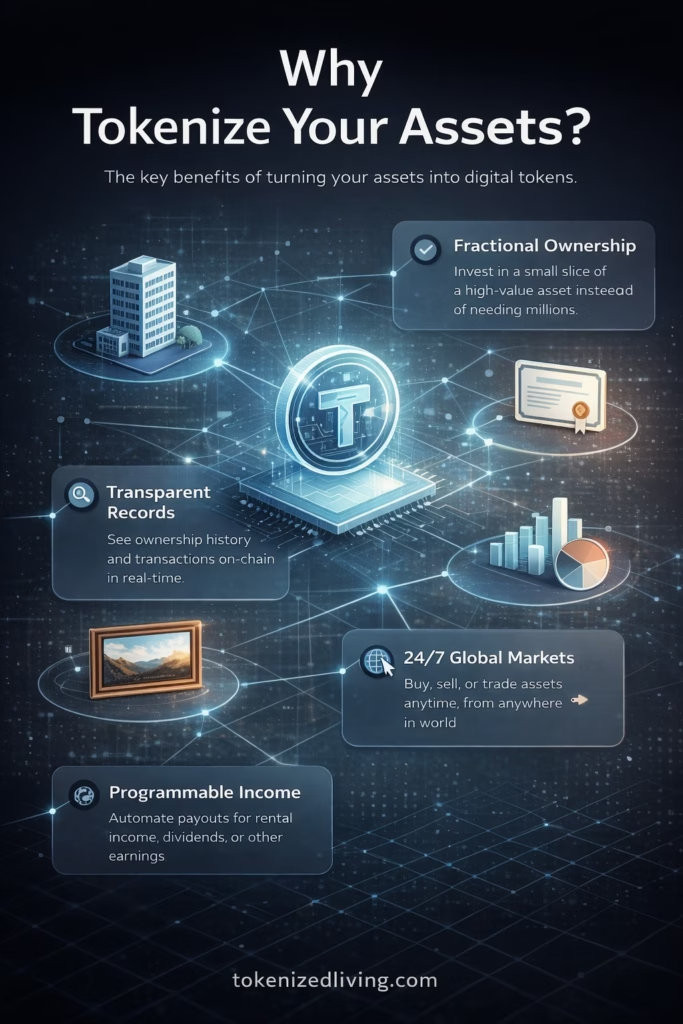
3.1.2 Fractional ownership and more flexible portfolios
Because tokens are divisible, you can:
- Buy small fractions of multiple assets
- Avoid putting a huge chunk of your net worth into one property or fund
- Rebalance more easily when your situation changes
This is significantly different from owning a whole apartment or being locked into a single private fund. Tokenization helps you build a more diversified and granular portfolio.
3.1.3 Liquidity and 24/7 markets (with a big asterisk)
One of the big promises of tokenization is better liquidity:
- Peer-to-peer trading on digital marketplaces
- 24/7 order matching instead of fixed market hours
- Faster settlement compared to traditional transfers
When the market is active, it becomes easier to:
- Exit a position
- Adjust your allocation
- Take profits or cut risk
The asterisk: some tokenized assets still trade very thinly. So you should treat improved liquidity as potential, not as a guarantee.
3.1.4 Transparent, on-chain records
Blockchains act as a shared source of truth:
- Ownership changes are recorded on-chain
- Transfers and distributions leave a verifiable audit trail
- Everyone sees the same ledger
For an individual investor, that transparency:
- Reduces disputes about who owns what
- Makes it easier to track cash flows and performance
- Builds trust when dealing with new platforms and structures
3.1.5 Programmable income and DeFi-style utility
Because tokenized assets live in smart contracts, they can be programmable:
- Rental income or coupons can be paid out automatically
- Revenue shares can follow predefined rules
- Tokens can sometimes be used as collateral in on-chain lending or structured products
You move from “I own a static asset” to “I own an asset that can plug into a wider digital ecosystem”.

3.2 The downside for individuals
3.2.1 Do you own the asset or just a promise?
The most important question is:
What does this token legally represent?
Common possibilities:
- A direct legal interest in the asset
- Shares in a special-purpose vehicle that holds the asset
- A contractual claim on a platform or issuer
If the structure is weak and the platform fails, your token may not get you what you expect. The label “tokenized” does not guarantee strong legal rights.
3.2.2 Regulatory fragmentation and uneven protections
Tokenized assets sit at the intersection of:
- Securities law
- Property law
- Tax law
- Data and consumer-protection rules
Each jurisdiction mixes those pieces differently. As an individual investor, that can mean:
- Different levels of protection depending on where the issuer sits
- Limited clarity on what happens in a dispute or insolvency
- Extra complexity if the project is cross-border
You cannot assume that a tokenized asset is protected like a traditional brokerage account.
3.2.3 Technology and custody risk
With tokenized assets, you also inherit crypto-style operational risk:
- Lose your private key, lose your asset
- Fall for a phishing email, lose your asset
- Use a platform with weak security, risk loss or downtime
Custody is improving, but you still need good security habits and a clear understanding of who actually controls the keys.
3.2.4 Liquidity can be worse than the marketing
A 24/7 marketplace with no buyers is still illiquid.
Some tokenized assets trade actively. Others are listed but barely move. You may find:
- Wide bid–ask spreads
- Low volumes
- Difficulty selling at a fair price
So always look at real trading data, not only the brochure.
3.2.5 Complexity and information gaps
Tokenized structures can be hard to understand:
- Multiple entities (issuer, SPV, custodian, trustee, platform)
- On-chain and off-chain components
- Different rights baked into different token classes
Issuers and platforms often know much more than investors. That information gap can lead to mispriced risk and nasty surprises.
| Perspective | What you gain | What to watch | Best fit if… |
|---|---|---|---|
| Individual investor | Access to high-value assets, lower minimums, fractional ownership, potential liquidity | Platform risk, legal structure, custody, thin secondary markets | You want exposure to real estate, private credit, or funds without huge tickets |
| Crypto-savvy retail | On-chain income, DeFi collateral, 24/7 markets | Smart contract risk, correlation with wider crypto, key security | You already use wallets and are comfortable managing digital assets |
| HNW / family office | Diversified alternative exposure, easier position sizing, global access | Cross-border rules, tax, counterparty quality | You want to expand alternatives without locking into a few big tickets |
| Asset issuer / sponsor | Larger investor base, smaller tickets, smoother cap table, faster settlement | Structuring cost, regulation, platform choice | You raise capital often and manage many investors or deals |
| Asset manager / fund | New share classes, global distribution, programmable fees and lockups | Integration with legacy systems, compliance, reporting | You run funds with high admin overhead or want digital-first distribution |
| Bank / broker / platform | New products, better collateral mobility, balance sheet efficiency | Cyber risk, governance, conduct risk | You handle securities and want faster, cheaper rails for clients |
4. Why tokenize your assets from a company or issuer’s viewpoint?
Now, switch to the supply side: asset managers, real-estate sponsors, banks, platforms, and corporates.
4.1 The upside for companies
4.1.1 A broader and more granular investor base
Tokenization lets you:
- Lower minimum tickets
- Reach new segments (mass-affluent, global investors, digital-first clients)
- Package offers more flexibly by region, risk level, or lock-up
You can tap pools of capital that were not reachable through old-school private placements alone.
4.1.2 Lower operational friction and cost over time
Today, many asset workflows rely on:
- Manual reconciliations
- Spreadsheet-based cap tables
- Long settlement chains with multiple intermediaries
Tokenization allows more of this to move into smart contracts and shared ledgers:
- Automated checks for eligibility and lock-ups
- Automatic updates to ownership records
- Streamlined distribution of income and redemptions
The result over time: leaner operations, fewer errors, and lower servicing costs.
4.1.3 Faster settlement and improved collateral management
Shorter settlement cycles help:
- Reduce counterparty risk
- Free capital sooner
- Improve collateral mobility for financing and treasury operations
For banks, brokers, and trading platforms, tokenized assets can become more agile collateral in repo, lending, and structured deals.
4.1.4 Product innovation and programmable features
Tokenization makes it easier to launch:
- Revenue-sharing tokens instead of simple equity
- Multi-asset baskets with automatic rebalancing
- Products that embed compliance rules and regional restrictions directly in the code
You can experiment with new business models without multiplying manual processes.

4.1.5 Unlocking value from illiquid or stranded assets
Many balance sheets hold assets that are:
- Hard to divide
- Hard to sell
- Hard to finance efficiently
Examples include:
- Commercial real estate
- Infrastructure projects
- Trade receivables
- Royalties and niche cash flows
Tokenization helps convert these positions into smaller, tradable, financeable units, which can unlock new revenue or financing channels.
4.2 The downside for companies
4.2.1 Regulatory and legal complexity
You need clear answers to questions like:
- How is this token classified in each jurisdiction?
- How do we handle investor protections, disclosures, and voting?
- How do we fit this into existing securities and custody rules?
This usually requires serious legal, compliance, and structuring work. It is not a plug-and-play experiment.

4.2.2 Integration with legacy systems
Tokenization does not live in isolation. It must connect to:
- Core banking or portfolio systems
- Risk and finance reporting
- Tax and regulatory reporting
- Client onboarding and KYC platforms
If integration is weak, tokenization ends up as a cool pilot on an island instead of a core business tool.
4.2.3 New operational and cyber risks
New rails bring new risks:
- Smart-contract bugs
- Key-management failures
- Oracles and data feeds that can be manipulated
Companies must build:
- Strong governance for upgrades and emergency actions
- Robust testing and audits
- Clear incident-response plans
If they do not, a small technical error can become a major reputational and financial event.
4.2.4 Uncertain ROI in the early stages
The promise is clear: lower cost, better access, new products. The reality:
- Benefits may only appear at scale
- Early projects may feel like extra cost and complexity
- It is easy to over-invest in tech and under-invest in distribution and product-market fit
Tokenization works best when tied tightly to a concrete business goal, not just to “innovation theatre”.
4.2.5 Reputational and conduct risk
If investors do not understand:
- What they own
- What could go wrong
- How the token sits in the legal stack
Then, tokenisation can backfire. Mis-selling or poor disclosures can lead to regulatory pushback and brand damage.
For established institutions, that risk can be more painful than any tech issue.
| Asset type | Current pain point | How tokenization helps |
|---|---|---|
| Income-producing real estate | High minimums, slow sales, heavy paperwork | Fractional ownership, easier secondary trading, automated rent distributions |
| Private credit / invoices | Illiquid, complex servicing, limited lenders | Breaks deals into smaller units, global investors, automated cash-flow waterfalls |
| Funds / alternatives | High entry ticket, clunky subscriptions and redemptions | Lower minimums, on-chain share register, faster subscriptions and exits |
| Infrastructure projects | Large, lumpy tickets, long hold periods | Slice projects into smaller tickets, new investor groups, clearer cash-flow rights |
| Revenue streams / royalties | Hard to value, niche buyers, bespoke contracts | Standardized tokens, transparent flows, easier secondary markets |
| Collectibles / art | Storage, authentication, very illiquid | Fractional exposure, digital provenance, potential trading without moving the asset |
5. When does tokenization actually make sense?
5.1 For individuals
Tokenization makes the most sense when:
- You want access to assets that normally require high minimums
- You understand and accept platform, legal, and tech risk
- You are comfortable with digital custody, or use a trusted custodian
- You have checked secondary market activity, not just marketing promises
It makes less sense if you:
- Are extremely risk-averse
- Need guaranteed short-term liquidity
- Do not want to manage any digital-asset security at all
5.2 For companies and issuers
Tokenization is worth serious consideration when:
- You deal in high-value, illiquid, or complex assets
- Operational processes are slow, manual, and expensive
- There is a real distribution edge from going digital and lowering minimums
- You can build or partner for reg-grade legal, custody, and tech infrastructure
It is less compelling if the goal is just to add “blockchain” to a slide deck.
6. FAQs: Why tokenize your assets?
1. What types of assets can be tokenized?
Almost any asset with clearly defined rights can be tokenized, including:
- Real estate
- Private credit and invoices
- Funds and structured products
- Royalties, revenue shares, and even some collectibles
The key is a clean legal structure behind the token.
2. Does tokenization guarantee better liquidity?
No. Tokenization can enable better liquidity, but it does not guarantee it. You still need:
- Active buyers and sellers
- Good market design
- Clear legal and regulatory frameworks
Always check actual trading volumes before you assume an easy exit.
3. Is a tokenized asset safer than a traditional one?
Not automatically. Safety depends on:
- The quality of the underlying asset
- The strength of the legal structure
- The security of the technology and custody setup
Tokenisation can enhance transparency and mitigate certain operational risks, but it also introduces new technical and platform-related risks.
4. How much technical knowledge do investors need?
You do not need to be a developer, but you should understand the basics:
- How wallets and keys work
- How to keep credentials safe
- How the platform handles custody and recovery
If that feels overwhelming, consider using a regulated platform or custodian rather than full self-custody.
5. Is tokenization only for crypto-native projects?
No. Some of the most interesting work is happening with traditional assets:
- Real-world income streams
- Regulated funds
- Institutional-grade credit and fixed income
Tokenization is less about “crypto coins” and more about modernizing how ownership and cash flows move.
6. How do companies start a tokenization project?
A sensible path is:
- Choose a clear use case (for example, a specific fund or property).
- Design a reg-compliant legal wrapper.
- Pick battle-tested infrastructure rather than building everything yourself.
- Plan integration with your existing systems.
- Launch with transparent disclosure and realistic expectations.
Start narrow, prove value, then scale.
7. Will tokenization replace traditional finance?
Not in one jump. It is more likely that:
- Traditional assets gain tokenized wrappers
- Institutions run hybrid models for a long time
- Over time, more value migrates to programmable rails behind the scenes
From the user side, things may just feel faster, cheaper, and more flexible, even if the word “tokenization” vanishes into the background.
7. Final thoughts
So, why tokenize your assets?
Because in the right context, tokenization can:
- Open up new pools of capital
- Turn illiquid assets into more flexible positions
- Automate painful back-office processes
- Make ownership and cash flows more transparent and programmable
For individuals, it is a way to step into higher-quality, previously closed-off opportunities, as long as you respect the legal and technical risks.
For companies, it is a tool to modernize infrastructure, cut friction, and innovate on product design, provided you treat regulation, custody, and governance as first-class requirements.
Used well, tokenization is not just a trend. It is a quiet step toward a more open, efficient, and programmable financial system.