
Most of what you see about “AI tokenization” is confusing.
In AI, tokenization usually means breaking text into data.
In finance, tokenization means turning assets into digital ownership.
This article focuses on the second.
More specifically, how AI is starting to interact with tokenized assets in real markets.
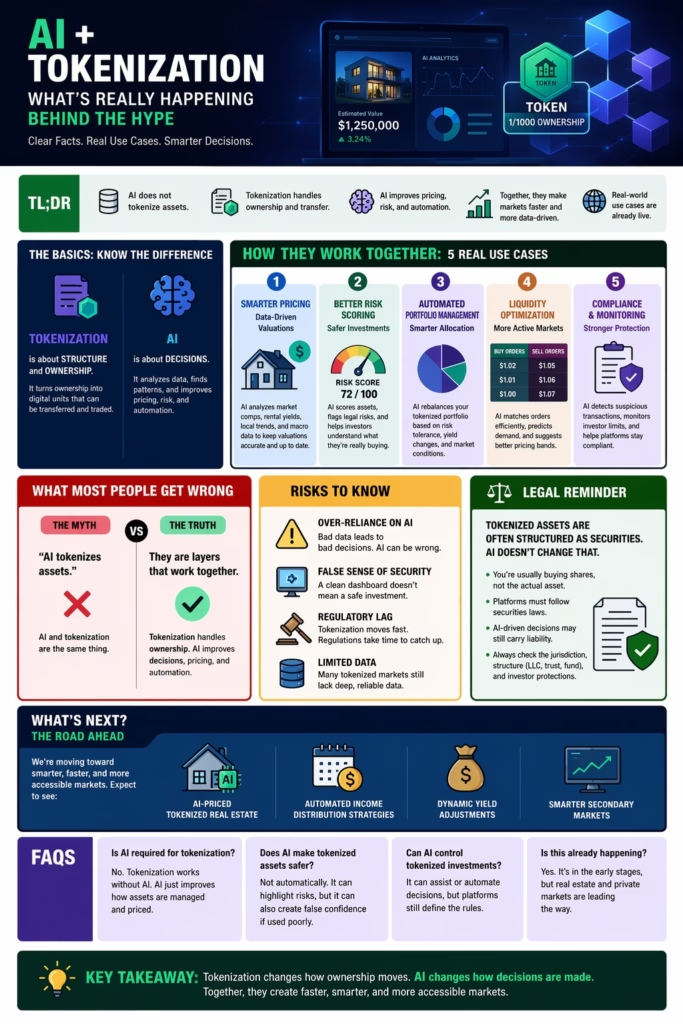
TL;DR
- AI does not “tokenize” assets
- Tokenization handles ownership and transfer
- AI improves pricing, risk, and automation
- Together, they make markets faster and more data-driven
- Real-world use cases are already live
AI Tokenization vs Asset Tokenization (Important Difference)
In artificial intelligence, tokenization refers to processing text.
In finance, tokenization refers to ownership.
They are not the same thing.
This article focuses on financial tokenization.
AI and Tokenization in Finance (Simple Explanation)
AI analyzes data and improves decisions.
Tokenization turns assets into digital shares.
This article focuses on how these two systems work together in real financial markets.
Why This Topic Is Suddenly Everywhere
You are seeing “AI + tokenization” everywhere right now.
But most of it is vague.
It usually sounds like this:
AI will revolutionize tokenization.
That does not mean much.
So let’s strip it back.
AI and tokenization solve completely different problems.
And when they work together, things get interesting.
What Tokenization Actually Does (Quick Reset)
Tokenization turns ownership into digital units.
In most real-world cases:
- A property sits inside an LLC
- Tokens represent shares in that LLC
- Investors hold equity, not the deed
This matters.
Because it means tokenization is about structure and ownership, not intelligence.
What AI Actually Does in Finance
AI is about decisions.
It processes large amounts of data and finds patterns.
In finance, that usually means:
- Pricing models
- Risk analysis
- Fraud detection
- Portfolio optimization
So already, you can see the split:
- Tokenization = ownership layer
- AI = decision layer

Where They Actually Meet
This is where things start to make sense.
1. Smarter Pricing of Tokenized Assets
Tokenized assets still need pricing.
And pricing is messy.
Especially for:
- Real estate
- Private equity
- Collectibles
AI can pull in:
- Market comps
- Rent yields
- Local trends
- Macro data
Then adjust valuations in near real-time.
This is something traditional markets struggle with.
2. Risk Scoring for Fractional Investors
Most small investors do not read legal structures.
They just see yield.
That is a problem.
AI can help by:
- Scoring properties or assets
- Flagging legal risks
- Highlighting weak structures
Think of it like a credit score, but for investments.
This is where tokenization becomes safer.
Not risk-free. Just clearer.
This is a big one.
If you hold:
- 5 tokenized properties
- 3 tokenized bonds
- 2 tokenized funds
AI can rebalance automatically.
Based on:
- Risk tolerance
- Yield changes
- Market conditions
That kind of automation is hard to do manually.
4. Liquidity Optimization
Tokenized markets often struggle with liquidity.
There are buyers and sellers, but not always at the same time.
AI can:
- Match orders more efficiently
- Predict demand
- Suggest pricing bands
This improves market activity.
And that is critical if tokenization is going to scale.
5. Compliance and Monitoring
This is less exciting, but more important.
AI can track:
- Suspicious transactions
- Regulatory breaches
- Investor limits
In tokenized systems, everything is traceable.
AI just makes that data usable.
Here’s a simple breakdown of how AI and tokenization actually work together in real markets.
Market Insight
The biggest shift is not technology.
It is how decisions are made.
Before:
- Humans priced assets
- Humans assessed risk
- Humans managed portfolios
Now:
- AI assists or replaces parts of that process
- Tokenization makes execution faster
Put together, this reduces friction.
And that is where value comes from.
What Most People Get Wrong
Here is the common mistake.
People think AI and tokenization are the same trend.
They are not.
They are layers.
If you remove AI, tokenization still works.
If you remove tokenization, AI still works.
But together, they:
- Speed things up
- Reduce guesswork
- Open access to smaller investors
| Feature | AI | Tokenization |
|---|---|---|
| Purpose | Analyze data | Represent ownership |
| Role | Decision layer | Ownership layer |
| Example | Pricing models | Fractional property shares |
| Dependency | Independent | Independent |
In tokenized real estate, the full integration of AI is still early.
But parts of the system are already in place.
Platforms like RealT provide structured data on rent income, occupancy, and yields. This is exactly the type of data AI models use for pricing and risk analysis.
At the institutional level, firms like BlackRock are already using AI in portfolio management, while platforms like Securitize are bringing tokenized assets to market.
These two layers are starting to overlap.
So while fully AI-driven tokenized platforms are still limited, the building blocks are already in place.
The Risks No One Talks About Enough
Let’s keep this grounded.
1. Over-reliance on AI
AI models can be wrong.
Bad data = bad decisions.
And most tokenized markets still lack deep data.
2. False Sense of Security
A clean dashboard does not mean a safe investment.
AI can make things look more reliable than they are.
3. Regulatory Lag
Tokenization is already ahead of regulation.
Adding AI makes it more complex.
This slows adoption at scale.
Legal Risk Box
Tokenized assets are often structured as securities.
AI does not change that.
Key points:
- You are usually buying shares, not assets
- Platforms must follow securities laws
- AI-driven decisions may still carry liability
Always check:
- Jurisdiction
- Structure (LLC, trust, fund)
- Investor protections
Where This Is Heading
This is where things get interesting.
You will start to see:
- AI-priced tokenized real estate
- Automated income distribution strategies
- Dynamic yield adjustments
- Smarter secondary markets
Not overnight.
But gradually.
And the platforms that combine both well will win.
Watch This Trend
The real opportunity is not just tokenizing assets.
It is making those assets intelligent.
That means:
- Better data
- Better pricing
- Better decisions
That is where this space is heading.
FAQs
Is AI required for tokenization?
No. Tokenization works without AI. AI improves how assets are managed and priced.
Does AI make tokenized assets safer?
Not automatically. It can highlight risks, but it can also create false confidence if used poorly.
Can AI control tokenized investments?
It can assist or automate decisions, but platforms still define the rules.
Is this already happening?
Yes, but mostly in early stages. Real estate and private markets are leading the way.
Can AI create tokenized assets?
No. AI does not create tokenized assets. It can help analyze, price, or manage them, but the tokenization process itself is handled through blockchain systems.
Why combine AI with tokenization?
Combining AI with tokenization improves decision-making, pricing accuracy, and automation, making digital asset markets more efficient.
Final Thought
Tokenization changes how ownership moves.
AI changes how decisions are made.
Put them together, and markets start to feel different.
Faster. More accessible. Slightly less human.
And that last part is where things will get interesting.
Finally, we refined and enhanced the article using ChatGPT.