

Last updated: August 18, 2026
BlackRock’s BUIDL fund has become one of the clearest examples of institutional finance moving onto public blockchains.
However, BUIDL is frequently misunderstood.
It is not a cryptocurrency, stablecoin or retail Treasury-investment app. Instead, each BUIDL token represents a share in a private fund managed by BlackRock.
The fund holds cash, U.S. Treasury bills and repurchase agreements. Meanwhile, blockchain technology handles the digital representation and transfer of its shares.
This structure combines a conventional investment fund with the infrastructure used in real-world asset tokenization.
BUIDL launched on Ethereum in March 2024. It has since expanded across several blockchain networks and grown to approximately $2.71 billion in assets.
Nevertheless, ordinary retail investors cannot simply buy BUIDL through a crypto exchange.
BlackRock BUIDL Fund: Quick Overview
| Question | Answer |
|---|---|
| Full name | BlackRock USD Institutional Digital Liquidity Fund |
| Ticker | BUIDL |
| Launch date | March 20, 2024 |
| Investment manager | BlackRock Financial Management |
| Tokenization platform | Securitize |
| Custodian and administrator | BNY |
| Main holdings | Cash, U.S. Treasury bills and repurchase agreements |
| Target token value | $1 |
| Reported assets | Approximately $2.71 billion on August 18, 2026 |
| Reported seven-day APY | 3.42% on August 18, 2026 |
| Initial investment minimum | $5 million |
| Eligible investors | Qualified purchasers who complete the required checks |
| Retail access | No direct general retail access |
| Blockchain networks | Ethereum, Aptos, Arbitrum, Avalanche, Optimism, Polygon, Solana and BNB Chain |
The assets, yield and holder figures change over time. Therefore, investors should check the latest data before drawing conclusions.
What Is the BlackRock BUIDL Fund?
BUIDL stands for the BlackRock USD Institutional Digital Liquidity Fund.
BlackRock launched it with Securitize on March 20, 2024. It was BlackRock’s first tokenized fund issued on a public blockchain.
The fund seeks income while prioritizing liquidity and principal stability. According to the original BUIDL launch announcement, it invests entirely in:
- Cash
- U.S. Treasury bills
- Repurchase agreements
These assets generate the fund’s underlying income.
The BUIDL token does not generate yield through crypto lending, staking or speculative trading. Instead, the income comes from the traditional financial instruments held inside the fund.
This distinction matters because “tokenized Treasury fund” does not mean the blockchain has replaced the Treasury market.
BlackRock still manages the portfolio. BNY still holds the underlying cash and securities. Furthermore, Securitize still performs regulated transfer-agent and investor-onboarding functions.
The blockchain adds a new ownership and transfer layer.
What Does a BUIDL Token Represent?
A BUIDL token represents a share in the BlackRock USD Institutional Digital Liquidity Fund.
Therefore, token holders do not directly own individual Treasury bills.
They own an interest in a fund that holds Treasury-related assets. The token records that fund interest through blockchain infrastructure.
The fund is organized as a British Virgin Islands limited company. Its SEC Form D filing also identifies it as a Section 3(c)(7) vehicle.
Consequently, BUIDL remains a security even though its shares exist in tokenized form.
Putting a financial product on Ethereum does not remove securities laws, investor restrictions or compliance requirements.
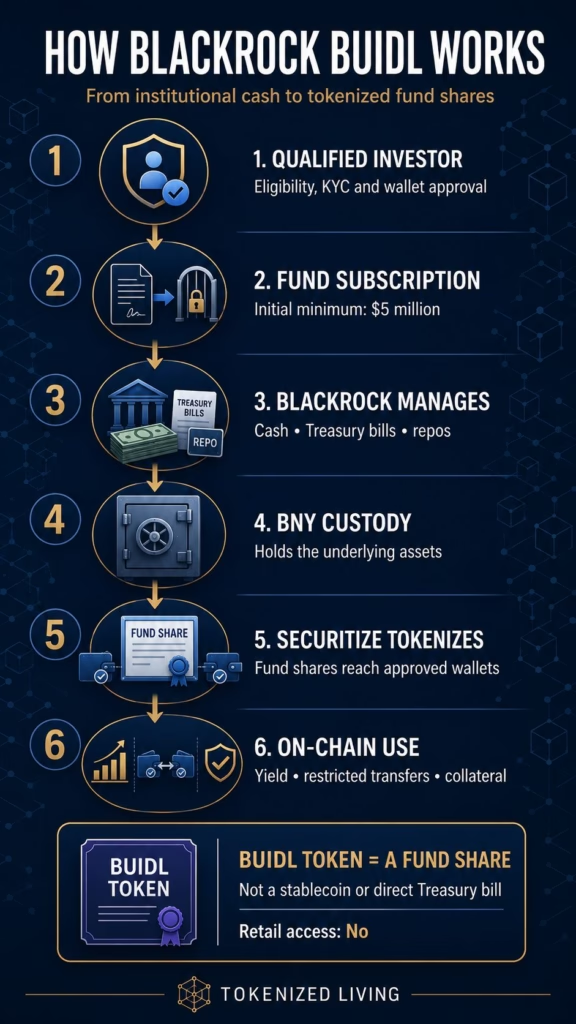
How Does the BUIDL Fund Work?
BUIDL connects several traditional and blockchain-based processes.
1. The investor completes onboarding
A prospective investor must register through Securitize and complete the required checks.
These can include:
- Identity verification
- Know Your Customer checks
- Anti-money-laundering screening
- Sanctions screening
- Investor eligibility verification
- Wallet approval
Owning a compatible wallet does not provide automatic access.
2. The investor subscribes to the fund
An eligible investor submits a subscription through the approved process.
BUIDL launched with a $5 million initial investment minimum. However, eligibility and minimum investment are separate requirements.
Meeting one requirement does not automatically satisfy the other.
3. BlackRock manages the assets
BlackRock Financial Management serves as the investment manager.
It allocates the fund’s capital across its permitted cash, Treasury and repurchase-agreement holdings.
Therefore, the fund’s yield largely follows short-term U.S. interest rates after fees and expenses.
4. BNY holds the underlying assets
BNY acts as the fund’s custodian and administrator.
It safeguards the conventional financial assets and supports the connection between the traditional fund records and blockchain-based shares.
The Treasuries do not sit inside an investor’s crypto wallet.
5. Securitize manages the tokenized shares
Securitize acts as the transfer agent and tokenization platform.
It records subscriptions, redemptions, distributions and permitted transfers. Securitize Markets also serves as the placement agent.
When an approved investor subscribes, the system can issue the appropriate BUIDL tokens to an authorized wallet.
6. Transfers remain restricted
Investors can transfer BUIDL tokens to other approved wallets.
However, a transfer to an unapproved address should fail because the token includes compliance controls.
This makes BUIDL fundamentally different from permissionless cryptocurrencies.
Who Can Invest in BUIDL?
BUIDL is not designed for general retail investors.
The fund issues shares under Rule 506(c) of the Securities Act. It also relies on Section 3(c)(7) of the Investment Company Act.
A Section 3(c)(7) fund limits participation to qualified purchasers.
According to the U.S. Securities and Exchange Commission, this category generally includes:
- Individuals who own at least $5 million in investments
- Certain family-owned companies with at least $5 million in investments
- Institutions or other entities controlling at least $25 million in investments
- Certain trusts and knowledgeable employees that meet specific conditions
These rules contain important legal details. Therefore, investors should not rely solely on a simple net-worth calculation.
Securitize must confirm eligibility before approving an investor and wallet.
Can ordinary investors buy BUIDL?
For most people, the answer is no.
A retail investor cannot normally visit a crypto exchange and purchase a small amount of genuine BUIDL.
Tokens with the same name may also be fake. BlackRock publishes a list of official BUIDL token addresses to help users detect impersonations.
Anyone considering a tokenized investment should also understand the broader risks covered in our beginner’s guide to investing in tokenized assets.
Which Blockchains Support BUIDL?
BUIDL began on Ethereum. However, BlackRock and Securitize later introduced additional blockchain share classes.
| Date | Network expansion |
|---|---|
| March 2024 | Ethereum launch |
| November 2024 | Aptos, Arbitrum, Avalanche, Optimism and Polygon |
| March 2025 | Solana |
| November 2025 | BNB Chain |
The November 2024 expansion created new share classes across five additional networks. BNY supported the rollout as the fund’s administrator and custodian.
In March 2025, Securitize added a Solana share class. At that point, BUIDL had also passed $1 billion in assets, according to the Solana expansion announcement.
BNB Chain followed in November 2025. The launch coincided with BUIDL becoming available as off-exchange collateral for eligible Binance clients.
Why use multiple blockchains?
Different institutions use different blockchain ecosystems.
Some prioritize Ethereum’s established infrastructure. Others prefer lower transaction costs, faster settlement or compatibility with specific custody providers.
Multiple share classes allow approved investors and financial applications to interact with BUIDL on their preferred network.
However, expanding across blockchains does not automatically increase retail access.
Every supported share class still operates within the fund’s compliance system. Furthermore, cross-chain infrastructure introduces additional technical and operational dependencies.
This is one reason why choosing a blockchain for tokenization involves more than comparing transaction speeds.
How Does BUIDL Generate and Distribute Yield?
BUIDL generates income from the assets held inside the fund.
Treasury bills pay interest through the difference between their purchase value and maturity value. Meanwhile, repurchase agreements provide short-term secured income.
The resulting yield changes with:
- Federal Reserve policy
- Short-term Treasury rates
- Repurchase-agreement rates
- Portfolio composition
- Management fees
- Fund expenses
BUIDL does not offer a fixed return.
At launch, BlackRock said dividends would accrue daily and arrive as new tokens each month. More recent Securitize announcements describe daily dividend payouts.
Therefore, eligible investors should confirm the current distribution schedule for their specific share class.
The important point is that BUIDL seeks to maintain a $1 token value. It generally distributes income through additional tokens rather than allowing the token price to rise continually.
However, the $1 value remains a target rather than a guarantee.
How Large Is the BUIDL Fund?
On August 18, 2026, RWA.xyz reported:
- Total asset value of approximately $2.71 billion
- A $1 net asset value
- A seven-day APY of 3.42%
- Management fees ranging from 0.20% to 0.50%
- 106 holder addresses
These figures make BUIDL one of the world’s largest tokenized Treasury-related funds.
Nevertheless, the holder count reveals an important limitation.
BUIDL’s growth does not represent millions of ordinary investors moving their savings on-chain. A relatively small group of large participants accounts for its multibillion-dollar size.
In addition, one blockchain address may represent a custodian or institution acting for other parties. Therefore, an address count does not necessarily equal the exact number of beneficial investors.
BUIDL demonstrates institutional adoption, not mass retail adoption.
Why Is BUIDL Used as Collateral?
BUIDL’s significance now extends beyond earning Treasury-related income.
In June 2025, Crypto.com and Deribit began accepting BUIDL as collateral for eligible institutional clients. Binance later added an off-exchange collateral arrangement.
This allows approved traders to maintain exposure to the fund’s yield while using their BUIDL position to support trading activity.
Traditional collateral often sits idle. By contrast, tokenized fund shares can potentially earn income while supporting another financial position.
That improves capital efficiency.
However, using BUIDL as collateral creates additional risks. A trader can still face margin calls, liquidation or trading losses. The stability of the collateral does not make a leveraged position safe.
The integrations also target qualified and institutional clients. They do not turn BUIDL into a retail exchange token.
Can Investors Convert BUIDL Into USDC?
Circle introduced a smart contract in April 2024 that allows approved BUIDL holders to transfer shares to Circle in exchange for USDC.
The arrangement provides a near-instant blockchain-based exit route outside normal banking hours.
However, this is a secondary-market facility. It should not be confused with an unconditional government guarantee or unrestricted redemption right.
Users must satisfy the relevant eligibility and compliance requirements. Availability can also depend on Circle, Securitize, the blockchain network and current operating conditions.
BUIDL vs Stablecoins and Direct Treasuries
BUIDL’s targeted $1 value often leads people to describe it as a stablecoin.
That description is misleading.
| Feature | BUIDL | Typical dollar stablecoin | Direct Treasury bill |
|---|---|---|---|
| Legal asset | Share in a private fund | Token linked to an issuer’s reserve and redemption structure | U.S. government debt security |
| Main purpose | Institutional cash management and on-chain yield | Payments, transfers and digital-dollar liquidity | Government borrowing and investor income |
| Yield to holder | Yes, subject to rates and expenses | Usually no automatic holder yield | Yes |
| General retail access | No | Often available | Often available through brokers or auctions |
| Transfer restrictions | Approved wallets only | Often broadly transferable | Held through conventional financial accounts |
| Target value | $1 per fund token | Usually $1 per token | Bought at market or auction price |
| Blockchain risk | Yes | Yes | Not normally at the ownership-record level |
| FDIC insured | No | No | No |
BUIDL combines a conventional investment product with programmable blockchain infrastructure.
It does not eliminate the fund, custodian, transfer agent or securities-law framework.
For a broader comparison, our guide to Wall Street Treasury tokenization explains the differences between direct Treasury ownership, tokenized fund interests and Treasury-backed notes.
The Principal Risks of BUIDL
BUIDL holds relatively conservative underlying assets. Nevertheless, the complete product includes more risks than simply holding cash.
The $1 value is not guaranteed
The fund seeks to maintain a stable $1 token value.
However, losses, market disruption, counterparty failure or operational problems could prevent it from doing so.
Yield can fall
BUIDL’s income depends heavily on short-term interest rates.
If the Federal Reserve cuts rates, the fund’s yield will probably decline after a short delay.
Blockchain technology can fail
Smart contracts can contain bugs. Networks can also suffer congestion, outages, governance disputes or security failures.
Adding multiple networks increases flexibility. At the same time, it increases the number of systems that require monitoring.
Wallets and private keys create risks
Approved investors still need secure custody arrangements.
A compromised wallet, stolen key or faulty custody process could interrupt access or cause losses.
Transfers are not permissionless
Investors can only transfer shares within the approved compliance network.
Therefore, advertised 24/7 transferability does not mean anyone can receive or trade the token.
Liquidity depends on several parties
A blockchain may process a transaction quickly. However, a redemption can still depend on fund procedures, approved counterparties, liquidity providers and banking arrangements.
Fast token movement does not guarantee immediate access to cash under every condition.
Fees reduce the underlying yield
Reported management fees vary between share classes.
Consequently, investors should compare the net return with direct Treasury holdings and other cash-management products.
Collateral use adds leverage risk
Posting BUIDL as collateral can improve capital efficiency.
Nevertheless, leverage can transform a conservative fund holding into part of a high-risk trading strategy.
Why BUIDL Matters for Tokenized Finance
BUIDL matters because it shows that public blockchains can support regulated institutional fund shares at meaningful scale.
The fund also demonstrates a hybrid model.
BlackRock did not remove traditional financial institutions. Instead, it connected them to blockchain-based ownership and settlement infrastructure.
This model resembles other institutional tokenization systems. For example, Calastone’s tokenized fund-distribution model also connects blockchain channels to established fund operations.
The real innovation is not simply placing a Treasury fund on Ethereum.
It is making a regulated, yield-bearing fund share usable across approved digital markets, wallets and collateral systems.
BUIDL Is No Longer BlackRock’s Only Tokenized Fund
In August 2026, BlackRock expanded its tokenized cash strategy with two additional products:
- OnChain Shares of the BlackRock Select Treasury Based Liquidity Fund
- BlackRock Daily Reinvestment Stablecoin Reserve Vehicle
The first adds an Ethereum-based share class to an existing money market fund. The second targets reserve management for stablecoin issuers and other institutional users.
This expansion suggests BUIDL was not a one-off experiment.
Instead, BlackRock now appears to view tokenized cash products as a developing distribution channel within its wider asset-management business in Hong Kong and Europe.
However, the products have different structures, regulations and intended users. They should not be treated as interchangeable.
| For the wider picture, our tokenization in 2026 overview compares live investment products, banking trials and regulatory developments. |
Final Verdict
BlackRock’s BUIDL fund is an important institutional tokenization project.
It has grown from an Ethereum experiment into a multibillion-dollar, multi-chain financial product. Moreover, its use as collateral shows how tokenized funds can perform functions that traditional fund shares handle less efficiently.
Still, the hype requires restraint.
BUIDL has not democratized Treasury investing. Its $5 million initial minimum, qualified-purchaser rules and restricted wallets keep it firmly outside normal retail access.
It also does not remove financial intermediaries.
BlackRock manages the portfolio. BNY holds the assets. Securitize controls the tokenized share records and onboarding process. Meanwhile, Circle and trading venues provide additional liquidity and utility.
Therefore, BUIDL’s real achievement is not decentralization.
It is the creation of a working bridge between regulated investment funds and blockchain-based financial infrastructure.
Frequently Asked Questions
What does BUIDL stand for?
BUIDL is the ticker for the BlackRock USD Institutional Digital Liquidity Fund. The name also references the crypto expression “BUIDL,” meaning to build useful blockchain products.
Is BUIDL a cryptocurrency?
No. BUIDL is a tokenized security representing a share in a privately offered fund managed by BlackRock.
Is BUIDL a stablecoin?
No. The fund targets a $1 token value, but each token represents a fund share. A typical stablecoin serves mainly as a digital payment or settlement asset.
What assets back BUIDL?
The fund invests in cash, U.S. Treasury bills and repurchase agreements.
Can retail investors buy BUIDL?
Most retail investors cannot buy BUIDL directly. Investors must satisfy qualified-purchaser rules, complete Securitize onboarding and meet the applicable investment minimum.
What is BUIDL’s minimum investment?
The fund launched with a $5 million initial minimum investment. Investors should verify the latest terms directly with Securitize.
Does BUIDL always remain worth $1?
No guarantee exists. The fund seeks to maintain a stable $1 value, but investments can lose value.
Does BUIDL pay a fixed yield?
No. Its yield changes with short-term interest rates, portfolio income, fees and expenses.
Which blockchains support BUIDL?
BUIDL has launched share classes on Ethereum, Aptos, Arbitrum, Avalanche, Optimism, Polygon, Solana and BNB Chain.
Can BUIDL tokens move to any wallet?
No. Transfers remain restricted to approved investors and authorized wallets.
This article provides general information and does not constitute financial, legal or investment advice. Eligibility, fees, yields and product terms can change. Always consult the official fund documents and obtain professional advice when necessary.