
Updated: September 7, 2026
Kraken xStocks bring exposure to US stocks and exchange-traded funds onto public blockchains.
Eligible investors can buy small amounts, hold tokens in a wallet and access extended trading hours.
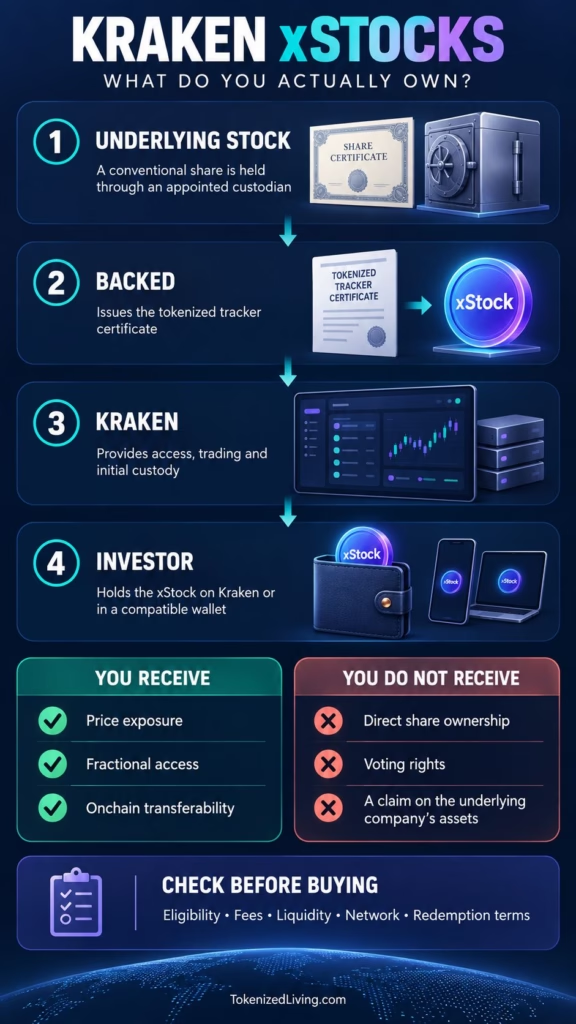
However, an xStock is not an ordinary company share. Buyers receive a tokenized tracker certificate issued by Backed Assets (JE) Limited.
That distinction affects shareholder rights, dividends, custody, redemption and investor protection.
This Kraken xStocks review explains the product without the “Wall Street without borders” sales pitch.
TL;DR
- xStocks provide economic exposure to selected US stocks and ETFs.
- Backed Assets (JE) Limited issues the tokens. Kraken distributes and trades them for eligible customers.
- Backed says each xStock has 1:1 collateral held through appointed custodians.
- Tokenholders do not own the underlying company shares.
- Therefore, they receive no voting rights or claim on the company’s residual assets.
- Kraken restricts the product by country, customer type and trading route.
- Most xStocks trade 24/5 on Kraken. Selected assets also trade there during weekends.
- Onchain transfers can continue 24/7, although liquidity and accurate pricing may weaken.
- Trading spreads, conversion charges, network costs and issuer fees may apply.
- Self-custody removes Kraken custody risk but introduces wallet and smart-contract risks.
Editorial disclosure: Tokenized Living did not receive payment for this article. We have no stated commercial relationship with Kraken or Backed. This review uses public product information and legal disclosures.
What Are Kraken xStocks?
xStocks are blockchain tokens linked to the prices of stocks and ETFs.
Examples include tokens tracking Apple, Tesla, Nvidia and the SPDR S&P 500 ETF.
Backed Assets (JE) Limited issues each product. Kraken offers the tokens to eligible customers through Payward Digital Solutions Limited.
According to Kraken’s xStocks information, Backed holds matching securities through appointed custodians.
This arrangement supports the advertised 1:1 backing. Nevertheless, backing does not turn the tokenholder into a registered company shareholder.
If you need the foundations first, our guide explains what tokenization means in plain English.
Kraken launched xStocks with around 60 products in June 2025. By March 2026, Kraken reported that the range had reached 100 xStocks.
The company also reported more than $25 billion in cumulative transaction volume. That figure comes from Kraken rather than an independent market audit.
Moreover, product availability changes. Investors should check the current catalog before opening an account or transferring money.
What Do xStock Holders Legally Own?
This is the section that matters most.
Buying AAPLx does not place your name on Apple’s shareholder register. Likewise, TSLAx does not give you a conventional Tesla share.
Instead, you hold a security issued by Backed. Its value tracks an underlying stock held within the product’s collateral arrangement.
Kraken’s risk disclosure states that holders receive no ownership in the underlying shares. They also receive no voting rights or liquidation claim against the underlying company.
Consequently, the token creates economic exposure through the issuer. It does not create a direct relationship with Apple, Tesla or another referenced company.
The underlying company does not sponsor the xStock. Nor does it owe duties to the tokenholder.
That structure creates an extra layer of risk. A direct shareholder mainly faces the company, broker and market infrastructure.
An xStock holder also depends on Backed, its custodians, the trading venue and the relevant blockchain.
How the Structure Works
| Layer | Role | What the investor depends on |
|---|---|---|
| Underlying company | Issues the conventional stock | Company performance and corporate actions |
| Custodians | Hold the securities supporting the product | Asset safekeeping and counterparty reliability |
| Backed Assets (JE) Limited | Issues the tracker certificate | Collateral management, legal terms and solvency |
| Kraken | Provides access, trading and initial custody | Platform availability, execution and account controls |
| Blockchain | Records and transfers the token | Network operation and smart-contract security |
| Investor wallet | Holds withdrawn xStocks | Private-key security and correct network use |
This layered model is not automatically defective. However, investors must understand every dependency before judging the product.
Our guide to buying tokenized assets safely explains how to check the legal claim before choosing a wallet.
Are xStocks Available Everywhere?
No. The word “global” needs a large qualification.
Kraken says xStocks serve eligible customers in more than 110 countries. However, customers in the United States, United Kingdom, Canada and Australia cannot access them.
Sanctioned and other prohibited jurisdictions also face restrictions.
Furthermore, eligible European Economic Area customers must complete an appropriateness questionnaire.
EEA customers face additional trading limits. Kraken’s current availability rules restrict them to fiat purchases, sales and conversions through specified interfaces.
Therefore, neither blockchain access nor a Kraken account guarantees eligibility.
The rules can also change. Users should verify their country, customer classification and permitted trading route before depositing funds.
Do Kraken xStocks Trade 24/7?
The honest answer is: sometimes.
Kraken’s xStocks FAQ lists ten assets with 24/7 trading on Kraken Pro. They include AAPLx, GOOGLx, NVDAx, TSLAx, SPYx and QQQx.
Most other xStocks trade 24 hours per day from Monday through Friday. Therefore, the entire Kraken range does not trade continuously.
Withdrawn tokens may move and trade through supported onchain venues at any time. Yet technical availability does not guarantee strong liquidity.
Traditional US exchanges close overnight, during weekends and on public holidays. During those periods, market makers cannot hedge through the underlying market as easily.
As a result, bid-and-ask spreads may widen. Prices can also diverge from the last conventional stock-market price.
Moreover, a token could trade at the weekend and jump when Nasdaq or the New York Stock Exchange reopens.
Our analysis of tokenized secondary markets explains why continuous transferability does not ensure continuous liquidity.

Does Blockchain Settlement Remove Traditional Settlement?
An onchain xStock transfer can settle within seconds. However, that only describes the token movement.
It does not mean every supporting process happens instantly.
The issuer still buys, holds and manages conventional securities. Custodians still maintain the off-chain collateral.
Meanwhile, most conventional US securities transactions have followed a T+1 settlement cycle since May 2024. The SEC’s T+1 guidance confirms that change.
Therefore, comparing xStocks against T+2 stock settlement is obsolete.
Blockchain can accelerate the token leg. It does not erase every process or counterparty behind the product.
Which Blockchains Support xStocks?
Solana played a central role in the original launch. Its low transaction costs and fast confirmation times suited retail-sized transfers.
However, xStocks are no longer exclusively a Solana product.
Kraken’s support documentation lists Solana, Ethereum, TON and Ink for supported withdrawals. Backed product pages also identify Ethereum and Solana versions for several tracker certificates.
Availability can differ by asset, platform and blockchain. Therefore, investors should never assume every xStock exists on every supported network.
Before withdrawing, confirm the token contract and destination chain. Sending an unsupported token can cause a permanent loss.
Self-custody also transfers responsibility to the holder. Kraken cannot recover a seed phrase or reverse an incorrect blockchain transaction.
Kraken xStocks Fees and Costs
The phrase “zero trading fees” does not mean zero cost.
Kraken says purchases made with USD or USDG through its standard service carry no separate trading fee. Nevertheless, the quoted price may include a spread.
Purchases using other assets can incur Instant Buy charges. Kraken also lists a fixed 1% fee for conversions.
On Kraken Pro, the published xStocks schedule lists a maker rebate and a taker fee. These figures may change with the platform’s pricing policy.
Additional costs can include:
- The difference between buying and selling prices
- Blockchain withdrawal fees
- Decentralized-exchange trading fees
- Stablecoin conversion costs
- Currency-conversion charges
- Direct issuance or redemption fees
- Product-level management costs
- Wider spreads outside underlying market hours
- Tax reporting and professional advice
Backed’s product terms vary by xStock. For example, its SPYx product page lists an issuance or redemption charge of up to 0.50%.
ETF-linked products can also reflect expenses charged by the underlying fund. Consequently, returns may differ from direct ownership of the referenced security.
Investors should inspect the final terms for the exact xStock. A platform-wide marketing page cannot replace product-specific disclosure.
What Happens to Dividends and Corporate Actions?
xStock holders do not receive ordinary shareholder distributions directly from the company.
Instead, Kraken says dividend value gets reinvested into additional units of the same xStock. The holder’s token balance should increase after the adjustment.
Taxes, fees and product terms may reduce the economic value that reaches investors.
Stock splits, mergers and other corporate actions also require adjustments. Backed and Kraken must translate those events into the token structure.
Therefore, investors depend on the issuer and platform to process each event correctly.
This differs from direct share ownership. A broker normally credits cash dividends or additional shares to the shareholder’s account.
Can You Redeem xStocks for Real Shares?
The old version of this article gave an unjustifiably simple answer.
Kraken says tokenholders may seek redemption through Backed, subject to additional fees and applicable terms. Alternatively, they can sell through Kraken or another supported venue.
However, xStocks cannot move into a conventional brokerage account such as Interactive Brokers.
Redemption should not be described as swapping one token for one registered share inside your brokerage portfolio.
Eligibility, processing routes, minimums, fees and settlement methods can apply. Investors must read Backed’s current final terms before relying on redemption.
For most retail users, selling the token will probably offer the simpler exit. Nevertheless, that route requires sufficient market demand.
xStocks Versus Direct Stock Ownership
| Feature | Kraken xStocks | Direct stocks through a broker |
|---|---|---|
| Legal position | Holder of a Backed tracker certificate | Beneficial or registered owner of shares |
| Price exposure | Tracks a referenced stock or ETF | Comes directly from the owned security |
| Voting rights | None | Often available for voting shares |
| Dividends | Reflected through token adjustments | Usually paid as cash or reinvested |
| Trading hours | 24/5 for most; 24/7 for selected assets | Exchange and broker hours apply |
| Self-custody | Available on supported blockchains | Usually held through a brokerage system |
| Settlement | Near-instant token transfer | Generally T+1 in the United States |
| Main extra risks | Issuer, custodian, token, network and venue | Broker, custodian and market risks |
| Geographic access | Restricted by product rules | Depends on the broker and jurisdiction |
| Investor protection | Depends on the xStock structure and jurisdiction | Depends on the broker and local regime |
Neither route wins every category.
xStocks offer portability and blockchain integration. Direct shares provide a clearer ownership relationship and established investor protections.
Our Coinbase tokenized stocks guide examines another structure, including Base access, dividend reinvestment and eligibility conditions for shareholder rights.”
Potential Advantages of Kraken xStocks
xStocks solve several practical problems for eligible users.
First, the $1 entry point supports small allocations. Investors do not need enough money for a full share.
Second, supported withdrawals allow self-custody. Users can move tokens beyond Kraken rather than leaving everything inside one account.
Third, the product connects familiar market exposure with onchain applications. Some holders may use supported xStocks in decentralized exchanges or lending systems.
Finally, extended trading hours provide flexibility across time zones.
These benefits are real. Still, none guarantees better returns, reliable liquidity or stronger legal protection.
Readers comparing wallet-based access can also examine our report on tokenized stocks through MetaMask.
The Main Kraken xStocks Risks
Issuer and Custodian Risk
The tokenholder relies on Backed and its service providers. Insolvency, operational failure or restricted access to collateral could cause losses.
Liquidity Risk
A transferable token may still lack buyers. Thin order books and wide spreads can make an exit expensive.
Tracking Risk
The token price may diverge from the underlying stock. This risk can increase while conventional markets remain closed.
Regulatory Risk
Authorities can restrict distribution, trading or wallet transfers. A currently eligible customer could lose access after a rule change.
Smart-Contract and Network Risk
Code failures, compromised bridges, congestion or unsupported transfers can affect token access and value.
Wallet Risk
Self-custody gives the holder control. It also makes the holder responsible for keys, networks and transaction accuracy.
Corporate-Action Risk
Tokenholders depend on intermediaries to translate dividends, splits, mergers and delistings into the tracker structure.
Tax Uncertainty
Tax authorities may treat tokenized securities differently across jurisdictions. Onchain transfers can also complicate recordkeeping.
Kraken’s disclosure warns that investors can lose their entire investment. That warning deserves more attention than the product’s “borderless” branding.
For another structure, see our Ondo Finance review. It shows how similar market exposure can involve different entities, rules and fees.
Who Might Consider xStocks?
xStocks may suit an eligible investor who understands crypto wallets and wants onchain US equity exposure.
They may also interest users who value small purchases, extended trading hours or DeFi compatibility.
However, the product does not suit everyone.
Investors seeking voting rights should use direct shares. The same applies to anyone who needs conventional brokerage protection or simple tax reporting.
Likewise, beginners should not treat a familiar ticker as proof of a familiar legal structure.
AAPLx may track Apple. Legally, however, it remains a different instrument from AAPL.
European readers can compare this model with Robinhood’s tokenized stock structure. The branding may look similar, but the legal and operational details still require separate analysis.
Due-Diligence Checklist
Before buying an xStock:
- Confirm whether your country and customer type qualify.
- Identify the legal issuer in the final terms.
- Check the referenced share or ETF.
- Review the custodian and collateral arrangements.
- Confirm your voting and distribution rights.
- Check Kraken’s current trading hours for that token.
- Calculate the spread and every applicable fee.
- Understand how dividends and corporate actions work.
- Verify the available redemption or selling route.
- Examine trading volume and order-book depth.
- Confirm the correct blockchain and contract address.
- Research the tax treatment in your country.
- Ask what happens if Kraken, Backed or a custodian fails.
Kraken xStocks Verdict
| Category | Assessment |
|---|---|
| Product status | Active and significantly larger than at launch |
| Legal ownership | Economic exposure, not direct company share ownership |
| Accessibility | Broad international reach with major exclusions |
| Trading | Extended hours, but not universal 24/7 trading on Kraken |
| Transparency | Useful disclosures, although the structure remains layered |
| Main strength | Self-custodial, fractional exposure to familiar securities |
| Main weakness | Additional issuer, custody, liquidity and regulatory risks |
| Overall view | Credible infrastructure, but not a replacement for direct shares |
| The Robinhood Stock Tokens review offers another comparison of custody, dividends and exit conditions. |
Final Thoughts
Kraken xStocks represent a meaningful expansion of tokenized public-market exposure.
The product now covers far more assets and networks than its original Solana launch suggested.
However, the essential limitation remains unchanged. Investors receive a tokenized tracker certificate rather than the underlying company share.
That instrument can provide fractional access, self-custody and longer trading hours. In exchange, buyers accept more structural and technological dependencies.
Therefore, the right comparison is not “old Wall Street versus better blockchain.”
The real choice sits between two different legal and operational products.
Anyone considering xStocks should start with ownership, fees and exit conditions. The blockchain comes after those questions.
Frequently Asked Questions
Are Kraken xStocks Real Stocks?
No. They are tokenized tracker certificates linked to stocks and ETFs. Backed holds supporting collateral, but tokenholders do not own the underlying company shares.
Who Issues xStocks?
Backed Assets (JE) Limited issues xStocks. Kraken provides access and trading to eligible customers through its relevant operating entity.
Do xStock Holders Receive Voting Rights?
No. Kraken states that xStock holders receive no voting rights or legal claim against the underlying company.
Can US Investors Buy Kraken xStocks?
No. Kraken excludes the United States and US persons. The United Kingdom, Canada and Australia also remain excluded.
Do All xStocks Trade 24/7?
No. Kraken lists 24/7 trading for selected xStocks. Most of the range trades 24/5, although supported onchain venues may operate continuously.
Are xStocks Still Only on Solana?
No. Kraken lists support across Solana, Ethereum, TON and Ink. However, each asset and venue may support a different set of networks.
How Do xStock Dividends Work?
Kraken says dividend value gets reinvested into additional units of the same xStock. Tokenholders do not receive a normal company dividend directly.
Can I Transfer xStocks to a Traditional Broker?
No. Kraken says xStocks cannot move into a conventional brokerage account. Backed redemption follows separate terms, eligibility rules and fees.
Are xStocks Safer Than Ordinary Stocks?
Not necessarily. They add issuer, custodian, blockchain, wallet, liquidity and regulatory risks to the underlying market risk.
Are Kraken xStocks Suitable for Beginners?
Only if the buyer understands the legal structure and wallet risks. A familiar company ticker does not make the token equivalent to a direct share.
Disclaimer: This article provides general educational information. It does not provide financial, legal, investment or tax advice. Product availability, fees and regulations can change. Verify the latest terms and seek qualified professional advice where necessary.