
Updated: September 11, 2026
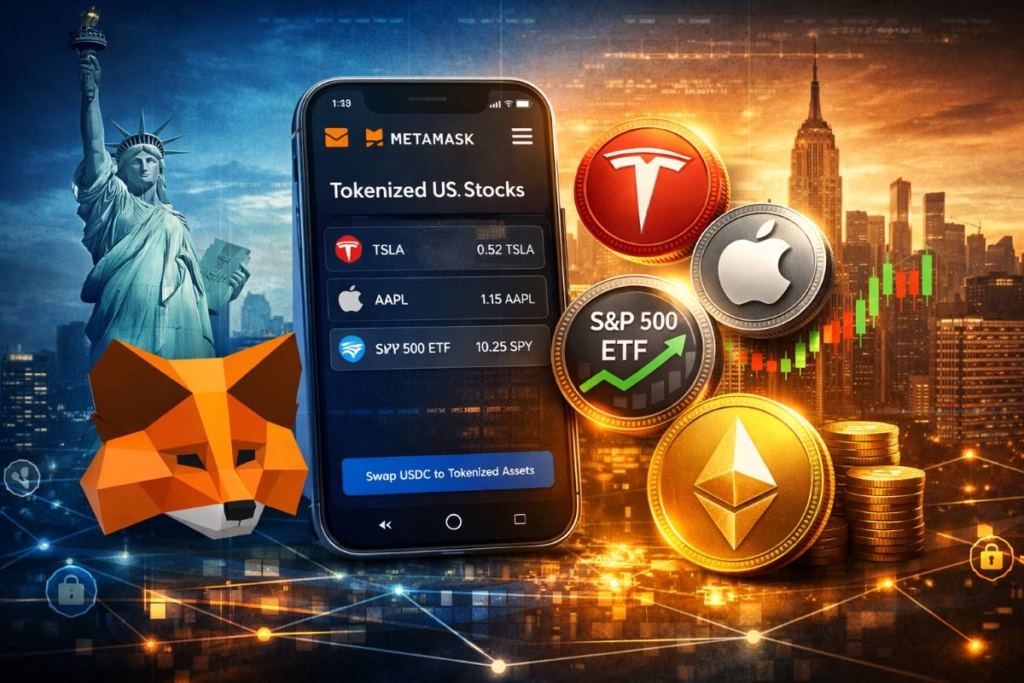
MetaMask tokenized stocks let eligible users gain exposure to US equities and exchange-traded funds through a crypto wallet. Ondo supplies the tokenized products, while MetaMask provides a familiar trading interface.
However, buying a stock-linked token is not the same as buying the underlying company share. Your investment depends on the issuer, its backing assets and the terms attached to the token.
The useful question is not whether stocks can fit inside a wallet. It is whether this route offers the access, costs and protections you need.
TL;DR
- You hold an Ondo-issued investment token, not the underlying company share.
- Self-custody protects control of your tokens, not control of the backing securities.
- Dividends contribute to total-return exposure through reinvestment, after applicable withholding taxes.
- Eligibility, trading costs and exit arrangements deserve more attention than the wallet interface.
- Tokenized equities and tokenized property do not automatically share the same rights or liquidity.
What Are MetaMask Tokenized Stocks?
These products link blockchain tokens to conventional securities held outside the blockchain. The range includes exposure to individual companies and ETFs.
An ETF is a fund that trades on an exchange. Depending on its holdings, it can provide exposure to shares, bonds or commodities.
The distinction matters when browsing a token catalog. A token tracking a gold-related ETF is not necessarily a claim to collect physical gold.
Ondo uses an “on” suffix for its tokens. For example, AAPLon references Apple, while TSLAon references Tesla. These are product identifiers, not ordinary stock-market tickers.
Also, a token’s displayed price may differ from the corresponding share price. Reinvested income and corporate actions can change the amount of exposure represented by each token.
Therefore, compare the investment’s economic value rather than assuming one token always equals one share.
Read our Ondo Finance review for a broader look at its tokenized stocks, Treasury products, fees and ownership risks.
What Do You Actually Own?
Ondo describes these products as structured notes: debt instruments issued by Ondo Global Markets (BVI) Limited. The issuer is a special-purpose company in the British Virgin Islands. Its sales terms govern tokenholder rights under Swiss law.
The notes track referenced assets. They do not give holders the voting or information rights attached to the underlying shares. A security agent holds a first-priority security interest in the collateral for tokenholders. These distinctions appear in Ondo’s legal explanation.
Here is the relationship in plain English:
| Layer | Its role |
|---|---|
| Referenced company or fund | Provides the underlying investment exposure |
| Custodial broker-dealer | Holds the backing securities |
| Ondo issuer | Issues the note and owes its contractual obligations |
| MetaMask | Provides wallet access and a trading interface |
| Your wallet | Holds the blockchain token |
This is more than a difference in packaging. The legal claim determines what happens when something goes wrong.
A wallet balance cannot answer who must repay you, which assets support the obligation or how enforcement works. Those answers come from the product documents.
Owning the token does not mean controlling the securities behind it.
Current Access, Networks and Fees
The following details come from MetaMask’s operational support guide, checked for this update.
| Item | Current guidance |
|---|---|
| Interface | Mobile and browser Extension |
| Networks | Ethereum and BNB Chain |
| Preferred funding routes | USDC on Ethereum; USDT on BNB Chain |
| Minimum swap | $5 |
| MetaMask fee | 0.875% per trade |
| CoW Swap route extras | 0.12% plus a 0.005% execution adjustment |
Network costs also apply. Keep ETH or BNB available for gas. Check the final quote before confirming.
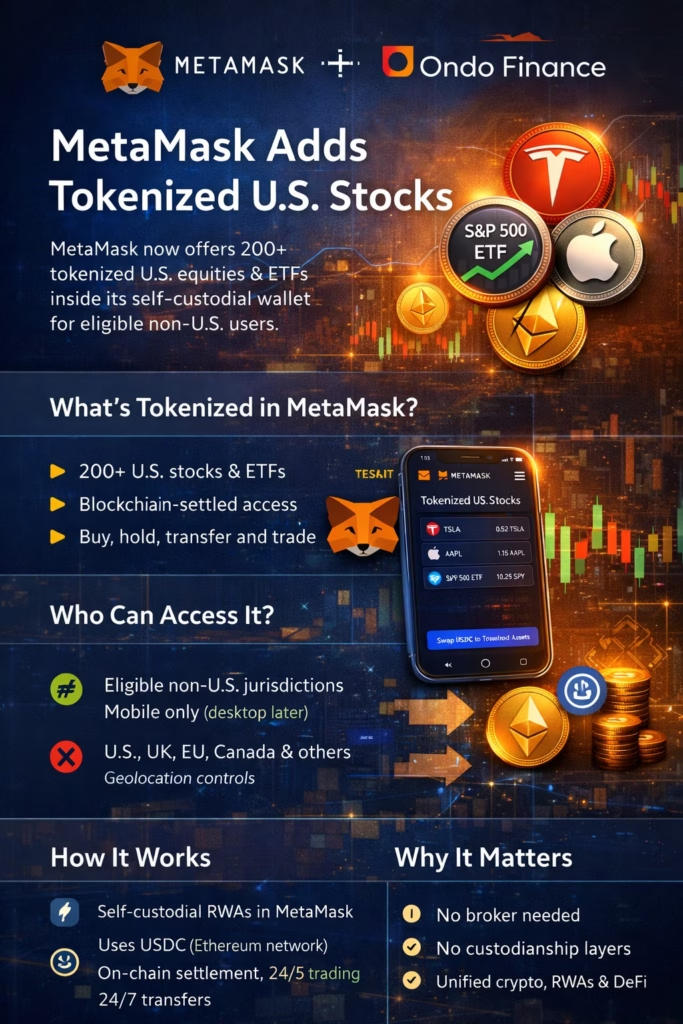
MetaMask lists the US, UK, EEA, Canada, China including Hong Kong, Singapore, Malaysia, Switzerland and Brazil among excluded locations. This is not the complete list.
Its support guide lists Extension access, although the marketing FAQ still describes it as forthcoming. Availability can vary; verify the feature in your current app.
To trade, open Swap, choose the supported funding asset, search for the Ondo token, enter the amount and review the transaction.
Check the Route, Not Just the Country
Ondo’s direct-investor eligibility rules and MetaMask’s distribution restrictions are not interchangeable. Ondo distinguishes prohibited jurisdictions from others where professional or qualified-investor conditions apply.
That does not mean a qualifying investor automatically gains access through MetaMask. Each route has its own requirements.
Similarly, holding a wallet is not proof of eligibility. Check your location, investor status and the product terms before moving funds.
If a service says you are ineligible, do not treat another interface as a workaround. Resolve the access question first.
What the Fees Mean in Dollars
Consider an illustrative $1,000 trade. A 0.875% charge equals $8.75.
For a route charging all three percentages above, the total is 1%: $10 on a $1,000 trade. This excludes gas and any further pricing differences.
If both a purchase and a later sale have a $1,000 fee base, those charges total $20. Actual amounts change with the quote and sale value.
Small trades deserve particular care. A low entry minimum does not guarantee low costs relative to the amount invested.
For example, a hypothetical $2 network cost on a $20 purchase consumes 10% before trading charges. This is an illustration, not a current gas quote.
The practical comparison is the full cost of entering and exiting. Include currency conversion and the cost of returning proceeds to your bank, where relevant.
How Dividends and Taxes Work
Ondo’s tokens track total returns. Dividend income is reinvested rather than distributed as cash to your wallet.
However, reinvestment occurs after withholding tax. Ondo states that dividends from US-based companies generally face 30% withholding at its BVI issuer. Other distributions can receive different treatment, including exemptions for parts of certain fixed-income ETF distributions. See Ondo’s fees and tax documentation.
A Simple Dividend Example
Suppose the securities backing your exposure generate a hypothetical $20 dividend. If 30% withholding applies, $6 is withheld and $14 remains for reinvestment.
You would not receive a $20 cash payment in MetaMask. Nor would you receive the remaining $14 as spendable wallet cash.
This matters if you want income for living expenses. Reinvested returns and cash distributions serve different needs.
Our guide to a tokenized real estate retirement portfolio explores that distinction in a property-investment context.
Withholding at the issuer does not settle every personal tax obligation. Your own jurisdiction may require reporting or additional tax. Seek qualified tax advice for your circumstances.
Can You Sell Whenever You Want?
Separate three things: transferring a token, obtaining a trading quote and withdrawing money to a bank.
MetaMask markets generally available 24/5 trading and 24/7 peer-to-peer transfers. Temporary pauses can still occur. Corporate actions, market conditions and risk controls may interrupt quoting.
An onchain transfer moves a token between addresses. It does not guarantee that someone will buy it at your preferred price.
Likewise, selling for a stablecoin does not put cash in your bank account. You may still need an exchange or another conversion service.
Before investing, work backwards from the exit:
- Which asset will you receive when you sell?
- What happens if your usual quote provider is unavailable?
- Can your chosen cash-out service receive that asset on the correct network?
- How much could conversion and withdrawal cost?
These questions are especially important when you need money by a fixed date.
Selling Is Not the Same as Direct Redemption
A wallet swap is a trading route. Direct redemption involves the issuer and its separate procedures.
Ondo requires onboarding for direct purchases and redemptions. Do not assume a token balance grants immediate access to every issuer service.
An exit plan should identify a route you can actually use, not merely one mentioned somewhere in the wider product ecosystem.
Does Self-Custody Remove Counterparty Risk?
No. It changes where part of the responsibility sits.
You control the keys to your wallet, but the underlying securities remain with custodial broker-dealers. The issuer and its service providers still connect those securities to your token.
Ondo describes safeguards including separated assets and accounts, independent governance, collateral backing and third-party oversight. These arrangements aim to protect claims if a business fails.
Our assessment is that safeguards deserve scrutiny, not dismissal. However, a protected claim is not a promise of immediate repayment.
Questions to ask include how a default is established, who acts for holders and how long recovery could take.
Other Risks to Check
Investment risk: A falling stock or fund can reduce the value of the linked exposure. Tokenization does not improve the underlying company’s performance.
Wallet risk: A stolen recovery phrase or malicious approval can compromise tokens. Keep recovery information private and review what you sign.
Technical risk: The token relies on contracts and network infrastructure. Additional bridges or DeFi applications introduce more dependencies.
Pricing risk: The exit quote matters more than a portfolio screen’s estimated value. Investigate unexpected differences before trading.
Access risk: Rules or service availability may change. Consider how you would manage an existing holding if your normal interface stopped working.
These risks can overlap. A market fall is harder to manage if you simultaneously lose access to your preferred exit route.
How to Compare It With Other Ways to Invest
Start with your goal. Are you seeking company exposure, wallet-based holdings, spendable income or a particular DeFi use?
Then compare the route against alternatives available to you. The most attractive interface may not offer the best overall arrangement.
Use five questions:
- What legal instrument am I buying?
- What will buying, holding and selling cost?
- How does the product handle income?
- Which protections and restrictions apply to me?
- Can I explain the exit without relying on a promotional promise?
Our Kraken xStocks review and Robinhood stock tokens review examine other distribution models. Their terms should not be assumed to match Ondo’s.
Buying different tokens through the same issuer may diversify company exposure. It does not necessarily diversify issuer or custody dependencies.
Our Coinbase tokenized-stocks guide examines its Base products, including ownership rights, eligibility and redemption requirements.
What Does This Mean for Tokenized Real Estate?
Our view is that wallet integration offers a useful distribution lesson. Familiar interfaces can make an unfamiliar investment easier to find and manage.
However, distribution is only one part of the problem.
A property investment still needs clear legal rights, reliable management and a workable exit. Rental income also depends on tenants, expenses and the building itself.
Putting property tokens beside stock-linked tokens does not make their markets equally liquid. Nor does it make their ownership structures equivalent.
The tokenized real estate platform comparison explains why investors should examine each product’s structure rather than relying on the tokenization label.
Frequently Asked Questions
Does MetaMask Issue the Stock Tokens?
No. MetaMask provides the wallet interface. Ondo Global Markets (BVI) Limited issues the structured notes discussed here.
Does One Token Always Equal One Share?
No. Total-return tracking and corporate actions can change the exposure represented by a token. Compare economic value, not token count alone.
Is Full Backing a Guarantee Against Loss?
No. Backing does not prevent market losses or eliminate operational problems. It supports the product’s obligations under its legal structure.
Should I Choose This Over a Brokerage Account?
Not simply because it uses blockchain. Compare eligibility, total costs, legal rights, tax treatment and withdrawal options for your own needs.
Conclusion
MetaMask tokenized stocks offer a wallet-based route to familiar markets. Their value lies in whether that route solves a real access or portfolio need.
Convenience alone is not enough. Understand the instrument, calculate the full trading cost and check how you will exit.
Most importantly, distinguish control of the token from control of the assets behind it. That is the starting point for judging this investment fairly.
This article provides general information, not investment, legal or tax advice.