

Updated September 10, 2026
Tokenized real estate platforms offer several ways to invest in property, but the rights behind each investment differ. You might become a company shareholder, lend money to a project or hold a registered property interest.
Those differences affect your income, voting rights and ability to recover money when problems arise. Therefore, comparing minimum investments and advertised yields is only a starting point.
This guide compares Lofty, Reental, Binaryx and PRYPCO Mint. It also includes Stake as a fractional property alternative. RealT appears separately as a distressed-platform case study.
Our assessment uses public platform explanations, investment terms and help pages. We have not completed investment or withdrawal tests for this comparison. The platform order is not a safety ranking, and individual offering documents take priority over general descriptions.
TL;DR
- Start with the legal claim: company equity, project debt and registered property ownership give investors different rights.
- Compare the full cost of buying, holding and selling. A low minimum does not mean low fees.
- Check eligibility before funding an account. Some platforms restrict US investors or particular countries.
- Treat secondary trading as a possible exit route. Sale timing and price remain uncertain.
- Keep RealT outside the active-platform shortlist because of its reported liquidation plans and Detroit legal problems.
For the underlying concepts, read our complete guide to tokenized real estate.
What Investors Own on Each Platform
The following table describes published models. It does not establish the rights attached to every individual offering.
| Platform | Published investment structure | Main distinction |
|---|---|---|
| Lofty | Membership interests in a property-specific LLC | The company holds the property; investors hold company interests. |
| Reental | Spanish participatory loans and US property-company interests | A lender’s claim differs from a shareholder’s rights. |
| Binaryx | DAO LLC interests connected to local property arrangements | Examine the entire chain between the US entity and the overseas asset. |
| PRYPCO Mint | Fractional property interests registered with Dubai Land Department | Its terms describe direct proportional ownership registered in the investor’s name. |
| Stake UAE Properties | Shares in a property-owning special purpose vehicle | Investors own shares in the company holding the title deed. |
These structures come from Lofty’s explanation, Reental’s FAQ, Binaryx’s legal overview, PRYPCO Mint’s terms and Stake’s ownership guide.
Legal distinction: A claim linked to a building does not automatically give you a mortgage over that building. Similarly, a company share does not put your name on the property’s title deed. Establish who holds title, what the issuer owes you and which liabilities rank ahead of your claim.
Our Sabai Property review examines another model, focusing on the contractual income rights, ownership structure and exit terms behind its Phuket property tokens.
Minimum Investments and Investor Access
| Platform | Published starting amount | Access qualification |
|---|---|---|
| Lofty | One share, often around $50 or less | Adults in supported US and international jurisdictions; identity checks apply. |
| Reental | About €100/$100 through crypto; €500/$500 by bank transfer | US tax residents must qualify as accredited investors under its FAQ. |
| Binaryx | Advertises investments from $500 | Its eligibility FAQ excludes US citizens; other country restrictions apply. |
| PRYPCO Mint | AED 1,000 for real estate on its dedicated product page | Confirm acceptance for your residence and investor category before funding. |
| Stake UAE Properties | AED 500 | Adults with accepted identity and address documents; country restrictions apply. |
Reental’s different amounts reflect payment routes, as its investment help page explains. Binaryx’s US restriction appears in its eligibility FAQ. Stake publishes separate UAE access requirements.
PRYPCO’s general website still contains AED 500 messaging. However, its dedicated Mint product page explicitly states AED 1,000 for real estate. Use that figure as the published baseline and confirm the amount at checkout. Its gold product has different terms and is outside this comparison.
A platform accepting your registration does not mean that every investment is available to you. Citizenship, tax residence and investor classification can each affect access.
Tokenized Real Estate Platform Fees Compared
Fees apply to different amounts and transactions, so the percentages below are not directly interchangeable. They also exclude some property expenses, taxes and payment-provider charges.
| Platform | Published platform charges | Cost detail that matters |
|---|---|---|
| Lofty | 2.5% on purchases; 3% on sales | Its guide also discusses market-order execution charges; confirm the complete order quote. |
| Reental | No single current schedule covering all offerings was established in this review | Obtain the selected project’s budget and transfer charges. Missing figures do not mean zero fees. |
| Binaryx | 5% purchase commission, included in the investment amount | Its P2P guide describes a 3% buyer discount plus a 2% transaction charge. |
| PRYPCO Mint | 2% acquisition; 0.5% management; 1% exit; incentive fee up to 15% of qualifying excess return | Acquisition and management use the funding target; exit uses sale value. Confirm management-fee frequency. |
| Stake UAE Properties | 1.5% acquisition; 0.5% annual administration; 2.5% exit; 7% of appreciation profits | Compliance charges add 0.2% initially and 0.1% annually from year two. |
The figures reflect Lofty’s published guide, Binaryx’s fee schedule, PRYPCO Mint’s terms and Stake’s UAE fee guide.

PRYPCO’s fee clause lists 0.5% management without stating the billing frequency in that clause. Its terms also identify operating and administrative deductions elsewhere. Request a dated breakdown instead of assuming that one percentage describes the entire annual cost.
For every platform, separate service fees from the costs of owning the building. Repairs, insurance, property management and vacancy can reduce distributions even when no extra charge appears on your account.
How Exit Costs Affect Returns
Consider a hypothetical investment bought for $1,000. It pays $60 during the year, then sells for $900. A 3% selling charge leaves $873 from the sale.
Your total receipts are $933, including the income. The result is a $67 loss before taxes and any purchase costs.
This example illustrates why rental yield alone cannot show your total return. The sale price and transaction costs can outweigh a year of distributions.
Lofty for US Property Company Ownership
Lofty offers individual US property exposure through LLC interests. Its public guide describes daily rental distributions, investor voting and an exchange with market and limit orders.
A limit order waits for a matching buyer. An available trading interface therefore does not establish a dependable exit price. Investors should review the bid, spread and complete charges before placing an order. Lofty explains its model here.
The practical attraction is the ability to select individual properties with a modest initial commitment. However, property selection creates work: compare local demand, insurance costs, maintenance records and the manager’s reporting.
Our assessment: A useful candidate for investors researching individual US rental assets. Its small starting amount should not substitute for checking the property’s financial condition.
Read our full Lofty review for more on ownership, fees, daily income and selling property shares.
Reental for Different Property Strategies
Reental requires careful separation of its investment models. Its Spanish participatory-loan description gives investors credit rights against an issuer. Its published US model uses company interests. The selected agreement determines your actual position. Reental’s FAQ
Payment schedules differ too. A project may make periodic distributions or target payment at completion. Our Reental review examines examples, wallet choices and withdrawal conditions.
For a debt offering, establish the repayment source, security and creditor priority. For company equity, examine distribution rules and who controls a sale. A monthly payment alone does not identify which structure you hold.
Secondary sales also require an eligible token, a supported route and a buyer. Borrowing against tokens introduces another obligation; it does not repay the underlying investment.
Our assessment: Relevant for investors able to assess private property projects and tolerate delays. The main challenge is comparing different contracts, payment schedules and costs consistently.
Binaryx for Overseas Rental and Development Exposure
Binaryx describes a Wyoming DAO LLC structure linked to local property arrangements. A US company registration does not, by itself, establish the title or lease rights held in another country. Examine the local entity, investment agreement and underlying asset together. Binaryx’s published model
The platform offers rental and construction strategies. Its homepage promotes secondary sales but also explains restrictions around construction-stage exits. Consequently, rental-token resale claims should not be applied automatically to development investments.
Its published P2P costs also matter: the buyer discount reduces what the seller receives, even though it differs from the platform’s transaction charge. Obtain a net-proceeds estimate before deciding that an early sale is economical.
Our assessment: Potentially relevant to eligible investors researching overseas projects. Local ownership rights, developer performance and exit restrictions deserve particular attention. It is unavailable to US citizens under the eligibility FAQ reviewed.
Read our Binaryx review for a fuller assessment.
PRYPCO Mint for Dubai Registered Property Interests
PRYPCO Mint’s terms describe proportional property ownership registered with Dubai Land Department. They also describe investor votes on selected major decisions and a cessation plan for business disruption. These are meaningful features, although they cannot guarantee investment recovery. PRYPCO Mint’s terms
The published marketplace rules are specific: a three-month lock-in from the property’s original purchase date, listings within 15% above or below the latest DLD valuation, and access for approved buyers. PRYPCO Mint’s marketplace explanation
A permitted pricing range limits your flexibility. If buyers will not pay an allowed price, the ability to list does not solve your exit problem.
The product page promotes monthly rental distributions, while the terms allow timing variations. Build a cash-flow plan around the contract and actual collections.
Our assessment: A useful model to examine for its connection between token records and property registration. Confirm investor acceptance, total costs and resale conditions for the selected property.
Stake as a Fractional Property Alternative
Stake’s UAE property product uses SPV shares. It belongs in this comparison because it offers another route to fractional property exposure. Its Saudi fund products have different structures and should be evaluated separately. Stake’s product overview
The UAE exit guide describes two-week windows in May and November, following at least one year of ownership. Investors can also participate in a decision to sell the whole property. These early-exit arrangements do not apply to its funds. Stake’s exit guide
Our assessment: Relevant for eligible investors seeking managed fractional exposure with a longer holding horizon. The scheduled windows provide a selling opportunity, subject to demand. They are unsuitable as a promise of emergency access to cash.
What Happens if a Platform Fails
Legal separation can help preserve an investor’s claim when the technology provider stops operating. However, someone must still collect rent, pay bills, maintain ownership records and communicate with investors.
Lofty says its property LLCs remain separate from the platform. Stake describes SPV separation and a business cessation plan involving an administrator seeking a replacement operator. These are published arrangements, not guarantees against delay or loss. Lofty’s explanation and Stake’s cessation guidance
For Reental and Binaryx, the documents reviewed do not establish one universal replacement-servicer process for every offering. Obtain the arrangement for the specific issuer and property.
Before investing, save copies of the agreement, ownership evidence and manager’s details outside the platform. Also identify who can replace the operator and how that replacement would be funded. An enforceable right is more useful when you can prove it without logging into the original app.
RealT as a Distressed Platform Case Study
RealT is excluded from our active-platform shortlist.
Outlier Media reported that co-founder Jean-Marc Jacobson announced plans for voluntary liquidation during a July 2, 2026 investor call. Its reporting also describes approximately 700 Detroit properties under special fiduciary Charles Bullock and uncertainty around the proposed sales. Outlier Media’s report
An announced intention to liquidate does not establish a completed legal process or a recovery amount for every token holder. Our RealT Detroit update covers the reported background and unresolved questions.
The case shows why property maintenance, reserves and legal control belong in a platform comparison. A functioning token cannot generate cash when the underlying asset needs repairs or faces unpaid liabilities.
For existing holders, the relevant questions concern their issuing entity, its obligations and the treatment of sale proceeds. A displayed token valuation is not a recovery estimate.
How to Choose Between Tokenized Real Estate Platforms
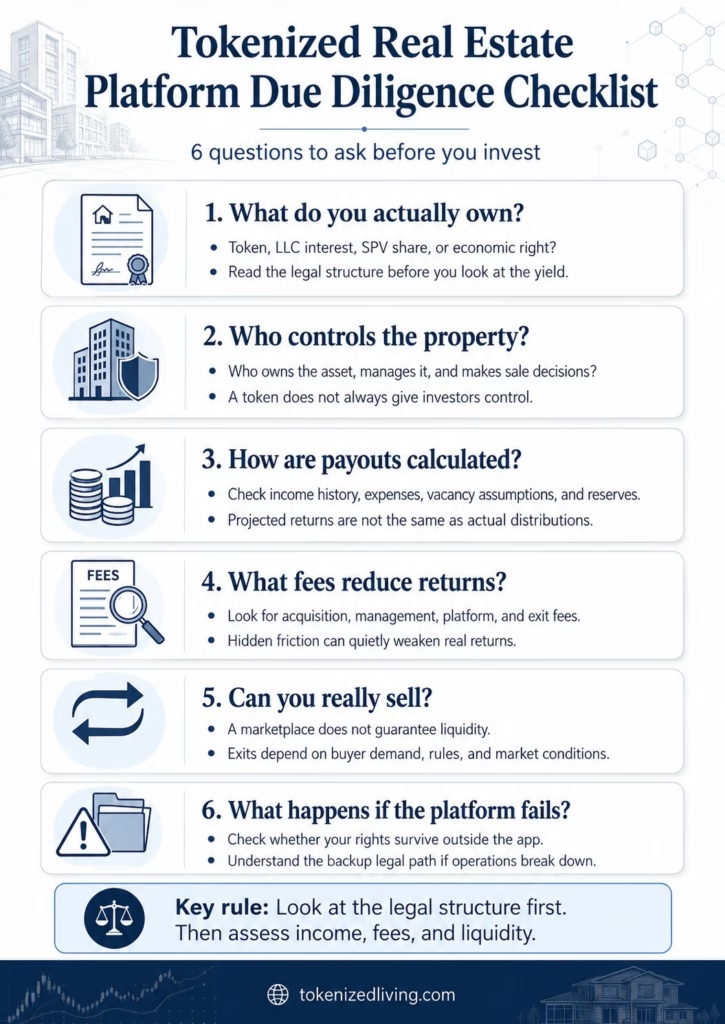
Begin with investments you are eligible to buy. Then compare specific offerings using the same set of documents and assumptions.
- Identify your claim. Write down the issuer, title holder and rights you receive.
- Examine the property finances. Check occupancy, expenses, borrowing and repair reserves, or the development budget and permits.
- Calculate net cash flow. Separate paid distributions from projected income and estimated appreciation.
- Price the exit. Include selling charges, possible discounts and the time you may have to wait.
- Test the failure arrangements. Establish who continues operations and where your ownership evidence survives.
A shortlist should follow those checks. High advertised returns cannot compensate for an unclear contract or an unaffordable holding period.
For more on sale mechanics, read our guide to tokenized asset secondary markets.
Frequently Asked Questions
Does Buying a Property Token Make Me a Landowner
It depends on the structure. The models compared here include company interests, issuer debt and registered fractional property ownership. Read the agreement and ownership record together before drawing a conclusion.
Can I Sell Whenever I Want
You may be able to submit a sale request, but restrictions and buyer demand determine whether it completes. Check the lock-in period, permitted price and net proceeds for the investment you hold.
Are Frequent Distributions Evidence of a Better Investment
No. Payment frequency describes timing, not profitability. Compare total cash received, remaining capital value and all costs over the same period.
What Should I Do When Public Fee Pages Are Unclear
Request a dated, written breakdown for your transaction. It should show the investment amount, acquisition costs, recurring charges and expected deductions on sale. Avoid calculating a net return from incomplete figures.
Which Platform Is Best for Beginners
There is no defensible universal winner from public descriptions alone. A beginner needs understandable rights, clear costs and a holding period they can afford. Choosing a smaller investment does not resolve weaknesses in those areas.
Our Verdict
Compare tokenized real estate platforms by the investment contract and property economics first. Access, payment frequency and trading features become useful only after the underlying rights and risks are clear.
The strongest candidate for your shortlist is the offering you can explain: what you own, how it earns money, what it costs and how you could exit. If any of those answers remains vague, pause before committing capital.
This comparison is educational and does not provide personalised investment, legal or tax advice.