
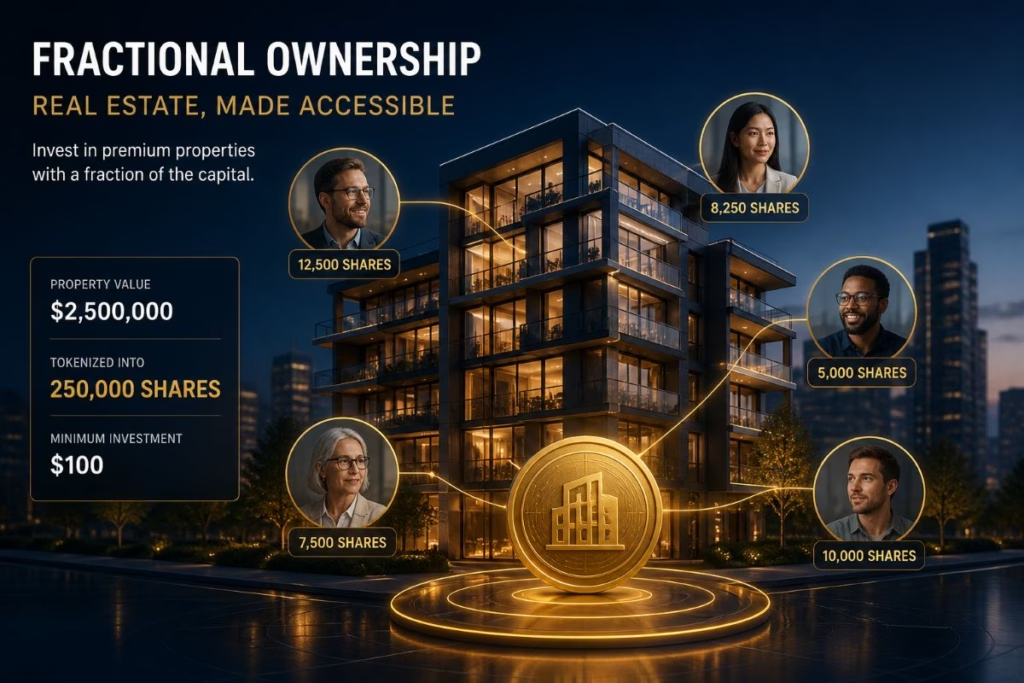
Fractional ownership explained properly means one thing first: investors need to know what sits behind the word “own.”
That sounds obvious, but it is where most beginner guides fall apart. A platform may say you can own a piece of real estate, artwork, farmland, or another high-value asset. The legal reality can be very different.
In many fractional real estate deals, you do not own the property deed directly. You may own shares in a company, units in an LLC, tokens linked to an SPV, or contractual rights to future proceeds.
That distinction matters.
A small piece of a strong asset can be useful. Yet a weak legal structure can turn that same small slice into a headache.
This guide explains how fractional ownership works, what investors may actually own, where tokenization fits, and which risks beginners usually miss.
TL;DR
Fractional ownership lets several investors share economic exposure to the same asset.
In real estate, the property is often held by a company, LLC, trust, fund, or special purpose vehicle.
Investors usually own shares, tokens, membership units, or contractual rights linked to that structure.
Direct deed ownership is possible, but it is not the default in many modern platforms.
Payouts may come from net property cash flow, sale proceeds, appreciation, or interest payments.
Liquidity is not guaranteed, even when a dashboard shows a resale option.
Tokenization can improve records, transfers, compliance checks, and reporting, but it does not remove property risk.
The serious question is not “Can I buy a fraction?” The serious question is “What legal rights does this fraction give me?”
What Is Fractional Ownership?
Fractional ownership is a structure where several people share ownership rights, economic rights, or investment exposure to one asset.
That asset could be a house, apartment building, commercial property, farmland, artwork, luxury watch, music royalty stream, private credit deal, or fund interest.
Real estate gets most of the attention because property is expensive and difficult to divide.
A normal buyer may need a large deposit, mortgage approval, legal paperwork, insurance, maintenance reserves, and enough spare cash to survive vacancies. Fractional ownership changes the entry point.
Instead of buying the whole asset, investors buy a smaller piece of the structure around it.
That piece may be a share, token, note, unit, or participation right.
The pitch is simple. Smaller tickets give more people access to assets that used to sit out of reach.
The weakness is also simple. Access does not automatically mean control, liquidity, or strong legal protection.
How Fractional Ownership Works in Real Estate
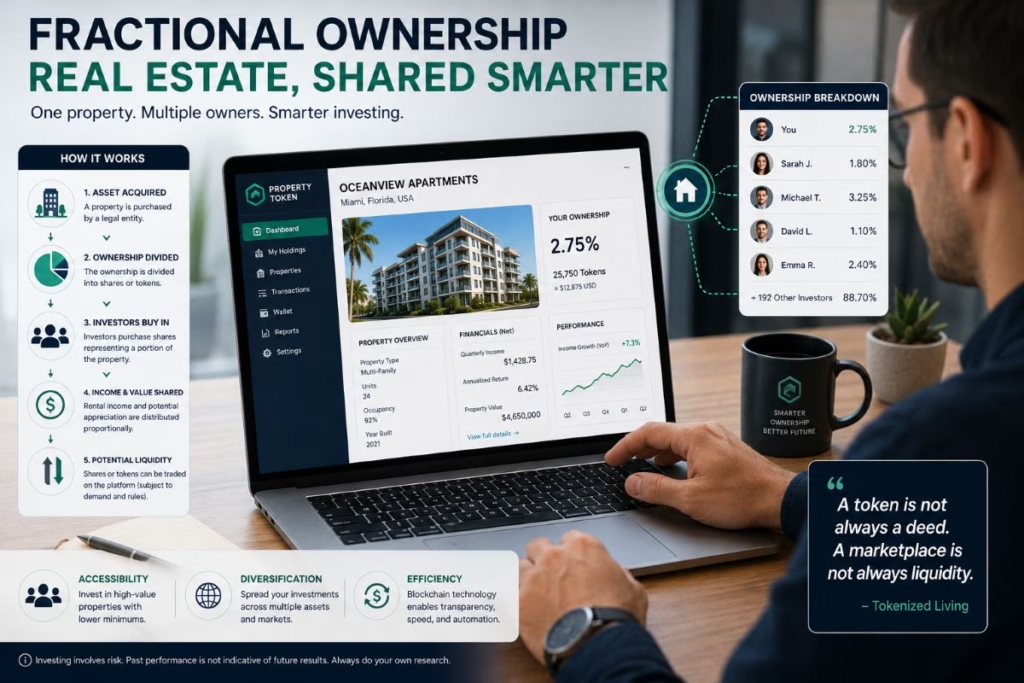
Most fractional real estate deals follow a basic pattern.
A sponsor, platform, or manager selects a property.
Next, a legal entity is created to hold the asset.
That entity may be an LLC, company, trust, fund, or SPV.
Investors buy smaller interests linked to the entity.
The property manager handles tenants, maintenance, insurance, taxes, repairs, reporting, and distributions.
After expenses, eligible investors may receive a share of net property cash flow.
Later, if the property sells, investors may receive part of the sale proceeds.
That is the clean version.
Real deals are messier. Some platforms use debt. Others use equity. A few use tokens that represent economic rights rather than title. Certain structures restrict resale to approved investors only.
Documents decide everything.
The dashboard is just the interface.
What Do Investors Actually Own?
This is the section that matters most.
Fractional ownership can mean several different things. Anyone who skips this part is investing blind.
1. Direct Property Ownership
Some structures give investors a direct legal interest in the property.
That may sound ideal, because the investor is closer to the asset. Yet direct co-ownership can create practical problems.
Every transfer may need legal paperwork. Voting rights can become awkward. Selling one slice may be difficult. Local property law may also limit how ownership can be divided.
Direct title is powerful, but it is not always efficient.
2. Shares in a Property-Holding Company
Many platforms use a company to own the asset.
The company holds the property.
Investors hold shares in the company.
This structure keeps the deed in one place while allowing smaller investment interests to be issued.
From an investor’s perspective, this means the economic exposure may come from the property, but the legal claim runs through the company.
That is not automatically bad.
However, it does mean investors must read the shareholder terms, voting rules, fee schedule, transfer limits, and exit provisions.
3. LLC Membership Interests
Some real estate platforms use LLCs.
The LLC owns the property.
Investors receive membership interests or tokens linked to those interests.
This model can be practical, especially in the United States. It can also make tax reporting more complex.
An LLC agreement should explain investor rights, manager powers, distribution rules, voting rights, and what happens during a sale.
Skip that agreement, and you are trusting marketing copy with your money.
4. Fund or Trust Units
Other fractional products use funds or trusts.
Investors own units in the vehicle.
The vehicle then owns or finances one or more properties.
This may provide more diversification than a single-property deal. It may also reduce asset-level transparency.
A fund can be useful when managed well.
Poor reporting turns it into a black box.
5. Tokenized Economic Rights
Tokenized fractional ownership adds a blockchain layer.
The token may represent a share, LLC interest, fund unit, note, or contractual right.
A blockchain can record who holds the token. It can also support transfers, compliance rules, and automated payment workflows.
Even so, the token does not replace the legal structure.
Law decides what the token means. Blockchain records who holds it.
That is the sentence beginners need burned into their brain.
Those rights come from the ownership documents, not the token. Our fractional ownership agreement guide explains the legal clauses investors should examine.

Legal Risk Box: A Token Is Not Always the Deed
A tokenized property investment may look like direct ownership inside a platform dashboard.
Legally, the deed often sits somewhere else.
It may be held by an LLC, company, trust, or SPV.
Token holders may own economic rights linked to that entity rather than title recorded in the land registry.
That does not make the structure useless.
It does make the documents essential.
Check the operating agreement, offering terms, transfer rules, fee schedule, investor eligibility, tax notes, and dispute process before treating any token as “property ownership.”
Why Fractional Ownership Is Growing
Fractional ownership is growing because it attacks a real problem.
Property prices have moved beyond what many first-time investors can afford. Traditional real estate also requires time, paperwork, local knowledge, and management experience.
A digital platform can make the first step feel easier.
Smaller investment sizes help investors test the market. Property-level dashboards make deals easier to compare. Tokenization can also improve ownership records and distribution workflows.
Institutional interest has added fuel.
Deloitte’s Center for Financial Services predicted that tokenized real estate could rise from less than US$0.3 trillion in 2024 to US$4 trillion by 2035. That forecast is not a promise, but it shows why serious firms are now watching the space.
RWA data platforms also show broader tokenized real-world asset markets gaining institutional attention across treasuries, private credit, funds, and other assets.
The direction is clear.
Deal quality is not.
Market Insight: Access Is Improving, Liquidity Is Still Unproven
Fractional ownership improves access.
Liquidity is a different question.
A token can be transferable in theory and hard to sell in practice. Secondary markets need buyers, compliance checks, market makers, pricing confidence, and enough volume to avoid ugly spreads.
Plenty of tokenized assets exist on-chain with limited trading activity.
That gap matters because many platforms still use “liquidity” too loosely.
The honest wording is this:
Tokenization may improve transferability, but it does not guarantee liquidity.
A token is not always a deed. A marketplace is not always liquidity.
Fractional Ownership vs Traditional Property Ownership
Traditional ownership gives more control.
You own the asset directly. Control covers tenants, renovations, financing, insurance, and exit timing. Full responsibility comes with that power.
Roof damage lands on you. Bad tenants become your problem. Local market slumps hit your asset directly.
Fractional ownership spreads the exposure.
Investors may start with smaller amounts. They can also diversify across several properties instead of concentrating capital in one deal.
Control drops sharply, though.
The manager decides how the property operates. Platform rules shape resale. Legal documents define investor rights.
That trade-off is the whole model.
More access. Less control.
Fractional Ownership vs REITs
REITs already allow investors to access real estate without buying buildings directly.
Publicly traded REITs can also offer easier liquidity through stock exchanges.
Fractional ownership is more specific.
It may let investors choose a single house, building, project, or local market. That can feel more transparent than buying shares in a large REIT portfolio.
The downside is concentration.
One property can underperform badly. A single tenant problem, repair bill, lawsuit, or refinancing issue may hit returns.
Public REITs often provide broader diversification.
Fractional deals may provide clearer asset selection.
Neither is automatically better.
The right choice depends on whether the investor values liquidity and diversification more than asset-level control.
Fractional Ownership vs Real Estate Crowdfunding
Real estate timeshares, crowdfunding and fractional ownership often overlap.
Both allow many investors to fund property deals.
The difference is structure.
Crowdfunding may involve debt, preferred equity, common equity, revenue participation, or development finance.
Fractional ownership usually suggests a divided interest in an asset or asset-holding vehicle.
Tokenization can sit on top of either model.
That creates confusion.
A tokenized crowdfunding deal is not automatically stronger than a traditional crowdfunding deal. The legal rights, asset quality, fees, and exit plan still decide the risk.
How Investors May Make Money
Fractional ownership returns usually come from one or more sources.
Net Property Cash Flow
A rental property may produce cash after expenses.
Those expenses can include repairs, insurance, taxes, debt payments, management fees, platform fees, reserves, and vacancies.
Investors should focus on net distributions, not gross rent.
Gross figures make weak deals look better than they are.
Sale Proceeds
If the asset sells for a profit, investors may receive a share of the proceeds.
The timing depends on the structure.
Some platforms have target hold periods. Others leave the exit decision to the manager. Certain deals may offer a vote, but voting power can vary.
Capital appreciation is never guaranteed.
A projected exit price is just a forecast.
Interest or Debt Payments
Some fractional real estate products are debt-based.
Investors do not share ownership upside in the same way. They receive interest payments if the borrower performs.
Debt may look safer, but it carries default risk, collateral risk, valuation risk, and recovery risk.
The word “secured” does not mean painless.
The Main Risks of Fractional Ownership
This section cannot be soft. Weak risk sections create bad investor expectations.
Liquidity Risk
Liquidity risk is the big one.
A platform may allow resale, but buyers may not appear.
Thin secondary markets can force sellers to wait, discount heavily, or hold until the property exits.
Tradable does not mean liquid.
Platform Risk
The platform may source deals, manage onboarding, process distributions, handle reporting, maintain the marketplace, and communicate with investors.
That creates dependence.
If the platform fails, loses partners, faces regulatory trouble, or stops supporting a market, investors may have limited options.
A decent property can still become a messy investment when platform operations break.
Legal Structure Risk
Legal rights depend on documents.
Marketing language does not define ownership.
Investors need to understand the entity, investor agreement, transfer restrictions, management powers, dispute process, and bankruptcy treatment.
Unclear documents are not a small problem.
They are the problem.
Property Risk
The property can underperform.
Vacancy, repairs, weak tenant demand, local crime, insurance increases, tax changes, storms, court disputes, and debt costs can all damage returns.
Fractional ownership spreads property risk among investors.
It does not remove that risk.
For personal-use property, compare fractional ownership and timeshares before assuming both structures provide the same ownership or exit rights.
Valuation Risk
Private assets are difficult to price.
A dashboard value may come from an estimate, appraisal, model, or manager calculation.
The resale price may be lower.
Only a real buyer proves the price.
Fee Risk
Fees can eat the investment alive.
Check acquisition fees, platform fees, management fees, maintenance reserves, transfer fees, legal costs, loan fees, exit fees, and performance fees.
A high-fee structure needs stronger performance just to produce average results.
Debt Risk
Debt can boost returns when the market behaves.
It can also magnify losses when rent drops, refinancing costs rise, or the property needs unexpected repairs.
Every fractional property investor should check leverage.
Ignoring debt is amateur hour.
Regulatory Risk
Fractional real estate may fall under securities law, crowdfunding rules, fund regulation, property law, crypto-asset rules, or a mix of all five.
The European Union’s MiCA framework now sets uniform rules for many crypto-asset services, including transparency, disclosure, authorization, and supervision, but it does not replace property law.
In the United States, economic substance often matters more than the technology label.
Different jurisdictions create different investor rights.
That means “legal” in one country does not mean simple everywhere.
Tax Risk
Investors may receive ordinary income, capital gains, interest income, partnership reporting, foreign tax documents, or platform-specific statements.
Cross-border deals can add more complications.
Anyone investing serious money should get tax advice before buying.
Beginner Mistakes to Avoid
Most bad decisions start with lazy assumptions.
Investors assume a token equals a deed.
They mistake projected yield for promised income.
Some treat resale buttons as guaranteed liquidity.
Others ignore fees because the platform looks clean.
Many never read the operating agreement.
A few invest in one property and call it diversification.
These mistakes are avoidable.
The market is risky enough without adding laziness.
How to Evaluate a Fractional Ownership Deal
Use this checklist before putting money into any platform.
| Question | Why it matters |
|---|---|
| Who owns the asset? | Shows whether investors own title, shares, units, debt, or contract rights. |
| What do investors receive? | Defines cash flow rights, voting power, and sale proceeds. |
| How are fees charged? | Reveals whether the deal still works after costs. |
| Can investors resell? | Tests whether liquidity is real or just marketing. |
| What happens if the platform fails? | Exposes dependence on the operator. |
| Is debt involved? | Shows how much leverage can affect returns. |
| Which laws apply? | Determines investor protection, tax treatment, and transfer rules. |
| Who manages the property? | Connects performance to execution, not just asset selection. |
Keep this table mobile-friendly.
Two columns are enough.
Anything larger will look terrible on phones.
Examples of Fractional Real Estate Platforms
Fractional real estate platforms are not all the same.
RealT is known for tokenized exposure to mostly U.S. rental properties through property-specific structures.
Lofty has focused on fractional property investing with a marketplace-style experience.
Reental has pushed tokenized real estate projects across Spain and other international markets.
Stake has built a real estate investment platform with a strong Dubai angle.
Other names appear across crowdfunding, private markets, and tokenized infrastructure.
Do not rank platforms by hype.
Compare structure, jurisdiction, reporting, fees, investor rights, asset quality, and exit options.
A slick website is not due diligence.
Is Fractional Ownership Good for Beginners?
Fractional ownership can help beginners learn.
It can also punish them quickly.
The model works best when investors start small, read documents, compare platforms, and avoid chasing headline yields.
A beginner should not treat fractional ownership as a shortcut into guaranteed passive income.
That mindset is dangerous.
A better approach is to treat each deal like a private real estate investment with a digital wrapper.
Because that is usually closer to the truth.
Who Fractional Ownership May Suit
Fractional ownership may suit investors who want real estate exposure without buying a whole property.
It may also fit people who want to diversify across several assets with smaller amounts.
Passive investors may like the managed structure.
Tokenization-focused investors may see it as a practical real-world asset use case.
Still, suitable does not mean safe.
Every deal needs its own review.
Who Should Avoid Fractional Ownership?
Some investors should stay away.
Anyone needing fast access to cash should be careful.
People who refuse to read legal documents should avoid it.
Investors who want full control over tenants, repairs, financing, and sale timing may hate the structure.
Anyone chasing yield screenshots should stop immediately.
That is not investing.
It is clicking buttons and hoping.
Fractional Ownership and Tokenization: What Changes?
Tokenization can make fractional ownership easier to manage.
It may improve ownership records, transfer workflows, compliance rules, and distribution tracking.
Smart contracts can help automate parts of the process.
On-chain records can also increase transparency.
Yet the asset remains off-chain.
A property still needs tenants, insurance, repairs, legal title, bank accounts, tax filings, and local compliance.
Blockchain improves the wrapper.
It does not fix a weak deal.
The Future of Fractional Ownership
Fractional ownership is likely to grow.
Real estate remains expensive. Younger investors want access. Platforms are improving. Institutions are studying tokenized real-world assets more seriously.
Nasdaq has already pushed for tokenized securities trading inside the existing market system, which shows how far the broader tokenization conversation has moved into mainstream finance.
Regulators are also paying closer attention.
ESMA has warned that tokenized instruments can create investor misunderstanding when they provide exposure without the same rights as the underlying asset.
That warning applies neatly to fractional ownership.
The future will not reward vague platforms.
Serious players will need clear documents, compliant structures, honest risk language, better reporting, and realistic liquidity claims.
That is where the market has to mature.
Final Thoughts
Fractional ownership is not fake.
It is not magic either.
At its best, it gives investors access to assets that once required far more capital, paperwork, and local knowledge.
In weaker deals, it wraps poor rights, thin liquidity, and high fees in a shiny platform dashboard.
The difference sits in the structure.
Before investing, ask what you actually own, who controls the asset, how payouts are calculated, when you can exit, and what happens if things go wrong.
Those questions are not boring details.
They are the investment.
A token can help record ownership.
Platforms can improve access.
Only strong legal rights, sensible pricing, good management, and clear exits make the opportunity worth considering.
FAQs About Fractional Ownership
What is fractional ownership?
Fractional ownership means several investors share ownership rights, economic rights, or investment exposure to the same asset.
Do fractional real estate investors own the property deed?
Sometimes, but not always. Many structures give investors shares, LLC interests, fund units, tokens, notes, or contractual rights linked to a property-owning entity.
Is tokenized real estate the same as fractional ownership?
No. Fractional ownership describes the divided investment structure. Tokenization describes the digital representation and transfer layer.
Can fractional ownership produce income?
Yes, but income is not guaranteed. Payouts usually depend on net property cash flow after expenses, fees, debt costs, reserves, and vacancies.
Is fractional ownership liquid?
Not always. A platform may allow resale, but real liquidity depends on buyer demand, legal restrictions, market depth, and platform support.
Is fractional ownership better than a REIT?
Not necessarily. REITs may offer broader diversification and easier trading. Fractional ownership may offer more asset-level choice but often carries weaker liquidity.
What is the biggest risk?
The biggest risk is misunderstanding ownership. Many investors focus on yield before checking legal rights, fees, debt, and exit options.
How should beginners start?
Beginners should start small, read the documents, compare platforms, review fees, understand tax treatment, and avoid treating projected returns as promises.