

Updated: September 2, 2026.
Splint Invest makes art, whisky, watches, trading cards and other expensive collectibles available from €50.
That low entry point sounds attractive. However, it tells investors almost nothing about the quality of the investment.
Splint Invest charges an initial platform fee of between 4% and 10%. Most assets produce no regular income. Their valuations can also depend heavily on appraisals, auction records and market trends.
Selling presents another problem.
The platform provides an internal marketplace and planned asset exits. Nevertheless, neither route guarantees that investors will receive their preferred price—or find a buyer when they need one.
This Splint Invest review examines what investors own, how the platform works, its fees, reported returns, regulatory position and most important risks.
This article is for educational purposes only. It does not constitute investment, financial, tax or legal advice.
Splint Invest Review: The Short Version
Splint Invest is a Swiss fractional-ownership platform operated by MARK Investment Holding AG.
Eligible investors can purchase digital co-ownership certificates called Splints. These certificates connect investors with fractional interests in physical alternative assets.
The available categories include:
- Art
- Fine wine
- Rare whisky
- Luxury watches
- Trading cards
- Classic cars
- Handbags
- Precious metals
- Sneakers
- Sports memorabilia
- Other collectibles
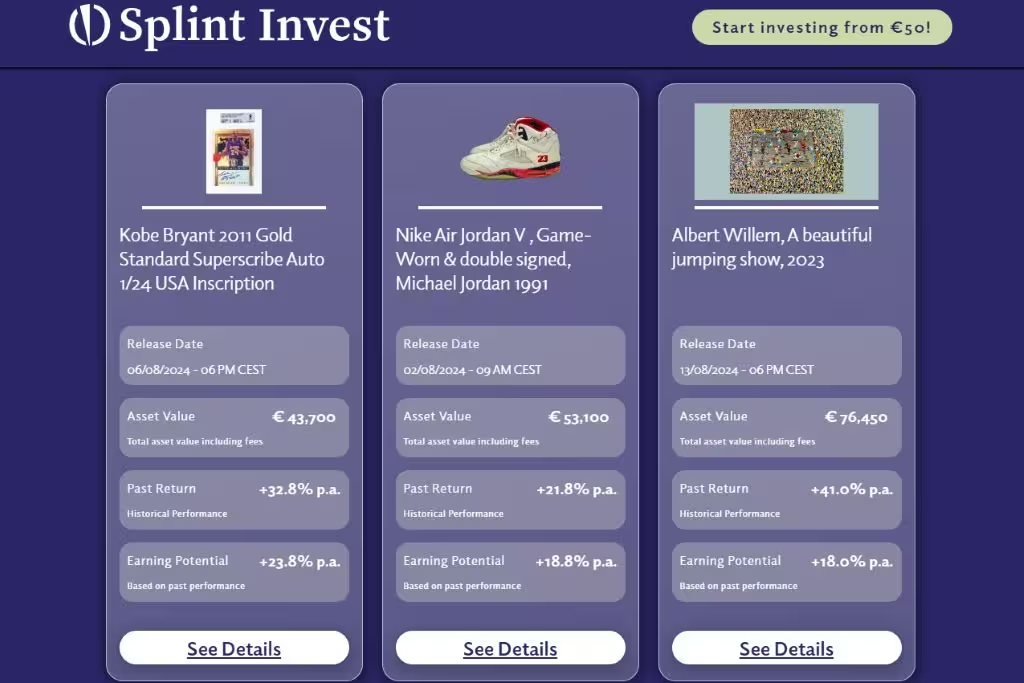
According to Splint Invest’s company-reported performance figures, the platform had released 678 assets with a combined volume of €40 million by November 1, 2025. It also reported 19,104 investing users.
Those figures indicate genuine activity. They do not prove that every investment has been profitable.
| Area | Assessment |
|---|---|
| Minimum investment | €50 |
| Asset selection | Broad |
| Platform fee | High at 4%–10% |
| Storage and insurance | Included initially but subject to adjustments |
| Investor ownership | Described as fractional co-ownership |
| Regulation | Swiss AML supervision through VQF affiliation |
| Liquidity | Limited and dependent on buyers or asset sales |
| Valuation | Frequently subjective |
| Geographic access | Switzerland, EU/EEA and UK residents |
| Best suited to | Long-term investors seeking small alternative-asset exposure |
Splint Invest is a legitimate and active platform. However, it should not be treated as a substitute for a diversified portfolio of conventional investments.
What Is Splint Invest?
Aurelio Perucca and Mario von Bergen founded Splint Invest in 2021.
The platform operates from Zug, Switzerland, through MARK Investment Holding AG. Its purpose is to divide expensive physical assets into smaller investment units.
Splint Invest sources assets through specialist partners. These partners may focus on areas such as art, whisky, watches or trading cards.
The company then reviews the asset, legal structure, valuation, storage and insurance arrangements. Approved opportunities appear inside the mobile app.
Investors buy fractions rather than taking physical possession.
Consequently, someone can gain exposure to a valuable painting or collectible car without purchasing, storing and insuring the entire asset.
That model resembles the wider structure explained in our guide to fractional ownership.
However, access represents only one side of the investment.
Splint Invest controls or coordinates several important parts of the process. These include sourcing, due diligence, valuation, storage, insurance, marketplace access and the eventual sale.
Investors must therefore assess the platform as carefully as the underlying asset.
How Does Splint Invest Work?
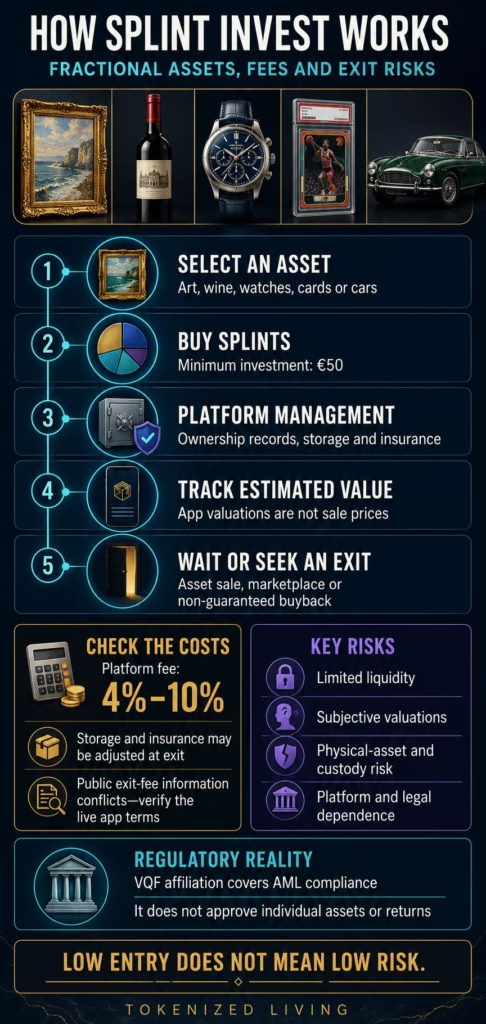
The process follows several broad stages.
1. Create an Account
Investors download the Splint Invest app and create an account.
The platform requires identity verification. Applicants may need to provide identification, contact details, tax information and evidence concerning the source of funds.
Access depends on the investor’s country.
The current Google Play listing states that Splint Invest is available to residents of Switzerland, the European Union, the European Economic Area and the United Kingdom.
People outside these regions should not assume they can participate.
2. Browse Available Assets
Verified users can examine available investments through the app.
Each opportunity may include:
- An asset description
- Photographs
- Valuation information
- Expected holding period
- Defensive, balanced and promising scenarios
- Storage details
- Insurance information
- The specialist connected with the asset
- Platform and asset-related costs
- Supporting documents
These details help investors conduct research. Nevertheless, platform projections remain estimates rather than guaranteed outcomes.
3. Purchase Splints
The official minimum-investment page states that users can begin with €50.
Funding options can include bank transfers and payment cards. Availability may vary by country and account.
A low minimum allows an investor to spread a modest amount across several assets. Yet diversification within one platform does not remove platform risk.
Buying ten Splints still leaves the investor dependent on Splint Invest’s systems, documentation and exit arrangements.
4. Store and Insure the Asset
Investors do not normally receive the physical item.
Instead, approved service providers store and insure it. The appropriate conditions differ between categories.
Wine requires controlled temperature and humidity. Art needs secure storage and condition monitoring. Cars may require maintenance, while watches and trading cards need specialist authentication and protection.
Splint Invest says it reviews the asset’s existence, authenticity, custody, insurance and valuation before release. Its asset-quality explanation describes a two-stage process covering both the specialist provider and the individual asset.
These checks reduce certain risks. They cannot eliminate fraud, damage, incorrect valuations or disputes.
5. Track the Estimated Value
Splint Invest displays portfolio values inside the app.
However, an app valuation is not the same as a completed sale.
Collectibles do not trade continuously on deep public markets. Their estimated values may depend on expert assessments, dealer prices, indices and comparable auction results.
As a result, the displayed figure could differ significantly from the amount eventually received.
6. Wait for an Exit or Seek an Early Sale
Splint Invest usually establishes an expected holding period before releasing an asset. Its exit-process explanation says the planned period is often around two years.
The actual timeframe can be shorter or considerably longer.
Investors may eventually receive proceeds through:
- A planned sale of the underlying asset
- An earlier offer accepted by Splint Invest
- A sale to another investor on the internal marketplace
- A discretionary platform buyback
None of these methods guarantees immediate liquidity.
What Can You Invest In?
Splint Invest covers a wider range of assets than the old version of this article suggested.
| Asset category | Potential attraction | Important risk |
|---|---|---|
| Art | Access to established or emerging artists | Subjective valuation and changing demand |
| Wine | Scarcity and ageing potential | Storage, provenance and market-cycle risk |
| Whisky | Exposure to bottles or casks | Authenticity, evaporation and uncertain demand |
| Watches | Established collector market | Fashion cycles, condition and authenticity |
| Trading cards | Strong demand for rare cultural assets | Highly speculative prices |
| Classic cars | Scarcity and collector appeal | Maintenance, storage and buyer concentration |
| Handbags | Demand for selected luxury models | Brand trends and physical-condition risk |
| Precious metals | Exposure to commodity value | Markups, storage costs and no income |
| Sneakers | Popular collectible market | Rapidly changing tastes and counterfeiting |
| Memorabilia | Rarity and emotional appeal | Difficult valuation and narrow buyer markets |
Different assets require different research.
A strong market for one artist does not improve the outlook for every painting. Rising whisky indices do not guarantee that a specific cask will sell profitably.
Likewise, a rare trading card can remain difficult to value when only a few comparable sales exist.
Readers interested in particular categories can also review our guides to art tokenization and tokenized wine and spirits.
What Does a Splint Represent?
Splint Invest currently describes a Splint as a digital certificate proving fractional co-ownership in a physical asset.
Therefore, investors are not simply buying loyalty points or making an unsecured prediction about an item’s price.
The company says investors retain their asset interests if MARK Investment Holding AG becomes insolvent. It also states that the underlying assets should remain outside the company’s liquidation estate.
According to Splint Invest’s legal-framework page, Xellenz Revisionen GmbH would represent co-owners during an insolvency process.
That structure sounds stronger than a simple contractual promise from an unconnected app.
However, investors still need to examine the agreement for each asset.
Important questions include:
- Who holds legal title?
- How is each co-owner recorded?
- Which document creates the ownership interest?
- Can an investor independently prove ownership?
- Which country’s law governs the agreement?
- Can Splint Invest replace a custodian?
- Who decides when to sell?
- Do co-owners have voting rights?
- What happens after an insurance dispute?
- How are legal and liquidation costs paid?
Marketing language cannot answer these questions. The contractual documents must do that work.
Does Splint Invest Really Use Tokenization?
This question does not have a completely clear public answer.
A 2023 Republic case study described Splint Invest’s ownership tokens as exportable. It suggested investors could choose between platform custody and external custody.
Current public materials use different language.
The present Google Play description calls a Splint a “digital certificate” of co-ownership. The retail experience centres on the mobile app and internal marketplace.
Public information does not clearly show that ordinary investors currently receive self-custodied blockchain tokens that they can transfer through an external wallet.
That does not make the ownership model invalid.
Fractional ownership can exist without a blockchain. The legal agreement matters more than the database used to record it.
Still, the distinction should be explicit.
A digital certificate held inside one company’s app is not automatically the same as an independently transferable blockchain asset.
Investors should ask:
- Which blockchain records the Splints?
- Can users view the tokens through a public explorer?
- Can Splints move to an external wallet?
- Does blockchain transfer legally transfer co-ownership?
- Can the company freeze or reverse a transfer?
- What happens if the app closes?
- Does the internal register override the blockchain record?
Unless Splint Invest provides current answers, the platform is better understood as a fractional alternative-asset app with digital ownership records—not a permissionless token marketplace.
How Is Splint Invest Regulated?
Splint Invest says MARK Investment Holding AG is affiliated with VQF.
VQF is a Swiss self-regulatory organisation supervised by the Swiss Financial Market Supervisory Authority, commonly known as FINMA.
This arrangement covers anti-money-laundering obligations. It requires processes such as customer identification, transaction monitoring and sanctions checks.
However, readers must not exaggerate what that status means.
VQF affiliation does not represent FINMA approval of:
- Individual artworks
- Collectible valuations
- Projected returns
- Exit scenarios
- Storage providers
- Marketplace prices
- Every investor agreement
Splint Invest also says it operates under the Swiss Fintech Sandbox regime. According to the company, this allows it to hold customer funds up to an aggregate limit of CHF1 million.
A sandbox arrangement is not the same as a full banking licence or a government guarantee.
Registration and supervision can improve accountability. They cannot prevent an asset from losing value.
Splint Invest Fees
Fees are one of the platform’s biggest weaknesses.
The Splint Invest fee page currently lists an initial platform fee ranging from 4% to 10% of the investment amount.
That is substantial.
For example:
| Investment amount | 4% platform fee | 10% platform fee |
|---|---|---|
| €50 | €2 | €5 |
| €250 | €10 | €25 |
| €500 | €20 | €50 |
| €1,000 | €40 | €100 |
The underlying asset must rise enough to recover that initial cost before the investor achieves a genuine profit.
A small €50 minimum does not make the percentage fee small.
Platform Fee
Splint Invest says the 4%–10% fee covers services such as:
- Asset sourcing
- Verification
- Platform maintenance
- Operational administration
- Investment analysis
- Customer support
The exact percentage can vary between assets. Investors need to inspect the final purchase screen rather than assuming every opportunity carries the lowest rate.
Storage and Insurance Costs
Physical assets require professional storage and insurance.
Splint Invest says these costs are included in the initial investment amount. Nevertheless, they remain variable.
If the actual costs fall, the company says it may refund the difference at exit. Higher expenses can lead to an additional deduction.
Consequently, the initial amount does not always represent the final cost.
Exit and Marketplace Fees
Splint Invest’s public fee information is inconsistent.
The main FAQ currently states:
- No fee when Splint Invest sells the underlying asset
- A 0% seller fee on marketplace transactions
However, the Google Play listing states:
- A 2% fee when an asset is sold
- A 2% fee for sellers using the secondary marketplace
The company’s legal-framework page also refers to a 2% exit fee that would compensate Xellenz after a platform insolvency.
These statements cannot all describe the same permanent fee structure.
A temporary promotion or recent pricing change could explain the difference. Yet Splint Invest should update every public channel so investors receive one clear answer.
Until then, users should take screenshots of the live fee disclosure before purchasing.
Can Splint Invest Produce Strong Returns?
Yes, individual assets can generate attractive returns.
The company reported more than 21 completed sales during 2025. According to its figures, those exits produced an average net return of approximately 24% over an average holding period of around 16 months.
Several reported examples included:
- Art exits averaging a 20.4% net return
- Sports trading cards returning around 21%
- Precious metals returning around 21%
- A painting producing a reported 25.9%
- A platinum bar selling for more than a 20% gain
These results are encouraging. However, they require context.
The figures come from Splint Invest. They cover completed exits rather than every live, delayed or unsuccessful investment.
An average of successful sales can look considerably better than the performance of the complete portfolio.
Investors should request:
- The number of profitable exits
- The number of loss-making exits
- Assets still held beyond their original timeframe
- Returns after every fee and cost
- Median rather than average returns
- Performance by investment year
- Unrealised gains and losses
- Marketplace selling discounts
- The percentage of Splints that find buyers
Without those figures, the reported 24% average should not be treated as a platform-wide expected return.
Past performance also provides no guarantee concerning future sales.
How Does Splint Invest Value Its Assets?
Splint Invest uses different valuation methods for different categories.
Its valuation guide names sources including:
- Liv-ex for wine
- Rare Whisky 101 and Whisky Hunter
- Chrono24 and WatchCharts
- Artsy and Artprice
- Sotheby’s and Christie’s
- Goldin for memorabilia and cards
- eBay and specialist trading-card databases
- Classic-car sales databases
- Luxury resale marketplaces
Using external sales information improves the process. Even so, many valuations remain estimates.
One painting may differ greatly from another work by the same artist. A watch’s papers, condition and service history can change its value.
Auction prices also create complications.
Buyer premiums, seller fees, taxes and transport costs can produce a large difference between the headline auction price and the investor’s net proceeds.
Splint Invest distinguishes between market value and liquidation value. The latter may be considerably lower when an asset must sell quickly.
Therefore, investors should not treat the app’s displayed portfolio value as cash they can withdraw.
Can You Sell Splints Easily?
Not necessarily.
Splint Invest offers weekly trading opportunities through its internal marketplace. Investors can list eligible Splints for other users to purchase.
That feature can improve transferability.
It does not create guaranteed liquidity.
A marketplace needs buyers. Those buyers must want the same asset at an acceptable price.
If demand disappears, an investor may need to:
- Reduce the asking price
- Wait for another trading period
- Hold until the underlying asset is sold
- Request a discretionary buyback
- Accept a loss
Splint Invest acknowledges that alternative assets are illiquid and long term. It also warns that a marketplace sale may include a liquidity discount.
The platform’s buyback option is not guaranteed. Fees can depend on the asset, holding period and amount being sold.
Therefore, users should invest only money they can leave untouched.
What Happens When Splint Invest Sells an Asset?
Splint Invest establishes a proposed exit period for each opportunity.
Before that period, the company may accept an unusually attractive offer. During the planned window, it actively seeks buyers.
If no suitable offer appears, the holding period can continue.
Splint Invest may eventually consider a lower defensive price. That approach could help complete the exit, but it may also create a loss.
After a successful sale, the company deducts applicable fees and outstanding expenses. Investors then receive their proportional share of the net proceeds.
The timing depends on the buyer, payment process and transfer requirements.
A two-year plan should never be interpreted as a guaranteed two-year maturity.
Splint Invest App and User Experience
Splint Invest operates primarily through its mobile app.
The Google Play listing showed:
- More than 50,000 downloads
- A rating of approximately 4.3 out of five
- Roughly 500 user reviews
- An update dated August 27, 2026
Positive comments often concern the asset selection and accessible minimum.
However, recent critical reviews have raised concerns about:
- Difficulty selling Splints
- Negative performance on particular holdings
- Restricted selling windows
- Login or account-access problems
- Long holding periods
Individual reviews do not prove that every user will encounter the same issues. They still reveal why liquidity and support deserve attention.
The old article cited a 4.9 rating without providing adequate context. That promotional figure should not be retained.
How Secure Is Splint Invest?
Security has several separate layers.
Account and Data Security
Splint Invest says it encrypts data transmitted between the app and its servers.
Investors should still use:
- A unique password
- Multi-factor authentication when available
- A secure email account
- Updated mobile software
- Care around payment and recovery links
Physical Asset Security
The company says specialist custodians store the physical assets. Insurance may cover defined events such as damage or theft.
Investors should check:
- The custodian’s name and location
- Insurance limits
- Policy exclusions
- Climate-control arrangements
- Inspection frequency
- Transport coverage
- Who receives an insurance payout
- Whether the asset remains insured during a sale
An insurance policy does not guarantee that every loss will receive full compensation.
Ownership-Record Security
Splint Invest says it transmits co-owner records to Xellenz monthly. The parties also conduct periodic insolvency-preparation exercises.
These procedures could support continuity after a company failure.
Nevertheless, investors should retain copies of every purchase agreement, payment record and ownership certificate.
Never rely entirely on a mobile dashboard as evidence of ownership.
Splint Invest and Elephantsclub
Splint Invest acquired Elephantsclub in May 2024.
Elephantsclub previously concentrated on fractional luxury-watch investments. Several of its assets later appeared within the Splint Invest ecosystem.
These included valuable watches from Rolex and Patek Philippe.
Our updated Elephantsclub review explains the acquisition and what happened to the original platform.
The deal expanded Splint Invest’s watch expertise. It also demonstrates why platform continuity matters.
An investment app can merge, close or change direction before the underlying assets reach their planned exit dates.
Splint Invest Advantages
- Minimum investment of €50
- Broad range of physical alternative assets
- Fractional co-ownership model
- Professional storage and insurance arrangements
- Asset-specific documentation
- Established mobile application
- Internal secondary marketplace
- Reported record of completed exits
- Asset-existence and custody audits
- Bankruptcy-continuity arrangements
- Access to assets that would otherwise be unaffordable
- No need for investors to store physical collectibles
Splint Invest Disadvantages
- Initial platform fee of 4%–10%
- Conflicting public information about exit and trading fees
- Limited secondary-market liquidity
- Buybacks are not guaranteed
- Valuations can be subjective
- Most assets produce no regular income
- Investors depend heavily on the platform
- Geographic availability is restricted
- Holding periods can exceed projections
- Marketplace buyers may demand a discount
- Company-reported returns lack complete portfolio context
- Blockchain functionality is unclear in current public materials
- Currency conversion can affect returns
- Collectible markets can be driven by short-lived trends
What Are the Main Risks?
Underlying Asset Risk
A collectible can lose value.
Changes in taste, oversupply, economic weakness or reputational damage can reduce demand.
Valuation Risk
An expert estimate does not guarantee a sale price.
Sparse market data makes some assets especially difficult to value.
Liquidity Risk
Investors may be unable to sell when they want.
The internal marketplace does not guarantee a buyer.
Fee Risk
A 4%–10% initial platform charge creates a meaningful hurdle before the investment becomes profitable.
Additional storage, insurance, payment or currency costs may further reduce returns.
Authenticity and Provenance Risk
A verification process can fail.
Forgery, incomplete ownership history or disputed authenticity could damage an asset’s value.
Storage and Insurance Risk
Fire, theft, moisture, poor handling or transport damage can affect physical assets.
Insurance policies may contain exclusions or valuation limits.
Platform Risk
Splint Invest coordinates ownership records, storage, valuations and exits.
A technical, legal or financial failure could create delays even if the underlying asset remains protected.
Legal Risk
The enforceability of co-ownership rights can depend on contractual wording and jurisdiction.
Cross-border investors may face additional complications.
Currency Risk
Investments are generally priced in euros.
Someone whose income or home currency differs from the euro can gain or lose through exchange-rate movements.
Concentration Risk
Buying several assets through one application creates asset diversification but not platform diversification.
No-Income Risk
Most collectibles do not pay interest, rent or dividends.
The entire return may depend on selling the asset for more than its total purchase and holding costs.
Who Should Consider Splint Invest?
Splint Invest may suit:
- Eligible European investors
- People interested in alternative assets
- Investors comfortable with long holding periods
- Users who can accept limited liquidity
- Collectors seeking small fractional exposure
- Investors who understand appraisal-based valuations
- People using alternative assets as a small portfolio allocation
- Users willing to examine every asset separately
It may not suit:
- Investors outside supported countries
- Anyone needing dependable liquidity
- People seeking regular passive income
- Beginners attracted only by projected returns
- Investors unwilling to pay high initial fees
- Anyone who may need the money within two years
- Users expecting stock-market-style pricing
- People seeking government-protected deposits
- Investors who want fully permissionless blockchain assets
- Anyone treating collectibles as a retirement portfolio foundation
Splint Invest Due-Diligence Checklist
Before purchasing a Splint, check:
- What exactly do I legally own?
- Which document records that ownership?
- Who owns and stores the physical asset?
- Has an independent specialist verified authenticity?
- What is the current market value?
- How was that value calculated?
- What is the liquidation value?
- How much am I paying above the asset’s estimated value?
- What is the complete initial fee?
- Which storage and insurance costs could change?
- What is the planned holding period?
- Who controls the sale?
- Can I vote against an unfavourable offer?
- How active is the marketplace for this asset?
- Which fee applies if I sell early?
- What happens if no buyer appears?
- How would an insolvency affect the asset?
- Which taxes apply in my country?
- Does currency conversion create additional risk?
- Can I afford to lose the complete investment?
If the answers remain unclear, do not invest.
Final Verdict: Is Splint Invest Worth Considering?
Splint Invest has built a credible and unusual alternative-investment platform.
Its €50 minimum opens access to assets that most people could never purchase independently. The app also handles sourcing, storage, insurance and eventual sales.
Furthermore, the company reports meaningful activity, including hundreds of released assets and more than 21 completed exits during 2025.
However, the weaknesses are serious.
A 4%–10% initial fee is expensive. Public fee information remains inconsistent, while valuations and reported returns rely heavily on company-selected data.
Liquidity also remains limited.
Weekly trading opportunities improve transferability, but they do not guarantee buyers. Planned two-year exits can take longer, and platform buybacks remain discretionary.
The tokenization claim deserves similar caution. Current materials emphasise digital certificates and an internal marketplace rather than investor-controlled blockchain tokens.
Therefore, Splint Invest should be judged as a managed fractional-collectibles platform.
For eligible investors seeking a small, speculative alternative allocation, it may be worth investigating. The minimum investment makes cautious experimentation possible.
Nevertheless, Splint Invest is not an alternative to a diversified core portfolio. Nor is it a reliable source of liquidity, passive income or guaranteed returns.
The assets may be fascinating.
That does not automatically make them good investments.
Frequently Asked Questions
Is Splint Invest legitimate?
Splint Invest is an active Swiss platform operated by MARK Investment Holding AG. It reports more than 19,000 investing users and €40 million in released asset volume. However, legitimacy does not guarantee that every investment will produce a profit.
What is the minimum Splint Invest investment?
Splint Invest states that users can begin with €50. Platform, storage and insurance costs can increase the total economic cost.
What does a Splint represent?
The company describes a Splint as a digital certificate representing fractional co-ownership in a physical asset.
Is Splint Invest regulated by FINMA?
Splint Invest says it is affiliated with VQF, a FINMA-supervised self-regulatory organisation. That arrangement concerns anti-money-laundering compliance. It does not mean FINMA approves each asset or return projection.
How much does Splint Invest charge?
The official FAQ lists an initial platform fee between 4% and 10%. Storage and insurance costs are included initially but can receive adjustments. Public pages currently provide conflicting information about exit and marketplace fees.
Can I sell Splints whenever I want?
No. Eligible Splints can be offered through the internal marketplace, but a willing buyer must exist. Trading windows and platform rules also apply.
Does Splint Invest guarantee buybacks?
No. Splint Invest describes buybacks as a worst-case option, but it states that they are not guaranteed.
How long do Splint Invest investments last?
The platform often targets a period of around two years. Actual exits can occur earlier or later depending on buyer demand and market conditions.
Does Splint Invest pay passive income?
Most physical collectibles do not produce regular income. Returns normally depend on selling the asset or Splint at a higher price.
Are Splint Invest returns guaranteed?
No. Assets can lose value, remain unsold or generate lower proceeds than the displayed valuation.
Does Splint Invest use blockchain?
Older material described exportable ownership tokens. Current public information focuses on digital co-ownership certificates and an internal marketplace. Investors should request confirmation of the current blockchain and external-wallet functionality.
Is Splint Invest available in the United States?
The current app listing names Switzerland, the EU/EEA and the UK. US residents should not assume they are eligible.
What happens if Splint Invest goes bankrupt?
Splint Invest says the physical assets remain outside its liquidation estate and investors retain co-ownership. It names Xellenz Revisionen GmbH as the representative for co-owners. Investors should still examine the governing agreements.
Is Splint Invest suitable for beginners?
The app is accessible, but the investments are not simple. Beginners must understand fees, valuations, ownership rights, liquidity and collectible-market risk before participating.
Alternative investments are speculative and may result in the loss of some or all invested capital.