

Fractional ownership and timeshares both let several people access the same property.
That similarity creates confusion.
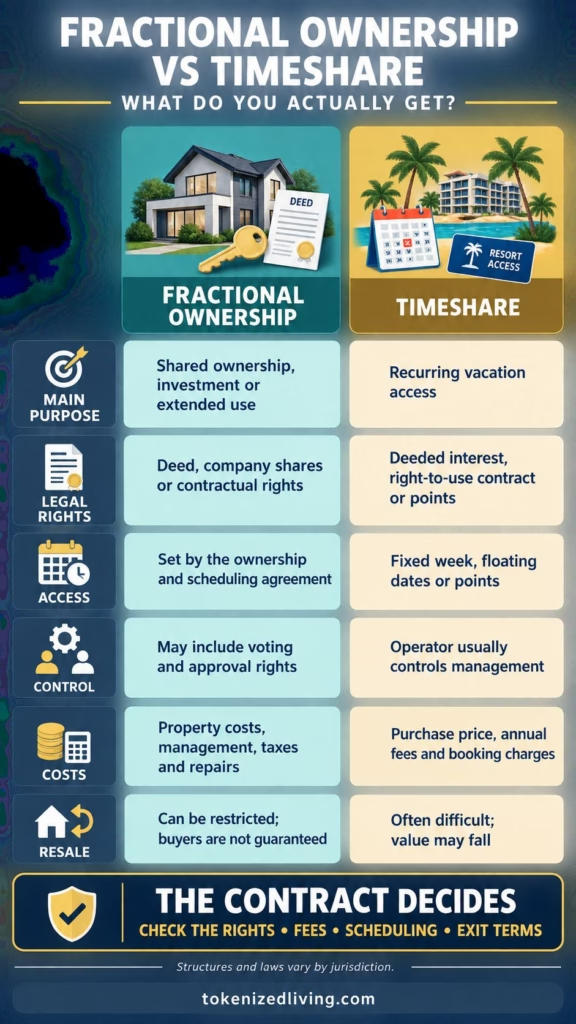
The crucial difference is not simply that fractional owners receive deeds while timeshare buyers do not. Some timeshares are deeded real estate interests. Meanwhile, some fractional products use companies, trusts or contracts instead of placing every investor directly on the property title.
The real distinction lies in the complete structure.
You need to examine what you legally own, how you can use the property, who controls it and whether you can exit.
In general, fractional ownership focuses more heavily on shared ownership or economic rights. Timeshares primarily sell recurring vacation use.
However, neither label tells you everything.
The contract does.
TL;DR
- Fractional ownership gives several people ownership or financial rights connected to one asset.
- A fractional buyer may hold a deed, company shares, membership interests or contractual rights.
- Timeshares primarily provide recurring access to vacation accommodation.
- Timeshares may use fixed weeks, floating periods, points or deeded interests.
- A deeded timeshare is still a timeshare.
- Fractional property can rise or fall in value, but appreciation is never guaranteed.
- Neither structure guarantees an active resale market.
- Both can charge annual fees and special assessments.
- Tokenized fractional ownership adds a digital token but does not automatically provide direct property ownership.
- Buyers must inspect the legal documents rather than trusting the product name.
Fractional ownership describes shared rights. A timeshare describes recurring use. The paperwork determines where those rights overlap.
Fractional Ownership vs Timeshare at a Glance
| Feature | Fractional ownership | Timeshare |
|---|---|---|
| Primary purpose | Shared ownership, investment exposure or extended personal use | Recurring vacation accommodation |
| Legal structure | Deed, company shares, trust interest, membership interest or contract | Deeded interest, right-to-use agreement, membership or points |
| Property rights | May provide direct or indirect ownership | May provide ownership or only usage rights |
| Usage | Determined by ownership agreement and scheduling rules | Fixed week, floating period, rotating schedule or points |
| Number of participants | Often fewer, but no universal limit applies | Often more participants, although structures vary |
| Management control | Owners may receive voting or approval rights | Resort or program operator usually controls most decisions |
| Costs | Purchase price, management, repairs, insurance, taxes and reserves | Purchase price, annual maintenance, exchange, booking and assessment charges |
| Resale | May be restricted and may lack buyers | Frequently difficult and sometimes heavily discounted |
| Appreciation | Possible, but never guaranteed | Usually purchased for vacation use rather than investment returns |
| Inheritance | Depends on the deed, entity and agreement | Deeded interests may pass to heirs; contractual rights depend on their terms |
| Exit | Sale, buyout, redemption or transfer may be available | Exit depends on the contract, operator and resale market |
This table describes common patterns. It does not replace the agreement for a particular property.
What Is Fractional Ownership?
Fractional ownership means several people share ownership or financial rights connected to one asset.
Instead of one buyer purchasing the entire property, each participant acquires a smaller interest.
That interest can take several forms.
Direct property ownership
Several buyers may appear on the property title.
For example, four people could acquire a vacation home as co-owners. Their agreement would then explain usage, expenses, voting and resale.
Each owner holds a legal interest in the property. However, ownership does not guarantee complete freedom.
The agreement may restrict rentals, transfers, renovations and sale decisions.
Ownership through a company
A company or special-purpose entity may hold the property deed.
Buyers then purchase shares or membership interests in that entity.
In this structure, the investor owns part of the company rather than appearing directly on the property title.
Those shares may still provide economic exposure to the property. Nevertheless, the company documents determine the investor’s rights.
Contractual fractional rights
Some products provide income, access or usage rights without transferring property ownership.
Marketing may still describe the arrangement as fractional ownership.
Therefore, buyers should ask whether they receive equity, debt, membership rights, occupancy rights or only a contractual benefit.
Our main guide explains what fractional ownership means across property and other asset classes.
What Is a Timeshare?
A timeshare gives a buyer recurring access to vacation accommodation.
The arrangement may involve one resort, several properties or a points-based network.
According to the Federal Trade Commission’s timeshare guidance, these products do not all work in the same way.
Common structures include:
Fixed-week timeshares
The buyer receives the right to use a property during the same period each year.
For example, the contract might provide access during the second week of August.
This model offers predictability. Yet it provides little flexibility when the owner cannot travel during that period.
Floating timeshares
The buyer chooses from an available range of dates.
Reservations remain subject to the program’s booking rules and availability.
A floating arrangement may sound flexible. However, popular dates can still be difficult to secure.
Points-based timeshares
Buyers receive points that they can use within a resort or vacation network.
The required number may vary by property, location, season and length of stay.
Some programs allow points to roll over. Others make unused allocations expire.
Additional booking or exchange charges may also apply.
Deeded timeshares
A deeded timeshare includes a real property interest.
For example, the 2026 Florida Statutes recognize both timeshare estates and timeshare licences. A timeshare estate can qualify as real property under Florida law.
Therefore, saying that timeshare buyers never own real estate is wrong.
The more accurate point is that a deeded timeshare usually provides a narrowly defined property interest tied to recurring occupancy. It does not provide the same control as owning an entire home.
The Most Important Difference: Purpose
Fractional property and timeshares are normally designed around different goals.
A timeshare primarily sells future vacation use.
Its value comes from staying at the resort or using the program successfully. The FTC warns consumers against treating timeshares as financial investments.
Fractional ownership may combine personal use with broader property rights.
Depending on the structure, participants could receive:
- rights connected to property appreciation
- proceeds from a future sale
- rental income
- voting rights
- longer periods of personal use
- the ability to transfer or inherit an interest
None of these rights should be assumed.
A fractional product designed mainly for holidays may still behave much like a timeshare. Conversely, a deeded timeshare may provide genuine real property ownership while remaining primarily a vacation product.
Does Fractional Ownership Always Include a Deed?
No.
This is one of the biggest weaknesses in the old version of this article.
A fractional buyer might appear on the deed. Alternatively, a company, trust or other entity may hold the title.
The buyer could then own an interest in that entity.
Other arrangements provide only contractual or financial rights.
Before buying, ask:
- Who appears on the property deed?
- What legal interest will I receive?
- Which document creates that interest?
- Do I own property, company shares or usage rights?
- Can the manager change those rights?
- What happens if the operator fails?
- Can creditors make claims against the property or entity?
If the seller cannot answer these questions clearly, stop.
Can a Timeshare Include Property Ownership?
Yes.
Some timeshares are deeded.
However, the deed does not automatically make the product a good investment.
The interest may apply only to a particular unit and recurring occupancy period. Owners must also follow the timeshare declaration, resort rules and management structure.
Resale demand can remain weak even when the buyer holds real property.
Other timeshares provide only a licence, membership or contractual right to use accommodation.
The word “timeshare” describes a broad category. It does not identify one universal legal structure.
Usage and Scheduling
The old article suggested that owning one-quarter of a property automatically provides approximately 13 weeks of annual use.
That calculation looks logical. Unfortunately, real agreements rarely work so neatly.
A quarter interest represents 25% of the ownership structure. It does not automatically guarantee 25% of all calendar days.
The agreement may reserve time for maintenance, cleaning or rental activity. Owners could also receive rotating access to peak periods rather than equal consecutive weeks.
Important scheduling questions include:
- How many nights can each participant book?
- Who receives peak-season access?
- Does the schedule rotate annually?
- How far ahead can owners reserve?
- What happens when two owners want the same dates?
- Can unused time carry forward?
- May owners rent unused periods?
- Are guests allowed?
- Does the manager reserve dates for maintenance?
Timeshare users need similar answers.
Points and floating weeks provide flexibility only when suitable accommodation remains available.
Control and Decision-Making
Fractional owners may have more influence over the asset than timeshare participants.
Still, that control is not guaranteed.
A fractional agreement should explain voting rights and decision thresholds.
Routine matters may require a simple majority. Major decisions could require a larger vote.
These decisions might cover:
- renovations
- annual budgets
- management appointments
- rental policies
- insurance
- borrowing
- accepting new owners
- selling the property
Timeshare participants usually have less direct control.
A resort operator, management company or owners’ association often handles scheduling, maintenance and program rules.
That may suit buyers who want a managed holiday product. It can become frustrating when fees increase or service quality falls.
Costs and Ongoing Fees
Both structures can cost far more than the initial purchase price.
Fractional ownership expenses may include:
- property taxes
- insurance
- repairs
- utilities
- cleaning
- management
- furnishings
- legal and accounting work
- reserve contributions
- unexpected assessments
Participants should know how the manager prepares budgets and divides expenses.
Timeshare buyers may face:
- purchase financing
- annual maintenance fees
- booking charges
- exchange-program fees
- club membership costs
- taxes
- special assessments
- charges for transferring or exiting the interest
The FTC warns that annual timeshare fees can increase and may remain payable even when the owner does not use the accommodation.
Do not compare the products using their purchase prices alone.
Calculate the total expected cost over several years. Then compare that figure with the realistic number of nights you expect to use.
Resale and Liquidity
Neither fractional property nor a timeshare should be treated as liquid.
A fractional owner still needs a permitted buyer. The agreement may also include approval requirements or rights of first refusal.
Some arrangements prevent sales during an initial holding period. Others allow the manager to control the process.
Timeshare resale can be particularly difficult.
Consumer agencies regularly warn about companies that promise quick exits or guaranteed buyers. In April 2026, the FTC announced a $14 million judgment against a timeshare exit scheme accused of using deceptive claims.
Treat any upfront resale or exit charge cautiously.
Before purchasing either product, ask:
- Can I sell without the manager’s permission?
- Does another owner receive first refusal?
- Is there a genuine resale market?
- What recent sales have occurred?
- Who sets the resale price?
- Can the manager charge a transfer fee?
- Is a buyback program legally guaranteed?
- What happens if no buyer appears?
A resale page is not proof of liquidity.

Can Fractional Property Appreciate?
It can, but appreciation is not automatic.
Property values can rise or fall. Maintenance, financing, taxes and selling expenses also reduce returns.
The fractional structure can introduce an additional discount.
A buyer might pay less for the whole property than the combined asking prices of every individual share. Resale buyers may also demand a discount because of transfer restrictions and shared control.
Entity-based ownership adds another layer.
The value of company shares depends on the property, liabilities, governance rules and rights attached to those shares.
Fractional ownership should never be promoted as guaranteed property appreciation.
Timeshares are normally better judged as vacation purchases. Their economic value depends mainly on whether the buyer uses the accommodation enough to justify the total cost.
Inheritance and Long-Term Obligations
A deeded fractional interest may pass to heirs.
Company shares can also form part of an estate.
However, heirs may inherit expenses, restrictions and management obligations alongside the asset.
Deeded timeshare interests may also be inheritable. Contractual products depend on the agreement and applicable law.
Buyers should investigate:
- whether the interest is perpetual or time-limited
- what happens after the owner dies
- whether heirs can refuse the interest
- whether annual fees continue
- how the interest gets valued for estate purposes
- whether transfers require approval
- which jurisdiction controls succession
“Pass it to your family” is not automatically a benefit.
An unwanted asset with permanent fees can become a burden.
Cancellation and Cooling-Off Rights
Timeshare laws often provide specific disclosure and cancellation protections.
However, the rules vary by location.
The FTC advises buyers to check the applicable rescission or cooling-off period before signing. Meanwhile, UK rules generally provide a 14-day withdrawal period for qualifying timeshare contracts, as explained in the government’s timeshare consumer-protection guidance.
Fractional property agreements may fall under different real estate, company, securities or consumer laws.
Do not assume that the same cancellation rights apply.
Obtain every promise in writing. Then have an independent lawyer review the documents before the deadline expires.
A Simple Comparison Example
Imagine an $800,000 beach property held by a limited company.
Eight buyers each acquire a 12.5% membership interest.
The agreement provides each member with several scheduled weeks of use. It also gives them voting rights and a share of net sale proceeds.
Transfers require approval from the other owners. Annual expenses get divided according to the ownership percentages.
That is an example of fractional ownership through a company.
Now imagine a resort points program.
A customer purchases annual points that can be used across several properties. Reservations depend on season, availability and the number of points required.
The customer pays yearly maintenance charges but has no claim on the sale proceeds from any specific resort unit.
That is a timeshare-style usage product.
A deeded timeshare would sit somewhere between those examples. The buyer could own a real property interest while still receiving limited recurring occupancy.
Tokenized Fractional Ownership Is Different Again
Tokenized fractional ownership uses blockchain-based tokens to represent rights connected to a property or legal entity.
The token may represent:
- company shares
- membership interests
- debt
- income rights
- fund units
- contractual claims
- direct ownership records in jurisdictions that permit them
A token does not automatically place the holder on a property deed.
Likewise, blockchain technology does not guarantee liquidity, legal ownership or access to the property.
Our guide to what tokenization means explains why the legal structure behind a token matters more than its digital format.
Some tokenized property products focus entirely on investment returns. Others may combine investment rights with accommodation or membership benefits.
Depending on their design, securities, property, consumer or timeshare rules could apply.
For a broader explanation, read our complete guide to tokenized real estate.
Which Option Is Better?
Neither model is automatically better.
The correct choice depends on what the buyer wants.
Fractional ownership may suit someone who:
- wants a substantial interest in one property
- expects longer or more frequent use
- accepts responsibility for property expenses
- understands shared decision-making
- can tolerate an uncertain resale period
- has reviewed the ownership structure independently
A timeshare may suit someone who:
- values repeated holidays more than investment returns
- intends to use the program consistently
- understands the points or booking system
- accepts recurring maintenance charges
- does not expect easy resale or appreciation
- prefers resort management over property control
Buying neither may be the best decision when the documents, fees or exit terms remain unclear.
Renting accommodation can offer greater flexibility without creating long-term obligations.
Buyer Due-Diligence Checklist
Before purchasing either product, answer these questions:
- What exactly am I buying?
- Who owns the underlying property?
- Will my name appear on the deed?
- If an entity owns the property, what rights do my shares provide?
- How many nights can I realistically use?
- How are peak dates allocated?
- What annual fees apply?
- Can the manager impose special assessments?
- What voting rights do I receive?
- Can I rent my unused time?
- Can I sell without permission?
- What recent resale evidence exists?
- Is any buyback promise legally binding?
- What happens if the operator fails?
- Can heirs refuse the interest?
- Which cancellation rights apply?
- Which country or state governs the agreement?
- Has an independent lawyer reviewed the documents?
Do not rely on a salesperson to interpret the contract they want you to sign.
Warning Signs
Walk away or seek independent advice when you encounter:
- same-day pressure to sign
- guaranteed appreciation
- guaranteed rental income
- claims of instant resale
- verbal promises missing from the contract
- unclear ownership documents
- no explanation of annual fee increases
- vague peak-season booking rules
- an unproven buyback program
- upfront fees for timeshare resale or exit
- tokenized ownership claims without a legal structure
- refusal to provide documents before payment
A beautiful property cannot repair an ugly contract.
Final Thoughts
The difference between fractional ownership and timeshares is more complicated than “ownership versus no ownership.”
Some fractional buyers hold direct property interests. Others own shares in a company or receive contractual rights.
Timeshares can also be deeded, contractual or points-based.
The most useful distinction concerns purpose.
Fractional ownership often provides broader ownership or economic rights. Timeshares usually focus on recurring vacation use.
However, the label on the sales brochure does not protect the buyer.
Review the deed, company documents, usage rules, fees, management powers and exit terms.
If those documents do not clearly explain what you own and how you can leave, do not buy.
FAQs
Is fractional ownership the same as a timeshare?
No. Fractional ownership generally provides shared ownership or financial rights connected to an asset. A timeshare primarily provides recurring access to vacation accommodation. However, the structures can overlap.
Do timeshare buyers own property?
Some do. Deeded timeshares can qualify as real property. Other timeshares provide contractual usage rights, memberships or points instead.
Does fractional ownership always provide a deed?
No. A company, trust or special-purpose entity may hold the property. Investors could own shares or membership interests rather than appearing directly on the deed.
Is fractional ownership a better investment than a timeshare?
Not automatically. Fractional property may provide exposure to appreciation or sale proceeds, but values can fall and resale may be difficult. Timeshares should generally be evaluated as vacation-use products rather than financial investments.
How many weeks can a fractional owner use the property?
The ownership agreement determines usage. A 25% financial interest does not automatically guarantee exactly 13 weeks of access.
Can I rent my unused time?
Only when the agreement permits it. Local short-term rental rules, management policies and owner approval requirements may also apply.
Are timeshare maintenance fees optional if I do not visit?
Usually not. Owners may remain responsible for annual charges even when they do not use the accommodation.
Can fractional property be tokenized?
Yes. Tokens can represent shares, membership interests or other rights connected to a property structure. The token does not automatically provide direct deed ownership.
Can I sell a fractional share easily?
Not necessarily. Transfer restrictions, approval requirements and weak buyer demand can make selling difficult.
Can I cancel after signing?
Possibly. Timeshare cooling-off periods vary by jurisdiction and contract. Fractional ownership products may follow different rules. Check the deadline immediately and obtain legal advice.
Which option is best for vacation use?
A timeshare may suit predictable repeat holidays. Fractional ownership may provide longer use and broader rights. Renting may remain more flexible than either long-term commitment.
This article provides general educational information. It does not provide financial, investment, legal or tax advice.