

Updated: 3 September 2026.
A fractional ownership agreement decides what an investor owns, controls, pays, receives, and can sell. In practice, those details matter more than the platform’s marketing language.
For example, some arrangements give investors direct property rights. By contrast, others provide company shares, fund units, debt claims, or contractual income rights.
Moreover, tokenization adds another possibility. However, a digital token does not automatically provide direct ownership of the underlying asset.
Therefore, investors must inspect the complete legal structure before paying. In other words, a polished dashboard cannot repair a weak agreement.
Important: This article provides general education, not legal, tax, financial, or investment advice. However, fractional ownership laws vary by asset and jurisdiction. Always obtain qualified advice for your circumstances.
TL;DR
- Fractional ownership is generally legal when the structure follows the relevant property, company, securities, tax, and consumer laws.
- The agreement should identify both the asset’s legal owner and the investor’s exact rights.
- Direct title, company shares, fund units, debt claims, and tokens are not interchangeable.
- A contract must explain voting, income, fees, reserves, insurance, transfers, defaults, valuation, and exit procedures.
- Tokenization does not remove traditional legal requirements or guarantee enforceable ownership.
- Tokenized securities remain securities, while other token arrangements require a facts-and-circumstances analysis.
- Private fractional interests may carry serious resale restrictions, even when a platform offers a marketplace.
- Regulation and a signed contract do not guarantee asset quality, liquidity, returns, or recovery after failure.
Is fractional ownership legal?
Yes, fractional ownership can be legal. Nevertheless, there is no single worldwide fractional ownership law or standard contract.
The applicable rules depend on the asset and legal structure. Moreover, the investor’s location and the offering’s target market also matter.
For example, friends may hold a vacation home as direct co-owners. By contrast, passive investors may buy shares in a property-owning company.
Those arrangements can involve different laws. Depending on the structure, property, company, securities, consumer, tax, inheritance, and insolvency rules may apply.
Moreover, legality does not equal investment quality. A lawful agreement can still impose high fees, weak voting rights, and a poor exit process.
If you need the basic concepts first, read our guide to what fractional ownership means. Instead, this article concentrates on the legal documents behind the investment.
What do fractional investors actually own?
In practice, the word “ownership” can conceal several different legal arrangements. Therefore, never rely on that word without identifying the underlying structure.
| Structure | What the investor may hold | Main legal document | Key limitation |
|---|---|---|---|
| Direct co-ownership | A registered percentage of the asset | Deed, title record, or co-ownership agreement | Local property and partition rules may apply |
| Company or LLC structure | Shares or membership interests | Operating agreement, shareholder agreement, and subscription agreement | The entity usually owns the asset |
| Partnership | Partnership interest | Partnership agreement | Partners may face specific duties and liabilities |
| Trust or fund | Units or beneficial interests | Trust deed, fund documents, and subscription terms | A trustee or fund vehicle controls the asset |
| Debt structure | A loan, note, or repayment claim | Loan or note agreement | The investor may own no equity in the asset |
| Contractual-rights model | Income, usage, redemption, or sale-proceeds rights | Participation or revenue-sharing agreement | Rights depend heavily on the counterparty |
| Tokenized structure | A digital record linked to another legal right | Token terms plus the relevant ownership documents | The token may not equal direct title |
Our detailed guide to what fractional investors actually own explains these structures further.
Above all, identify the legal owner shown on the official record. Next, determine how your interest connects with that owner.

Which documents form the complete agreement?
In practice, a fractional ownership agreement may not exist as one document. Instead, several documents can work together.
These may include:
- a deed or title record
- an operating or shareholder agreement
- a subscription agreement
- an offering memorandum or disclosure document
- platform terms and conditions
- property-management agreements
- custody or wallet terms
- tokenholder rules or smart-contract documentation
Consequently, reading only the website’s terms is not enough. Important rights may sit inside a separate operating agreement or offering document.
Finally, investors should check the order of precedence. This clause identifies which document controls after an inconsistency.
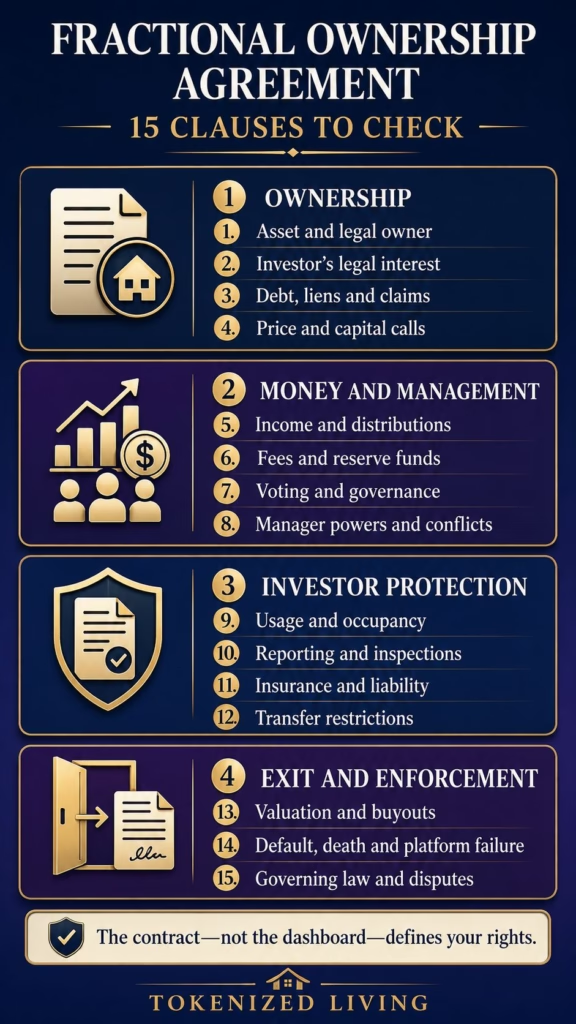
The 15 clauses every fractional ownership agreement should address
No checklist can replace legal advice. However, these clauses reveal whether an arrangement answers the most important ownership questions.
1. Asset identity and legal owner
First, the agreement should identify the exact asset. Property agreements should include the address, legal description, and title details.
For example, other assets may require serial numbers, custody records, intellectual-property schedules, or valuation reports.
Next, confirm which person or entity owns the asset. The platform’s brand name may differ from the legal owner.
For a practical example of why these distinctions matter, our Sabai Ecoverse review examines the agreements connecting property ownership, token issuance and investor income.
2. The investor’s exact legal interest
The agreement must define what the investor receives. For example, interests include direct title, equity, debt, usage rights, or contractual payments.
In particular, check whether your percentage applies to ownership, income, votes, or sale proceeds. Those percentages may differ.
Marketing phrases such as “own part of the property” are not sufficient. Instead, the controlling documents must create and describe that right.
3. Existing debt, liens, and competing claims
The agreement should disclose mortgages, security interests, liens, leases, unpaid taxes, and other claims. Otherwise, investors may misunderstand the asset’s net value.
Furthermore, examine whether lenders can seize or force the sale of the asset. A small ownership interest rarely gives investors control over that process.
For physical assets, request independent evidence of title and encumbrances. Likewise, inspect the entity’s liabilities when buying company interests.
4. Purchase price and capital contributions
The documents should explain how the issuer valued each fraction. Additionally, they should identify every amount investors must contribute.
However, the initial purchase price may not be the final obligation. Some agreements permit later capital calls for repairs, legal costs, or debt payments.
Check the consequences of refusing a capital call. Otherwise, your interest could face dilution, penalties, suspension, or forced sale.
5. Income and distribution rights
Income provisions should explain how the arrangement calculates distributable cash. However, gross rent or revenue does not equal an investor’s payment.
Typically, the manager deducts operating costs, taxes, insurance, debt payments, reserves, and fees first. The agreement should state the calculation order.
Moreover, check who can delay distributions or retain additional reserves. Projected monthly income creates no binding guarantee.
6. Costs, fees, and reserve funds
Every recurring and transaction fee should appear clearly. For example, these include management, administration, maintenance, custody, trading, and exit fees.
The agreement should also explain reserve-fund control. Specifically, investors need to know who sets the target and approves withdrawals.
Likewise, review unexpected-cost procedures. A cheap fraction can become expensive when the asset needs major work.
7. Voting and governance rights
Governance clauses determine which decisions require investor approval. Additionally, they should show the vote needed for each action.
For example, ordinary repairs may require no investor vote. Major borrowing, refinancing, related-party contracts, or asset sales should receive closer scrutiny.
Additionally, check whether voting power follows ownership percentages. Some managers retain special rights despite holding a smaller economic interest.
8. Manager powers and conflicts of interest
Most fractional investments rely on a sponsor, manager, trustee, or platform. Accordingly, the agreement should define that party’s authority and duties.
Pay particular attention to related-party transactions. For example, the manager may hire affiliated property managers, brokers, valuers, custodians, or contractors.
The contract should require conflict disclosure and approval procedures. Moreover, it should explain how investors can replace a failing manager.
9. Usage and occupancy rules
Personal-use ownership requires clear booking and access rules. Specifically, the agreement should address peak periods, guests, cancellations, damage, and unused time.
By contrast, passive investments may prohibit personal use completely. Mixing investment and personal-use rights can create tax or regulatory complications.
Therefore, never assume that fractional property ownership includes the right to stay there.
10. Reporting and inspection rights
Investors need reliable information about the asset and legal entity. Specifically, the agreement should set reporting frequency and minimum disclosure standards.
For example, useful records include financial statements, bank reconciliations, insurance certificates, occupancy data, valuations, invoices, and tax documents.
In addition, check whether investors can inspect books or request an independent audit. Weak information rights leave managers difficult to challenge.
11. Insurance, liability, and indemnities
The agreement should identify required insurance and coverage limits. For example, relevant policies may include property, liability, cyber, and directors coverage.
Furthermore, determine who bears uninsured losses. Direct co-owners can face different exposure from limited-liability company investors.
Indemnity clauses also need attention. Consequently, investors should challenge wording that protects managers after negligence, misconduct, or conflicts.
12. Transfer restrictions and buyer eligibility
Fractional interests are rarely as liquid as public shares. Therefore, the agreement must explain when and how investors can transfer them.
For example, restrictions may include holding periods, manager approval, investor eligibility, first-refusal rights, and securities-law limitations.
The SEC warns that private securities are often illiquid and may not trade freely. Additionally, its private secondary-market guidance explains restricted-security resale pathways.
A platform marketplace does not remove those restrictions. Furthermore, it does not guarantee an interested buyer.
13. Valuation, buyouts, and exit procedures
The exit clause should cover voluntary sales, buyouts, asset sales, redemptions, and winding up. Specifically, it must define the valuation method.
For instance, the parties may use an independent appraisal or a stated formula. Manager-controlled valuations create an obvious conflict risk.
Furthermore, examine forced-sale rights and minority protections. A majority owner may have the power to sell despite your objection.
14. Default, death, bankruptcy, and platform failure
Good agreements plan for bad outcomes. Specifically, they should address missed payments, insolvency, incapacity, death, divorce, fraud, and asset seizure.
Tokenized arrangements need additional procedures. For example, these include lost keys, frozen wallets, blockchain disruption, smart-contract faults, and custodian failure.
Most importantly, the legal entity should survive the platform where possible. Investors need a way to access records and enforce rights independently.
15. Governing law and dispute resolution
Finally, the agreement should identify the governing law, court, and dispute process. It may require negotiation, mediation, arbitration, or litigation.
Do not assume arbitration is always faster or cheaper. For example, costs, location, language, procedural rules, and enforcement can change the outcome.
Likewise, review collective-action restrictions and fee clauses. Small investors may struggle to pursue claims individually.
When does fractional ownership become a security?
Fractional ownership does not automatically create a security. Specifically, the legal analysis depends on the instrument, transaction, rights, promises, and surrounding circumstances.
Direct co-ownership of a personally managed holiday home may look unlike a passive investment. Conversely, managed profit-sharing interests can trigger securities rules.
In the United States, traditional shares, notes, and fund interests may already fall within statutory security categories. Accordingly, tokenizing them does not remove that status.
The SEC’s 2026 digital-assets interpretation defines tokenized securities as financial instruments represented through crypto assets. Importantly, tokenholder rights may differ from the underlying security’s rights.
Other arrangements may require an investment-contract analysis. Specifically, that assessment considers invested money, a common enterprise, expected profits, and managerial efforts.
Therefore, saying every asset-backed token “passes the Howey test” is wrong. Equally, calling a product a utility token cannot settle the question.
Regulation D, Regulation A, and Regulation S explained
If an arrangement involves securities, the offering generally needs registration or an available exemption. However, three frequently mentioned U.S. routes are not interchangeable.
| Route | General purpose | Important limitation |
|---|---|---|
| Regulation D | Exempt private offerings under Rules 504, 506(b), or 506(c) | Investor eligibility, solicitation, filing, disclosure, and resale rules vary |
| Regulation A | SEC-qualified exempt public offerings under Tier 1 or Tier 2 | Qualification, disclosure, reporting, and offering limits apply |
| Regulation S | Safe harbor for qualifying offshore offers and sales | Offshore conditions and resale restrictions still matter |
The SEC describes Regulation D as exemptions and a safe harbor. Meanwhile, Regulation A provides two tiers for qualifying public offerings.
Regulation S offers an offshore safe harbor. However, it is not a general exemption from every U.S. or foreign requirement.
None of these routes represents SEC approval of the investment. Instead, investors must assess the asset, manager, price, disclosures, and exit restrictions.
Are KYC and AML checks always mandatory?
No single rule makes identical checks mandatory for every fractional arrangement worldwide. Instead, obligations depend on the parties, activities, payments, and jurisdictions involved.
For example, FINRA Rule 3310 requires member firms to maintain anti-money-laundering programs. Accordingly, it requires risk-based customer due diligence.
Meanwhile, other businesses may face different financial-crime, sanctions, beneficial-ownership, or identity requirements. Therefore, issuers need advice tailored to their operating model.
For investors, identity checks can indicate that a platform recognizes compliance duties. Still, completed onboarding does not prove that an investment is legitimate.
How tokenization changes the agreement
Tokenization changes the recording and transfer layer. Instead, the legal wrapper around the asset remains essential.
If you are new to this distinction, read our explanation of what tokenization means.
A tokenized agreement should answer several extra questions:
- Which legal right does each token represent?
- Does the legal register match the blockchain record?
- Which record controls after a conflict?
- Who can mint, burn, pause, freeze, or replace tokens?
- How are investor-eligibility rules enforced during transfers?
- Who controls administrative keys and upgrade powers?
- What happens after a lost wallet or compromised key?
- Can investors move tokens away from the platform?
- Which custodian holds assets, tokens, or private keys?
- How will forks, network failures, and smart-contract defects be handled?
These provisions matter because code cannot create missing legal rights. Therefore, the token must remain connected with enforceable documents and accurate ownership records.
Moreover, technical transferability does not guarantee legal transferability. A wallet can send a token even when the contract prohibits the transaction.
Our guide to buying tokenized assets includes the practical checks needed before a purchase.
What RealT teaches about fractional ownership agreements
RealT historically offered tokens linked to interests in property-owning companies. Generally, investors did not hold the property deeds personally.
That structure shows why the operating documents matter. In practice, company interests, management arrangements, liabilities, and token terms shape investor rights.
RealT later announced plans for voluntary liquidation in July 2026. Consequently, its difficulties show that tokens cannot prevent operational or property-management failure.
Our updated RealT review and liquidation analysis explains the developing situation. Therefore, the example belongs here as a risk lesson, not a promotion.
Cross-border fractional ownership risks
Cross-border offerings can involve several legal systems at once. For example, the asset, issuer, investor, custodian, and marketplace may occupy different countries.
Consequently, investors should identify which jurisdiction governs each relationship. A favorable court judgment can still be difficult to enforce abroad.
For instance, other concerns include foreign-ownership limits, taxes, currency controls, sanctions, inheritance rules, and local offering restrictions.
Tax treatment can also depend on the legal wrapper. Accordingly, our 2026 tokenized real estate tax guide explains why structure and location matter.
Above all, do not treat “available in my country” as legal analysis. Website access says nothing about investor eligibility or enforceability.
Documents investors should request
First, request the documents that create and support your rights before investing.
| Document or evidence | What it should help verify |
|---|---|
| Title, deed, registry extract, or custody record | The asset exists and the stated owner controls it |
| Entity formation records | The property-owning or issuing vehicle exists |
| Operating, shareholder, partnership, trust, or fund agreement | Ownership, governance, fees, distributions, and exits |
| Subscription or purchase agreement | The terms governing your investment |
| Offering memorandum and risk disclosures | Material risks, use of funds, conflicts, and restrictions |
| Capitalization table or investor register | Your interest appears in the ownership records |
| Valuation or appraisal | The offering price has supporting evidence |
| Financial statements and debt records | Liabilities and operating performance are visible |
| Insurance certificates | Relevant risks carry current coverage |
| Management and related-party agreements | Manager duties, fees, and conflicts are disclosed |
| Token, smart-contract, and custody terms | Digital records connect with the legal structure |
| Tax reporting information | Expected forms and investor responsibilities are explained |
Where relevant, verify securities firms through FINRA BrokerCheck or the SEC’s adviser database. Also inspect public issuer filings rather than trusting screenshots.
Fractional ownership contract red flags
Walk away or obtain specialist advice when you find these warning signs:
- the documents never identify the asset’s legal owner
- marketing promises direct ownership, but the contract provides only income rights
- the platform can change material terms without investor approval
- the manager can transact with affiliates without disclosure
- fees appear only after registration or payment
- projected returns appear as guaranteed income
- investors cannot access financial or ownership records
- the platform controls all wallets, records, communications, and withdrawals
- transferability is advertised without explaining legal restrictions
- no procedure covers platform insolvency or lost access
- the governing law or dispute forum remains unclear
- the company discourages independent legal advice
These problems do not become harmless because the platform uses blockchain. In particular, technical complexity can make weak rights harder to detect.
For a wider risk assessment, compare tokenized real estate’s benefits and risks before choosing a platform.
Final verdict
A fractional ownership agreement is not administrative fine print. Instead, it creates, limits, and enforces the investor’s rights.
The strongest agreements identify the asset, owner, legal interest, costs, governance, information rights, transfers, and exit process. Moreover, they plan for failure.
In practice, tokenization can improve record-keeping and automate selected processes. Nevertheless, it cannot rescue defective title, missing rights, bad management, or an unaffordable asset.
Therefore, start with the documents rather than the dashboard. If the ownership chain cannot be explained clearly, do not invest.
Frequently asked questions
Is fractional ownership legal?
Yes, fractional ownership can be legal when it follows the relevant laws. However, requirements differ by asset, structure, offering, and jurisdiction.
What is a fractional ownership agreement?
It is the contract or group of documents governing shared rights in an asset. It covers ownership, management, costs, income, transfers, defaults, and exits.
Does fractional ownership mean my name appears on the deed?
Not always. You may instead own company shares, membership interests, fund units, debt, or contractual rights connected with the property.
Is tokenized fractional ownership always a security?
No. Existing tokenized securities remain securities, while other arrangements require analysis of their rights, promises, structure, and marketing.
Can I sell my fractional interest whenever I want?
Usually not. Contracts, securities laws, investor-eligibility rules, holding periods, and weak buyer demand can restrict sales.
What happens if the fractional ownership platform fails?
Your outcome depends on the legal structure. Strong arrangements preserve independent ownership records, asset control, management continuity, and enforcement rights.
Is a blockchain token the same as a property deed?
Usually not. A token commonly represents company equity, a fund unit, debt, or contractual rights. Official property records may remain controlling.
Should a lawyer review the agreement?
Professional review is sensible when the investment is substantial, cross-border, tokenized, difficult to exit, or legally complex.