
Sabai Ecoverse has changed considerably since this review was first published.
The original project combined tokenized property, blockchain games, education and a native cryptocurrency. Today, the main business operates under the Sabai Protocol name and focuses heavily on providing tokenization infrastructure to other companies.
However, retail investors can still access fractional Phuket real estate through Sabai Property.
That distinction matters because Sabai Protocol, Sabai Property and the SABAI utility token are separate parts of the ecosystem. Buying a property token is not the same as purchasing SABAI on a cryptocurrency exchange.
This updated Sabai Ecoverse review examines how the current property platform works, what investors appear to own, the advertised returns and the risks hidden beneath the marketing.
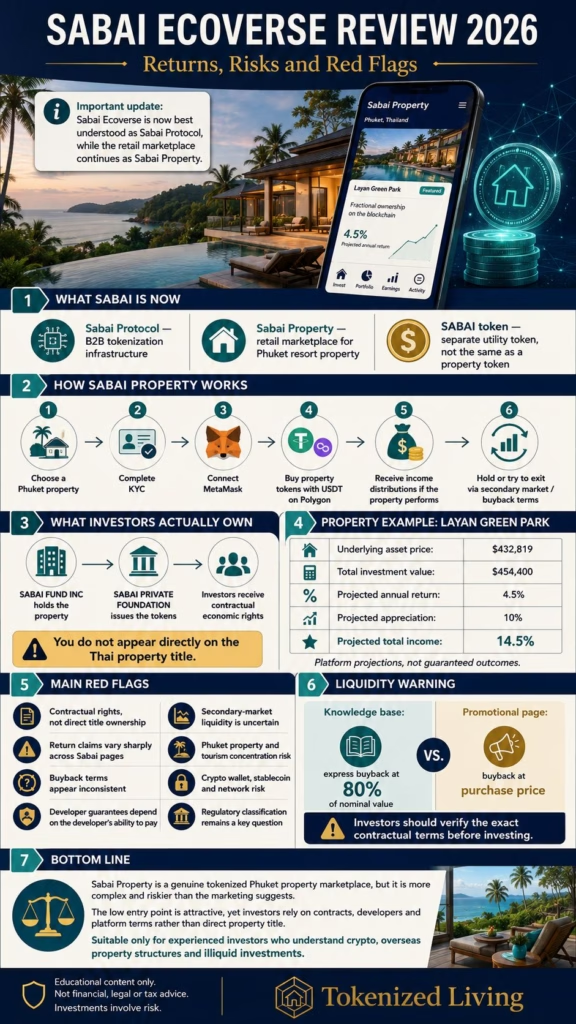
Important update: Sabai Ecoverse has rebranded its main business as Sabai Protocol. Its retail tokenized-property marketplace continues under the Sabai Property name.
TL;DR
- Sabai Ecoverse is now primarily known as Sabai Protocol.
- Sabai Protocol sells tokenization technology and legal-structuring services to businesses.
- Sabai Property remains its retail marketplace for fractional Phuket resort property.
- Property investments currently start from $50.
- Investors complete KYC, connect MetaMask and purchase property tokens with USDT on Polygon.
- Property tokens and the SABAI utility token are different assets.
- Investors do not appear on the Thai property title.
- Their income rights depend on contracts between Sabai-linked entities.
- Published returns range from 4.5% annual income to much higher promotional projections.
- Sabai’s documentation contains conflicting buyback and liquidity claims.
- The native SABAI token has suffered an extreme price decline and very weak trading activity.
- This is a high-risk investment for experienced crypto users—not an easy alternative to buying property.
Some links in this article may be affiliate links. We may receive a commission at no additional cost to you.
This article is for educational purposes only. It is not financial, legal or tax advice.
What Is Sabai Ecoverse Today?
Sabai Ecoverse began as a broad blockchain ecosystem connecting real estate, digital assets, gaming and education.
The main corporate-facing brand now uses the name Sabai Protocol.
Its current website promotes turnkey tokenization systems for businesses that want to create digital investment products. These services include token issuance, investor onboarding, payment processing, legal structuring and marketplace infrastructure.
Sabai currently advertises three business packages:
| Package | Starting price | Estimated launch time |
|---|---|---|
| Starter | $24,000 | 2–4 weeks |
| Optimal | $49,000 | 4–6 weeks |
| Enterprise | $224,000 | 3–6 months |
These packages show that Sabai Protocol has moved beyond operating one property marketplace. It now positions itself as an infrastructure provider for real estate, funds, bonds, agriculture, vehicle leasing and other real-world assets.
Retail property investing remains available through Sabai Property, which Sabai describes as a live demonstration of its tokenization technology.
Sabai Protocol vs Sabai Property vs SABAI Token
The similar names make the ecosystem unnecessarily confusing.
Sabai Protocol
Sabai Protocol is the wider technology and business-services operation.
It provides tokenization infrastructure to asset owners and companies.
Sabai Property
Sabai Property is the retail-facing marketplace where eligible investors can purchase tokens connected to individual Phuket properties.
The platform’s knowledge base advertises a minimum entry point of $50. It currently focuses on resort properties rather than a diversified international property portfolio.
SABAI Token
Meanwhile, SABAI is the ecosystem’s separate utility cryptocurrency.
Sabai promotes it for selected ecosystem services, staking, games and other platform functions. However, the current property-purchasing instructions tell investors to use USDT on Polygon, not SABAI.
Therefore, purchasing SABAI does not automatically give someone ownership rights or income from a Sabai Property asset.
How Sabai Property Works
Sabai Property combines a conventional legal structure with blockchain-based property tokens.
The process works roughly as follows:
- Sabai or one of its partners selects a Phuket property.
- The asset receives a valuation.
- The investment value is divided into units initially priced at $50.
- Sabai issues a corresponding number of property tokens.
- Investors register and complete identity verification.
- They connect a MetaMask wallet to the platform.
- The investor’s wallet is added to an approved whitelist.
- The investor purchases tokens using USDT on Polygon.
- The property generates rental income or developer-backed payments.
- Sabai distributes the investor’s share according to the property agreements.
The current instructions also require investors to hold a small amount of Polygon’s native network token to pay transaction fees. After completing the purchase, the property tokens appear inside MetaMask and the Sabai Property dashboard.
This process gives investors direct control of the blockchain tokens. However, holding the tokens does not mean their name appears directly on the property title.
What Do Sabai Property Investors Actually Own?
This is the most important part of the review.
Sabai’s property page identifies two main entities within its legal structure:
- SABAI FUND INC holds the property.
- SABAI PRIVATE FOUNDATION issues the property tokens.
According to Sabai, an investment agreement gives SABAI PRIVATE FOUNDATION rights to income generated by property held through SABAI FUND INC.
Token buyers then sign a separate purchase agreement. Sabai says this agreement gives them the right to participate in the investment agreement and receive income connected to the property.
In plain English, investors appear to receive contractual economic rights.
They do not appear to receive:
- Their name on the Thai title
- Direct control of the apartment
- The right to occupy the property
- Automatic equity in Sabai Protocol
- Control over the property manager
- Unrestricted access to the underlying asset
The blockchain records possession of the token. The contracts determine whether that token produces enforceable rights.
That difference is crucial.
A Contradiction in the Legal Wording
Sabai describes its property tokens as representing shares in properties and rights to rental income, developer payments and property appreciation.
However, the legal disclaimer at the bottom of its property pages says the tokens are:
- Non-security utility tokens
- Not financial instruments
- Not equity
- Not governance interests
- Not voting rights
- Intended for experienced blockchain users
The same disclaimer acknowledges legal uncertainty and warns investors that they could lose some or all of the token’s value.
This creates an uncomfortable question.
If an investor contributes money, expects income from a managed property and relies on other entities to produce that return, regulators in some countries may examine the arrangement differently from how the issuer labels it.
That does not automatically mean Sabai has broken securities laws. However, calling an asset a utility token does not by itself settle its legal classification in every jurisdiction.
Investors should obtain legal advice before assuming that the structure provides the same rights or protection as a regulated property security.
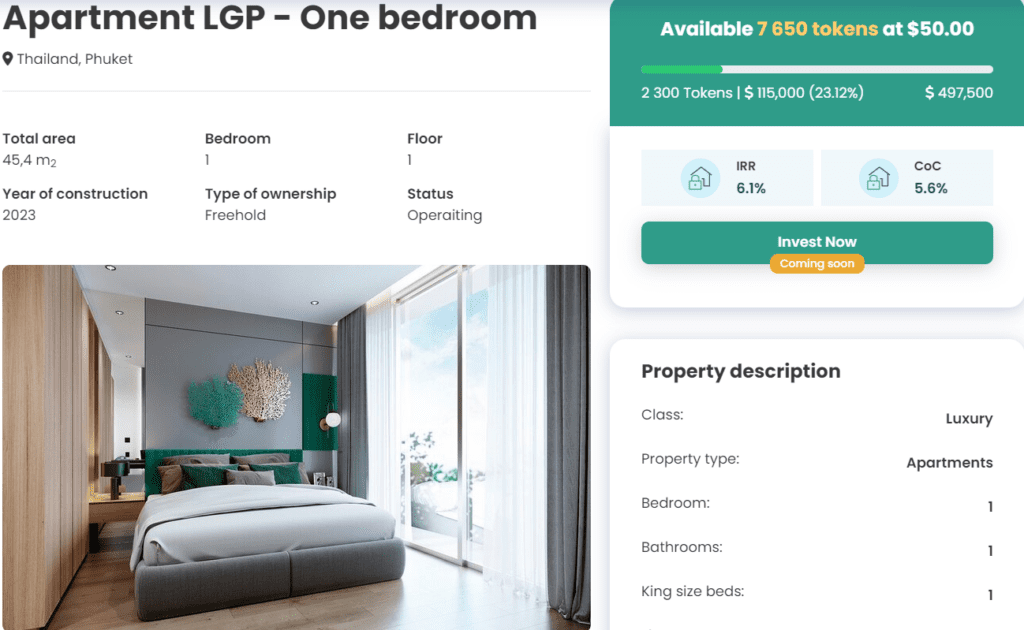
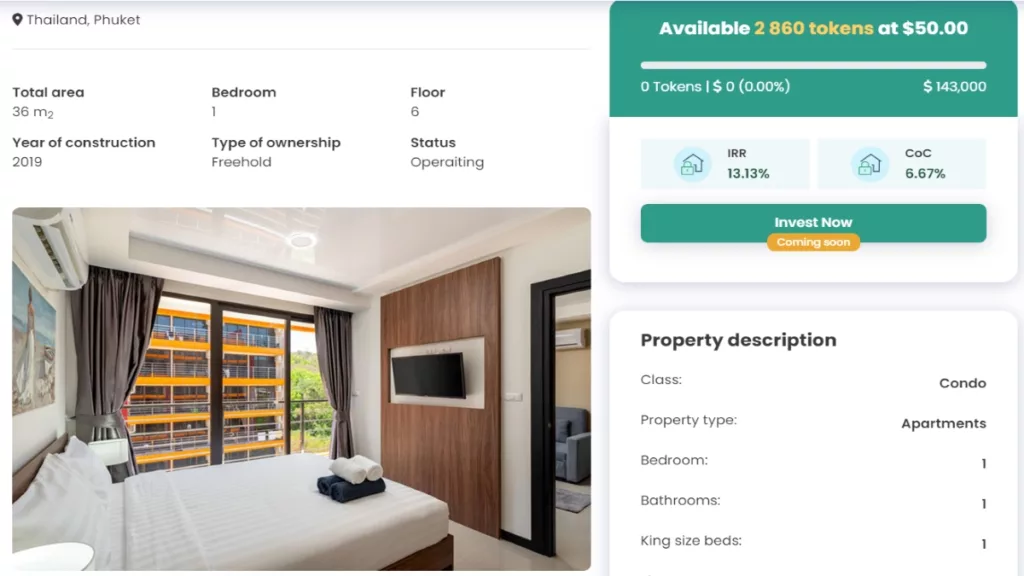
Which Properties Are Available?
Sabai’s knowledge base says the marketplace currently focuses on resort property in Phuket.
The properties have included:
- Layan Green Park
- Layan Verde
- Naiharn NBC Pearl
Some offerings involve completed or operating rental units. Others relate to development-stage property that may not generate normal rental income until construction finishes.
That distinction affects the risk considerably.
An operating apartment can produce rental revenue. A construction-stage project depends on the developer completing the property, controlling costs and eventually attracting tenants or buyers.
Layan Green Park Example
One live Sabai Property page covers a 72.22-square-metre apartment in the Layan Green Park development.
The property page currently lists:
| Item | Published figure |
|---|---|
| Underlying asset price | $432,819 |
| Total investment value | $454,400 |
| Sinking fund and utilities | $1,774 |
| Registration tax | $4,761 |
| DAO registration fees | $6,390 |
| Operating reserve | $8,656 |
| Projected annual return | 4.5% |
| Projected appreciation | 10% |
| Projected total income | 14.5% |
The difference between the underlying asset price and total investment value is approximately $21,581. Therefore, investors are not merely dividing the advertised property price. Their capital also covers taxes, reserves, registration and other costs.
The 4.5% return and 10% appreciation figures are projections supplied through the platform. They are not guaranteed market outcomes.
How Does Sabai Property Generate Returns?
Sabai presents several potential sources of return.
Rental Income
Operating properties may generate income from short-term or long-term rentals.
The amount available to investors depends on occupancy, room rates, management fees, maintenance, insurance, taxes and other property expenses.
Developer-Backed Payments
Certain properties include a developer payment described as a guaranteed annual return.
Sabai’s documentation commonly cites a range of 5% to 7%. It says the developer pays the difference when actual rental income falls below the stated level.
However, a developer guarantee is not the same as a government guarantee, insured deposit or bank letter of credit.
Its value depends on:
- The identity of the developer
- The wording of the contract
- The developer’s financial position
- Available reserves
- The jurisdiction governing the agreement
- The investor’s ability to enforce it
Property Appreciation
Investors may also benefit if the property increases in value.
Nevertheless, an appraisal is not a completed sale. Investors only realise appreciation when someone purchases the property or tokens at the higher valuation.
Development Profits
Construction-stage properties may target gains between the acquisition and completion stages.
These offerings carry additional risks, including delays, cost overruns, planning problems and weaker-than-expected resale demand.
Are the Advertised Returns Realistic?
Sabai’s published return claims vary significantly between pages.
The general knowledge base advertises:
- Developer-backed income of 5%–7%
- Projected rental yields of 8%–12%
- Projected resale profits of 5%–18%
Meanwhile, a current promotional page advertises:
- Annual returns of 23%
- Property appreciation of up to 55% over three years
- Total returns of up to 76% over three years
- Weekly income payments
- Buyback at the original purchase price
Yet the detailed Layan Green Park property page lists an annual return of only 4.5% and projected appreciation of 10%.
These figures are not directly comparable. Some combine income and speculative appreciation, while others refer to a specific property.
Investors should demand a property-level breakdown showing:
- Gross rental revenue
- Management fees
- Maintenance costs
- Insurance
- Taxes
- Reserve contributions
- Developer payments
- Net investor distributions
- The method used to calculate appreciation
A bold percentage on a sales page is not evidence that investors have earned it.
How Often Does Sabai Pay Investors?
The Sabai knowledge base says property income is calculated monthly and paid the following month through weekly distributions.
If a property earns less than its developer-backed return, the developer may pay the difference. When actual income exceeds the guaranteed amount, Sabai says investors receive the higher figure.
A newer sales page says income is paid in USDT. Investors can transfer the stablecoin to a personal wallet and exchange it through another service.
Stablecoin payments can reduce friction in international banking. However, they introduce wallet, network and stablecoin risks.
Is Sabai Property Liquid?
No tokenized property investment should be described as liquid simply because a “sell” button exists.
Sabai’s knowledge base describes two potential exit routes:
- Sell tokens to another investor through a secondary market.
- Use an express buyback at 80% of the token’s nominal value.
Under the second option, a token initially valued at $50 could be sold for $40. That is an immediate 20% loss before considering inflation, exchange costs or transaction fees.
However, another Sabai sales page advertises a buyback at the full original purchase price after the end of an annual contract. It also uses the phrase “guaranteed liquidity.”
Those two claims conflict.
The difference may result from separate promotional programmes or property contracts. Nevertheless, investors should not proceed until the signed agreement clearly answers:
- Who must repurchase the tokens?
- At what percentage of the original price?
- When does the right begin?
- Does the buyback depend on available funds?
- Are there limits or notice periods?
- Can Sabai suspend redemptions?
- Which legal entity guarantees payment?
Until those questions have clear contractual answers, it is safer to treat Sabai Property as an illiquid investment.
Does SABAI Token Power the Property Marketplace?
The native SABAI cryptocurrency remains part of the wider ecosystem, but it should not be confused with the property tokens.
Current investment instructions require USDT on Polygon for property purchases. Investors receive a separate token tied to the selected property.
The native SABAI token has also performed extremely poorly.
At the time of this July 2026 update, CoinGecko reported that SABAI traded approximately 99.2% below its July 2024 all-time high. Reported 24-hour trading volume was less than $2, which indicates almost no active market liquidity.
This does not prove that the individual property tokens have performed equally badly.
However, it destroys the original article’s unsupported suggestion that scarcity would naturally cause the utility token to increase in value.
Sabai Property Fees and Costs
Sabai does not present one simple platform-fee table comparable to a conventional brokerage.
Instead, costs appear inside each property’s total investment value.
For Layan Green Park, the published extras include:
- Registration tax
- DAO registration fees
- Operating reserves
- Sinking-fund and utility costs
Investors must also consider:
- Polygon network fees
- Stablecoin conversion costs
- Wallet withdrawal fees
- Property management expenses
- Maintenance and repairs
- Insurance
- Potential secondary-market discounts
- Taxes in their home country
A $50 token may make the entry point look simple. The underlying cost structure is not.
Security and the CertiK Audit
Sabai states that its smart contracts have passed a CertiK audit.
CertiK’s current project page shows that the audit was requested and revised in 2023. It reports 73.37% audited-code coverage for the contracts it tracks. CertiK also states that it has not verified the project team through its own process and has not completed CertiK KYC.
More importantly, a smart-contract audit does not verify:
- Ownership of a Phuket apartment
- The validity of a leasehold
- Rental income
- Developer solvency
- Property insurance
- Appraisal accuracy
- The enforceability of investor contracts
- Future market demand
The audit reduces some code risk. It does not validate the investment as a whole.
Regulation and Investor Eligibility
Sabai requires identity verification and says it operates AML controls.
Its FAQ also states that citizens of the United States and Canada face investment restrictions.
However, KYC does not mean a national securities regulator has approved the investment.
Sabai Protocol’s own current disclaimer says:
- Sabai Protocol is a label for a group of independent companies, not one separate legal entity.
- References to income and profit do not constitute guaranteed returns.
- Users must assess securities, tax and AML compliance in their own jurisdictions.
- Participation may result in the total loss of funds or tokens.
That is considerably more cautious than the promotional language elsewhere on the site.
Main Sabai Property Risks
Contractual Ownership Risk
Your rights depend on multiple agreements and entities rather than direct title ownership.
Developer Risk
Any guaranteed payment remains dependent on the developer’s ability and obligation to pay.
Development Risk
Layan Verde and other construction-stage offerings may face delays, rising costs or completion problems.
Phuket Market Risk
Returns depend heavily on tourism, occupancy, room rates and the local property market.
Leasehold Risk
Foreign property arrangements in Thailand may involve leasehold rights rather than permanent freehold ownership.
Valuation Risk
A platform appraisal does not guarantee that the property or token will sell at that price.
Liquidity Risk
The secondary market may not have enough buyers. The documented express exit may involve a substantial discount.
Documentation Risk
Conflicting return and buyback claims make it difficult to determine which terms apply without reading the signed contract.
Platform Risk
Investors depend on Sabai’s website, identity system, smart contracts and support team.
Wallet Risk
Losing wallet credentials or sending assets over the wrong network could cause losses.
Interestingly, Sabai’s general risk page says support may investigate lost tokens and return them to the rightful owner. However, the property page’s legal disclaimer warns that losing private keys may permanently remove access. These statements need clarification.
Stablecoin Risk
Income and investments involve USDT, which adds issuer, custody and conversion risk.
Native Token Risk
SABAI’s severe price decline and minimal trading volume demonstrate the speculative nature of the wider crypto ecosystem.
Regulatory Risk
Authorities may interpret income-linked property tokens differently from the issuer’s “utility token” classification.
Sabai Property Pros and Cons
| Potential advantages | Main disadvantages |
|---|---|
| Minimum investment from $50 | Investors do not hold direct property title |
| Property-specific tokens | Complex multi-entity legal structure |
| Tokens held in MetaMask | Requires crypto and wallet knowledge |
| USDT income distributions | Stablecoin and network risk |
| Access to Phuket resort property | Heavy geographic concentration |
| Some operating and development assets | Construction and developer risk |
| Property documents provided | Documentation contains inconsistencies |
| Potential secondary market | Buyer demand is not guaranteed |
| Developer-backed payment on some assets | Guarantee strength is unclear |
| Blockchain transaction records | Blockchain does not prove property performance |
Who Might Sabai Property Suit?
Sabai may appeal to investors who:
- Already understand MetaMask and Polygon
- Can verify overseas legal documents
- Accept illiquid investments
- Understand Phuket resort-property risk
- Can tolerate a total loss
- Want limited exposure to tokenized international property
- Are prepared to hold for several years
It is unsuitable for anyone who:
- Needs guaranteed access to their money
- Believes “guaranteed” means government-backed
- Does not understand self-custody
- Wants direct ownership on a property title
- Depends on the advertised income
- Cannot evaluate foreign contracts
- Expects stock-market liquidity
Sabai Ecoverse Review Verdict
Sabai is not an imaginary tokenization project.
It has built a functioning property-token marketplace, issued property-specific tokens on Polygon and connected them with identifiable Phuket developments. The wider company has also moved into providing tokenization infrastructure for other businesses. Sabai currently claims more than 20,000 users and over $4 million in tokenized property value, although these are company-reported figures rather than independently audited performance results.
However, the investment model is more complicated than the marketing suggests.
Investors do not appear to own the Thai property directly. Instead, they rely on contracts connecting a property-holding company, a token-issuing foundation and the token purchaser.
Return claims also vary sharply between Sabai’s documentation and promotional pages. Most seriously, one page describes an instant buyback at 80% of nominal value, while another advertises a buyback at the full purchase price.
That contradiction must be resolved in writing before anyone invests.
The native SABAI utility token’s collapse and almost nonexistent trading volume add another warning, although property-specific tokens remain separate assets.
Tokenized Living verdict: Sabai Property is a genuine but high-risk experiment in international property tokenization. Its low entry point and on-chain tokens are interesting, but investors face contractual ownership, developer, liquidity, wallet and regulatory risks. The platform is suitable only for experienced investors who can independently verify the legal agreements and afford to lose their entire investment.
Frequently Asked Questions
Is Sabai Ecoverse still active?
Yes, but the main business now operates as Sabai Protocol. The Sabai Property marketplace remains part of the ecosystem.
What is the minimum Sabai Property investment?
The platform currently advertises a $50 minimum entry point.
Do Sabai investors own part of the property title?
Not directly, based on the platform’s published structure. Investors receive tokens and contractual rights connected to income generated by property held through SABAI FUND INC.
Which blockchain does Sabai Property use?
Property tokens operate on Polygon.
How do investors buy Sabai property tokens?
Investors complete KYC, connect and whitelist a MetaMask wallet, and purchase tokens using USDT on Polygon.
Are property purchases made using SABAI tokens?
The current instructions specify USDT. SABAI is a separate utility cryptocurrency within the wider ecosystem.
Does Sabai guarantee rental returns?
Some properties include developer-backed payments. However, investors must verify who provides the guarantee, its contractual terms and whether the developer has sufficient resources.
Can investors sell Sabai property tokens immediately?
Sabai describes a secondary market and express-buyback options. However, its pages publish conflicting terms, including both an 80% buyback and a full-price buyback.
Is Sabai Property regulated?
Sabai uses KYC and AML procedures, but that does not mean every offering has approval from a national securities regulator. Investors must check their own jurisdiction.
Is Sabai Property safe?
No property or crypto investment is completely safe. Sabai combines property, developer, contract, platform, wallet, stablecoin and regulatory risks.
Is the SABAI utility token the same as a property token?
No. SABAI is the ecosystem utility token. Each tokenized property uses a separate asset-linked token.
Can US or Canadian citizens invest?
Sabai’s FAQ says citizens of the United States and Canada face investment restrictions.