

Updated: 3 September 2026.
The Qatar Digital Assets Framework gives selected tokenized rights a legal structure inside the Qatar Financial Centre. Specifically, it covers ownership, transfers, custody, exchanges, validation, and token generation.
However, one point needs correcting at the outset. Crucially, the Qatar Central Bank did not independently issue this framework. Instead, the Qatar Financial Centre Authority and Qatar Financial Centre Regulatory Authority jointly announced it in September 2024.
At the same time, the framework supports the Qatar Central Bank’s wider financial-sector strategy. Yet the detailed rules belong to the Qatar Financial Centre, known as the QFC.
In practice, that distinction matters. These rules create regulated tokenization routes within a specific legal and financial jurisdiction. They do not legalize every crypto asset across Qatar.
Important: This article provides general information, not financial, legal, tax, or investment advice. Tokenized assets can lose value and may be illiquid. Always review the issuer documents, governing law, custody arrangements, and regulatory status. Seek qualified advice before investing.
TL;DR
- The QFCA and QFCRA launched the framework, while the QCB provided strategic alignment and policy support.
- The rules apply to token activity conducted in or from the Qatar Financial Centre.
- A permitted token represents an identifiable off-chain property right.
- Shares, bonds, sukuk, commodities, and real-estate rights may fit the framework when properly structured.
- Cryptocurrencies, stablecoins, and central bank digital currencies remain outside the permitted-token regime.
- QFC licensing can cover validation, generation, custody, exchanges, and transfers.
- Investment-token businesses also need QFCRA authorization for the relevant regulated activity.
- Regulation improves legal clarity, but it cannot guarantee liquidity, returns, cybersecurity, or issuer quality.
What is the Qatar Digital Assets Framework?
The Qatar Digital Assets Framework is a package of QFC laws, regulations, and guidance. It took effect on 1 September 2024.
Specifically, its core components include the Digital Assets Regulations 2024 and the Investment Token Rules 2024. Together, they create a legal route for representing certain rights through tokens.
If the terminology feels unfamiliar, start with our guide to what tokenization means. In simple terms, tokenization records a defined right through a digital token. Above all, the legal right matters more than the visual token or blockchain label.
Under Article 8, a token represents a property right through cryptographically secured electronic data. Moreover, that property can include contractual rights, not only physical assets.
Therefore, the framework focuses on the connection between a token and its underlying right. It does not treat every blockchain entry as a regulated asset.
Who regulates tokenization in Qatar’s QFC?
Three institutions appear in discussions about the framework. However, they perform different functions.
| Institution | Main role in this framework | What that means in practice |
|---|---|---|
| Qatar Financial Centre Authority (QFCA) | QFC commercial licensing and token-service oversight | A business generally needs an appropriate QFCA licence to provide token services in or from the QFC. |
| Qatar Financial Centre Regulatory Authority (QFCRA) | Financial-services regulation | Investment-token activities may require QFCRA authorization as regulated financial activities. |
| Qatar Central Bank (QCB) | National financial strategy and central banking policy | The framework aligns with the QCB’s Third Financial Sector Strategic Plan, but the QCB did not issue the QFC rulebook alone. |
In practice, this division prevents a common misunderstanding. A QFC licence does not automatically authorize every financial activity. Likewise, QFCRA authorization does not turn excluded crypto assets into permitted tokens.
Why the Qatar Financial Centre scope matters
The QFC operates through its own legal and regulatory environment. Accordingly, Article 2 applies the regulations to permitted tokens and token services in or from the QFC.
Consequently, headlines describing a nationwide “crypto framework” miss the legal boundary. Instead, the regime provides tokenization rules for QFC participants. Meanwhile, other Qatar laws may still apply to the asset, issuer, buyer, or activity.
For example, a token could represent a contractual economic right connected with property. However, that does not necessarily make the token a national land title. Moreover, property registration rules and transaction documents can still control the outcome.
For clarity, this article uses “Qatar framework” as shorthand. Legally, the QFC scope remains essential.
Permitted tokens versus excluded tokens
The framework does not divide the market into “safe” and “unsafe” tokens. Instead, it separates tokens that can enter the QFC regime from those it excludes.
| Potentially permitted | Excluded from the permitted-token regime |
|---|---|
| Tokens representing shares or other securities | Cryptocurrencies without an off-chain property right |
| Tokenized bonds, sukuk, or debt rights | Stablecoins used as currency substitutes or payment instruments |
| Tokens linked to commodity ownership | Central bank digital currencies |
| Validated real-estate or contractual rights | Tokens that fail the framework’s validation and generation requirements |
| Other identifiable off-chain property rights | Other tokens treated as excluded under applicable QFC rules |
Article 9 defines a permitted token through two tests. First, an authorized generator must create it under Article 12. Second, it must not fall within an excluded category.
The QFCRA later clarified the treatment of cryptocurrencies and stablecoins. Its explanation also identified shares, bonds, sukuk, commodities, and real estate as areas for tokenization.
Notably, “permitted” does not mean “investment-grade.” Investment-grade describes credit quality in conventional markets. It is not the legal test used by this framework.
Moreover, permitted status does not certify profitability or market demand. Investors must still assess the issuer, asset, documentation, and exit route.
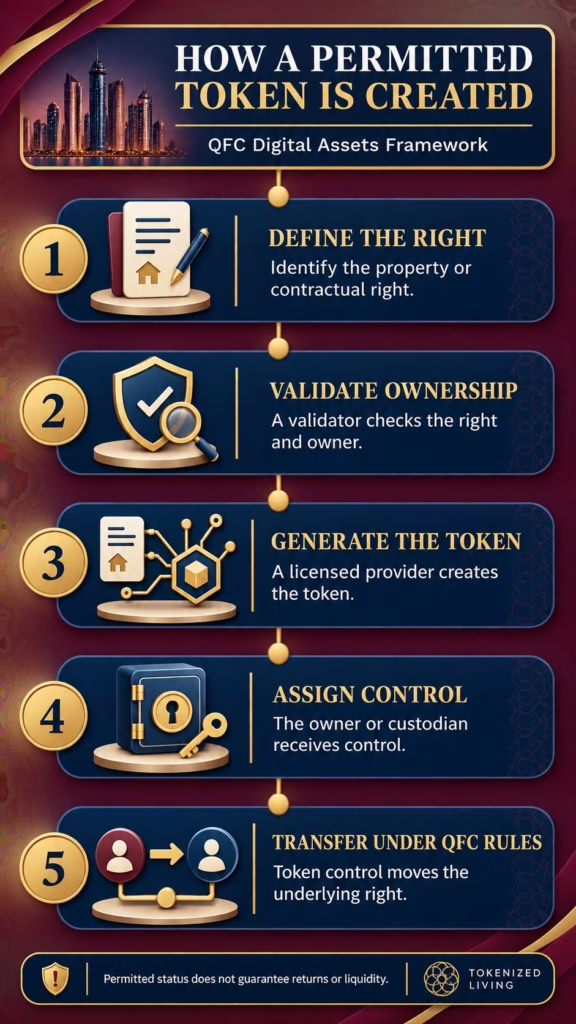
How a permitted token is created
Importantly, the QFC rules establish a controlled process. An owner cannot simply mint a token and claim that it carries a protected legal right.
1. Define the underlying right
First, the parties identify the precise property or contractual right. Clear documentation should explain what the holder owns and what limitations apply.
2. Obtain validation
Next, a validator examines the right and the purported owner. The resulting validation certificate describes the right and confirms the validator’s ownership finding.
3. Use a licensed token generator
Afterward, the owner asks a licensed provider to create the token. Article 12 connects generation to the validation certificate.
4. Assign transfer control
Finally, the generator gives transfer control to the owner or an appointed custodian. Control becomes central to the ownership presumption and transfer process.
In short, the model links documentation, validation, generation, and control. As a result, each step supports the token’s legal connection to the underlying right.
What token ownership means under the framework
Article 13 states that token ownership carries ownership of the represented underlying right. Accordingly, it presumes that the person controlling transfers owns the token.
However, that presumption is not absolute. The QFC Court can displace it when evidence supports a different owner.
Article 14 connects the transfer of token control with the transfer of the underlying right. Consequently, the token becomes the route for transferring that right within this legal structure.
Still, investors should read this carefully. The token only carries the right defined, validated, and legally attached to it. It does not create rights that the issuer never possessed.
Likewise, tokenization does not erase outside registration rules. Specifically, that is a practical legal inference from the framework’s limited QFC scope. Therefore, investors should confirm how the arrangement interacts with the asset’s governing law.
Which token services need a licence?
Article 18 identifies five licensed token services.
| Token service | Core function | Key question for users |
|---|---|---|
| Validation | Verifies the underlying right and ownership claim | Who checked the asset, title, and supporting records? |
| Token generation | Creates a permitted token against a validation certificate | Does the generator hold the required QFC licence? |
| Token custody | Controls tokens or private keys for clients | How are keys separated, protected, and recovered? |
| Token exchange | Operates a venue for token transactions | Are trading rules, conflicts, and settlement procedures clear? |
| Token transfer | Facilitates transfers between parties | How does the provider verify instructions and finality? |
In practice, a provider may offer more than one service. Nevertheless, it must manage conflicts through appropriate systems and separation.
In addition, an investment-token activity can trigger QFCRA financial-services regulation. Therefore, users should check both the provider’s QFCA licence and any necessary QFCRA authorization.
How investment tokens receive additional regulation
An investment token represents rights in a financial product or similar arrangement. For example, it can cover shares, debt, fund units, derivatives, deposits, and Islamic finance contracts.
The Investment Token Rules 2024 generally regulate the activity as though it involved the underlying financial right. Accordingly, technology alone should not change the regulatory treatment.
For instance, advice about a tokenized security can still count as investment advice. Operating an investment-token exchange can also require authorization. Custody rules may cover both the token and its private keys.
Furthermore, a token created outside the QFC can raise different legal questions. The applicable foreign law may govern its ownership and transfer.
This treatment resembles a broader regulatory trend. Similarly, Hong Kong has focused on the legal character of tokenized securities, not merely their delivery technology.

Does Qatar’s framework legalize cryptocurrency?
No. Specifically, the framework does not provide a general route for cryptocurrency trading inside the QFC.
In practice, cryptocurrencies usually lack an identifiable off-chain property right. Therefore, they fall outside the permitted-token model. Similarly, stablecoins used as payment substitutes remain excluded.
Likewise, central bank digital currencies do not qualify as permitted tokens under these rules. A future QCB-issued currency would belong to a different legal and policy category.
However, exclusion from this framework is not the same as a one-sentence description of every Qatar law. Businesses should assess the specific activity, location, asset, and regulator before drawing conclusions.
What the rules mean for tokenized real estate
Real estate provides one of the clearest use cases. Specifically, a properly structured token could represent an ownership, investment, income, or contractual right linked to property.
Yet those rights are not interchangeable. For instance, a token might represent direct title, company shares, fund units, or a revenue claim. Consequently, each structure gives holders different protections.
Our complete guide to tokenized real estate explains those distinctions in detail. Ultimately, one question matters: what legal right does the token actually convey?
For a QFC structure, validation can strengthen the connection between the token and the stated right. The ownership and transfer provisions can then support enforceability within the regime.
However, the framework does not guarantee fractional access for every investor. It also does not override property registries, offering restrictions, sanctions controls, or investor-eligibility rules.
Other markets have taken different routes. For comparison, India’s regulated small and medium REIT framework relies on securities regulation, not tokenization alone.
Smart contracts and automated transactions
The framework gives legal recognition to smart contracts. As a result, properly structured transactions can support automated instructions.
For example, code could distribute income after receiving verified payment data. It might also enforce transfer restrictions or record settlement events.
Nevertheless, code does not replace legal drafting. Developers must connect each automated action to the parties’ rights, obligations, and dispute procedures.
Smart contracts can also contain defects. Consequently, providers need testing, change controls, audits, and emergency procedures.
The QFC’s Token Service Provider Guidelines address governance, cybersecurity, data protection, audits, wallets, and smart-contract controls. Importantly, these guidelines support the binding legal requirements rather than replacing them.
Custody, key control, and legal remedies
Private-key control can determine whether a person can move a token. Accordingly, Article 21 treats holding or controlling client tokens or private keys as custody.
Therefore, before using a custodian, investors should ask:
- Does the provider hold the correct QFC licence and QFCRA authorization?
- Does it segregate client assets and operational access?
- How does it store, back up, and recover private keys?
- What happens after a cyberattack or unauthorized transfer?
- Which law and court govern a dispute?
- Can the investor withdraw or transfer the token independently?
Moreover, the framework provides court remedies. Under Article 17, the QFC Court can order damages, restoration, cancellation, or a replacement token after unlawful action.
That legal route improves clarity. Even so, a successful judgment may not produce immediate recovery. In addition, cross-border enforcement or insolvency can complicate the result.
What the framework can—and cannot—achieve
Overall, the framework can create clearer legal rails for tokenized transactions. It defines providers, connects tokens with rights, and offers a path to court remedies.
In turn, it could reduce uncertainty for businesses testing tokenization. At launch, the QFC reported that its Digital Assets Lab had accepted over 20 startups and fintech companies.
However, participation in a lab does not prove commercial scale. Nor does a regulatory framework guarantee active exchanges, deep liquidity, or broad investor demand.
For that reason, tokenized markets need both issuance and secondary trading. Our analysis of blockchain-powered secondary markets explains why compliant settlement alone cannot create buyers.
Likewise, Europe’s expanding digital tokenization market shows that regulation is only one adoption factor. Distribution, interoperability, asset quality, and infrastructure also shape growth.
Potential benefits for businesses and investors
Overall, a well-structured QFC project may offer several advantages.
Clearer legal treatment
The rules define how a permitted token connects with its underlying right. Consequently, issuers can design transactions around an explicit legal model.
Regulated service providers
Licensing gives users a practical starting point for due diligence. Moreover, it identifies responsibility for validation, generation, custody, exchange, and transfer services.
Programmable administration
Smart contracts may automate selected processes. For example, uses include distribution calculations, transfer checks, and settlement records.
Access to institutional structures
Investment-token rules can accommodate established financial rights. Therefore, institutions can explore tokenization without treating every product as an unregulated crypto asset.
A route to legal remedies
The QFC Court can address unlawful transfers. Consequently, the regime has more substance than a purely technical ledger entry.
Risks and limitations investors should examine
Regulatory status is only one layer of protection. Accordingly, examine these risks before investing:
- Asset risk: The property, company, debt, or commodity can lose value.
- Issuer risk: The issuer may default, mismanage funds, or become insolvent.
- Legal-structure risk: The token may represent a narrower right than marketing suggests.
- Liquidity risk: A licensed venue may still have few buyers or limited trading hours.
- Custody risk: Lost keys, internal misconduct, or cyberattacks can block access.
- Smart-contract risk: Coding errors can cause incorrect or irreversible actions.
- Valuation risk: Thin markets can make price discovery unreliable.
- Cross-border risk: Foreign ownership, tax, sanctions, or enforcement rules may apply.
- Technology risk: Networks, wallets, or external data feeds can fail.
- Regulatory-change risk: Authorities can amend rules, guidance, or licence conditions.
In particular, verify whether the provider appears on the relevant official register. Then match the authorized activity with the service being offered.
Finally, request the validation certificate, offering documents, custody terms, fee schedule, and exit process. A polished platform cannot substitute for those records.
Final verdict
The Qatar Digital Assets Framework represents a serious attempt to give selected tokenized rights legal substance. In particular, it links validation, licensed generation, token control, and the underlying right.
Crucially, the framework is not a general crypto approval. It applies in or from the QFC, excludes major payment-style crypto assets, and adds financial regulation for investment tokens.
For businesses, it offers a structured environment for testing asset tokenization. Meanwhile, investors gain clearer questions about ownership, custody, transfers, and remedies.
Still, the framework supplies legal infrastructure rather than investment quality. Adoption, liquidity, and reliable execution must develop separately.
Frequently asked questions
Did the Qatar Central Bank launch the Digital Assets Framework?
Not by itself. The QFCA and QFCRA jointly announced the QFC framework. It aligns with the Qatar Central Bank’s Third Financial Sector Strategic Plan.
When did the framework take effect?
The Digital Assets Regulations 2024 and Investment Token Rules 2024 commenced on 1 September 2024.
Does the framework apply across all of Qatar?
No. Its direct scope covers permitted tokens and token services conducted in or from the Qatar Financial Centre. Other Qatar laws may also apply.
Which assets can be tokenized?
Potential examples include shares, bonds, sukuk, commodities, real estate, and contractual rights. Each token must meet the relevant validation, generation, licensing, and financial-services requirements.
Are Bitcoin and stablecoins permitted tokens?
No. Cryptocurrencies, payment-style stablecoins, and central bank digital currencies remain excluded from the QFC permitted-token regime.
Does owning a real-estate token mean owning the property deed?
Not necessarily. The token carries only its documented and validated underlying right. That right could be direct ownership, company shares, fund units, or a contractual claim.
Can investors trade permitted tokens freely?
Not automatically. Transfers must follow the framework and product terms. Eligibility rules, liquidity limits, custody arrangements, and other laws can also restrict trading.
Does QFC regulation make an investment safe?
No. Regulation can improve accountability and legal clarity. It cannot remove market, issuer, custody, technology, or liquidity risk.