

Updated August 11, 2026
India’s fractional real estate market has changed dramatically since 2024.
Previously, online fractional ownership platforms operated without a dedicated regulatory structure. Investors could pool money to buy commercial properties, but legal structures, disclosures and investor protections varied considerably between platforms.
The Securities and Exchange Board of India introduced the Small and Medium Real Estate Investment Trust framework to bring much of this activity inside the regulated securities market.
However, one point needs to be clear:
SEBI did not create a general regulatory framework for blockchain-tokenized property.
SM REIT investors purchase listed investment units. They are not buying cryptocurrency or blockchain property tokens.
That distinction is essential for anyone researching tokenized real estate in India.
TL;DR
- SEBI introduced the SM REIT framework in March 2024.
- SM REIT schemes hold completed, income-generating real estate.
- Each scheme generally covers assets valued from ₹50 crore to below ₹500 crore.
- The minimum application amount in an initial offer is ₹10 lakh.
- Units must be listed on a recognized stock exchange.
- At least 95% of a scheme’s net distributable cash flow must generally be distributed to investors.
- SM REIT units are regulated securities—not blockchain tokens.
- Exchange listing may improve transferability, but it does not guarantee liquidity.
- PropShare Platina became India’s first listed SM REIT scheme in December 2024.
- By April 2026, Property Share had listed three SM REIT schemes.
Why SEBI Introduced SM REITs
Fractional ownership platforms emerged because individual investors wanted access to commercial real estate without buying an entire building.
A platform could identify an office property, create a special-purpose vehicle and invite several investors to fund the purchase. Investors would then receive a share of the rental income and any future sale proceeds.
The model addressed a genuine market need. Nevertheless, it also created regulatory problems.
Different platforms used different ownership structures. Disclosure standards were inconsistent, and investors could find it difficult to sell their interests. In some cases, investors also depended heavily on the platform to manage the property, maintain records and arrange an eventual exit.
SEBI responded by adding an SM REIT framework to India’s existing REIT regulations in March 2024.
The objective was not to eliminate fractional property investment. Instead, it was to move eligible models into a more standardized structure involving:
- SEBI registration
- independent trustees
- professional investment managers
- asset valuations
- defined distribution requirements
- stock-exchange listing
- ongoing financial disclosures
- investor voting rights
The official SEBI regulations provide the legal foundation for the framework.
What Is an SM REIT?
A Small and Medium Real Estate Investment Trust is a SEBI-registered trust that can operate one or more property investment schemes.
Each scheme can hold a separate property or portfolio.
For example, one SM REIT could establish:
- one scheme holding an office building in Bengaluru
- another holding a commercial property in Mumbai
- a third holding a warehousing asset in Hyderabad
Investors choose the individual scheme they want rather than automatically receiving exposure to every property managed by the trust.
This gives SM REITs a more asset-specific structure than many traditional REITs.
The model is particularly suitable for properties that are too small to form part of a conventional large REIT but too expensive for most investors to purchase individually.
How the SM REIT Structure Works
An SM REIT has several layers designed to separate property ownership, investment management and investor oversight.
1. The SM REIT
The SM REIT is established as a trust and registered with SEBI. It provides the umbrella under which individual property schemes can be launched.
2. The investment manager
The investment manager identifies properties, structures schemes and manages the investments.
It is also responsible for operational decisions, disclosures, compliance and communication with investors.
3. The trustee
The trustee supervises the investment manager and is expected to protect the interests of unit holders.
This separation matters because the company selecting and managing the assets should not have unchecked control over investor money.
4. The scheme
Each scheme raises capital for a defined property or group of properties.
Investors receive units in that particular scheme. Their returns therefore depend on the financial performance of its underlying assets.
5. The special-purpose vehicle
A scheme may hold property through a special-purpose vehicle, commonly known as an SPV.
The SPV is the legal entity that owns the property, receives rent and pays property-related expenses. Cash can then pass through the structure before being distributed to SM REIT unit holders.
This is still fractional property investment, but the investor owns securities issued by the scheme—not a separately registered portion of the building.
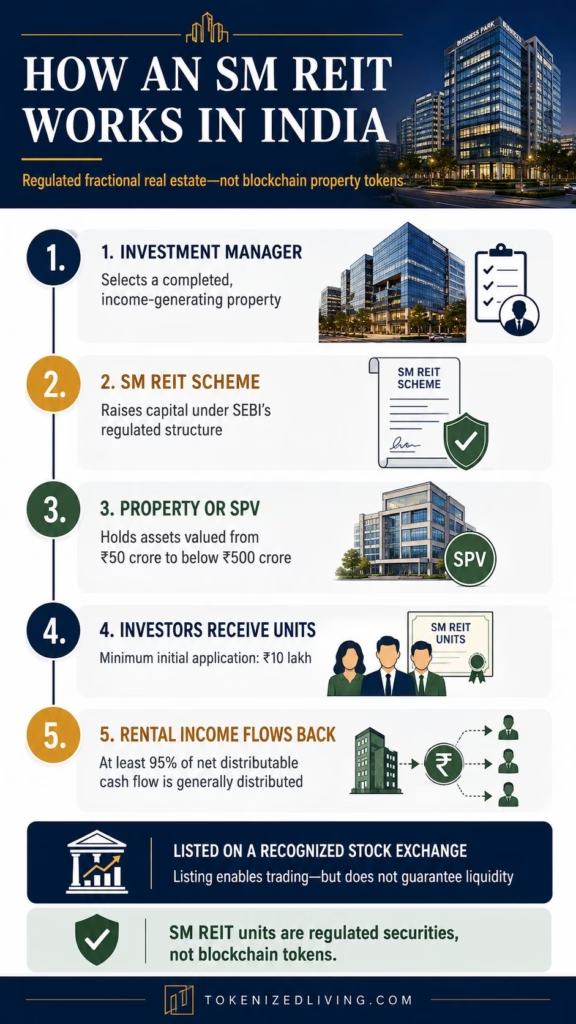
The ₹50 Crore to ₹500 Crore Property Range
Each SM REIT scheme must hold assets with a value of at least ₹50 crore and less than ₹500 crore.
This range separates SM REITs from larger conventional REITs.
A scheme cannot simply be used to divide a small apartment among a handful of investors. The framework is primarily designed for significant income-producing properties, such as:
- office buildings
- business parks
- warehouses
- retail properties
- other completed commercial assets
Properties worth ₹500 crore or more fall outside the small and medium scheme range and may be more appropriate for a conventional REIT structure.
Which Properties Can an SM REIT Hold?
SM REIT schemes must concentrate on completed, revenue-generating property.
At least 95% of the value of a scheme’s assets must generally be invested in completed and income-producing real estate. An SM REIT cannot use the scheme as a speculative fund for unfinished development projects.
This restriction reduces construction risk.
However, it does not make an SM REIT risk-free. A completed office building can still lose tenants, require expensive repairs or fall in value.
The distinction is that investors are funding an operating asset rather than depending primarily on a developer to complete construction.
How Much Do Investors Need?
The minimum application amount for an SM REIT initial offer is ₹10 lakh.
That is much lower than the cost of buying a complete institutional-grade commercial property. Yet it is still a substantial entry barrier for most retail investors.
Therefore, claims that SM REITs make commercial property accessible to everyone are exaggerated.
They improve access for affluent individuals and other investors who can commit at least ₹10 lakh to one offering. They do not provide the ultra-low entry levels associated with some international tokenized property platforms.
After listing, the market price and applicable trading rules determine how investors can buy or sell units through the exchange.
How Investors May Earn Returns
SM REIT investors can potentially receive returns from two principal sources.
Property income
Tenants pay rent to the entity holding the property. Operating costs, management expenses, financing costs and taxes are deducted before cash becomes available for distribution.
SM REIT schemes are required to distribute at least 95% of their net distributable cash flow, subject to the detailed calculation and applicable regulations.
Distributions must generally be made at least quarterly.
This does not mean investors receive 95% of the property’s gross rent. The requirement applies to net distributable cash flow after relevant expenses and adjustments.
Capital appreciation
If the property increases in value, the scheme’s units may also increase in value.
Investors may benefit by selling their units or when the underlying property is eventually sold. Conversely, they can lose money if the property value or market price of the units declines.
Neither rental income nor capital appreciation is guaranteed.
SM REITs Versus Traditional REITs
SM REITs and conventional REITs both provide indirect exposure to income-producing property, but their structures differ.
| Feature | SM REIT | Traditional REIT |
|---|---|---|
| Property scale | ₹50 crore to below ₹500 crore per scheme | Larger portfolios |
| Investment approach | Often scheme-specific or property-specific | Broad portfolio exposure |
| Initial minimum | ₹10 lakh application amount | Usually substantially lower through exchange trading |
| Property requirements | Primarily completed, revenue-generating assets | May hold a broader portfolio within REIT limits |
| Diversification | May depend heavily on one property | Usually spread across several assets |
| Listing | Mandatory | Mandatory |
| Main appeal | Targeted access to individual commercial assets | Diversified real estate exposure |
The scheme-specific structure can give investors more control over property selection.
It also creates concentration risk. If a scheme owns only one building and its main tenant leaves, the effect on income could be severe.
A large REIT with numerous buildings and tenants may be better able to absorb that problem.
SM REIT Units Are Not Property Tokens
The phrase “tokenized real estate” is frequently used as a loose description for almost any fractional property investment. Technically, that is wrong.
An SM REIT unit is a conventional regulated security.
Ownership and transactions are handled through India’s securities-market infrastructure, including stock exchanges, brokers and demat accounts. The unit does not need to exist on a public blockchain.
A tokenized real estate investment normally uses blockchain-based digital tokens to represent rights connected to:
- a property
- an SPV
- rental income
- property-backed debt
- another real estate security
Both structures can divide economic exposure to a property. The underlying technology and transfer systems are different.
| Feature | SM REIT unit | Blockchain property token |
|---|---|---|
| Recordkeeping | Securities-market and depository infrastructure | Blockchain ledger |
| Trading venue | Recognized stock exchange | Approved token platform or digital securities venue |
| Investor access | Broker and demat account | Platform account and potentially a digital wallet |
| Regulatory position in India | Specifically covered by SEBI’s SM REIT rules | No equivalent general property-token framework |
| Settlement | Conventional securities settlement | Blockchain-based transfer, subject to platform rules |
| Legal status | Listed security | Depends on the token and legal structure |
Readers who want the broader blockchain model can see our complete guide to tokenized real estate.
India’s First SM REIT Listings
The SM REIT market has progressed beyond regulatory proposals.
PropShare Platina, a scheme of Property Share Investment Trust, listed on the Bombay Stock Exchange on December 10, 2024. It was the first SM REIT scheme to reach the Indian public market.
PropShare Titania followed with its listing in August 2025.
On April 24, 2026, PropShare Celestia became the third SM REIT scheme listed by Property Share.
These launches matter because they demonstrate that the framework can support real offerings. However, three schemes do not constitute a mature market.
Investors still need evidence about:
- long-term distribution reliability
- secondary-market trading volumes
- tenant renewals
- property valuations
- management expenses
- performance during a real estate downturn
- the ease of selling large unit holdings
Early listings prove that the structure works operationally. They do not prove that every scheme will deliver attractive returns.
Does Exchange Listing Solve the Liquidity Problem?
A listing provides a mechanism through which investors can offer their units for sale.
That is better than an unlisted fractional ownership arrangement where investors may depend entirely on the platform to find another buyer.
Still, listing does not guarantee liquidity.
A seller needs a willing buyer. If trading volumes are low, an investor may have to accept a substantial discount or wait longer than expected.
Liquidity could be particularly limited when:
- the scheme has relatively few investors
- the underlying property experiences problems
- interest rates increase
- expected distributions fall
- buyers disagree with the reported property valuation
- the overall commercial property market weakens
This is also one of the most misunderstood claims surrounding blockchain tokenization. A digital unit can be technically transferable while remaining commercially difficult to sell.
Our guide to the benefits and risks of tokenized real estate explains why fractionalization and liquidity are not the same thing.
Principal Risks of SM REIT Investing
Property concentration
A scheme may rely on one building, location or major tenant. Poor performance at that asset can affect the entire investment.
Tenant risk
A financially weak tenant may miss payments. Alternatively, a major tenant may leave when its lease expires.
Valuation risk
Property valuations are professional estimates rather than guaranteed sale prices. The building may ultimately sell for less than its reported value.
Liquidity risk
Exchange listing does not ensure active trading or a buyer at the desired price.
Interest-rate risk
Higher interest rates can increase financing costs and make other income investments more competitive.
Management risk
Investors depend on the investment manager to select assets, negotiate leases, control expenses and manage conflicts of interest.
Regulatory and tax risk
Rules and tax treatment can change. The tax consequences may also vary according to the nature of each distribution and the investor’s circumstances.
High minimum exposure
The ₹10 lakh initial application requirement can leave investors with a significant amount concentrated in one scheme.

Could SM REITs Lead to Tokenized Real Estate in India?
The framework could provide part of the legal foundation for future digital securities, but it should not be described as blockchain regulation.
SM REITs show that SEBI accepts properly structured fractional real estate securities when they include registration, disclosures, professional management and investor safeguards.
A future blockchain-based system could potentially digitize some parts of this structure, such as:
- unit issuance
- ownership records
- compliance checks
- income distributions
- transaction settlement
- secondary transfers
Nevertheless, blockchain would not replace property law, securities regulation or investor protection requirements.
Any genuine tokenized property market in India would need clear rules covering custody, digital wallets, approved trading venues, identity verification and the legal status of on-chain records.
Until those issues are formally addressed, SM REITs and blockchain property tokens should be treated as related but separate models.
Are SM REITs Worth Considering?
SM REITs offer a more credible and regulated alternative to the informal fractional ownership structures that previously dominated this part of India’s property market.
Their strongest features include:
- access to selected commercial properties
- mandatory exchange listing
- defined disclosure requirements
- oversight by a trustee
- professional management
- exposure to rental income
- clearer investor rights
The weaknesses are equally important:
- the ₹10 lakh minimum remains high
- individual schemes may be poorly diversified
- market liquidity is still unproven
- returns depend on tenants and property performance
- fees reduce distributable income
- listing does not prevent capital losses
Investors should examine the property, tenants, leases, debt, fees and valuation assumptions before focusing on projected yields.
The regulatory label is useful, but it cannot rescue a bad building bought at an inflated price.
Final Thoughts
SEBI’s SM REIT framework is an important development for fractional real estate in India.
It moves eligible investment structures into a regulated market with listed units, independent oversight and clearer distribution rules. The first SM REIT listings show that the framework is already being used.
However, it is not a regulatory green light for blockchain-tokenized property.
SM REIT units are securities held and traded through conventional Indian market infrastructure. Blockchain property tokens remain a separate concept without an equivalent general framework in India.
The change is still significant. It gives fractional commercial property investment a clearer legal foundation and may eventually support more advanced digital ownership systems.
For now, the real achievement is regulation—not tokenization.