

Updated August 11, 2026
Stellar tokenization has spent more than a decade building blockchain infrastructure for payments and digital asset issuance. In 2026, that strategy is beginning to attract far greater institutional attention.
Franklin Templeton, WisdomTree, Spiko and other regulated financial companies have used Stellar to issue or distribute tokenized investment products. The network also reported that the value of its on-chain real-world assets exceeded $2 billion shortly after the first quarter of 2026.
Those figures make Stellar one of the more credible blockchain networks for real-world asset tokenization.
However, large headline numbers do not tell the entire story.
A tokenized fund may be recorded on Stellar while remaining available only to approved investors. An asset can also exist on-chain without having an active secondary market. Furthermore, investors normally depend on a regulated issuer to manage the off-chain securities and honor the rights represented by each digital token.
Stellar may improve the infrastructure behind an investment product. It does not remove the issuer, regulations or underlying financial risks.
TL;DR
- Stellar is a public blockchain designed around payments and asset issuance.
- The network reported more than $2 billion in on-chain real-world assets shortly after Q1 2026.
- Issuers can create assets using Stellar’s native ledger functions without developing a separate smart contract.
- Authorization, freezing and clawback controls can help institutions manage regulated assets.
- Soroban smart contracts provide additional programmability for more complex financial applications.
- Franklin Templeton’s BENJI fund is one of the best-established tokenized products on Stellar.
- WisdomTree offers multiple digital funds through its WisdomTree Prime platform.
- Stablecoins help connect tokenized assets with on-chain payments and settlement.
- Tokenization does not automatically provide public access or reliable liquidity.
- Stellar competes with Ethereum and other networks, but its payment-focused architecture gives it a different strengths-and-weaknesses profile.
- The Stellar Development Foundation’s reported figures should not be confused with independently guaranteed investor returns or trading volume.
What Is the Stellar Network?
Stellar is a public blockchain created to support payments, currency transfers and digital asset issuance.
The network launched in 2014. Its native cryptocurrency is lumen, normally identified by the ticker XLM.
Unlike proof-of-work blockchains, Stellar does not rely on cryptocurrency mining. Instead, validators use the Stellar Consensus Protocol to agree on the state of the ledger.
This approach allows the network to process transactions relatively quickly and with low fees. According to the Stellar Development Foundation, the network had processed 22.5 billion operations while maintaining 99.99% uptime by the end of the first quarter of 2026.
Low costs can be useful when a financial product needs to process frequent transfers, subscriptions, redemptions or distributions. Nevertheless, technical performance is only one part of institutional adoption.
A financial company must also consider:
- regulatory compliance
- investor identification
- asset custody
- transaction controls
- integration with existing systems
- privacy requirements
- operational reliability
- legal recognition of investor rights
Stellar’s main institutional argument is that many of these requirements can be supported through features built directly into the network.
How Asset Tokenization Works on Stellar
Tokenization involves creating a digital representation of an asset or financial right.
An issuer could use Stellar to represent:
- shares in an investment fund
- government securities
- corporate or private debt
- commercial real estate interests
- commodities
- fiat-backed stablecoins
- other regulated financial instruments
The token itself is not necessarily the underlying asset.
For example, a tokenized Treasury fund does not place a physical government bond inside a blockchain. A regulated organization acquires and manages the securities. Digital tokens then represent fund shares or associated ownership rights.
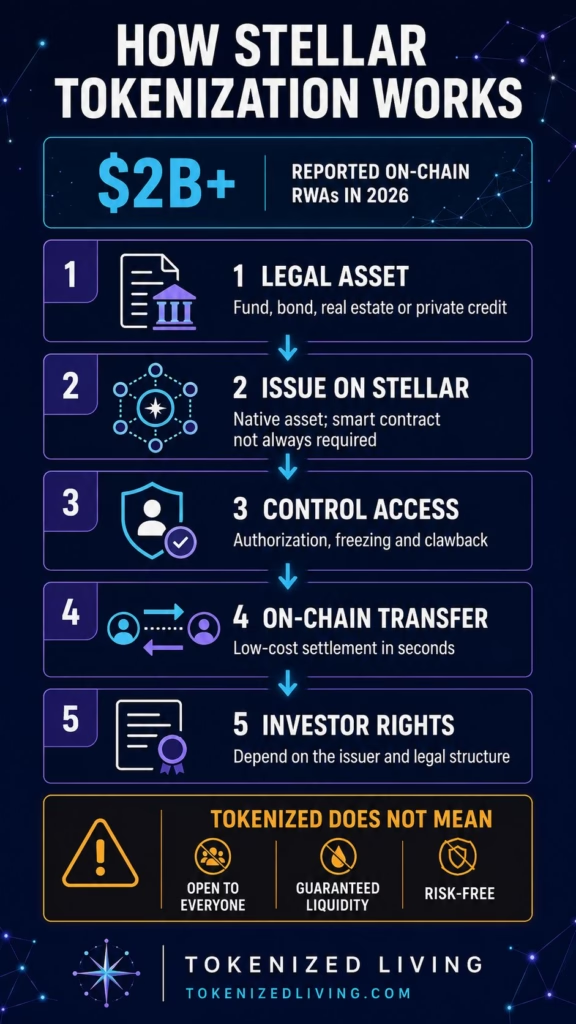
A simplified process may work as follows:
- An issuer establishes the legal investment product.
- Eligible investors complete identity and compliance checks.
- The issuer creates a corresponding asset on Stellar.
- Approved accounts are authorized to hold the asset.
- Investors subscribe using fiat currency or an accepted digital payment method.
- Tokens representing the investment are issued to approved accounts.
- Ownership changes are recorded on the Stellar ledger.
- Redemptions, transfers or distributions occur according to the issuer’s rules.
Blockchain improves the ownership and transaction layer. It does not eliminate the legal structure connecting the digital asset to the real investment.
For a broader explanation, see our guide to real-world asset tokenization.
Stellar Assets Do Not Always Need Smart Contracts
One of Stellar’s most important differences is frequently overlooked.
An issuer can create a digital asset using functions built into the Stellar ledger. It does not necessarily need to write and deploy a separate smart contract.
The asset is identified by its asset code and the account that issued it. Investors establish a trustline indicating that their account is willing and permitted to hold that particular asset.
This native model can reduce technical complexity. It also decreases the amount of custom code that an issuer must develop, audit and maintain.
For a straightforward regulated asset, the issuer may need controlled issuance and transfers rather than a highly customized decentralized application. Using established network-level functions can be attractive in that situation.
However, “no custom smart contract required” does not mean there is no operational complexity.
The issuer must still manage:
- wallet authorization
- identity verification
- investor records
- keys and account security
- subscriptions and redemptions
- regulatory reporting
- corporate actions
- links between on-chain and off-chain systems
Token issuance may be technically simple. Operating a compliant financial product is not.
Native Controls for Regulated Assets
Many cryptocurrency users expect tokens to be freely transferable between any two wallets. Regulated securities often cannot operate that way.
An issuer may be legally required to prevent sanctioned individuals, unverified investors or residents of restricted countries from holding its product. It may also need to correct fraudulent or legally invalid transactions.
Stellar provides several controls that can support these requirements.
Authorization
An issuer can require an account to receive approval before holding its asset.
Consequently, completing a blockchain transaction is not enough to gain access. An investor may first need to pass know-your-customer and anti-money-laundering checks.
This feature helps create a controlled group of eligible holders.
Revocable authorization and freezing
An issuer can revoke an account’s authorization to transact with an asset when the asset was configured to support that control.
The investor may still see the balance, but the account can be prevented from transferring it.
This power conflicts with the permissionless model associated with cryptocurrencies. Yet it may be essential for a regulated security.
Clawbacks
Clawback functionality allows an issuer to remove and burn an eligible asset from a holder’s balance.
It can be used in response to fraud, a court order, a regulatory action or certain recovery procedures. Stellar’s technical documentation on clawbacks explains how the function operates.
Again, this is not financial decentralization in its purest form.
The issuer retains significant control because the token represents an obligation or product it administers. Investors must understand that ownership of a regulated token may be subject to restrictions that do not apply to XLM or other unrestricted cryptoassets.
What Is Soroban?
Soroban is Stellar’s smart-contract platform.
Stellar introduced smart-contract functionality because native asset issuance cannot support every financial application. Developers sometimes need programmable logic for lending, collateral management, automated trading, structured products or complex compliance processes.
Soroban can support applications involving:
- decentralized exchanges
- lending and borrowing
- automated market makers
- collateralized transactions
- programmable distributions
- identity and compliance systems
- tokenized asset management
- settlement between different financial products
A native Stellar asset can also interact with Soroban applications through a corresponding Stellar Asset Contract.
This creates two broad approaches.
| Approach | Best suited to |
|---|---|
| Native Stellar asset | Straightforward issuance, payments and regulated transfers |
| Soroban contract token | Products requiring customized rules and programmability |
| Native asset plus Soroban | Existing Stellar assets that need access to programmable applications |
Soroban expands what developers can build. Still, it also introduces additional smart-contract risks.
Programming errors, weak access controls and poorly designed economic mechanisms can create losses. A financial institution must decide whether the benefits of custom logic justify the extra technical exposure.
Stellar’s Reported RWA Growth
The Stellar Development Foundation reported that on-chain real-world assets reached $785 million at the end of 2025. That represented an increase of 158% during the year.
The total passed $1 billion in the first week of January 2026. Shortly after the end of Q1, the foundation reported that the figure had exceeded $2 billion.
According to its Q1 2026 report, the increase came from several issuers and an expanding range of financial products.
The growth is significant. It suggests that Stellar is moving beyond small demonstrations and experimental token launches.
Nevertheless, the $2 billion figure requires context.
It represents the value of real-world assets recorded on the network. It does not necessarily represent:
- daily trading volume
- available market liquidity
- new money invested during the quarter
- assets accessible to the general public
- value locked in decentralized finance
- profits earned by token holders
Asset value and transaction activity measure different things.
A $500 million fund could have very little secondary trading. Conversely, a smaller stablecoin could generate substantial payment volume as the same units move repeatedly between users.
Therefore, Stellar’s RWA total demonstrates issuance and asset presence—not guaranteed investor demand.
Franklin Templeton and the BENJI Fund
Franklin Templeton provides Stellar’s most important institutional case study.
The Franklin OnChain U.S. Government Money Fund, also known as FOBXX, launched on Stellar in 2021. Its digital share token uses the ticker BENJI.
The fund invests primarily in:
- U.S. government securities
- cash
- repurchase agreements collateralized by government securities
BENJI tokens represent shares in a registered investment fund. They are not unsecured tokens issued merely because their market price is expected to rise.
Stellar serves as part of the fund’s official share-recording infrastructure. Approved investors can access the product through Franklin Templeton’s Benji Investments application, subject to eligibility and regulatory requirements.
Franklin Templeton selected Stellar partly because the network could support investor authorization, controlled transfers and clawbacks without requiring a bespoke smart contract for the basic token.
By 2026, Stellar reported that BENJI had approximately $654 million in assets under management on the network. However, the broader Franklin OnChain fund also uses additional blockchains, so figures for the entire fund should not automatically be attributed to Stellar.
The case demonstrates that a public blockchain can support a regulated investment fund for several years. It does not demonstrate that every Stellar token has equivalent legal protection or institutional backing.
Investors must evaluate the issuer and product—not simply the blockchain.

WisdomTree’s Tokenized Funds
WisdomTree has also used Stellar to support digital investment products.
The asset manager offers tokenized funds through WisdomTree Prime, a consumer-facing digital finance application. Its products include exposure to asset classes such as:
- U.S. government money markets
- fixed income
- equities
- digital assets
- gold
WisdomTree’s implementation highlights one of Stellar’s practical advantages. The company can issue fund interests using Stellar’s native asset functions rather than depending on a custom smart contract for each basic token.
Stellar reported in 2026 that WisdomTree offered 13 digital funds on the network.
Still, their presence on a public blockchain does not necessarily make the funds globally available. Eligibility depends on WisdomTree’s platform, applicable regulations and the investor’s jurisdiction.
This distinction matters across the tokenization industry.
A blockchain can operate continuously and globally while the regulated product built on it remains geographically restricted.
Spiko and Tokenized Treasury Products
Spiko provides tokenized money-market funds with exposure to short-term government securities.
Its European T-Bill product experienced substantial growth going into 2026. The Stellar Development Foundation reported that the product had grown from approximately $520 million to $970 million, with most of the increase represented on Stellar.
Tokenized money-market funds have become one of the strongest RWA categories because they address a clear on-chain need.
Cryptocurrency investors and financial platforms often hold stablecoins that do not automatically produce a return. A tokenized fund can provide regulated exposure to interest-bearing government securities while maintaining some blockchain-based transfer and settlement capabilities.
However, a fund token is not the same as a stablecoin.
Its value, income, settlement terms and redemption process depend on the fund structure. Investors may also face fees, eligibility requirements and delays that do not apply to a simple transfer of USDC.
Stablecoins and RWA Settlement
Stablecoins are essential to Stellar’s tokenization ecosystem.
A tokenized asset needs a reliable payment method. Without one, investors may have to leave the blockchain system whenever they subscribe, trade, receive income or redeem their holdings.
Fiat-backed stablecoins can act as digital settlement assets.
For example, an investor might:
- deposit conventional currency through a regulated provider
- receive a stablecoin on Stellar
- use it to purchase an eligible tokenized investment
- receive a stablecoin after selling or redeeming that investment
- transfer the proceeds or convert them back into fiat currency
USDC and other regulated digital currencies can therefore connect tokenized investments with payments.
Stellar reported $5.5 billion in stablecoin payment volume during Q1 2026, an increase of 72% from the same period a year earlier.
Stablecoin activity does not directly prove demand for every RWA product. Nevertheless, an active payment and settlement layer makes the network more useful to asset issuers.
Real Estate Tokenization on Stellar
Stellar’s RWA activity is not limited to investment funds and government securities.
The network’s 2025 report stated that RedSwan had issued and transacted more than $100 million in institutional commercial real estate on Stellar.
Real estate tokens may represent an interest in:
- a property-owning company
- a real estate fund
- property-backed debt
- rental income
- another legally structured security
They do not normally represent a deed transferred directly through the blockchain.
The legal entity remains critical. It determines what investors own, how income is distributed, who controls the property and what happens during a dispute or insolvency.
Blockchain records alone cannot guarantee that a building exists, has good tenants or was purchased at a sensible valuation.
Our complete guide to tokenized real estate explains the legal and technical layers behind these investments.
Ondo, Figure and Other Institutional Products
Stellar’s RWA ecosystem has expanded beyond its earliest Franklin Templeton and WisdomTree relationships.
Newer integrations have involved companies such as Ondo Finance, Figure and other issuers developing tokenized Treasuries, credit products and institutional settlement services.
These additions broaden the range of assets that could be issued, transferred or used across Stellar-based applications.
However, announcements must be treated carefully.
A company announcing support for Stellar does not prove that every proposed product is already live, fully funded or available to investors. Integration, issuance and meaningful market adoption are three separate stages.
Responsible analysis should distinguish between:
- a partnership announcement
- a technical integration
- a token issued on the network
- an actively funded product
- a liquid product accessible to investors
Tokenization projects frequently blur these stages to make their progress appear greater than it is.
The Tradable Private-Credit Agreement
In July 2026, Tradable announced an agreement to bring up to $1 billion of tokenized private-credit assets to Stellar.
The phrase “up to” is important.
It describes a potential amount under the agreement. It does not mean an additional $1 billion was immediately issued or deposited on Stellar when the announcement appeared.
Tradable had previously reported tokenizing $1.7 billion across approximately 30 private-credit positions on other infrastructure. Its Stellar integration is intended to support institutional assets, compliance workflows and on-chain investment processes.
Private credit could become an important tokenized asset class because the traditional market is frequently illiquid, administratively complex and difficult for smaller investors to access.
Yet tokenization does not remove its principal risks:
- borrower default
- unreliable valuations
- limited transparency
- long investment periods
- restricted transfers
- economic sensitivity
- weak secondary-market demand
Putting a private loan on Stellar may improve recordkeeping and settlement. It does not improve the borrower’s ability to repay.
Can Ordinary Investors Access Stellar’s RWAs?
Not necessarily.
A public blockchain can display an asset without making that asset publicly investable.
Access may depend on:
- country of residence
- investor accreditation
- identity verification
- issuer approval
- minimum investment amounts
- the distribution platform
- securities regulations
- wallet and custody requirements
Some products target retail investors in specific jurisdictions. Others are restricted to professional, institutional or accredited investors.
An investor may also see a token in a Stellar explorer but remain unable to purchase it. The issuer can require authorization before a wallet is permitted to hold the asset.
This is one reason total on-chain value can create a misleading impression of accessibility.
The infrastructure may be global. The investment product usually is not.
Does Tokenization Create Liquidity?
Tokenization can make an asset easier to divide and transfer. That does not guarantee an active market.
Genuine liquidity requires:
- willing buyers
- willing sellers
- clear pricing
- sufficient trading volume
- an approved marketplace
- regulatory permission to transfer
- reliable settlement
- market makers or other liquidity providers
A token may settle within seconds after a trade is agreed. Finding a buyer could still take days, weeks or longer.
Restricted securities face an additional difficulty. Buyers may need to complete verification and meet eligibility standards before receiving the token. That reduces the potential market.
Tokenization can improve the mechanics of secondary trading. It cannot manufacture demand for an unattractive investment.
This distinction is especially important for real estate and private credit, where underlying assets are naturally less liquid than publicly traded stocks or government bonds.

Stellar Versus Ethereum for Tokenization
Ethereum currently has the larger blockchain ecosystem and deeper decentralized-finance markets. It also supports a broad range of token standards, applications, custody providers and trading venues.
Stellar follows a more specialized approach.
| Feature | Stellar | Ethereum |
|---|---|---|
| Original focus | Payments and asset issuance | General-purpose smart contracts |
| Basic token issuance | Native ledger assets available | Usually created through smart contracts |
| Custom programmability | Soroban | Ethereum Virtual Machine |
| Issuer controls | Native authorization, freezing and clawback options | Usually implemented through token contracts |
| Transaction costs | Generally low | Vary according to network demand and scaling network |
| DeFi ecosystem | Smaller but developing | Much larger and more established |
| Institutional RWA presence | Strong in funds, payments and settlement | Broader ecosystem and greater overall scale |
| Liquidity opportunities | More limited | Generally deeper, although product-specific restrictions remain |
Stellar’s native asset controls can reduce complexity for regulated issuers. Its lower fees also suit frequent payments and settlement.
Ethereum offers broader programmability, more developers and a larger on-chain financial ecosystem. However, institutions may need to rely on customized smart contracts or specialized token standards to implement compliance controls.
Neither network is automatically superior for every project.
The appropriate choice depends on the asset, issuer, required controls, expected users and intended trading environment.
What Role Does XLM Play?
XLM is Stellar’s native cryptocurrency.
It is used to:
- pay network transaction fees
- meet minimum account balance requirements
- support certain trading and payment functions
- discourage spam and excessive ledger entries
XLM does not provide ownership in the Stellar Development Foundation. It also does not give holders a legal claim on the tokenized funds and securities issued on the network.
Growth in Stellar’s RWA value could increase network usage. Nevertheless, it does not create a guaranteed relationship between RWA adoption and the price of XLM.
An institution can issue a large tokenized fund while using relatively little XLM for fees because Stellar transactions are inexpensive.
Therefore, “Stellar has $2 billion in RWAs” is not a sound standalone argument for buying XLM.
The network’s success and the token’s market price are connected only indirectly.
Benefits of Using Stellar Tokenization
Native asset issuance
Companies can issue controlled digital assets without building every feature through a custom smart contract.
Built-in compliance controls
Authorization, freezing and clawback options can help regulated issuers meet legal and operational requirements.
Low transaction costs
Small fees support frequent payments, transfers and distributions.
Fast settlement
Transactions can reach finality in seconds, reducing delays between agreement and settlement.
Public ledger transparency
Authorized participants and observers can verify on-chain issuance and transfers, subject to how the product is structured.
Stablecoin infrastructure
Digital currencies can support subscriptions, redemptions and cross-border settlement.
Soroban programmability
Developers can create more advanced applications around native and contract-based assets.
Established institutional examples
Franklin Templeton’s multi-year use of Stellar provides stronger evidence than a short-lived pilot or partnership announcement.
Limitations and Risks
Issuer risk
A token remains dependent on the organization responsible for the underlying asset and investor rights.
Smart-contract risk
Soroban applications and custom tokens may contain vulnerabilities or design errors.
Custody risk
Investors can lose access through compromised keys, platform failures or weak custody arrangements.
Regulatory restrictions
A token may be transferable technically but prohibited from being sold to a particular investor.
Liquidity risk
An on-chain asset can have few buyers and limited secondary-market activity.
Oracle and data risk
Blockchain systems depend on external information for valuations, interest calculations and events involving off-chain assets.
Centralized controls
Freezing and clawback functions give issuers considerable authority over token holders.
Blockchain dependence
Network interruptions, protocol problems or infrastructure failures could disrupt transactions.
Valuation uncertainty
Reported on-chain asset value does not prove that the assets could immediately be sold for the same amount.
Marketing inflation
Announced pipelines and potential issuance are frequently presented as though the assets are already live.
Investors should assess the benefits and risks of tokenized assets before assuming that blockchain infrastructure makes an investment safer.
Is Stellar Leading RWA Tokenization?
Stellar has built a credible position, particularly in tokenized investment funds, payment infrastructure and controlled asset issuance.
Franklin Templeton’s operating history on the network is meaningful. WisdomTree and Spiko add further institutional weight, while Soroban gives developers more room to build programmable financial products.
The reported increase from $785 million in RWAs at the end of 2025 to more than $2 billion shortly after Q1 2026 is also substantial.
Still, calling Stellar the unquestioned leader would be promotional rather than analytical.
Ethereum and several competing networks support larger or rapidly growing tokenized asset ecosystems. Private and permissioned blockchain systems also remain important to banks and financial-market operators.
Stellar’s real advantage is more specific.
It combines a public network, inexpensive settlement, native asset controls and an established payments focus. That combination appears particularly suitable for regulated issuers that need more control than a typical cryptocurrency token provides.
Final Thoughts
Stellar has progressed from a blockchain known primarily for cross-border payments into credible infrastructure for tokenized real-world assets.
Its native issuance model allows institutions to create controlled digital assets without always relying on custom smart contracts. Soroban adds programmability when a product needs more complex financial logic.
Franklin Templeton, WisdomTree and Spiko demonstrate that recognized asset managers can use the network for live financial products. Stellar’s reported RWA growth in 2026 suggests that institutional adoption is accelerating.
Nevertheless, tokenization should not be mistaken for automatic accessibility, liquidity or safety.
Most tokenized securities still depend on regulated issuers, approved investors and off-chain assets. Transfers can be restricted, accounts can be frozen and secondary markets may remain thin. Announced issuance may also take months or never reach the projected amount.
Stellar is improving the infrastructure used to issue and move financial assets. It is not eliminating the institutions, laws or investment risks behind them.
That less dramatic conclusion is also the more important one: Stellar’s progress comes from making regulated finance work on a public blockchain—not from pretending regulation no longer matters.