
Updated August 12, 2026
Music tokenization can turn royalty income, copyright interests, or other music-related rights into digital assets recorded on a blockchain.
However, buying a music token does not automatically mean owning part of a song.
One token might provide a share of future streaming royalties. Another may offer exclusive content, concert access, or voting privileges. Some tokens are little more than digital collectibles.
Therefore, the important question is not whether a music asset uses blockchain. It is what legal rights sit behind the token.
In 2026, the strongest music tokenization projects are moving beyond speculative NFTs. Instead, they focus on royalty financing, fractional music rights, automated payments, and better ownership records.
Yet blockchain cannot repair a weak contract, resolve a copyright dispute, or create liquidity where no buyers exist.
TL;DR: Music tokenization can give artists new ways to raise money and help investors access royalty income. Nevertheless, the token is only the digital wrapper. Its value depends on the underlying rights, legal agreement, royalty performance, platform structure, and ability to resell.
This article is for informational purposes only and does not provide financial, legal, or tax advice. Music-rights investments can lose value and may be difficult to sell.
What Is Music Tokenization?
Music tokenization is the process of using blockchain-based tokens to represent rights, benefits, or financial interests connected to music.
The token could represent:
- A contractual share of future royalties
- An interest in a song or music catalogue
- Partial ownership of a company holding music rights
- Access to exclusive content or events
- Membership in an artist community
- A collectible digital edition
- Voting or participation rights
This is an application of the wider process explained in our guide to what tokenization means.
Music tokenization and fractional ownership are closely connected. However, they are not identical.
Fractional ownership divides an asset or income stream among several participants. Tokenization records or manages those interests through blockchain-based tokens.
A royalty interest can be divided without using blockchain. Likewise, a music token can exist without providing fractional ownership.
That distinction matters because marketing language often blurs the two.
Understanding Music Rights Before Buying Tokens
A recorded song normally involves more than one set of rights.
According to the U.S. Copyright Office, the musical composition and the sound recording are separate copyright-protected works. Different people or companies may own and license them.
Composition rights
Composition rights cover the underlying music and lyrics.
These rights may belong to:
- Songwriters
- Composers
- Music publishers
- Other parties that purchased the rights
Composition owners may earn mechanical, performance, and synchronization royalties.
Master recording rights
Master rights apply to a particular recorded version of the song.
They may belong to:
- The performing artist
- A record label
- A production company
- An investor or catalogue owner
Master-rights income can come from streaming, downloads, licensing, and certain public performances.
Royalty rights
A royalty right provides a claim on specified income. It does not necessarily transfer copyright ownership or creative control.
For example, an artist might sell 10% of the royalties generated by a master recording for ten years. The artist could retain the copyright while sharing part of the income.
Therefore, an investor must identify the exact right behind the token.
What Does a Music Token Actually Represent?
Different music products can look similar on a website while providing completely different rights.
| Product | What the buyer receives | Royalty income? | Copyright ownership? |
|---|---|---|---|
| Collectible music NFT | Digital artwork, audio, or limited-edition content | Usually no | No |
| Fan-access token | Membership, rewards, voting, or special access | Usually no | No |
| Royalty token | Contractual share of specified royalty income | Yes | Usually no |
| Tokenized security | Equity, debt, or another regulated financial interest | Possibly | Depends on structure |
| Copyright interest | A share of underlying music rights | Potentially | Yes or partial |
| Conventional royalty share | Royalty participation managed without blockchain | Yes | Usually no |
Never assume that “owning part of a song” means owning the copyright.
The purchase agreement, offering document, and rights schedule determine what the buyer receives. The token description alone is not enough.
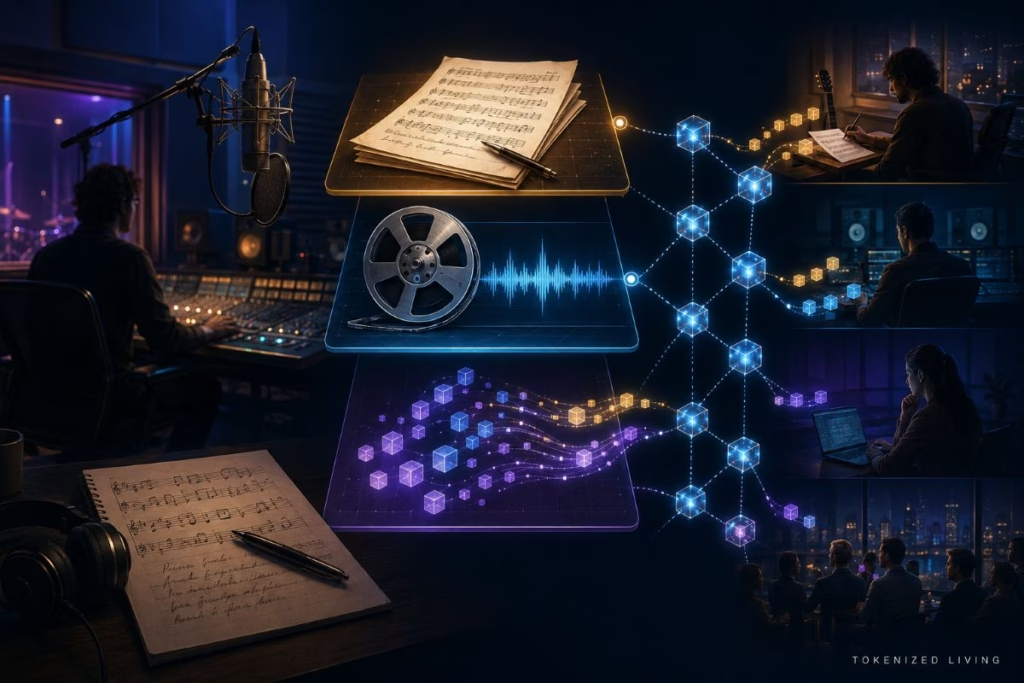
How Does Music Royalty Tokenization Work?
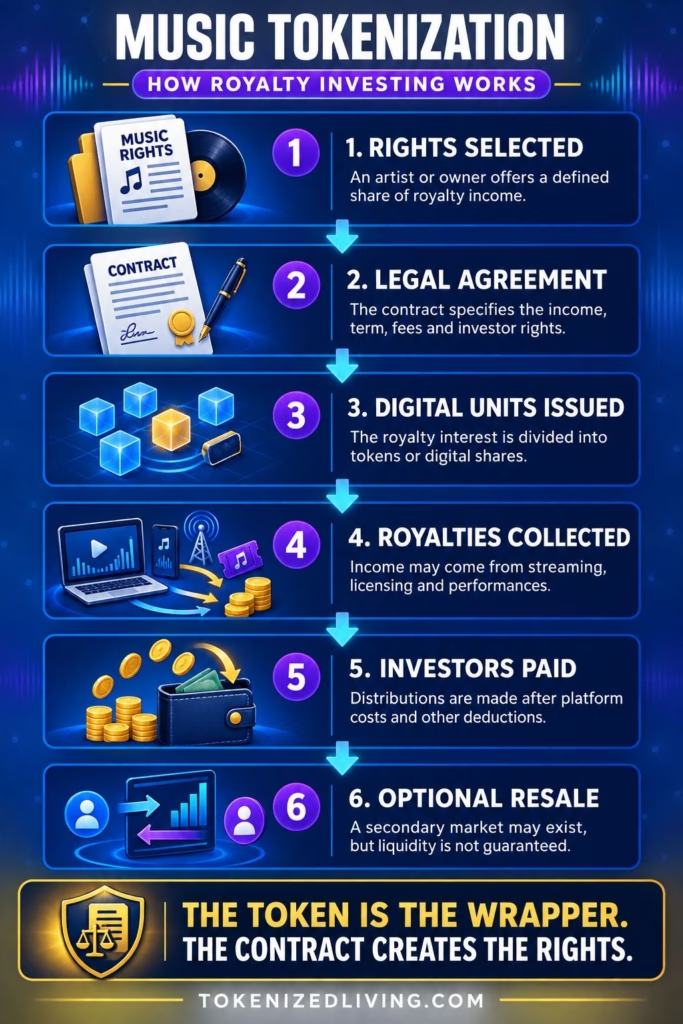
The exact process varies. However, a rights-backed offering generally follows several stages.
1. A rightsholder selects the music rights
An artist, songwriter, publisher, label, or catalogue owner decides which rights or royalty streams to offer.
The offering may cover one song, several tracks, or an entire catalogue.
2. The platform verifies the rights
The platform should confirm that the seller owns or controls the rights being offered.
This stage may include:
- Copyright records
- Distribution agreements
- Royalty statements
- Publishing contracts
- Ownership splits
- Existing licenses
- Disputes or financial claims
Poor verification creates a major risk. Blockchain can preserve a record, but it cannot prove that the original information was accurate.
3. A legal structure connects the rights to investors
The music rights might be placed in a special-purpose company. Alternatively, investors may receive a contractual claim on part of the income.
The legal agreement should explain:
- Which royalties are included
- How long the entitlement lasts
- What fees will be deducted
- Who collects the income
- Whether the interest can be transferred
- What happens if the platform closes
This legal connection gives the token meaning.
4. Tokens or digital shares are issued
The offering is divided into smaller units.
For example, a rightsholder could divide 20% of a royalty stream into 10,000 units. Each unit would then represent one ten-thousandth of that allocated income.
However, the investor would not automatically own one ten-thousandth of the complete song.
5. Investors purchase the units
Depending on the platform, buyers may pay using fiat currency, stablecoins, or other cryptocurrencies.
Some platforms require identity verification. Others restrict participation by country or investor type.
6. Royalties are collected off-chain
This stage is frequently misrepresented.
Spotify does not normally send revenue directly to a token holder’s blockchain wallet. Music income still travels through labels, distributors, publishers, performance-rights organizations, collection societies, and other administrators.
For example, The Mechanical Licensing Collective collects certain U.S. digital mechanical royalties. Other organizations handle different types of music income.
The platform or legal entity then receives the relevant royalties and calculates each investor’s share.
7. Investors receive distributions
After fees and expenses, investors receive their share of the available royalty income.
Payments may arrive monthly, quarterly, semi-annually, or according to another schedule.
Therefore, “real-time blockchain royalties” should not be confused with real-time collection from streaming services. Blockchain may accelerate the final distribution stage, but it does not control the entire royalty system.
8. Tokens may enter a secondary market
Some platforms allow investors to list their interests for resale.
Nevertheless, a secondary marketplace does not guarantee liquidity. A seller still needs a willing buyer at an acceptable price.
Where Does Music Royalty Income Come From?
Music can generate income from several sources.
These include:
- Interactive streaming
- Digital downloads
- Radio and public performance
- Physical music sales
- Film, television, advertising, and gaming licenses
- Social media and user-generated content
- Cover versions
- Live performances
- International collection societies
The royalty mix depends on the rights included in the offering.
For example, a token linked only to master-recording income may not receive songwriting royalties. Similarly, a publishing interest may earn from the composition without receiving the label’s share of streaming revenue.
Investors should also understand that royalties fluctuate.
An old song may gain attention after appearing in a television series. Meanwhile, another track could lose listeners as music trends change.
Historical revenue helps with analysis. However, it does not guarantee future income.
How Can Investors Make Money?
Investors generally have two possible return sources.
Royalty distributions
The first is income generated by the underlying music rights.
Suppose an investor pays $100 for a royalty interest. If that interest produces $7 after fees during one year, the cash yield would be 7%.
However, that calculation says nothing about changes in the investment’s resale value.
Reselling the interest
An investor may also profit if another buyer pays more for the token or royalty share.
Still, the reverse can happen.
If the investor receives $7 in royalties but can only resell the interest for $85, the total position has lost value.
Returns may also be reduced by:
- Platform fees
- Royalty administration costs
- Currency conversion
- Blockchain transaction fees
- Withholding taxes
- Personal tax obligations
- Reduced streaming activity
Consequently, headline yield figures should never be viewed in isolation.
How Can Music Tokenization Help Artists?
Music tokenization can provide alternatives to traditional financing.
Access to upfront capital
An artist can sell part of a future royalty stream to fund recording, marketing, touring, or another project.
This may offer more flexibility than selling an entire catalogue or accepting a traditional label advance.
Retaining part of the rights
A carefully structured offering could allow the artist to raise money while keeping most copyright ownership and future income.
However, this depends entirely on the agreement.
Stronger fan participation
Fans may become more engaged when they share in a project’s success.
Nevertheless, financial participation also changes the relationship. Fans who become investors may expect reporting, payments, and financial performance.
More efficient royalty splitting
Smart contracts and digital payment systems can help divide revenue among artists, producers, writers, and investors.
Companies such as Revelator use digital contracts, automated splits, and blockchain-based payment tools for music-rights administration.
Even so, the system still depends on accurate ownership data and royalty reports.
Greater transparency
Blockchain records can provide a visible history of token transfers and distributions.
Yet transparency has limits. On-chain records do not automatically reveal every off-chain deduction, licensing dispute, or missing royalty payment.
Artists should compare tokenization with other choices. These may include crowdfunding, conventional royalty financing, distribution advances, private catalogue sales, or label funding.
If tokenization adds high legal and platform costs without improving the deal, it offers little advantage.
Music Tokenization Platforms and Examples in 2026
The market contains several different business models. They should not be treated as interchangeable.
| Platform | Main function | Important distinction |
|---|---|---|
| Bolero | Music-rights investment through Song Shares and Catalog Shares | Digital-asset model linked to royalty-producing rights |
| ANote Music | Marketplace for shares in music catalogues and royalty interests | Fractional royalty investing does not automatically equal blockchain tokenization |
| Revelator | Rights management, royalty accounting, smart contracts, and payments | Infrastructure provider rather than a retail investment marketplace |
| Audius | Decentralized music platform with direct artist sales and token-based features | Not the same as buying fractional royalty rights |
| Royal | Early song-token and streaming-royalty model | Important historical example, but should not be presented as a broad active 2026 marketplace |
Bolero
Bolero offers Song Shares and Catalog Shares linked to music rights and royalty income.
Its current terms warn about capital loss, illiquidity, and valuation risk. That warning deserves more attention than the projected yields displayed beside individual listings.
Investors still need to inspect which master, publishing, or licensing rights support each offer.
ANote Music
ANote Music allows users to buy shares connected to music catalogues and receive a proportion of specified royalties.
The platform clearly states that owning a share provides a royalty interest. It does not automatically provide ownership of the songs themselves.
ANote also operates a secondary marketplace. Nevertheless, sellers are not guaranteed an immediate buyer.
Its royalty distributions may be monthly, quarterly, or semi-annual, depending on the catalogue. Therefore, claims that music royalties always arrive instantly would be false.
ANote is also a useful reminder that fractional royalty investing can work through contractual and centralized structures. Not every digital music share needs to be a blockchain token.
Revelator
Revelator provides technology for rights management, accounting, royalty splits, smart contracts, and global payments.
It shows how blockchain may improve the industry’s back-office infrastructure without selling speculative music NFTs to fans.
This may ultimately become a more valuable use of blockchain than collectible token launches.
Audius
Audius allows artists to upload music, sell content, and receive direct payments. The network also uses the AUDIO token for ecosystem features.
However, holding AUDIO or buying an artist’s content does not mean owning part of that artist’s copyright or royalties.
Audius belongs in the broader blockchain-music discussion. It should not be described as a tokenized royalty marketplace.
Royal
Royal became one of the best-known examples from the music NFT period. Its Song Tokens combined digital assets with defined streaming royalty rights and fan benefits.
However, Royal’s current homepage says its team is working on new products. Therefore, it is more accurate to describe Royal as an influential early model than as a leading active marketplace for new royalty offerings.
This change illustrates a wider lesson: platform risk is real, even when the company has recognizable founders, artists, and investors.
Music NFTs vs Tokenized Music Royalties
Music NFTs and royalty tokens can both use blockchain. Beyond that, they may have little in common.
A collectible NFT gains value from scarcity, artist popularity, community demand, and attached benefits. It may provide access to unreleased music, merchandise, or events.
For the practical side of fan access, our guide to setting up token-gated events explains wallet checks, ticket presales and admission rules.
A tokenized royalty interest gains value from a legal claim on income.
Some products combine both models. For example, a token could provide exclusive content and a small royalty share.
Investors must separate the collectible value from the financial value.
This mirrors problems seen in art tokenization and fractional ownership. A blockchain certificate connected to an asset is not automatically the same as legally enforceable ownership.
Our guide to NFTs and tokenization in gaming and entertainment examines the collectible and access-based models in more detail.
The Biggest Risks of Tokenized Music Rights
Music royalties can produce income. However, tokenizing them does not make them safe.
Unclear ownership
Several parties may hold interests in the same song.
An offering could face problems if a seller lacks authority to transfer the promised income.
Royalty decline
A song’s popularity can fall. Changes to streaming rates, licensing rules, consumer behavior, or platform algorithms may also reduce income.
Illiquidity
A secondary market may have few buyers.
As a result, investors might need to accept a large discount or hold the asset for years.
Platform failure
The platform may close, change its business model, restrict withdrawals, or lose essential partners.
Investors must determine whether their rights continue independently if the platform disappears.
Valuation risk
Music catalogues are difficult to value.
Recent viral success can make projected returns look better than the catalogue’s sustainable performance. Older songs can also experience long-term revenue decline.
Fee complexity
Management, administration, trading, withdrawal, and currency-conversion fees can reduce returns.
Investors should calculate expected income after every deduction.
Regulatory risk
A token tied to passive income or a financial claim may fall under securities or investment-product rules.
In January 2026, the U.S. Securities and Exchange Commission explained that placing a security on a blockchain does not change its underlying legal nature.
Rules vary by jurisdiction and product structure. Therefore, a platform’s use of words such as “utility,” “collectible,” or “community” does not settle the legal question.
Technology and custody risk
Wallet theft, lost credentials, smart-contract bugs, and incorrect transfers can cause permanent losses.
A platform-controlled wallet also creates counterparty risk.
Tax complexity
Royalty income, token sales, and cryptocurrency payments may receive different tax treatment.
Foreign withholding taxes can further complicate returns.
Is Blockchain Really Necessary for Music Royalties?
Blockchain can improve specific parts of the process.
It may help with:
- Recording token ownership
- Enforcing transfer restrictions
- Automating payment splits
- Creating auditable distribution records
- Supporting global digital payments
- Connecting wallets with verified identities
- Operating a regulated secondary market
However, blockchain cannot:
- Prove that a seller owns the rights
- Resolve conflicting copyright claims
- Force streaming services to report accurate data
- Guarantee future royalty income
- Create buyers for an unpopular token
- Replace every label, publisher, administrator, or collection society
- Protect investors from a bad legal agreement
In other words, blockchain can improve the wrapper and payment rails. The underlying music rights still need conventional contracts, administration, and enforcement.
This practical approach reflects the broader shift described in our Tokenization 2026 overview. Real adoption depends on useful infrastructure and enforceable rights, not token issuance alone.
How to Evaluate a Music Tokenization Investment
Before buying any music-related token, ask these questions:
- What exact right supports the token?
Identify whether it covers publishing, master rights, royalty income, equity, or only access benefits. - Does the seller control those rights?
Look for verified contracts, royalty statements, and ownership records. - How long does the entitlement last?
Some agreements continue indefinitely. Others expire after a fixed term. - Which income sources are included?
Streaming income alone is different from a combination of streaming, performance, mechanical, and synchronization royalties. - Are the figures gross or net?
Check what expenses and fees are deducted before distributions. - Who collects and distributes the money?
The process should remain understandable from the royalty payer to the investor. - What happens if the platform fails?
Investors need enforceable rights that do not vanish with the website. - Can the token actually be resold?
Review trading volume, transfer restrictions, withdrawal rules, and wallet compatibility. - How concentrated is the investment?
One track creates far more concentration risk than a diversified catalogue. - Which laws apply?
Confirm investor eligibility, securities treatment, tax obligations, and geographic restrictions.
This due-diligence process also applies when evaluating other tokenized real-world assets.
Red Flags to Avoid
Avoid platforms or offerings that:
- Promise guaranteed returns
- Claim guaranteed liquidity
- Cannot identify the underlying rights
- Use “ownership” without explaining the legal structure
- Display projections without historical royalty statements
- Depend on new token buyers to fund existing investors
- Hide fees inside vague distribution calculations
- Offer no plan for platform insolvency
- Give the issuer broad power to change investor rights
- Treat celebrity involvement as proof of investment quality
A popular artist can still be attached to a bad deal.
The Future of Music Tokenization
Music tokenization is unlikely to replace the entire music industry.
Labels, publishers, distributors, collection societies, and rights administrators still perform essential functions. Meanwhile, music ownership remains legally complicated and geographically fragmented.
Nevertheless, tokenization can improve how specific rights are financed, divided, recorded, and paid.
The most credible growth areas include:
- Fractional access to established catalogues
- Artist financing backed by future royalties
- Automated payments to collaborators
- On-chain ownership and distribution records
- Regulated markets for transferable music interests
- Stablecoin payments for international rights holders
- Better connections between royalty data and investor reporting
Collectible music NFTs may continue as fan products. However, they should not be confused with income-producing rights.
The industry’s future will probably combine traditional copyright law, contractual royalty rights, regulated marketplaces, and blockchain-based infrastructure.
That is less revolutionary than the early Web3 promises. It is also much more realistic.
Final Verdict
Music tokenization can create new funding options for artists and open royalty investing to a wider audience.
However, the token itself creates little value.
The real asset is the legally enforceable right to receive income or control intellectual property. Everything else depends on that foundation.
Investors should focus on contracts, royalty history, fees, liquidity, and platform failure protections. Artists should compare the long-term cost of selling future income with other financing options.
Music tokenization has genuine potential. Nevertheless, it will reshape the industry only when the rights behind the tokens are clearer than the marketing around them.
Frequently Asked Questions
Is music tokenization the same as a music NFT?
No. A music NFT may provide a collectible, exclusive content, or fan benefits. A tokenized music asset may represent royalty income, copyright ownership, or another financial interest. The legal agreement determines the difference.
Do music token holders own the song?
Usually not. Many products provide only a contractual share of specified royalties. Owning copyright requires a clear legal transfer of the relevant rights.
How do music royalty investors get paid?
Royalties are normally collected through labels, publishers, distributors, collection societies, or administrators. The platform then calculates and distributes the investor’s share after fees.
Are tokenized music royalties securities?
Some may qualify as securities or regulated investment products. The answer depends on the structure, investor rights, marketing, and jurisdiction. Calling a token an NFT or utility token does not automatically remove financial regulations.
Can I sell a music royalty token at any time?
Not necessarily. Some platforms provide secondary markets, but trading volume may be limited. A listed token is not automatically a liquid token.
What happens if the tokenization platform closes?
The outcome depends on the legal structure. Properly documented rights may continue outside the platform. Weak arrangements may leave investors dependent on the failed operator. This risk must be checked before investing.
Are music royalties passive income?
They can provide periodic income, but returns are not guaranteed. Royalty levels, fees, taxes, platform performance, and resale values can all change.
Is music tokenization a good investment?
It may suit investors who understand alternative assets, copyright risk, and illiquidity. However, it should not be treated as a guaranteed-income product. Thorough due diligence remains essential.
Overcoming Challenges with Blockchain
The traditional mechanisms of royalty payments and copyright management are fraught with challenges. From complex royalty structures to the difficulties in tracking music usage and distribution, artists often find themselves navigating a labyrinth of inefficiencies. Tokenization introduces a novel solution to these issues by leveraging blockchain’s inherent transparency and security to streamline royalty payments and copyright protection .
Blockchain’s role in the music industry extends beyond simplifying transactions to enhancing the relationship between artists and their fans. By facilitating peer-to-peer transactions, blockchain technology minimizes the role of intermediaries, ensuring a larger share of revenue reaches the creators directly. Therefore, the direct engagement model not only benefits artists financially but also fosters a deeper connection with their audience.