
Updated: September 9, 2026
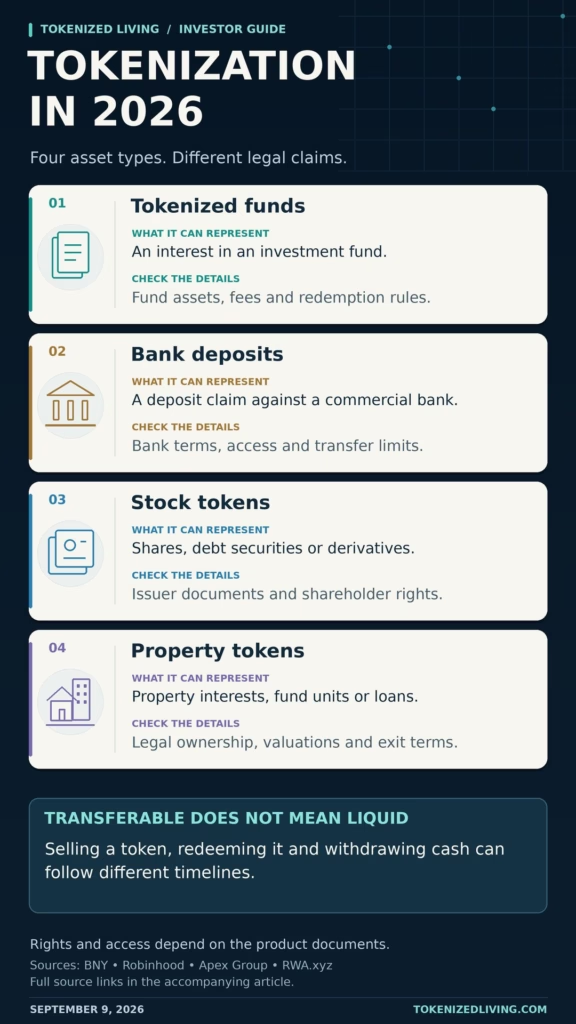
Tokenization in 2026 includes investment funds, stock-linked products, property fund units and digital representations of bank deposits. However, these developments sit at different stages of adoption.
Some products already serve eligible investors. Banks have introduced institutional capabilities, while central banks and commercial institutions continue testing new payment systems. Other projects still have planned launch dates.
The useful question is what each system actually does today. A transferable investment token, a mirrored bank record and a payment prototype solve different problems.
This overview examines the market figures, confirmed developments and practical limits as of September 9, 2026. For the underlying concepts, start with our beginner’s guide to real-world asset tokenization.
Key Tokenization Developments in 2026
The following milestones distinguish product launches, regulatory changes and controlled testing. A launch announcement does not establish unrestricted access or an active secondary market.
| Development | Dated milestone | What the evidence establishes |
|---|---|---|
| BNY digital deposits | January 9, 2026 | Launched mirrored deposit records for participating institutional clients; broader cash automation remains a goal. |
| FCA fund tokenization framework | April 30, 2026 | Published final guidance and new fund-dealing rules, including an optional Direct to Fund model. |
| LRC property fund collaboration | June 4, 2026 | Announced a fund launch using blockchain-native units and established fund service providers. |
| Robinhood’s newer Stock Tokens | July 1, 2026 | Launched wallet-based tokens for eligible users; Classic Stock Tokens continue separately. |
| Project Agorá | July 2026 | Completed controlled transactions involving real money; remains a prototype project. |
| ECB Pontes | Third quarter of 2026 target | The ECB page still describes the initial launch as planned at this update. |
How Large Are Selected Tokenized Markets?
Market-size claims depend on what a provider measures. Asset value, transaction volume and a manager’s total business are different numbers.
RWA.xyz distinguishes distributed assets from represented assets. Distributed assets can move outside the issuing platform and between wallets, including transfers subject to eligibility controls. Represented assets remain within the issuing platform and primarily support recordkeeping.
These categories describe transferability. Neither label establishes investment quality or universal access. RWA.xyz explains the distinction in its distributed and represented asset methodology.
The dashboards showed these selected values on September 9, 2026. All figures are in US dollars.
| Selected market | Distributed value | Represented value | Dashboard coverage |
|---|---|---|---|
| US Treasury funds | $15.87 billion | $50.31 million | US government debt and Treasury-focused money market funds. |
| Tokenized stocks | $2.88 billion | $23.71 million | Listed stocks and ETFs, including native and synthetic structures. |
| Tokenized real estate | $226.54 million | $279.84 million | Ownership interests, funds, REITs and property-backed debt. |
This is a snapshot of selected categories covered by one provider, rather than a complete valuation of global tokenization. Stablecoins and other asset classes are outside this table.
The figures show scale differences between these categories. They do not reveal how quickly an investor could sell a particular holding.
Tokenized Treasuries and Funds: Established Products, Different Models
Treasury products combine familiar underlying investments with blockchain-based ownership records or distribution. Nevertheless, the token’s structure determines how investors hold, transfer and redeem their exposure.
Our BlackRock BUIDL guide examines one institutional fund model. Different products can have different eligibility requirements, custody arrangements and dealing schedules.
Our explanation of why Wall Street is tokenizing Treasuries examines the practical uses for cash management, collateral and settlement, alongside the limits on access and redemption.
Mirrored Records Do Not Establish Instant Settlement
The BNY and Goldman Sachs money market fund initiative dates from July 23, 2025.
Its design lets investors subscribe and redeem through BNY’s LiquidityDirect platform. GS DAP creates corresponding mirror tokens, while BNY maintains the official books, records and settlement arrangements.
The announcement described improved transferability and collateral use as future opportunities. Therefore, its existence does not prove that every participating fund offers instant redemption or unrestricted transfers.
This distinction remains useful when comparing products in 2026. Ask whether the blockchain maintains the authoritative ownership record, distributes fund interests or mirrors an existing system.
Our Calastone fund-distribution explanation explores another approach to bringing existing funds onto blockchain infrastructure.
Cash Equivalents Require a Separate Assessment
Tokenization does not make an investment equivalent to cash.
Under IAS 7, qualifying investments need short maturities, high liquidity and conversion into a known cash amount. Exposure to value changes must also be insignificant.
A Treasury or money market fund label alone does not settle that accounting assessment. Product terms and the relevant accounting requirements still matter.
Private credit deserves particular care. Borrower defaults, uncertain recoveries and withdrawal restrictions make a blanket description of credit tokens as cash equivalents misleading.
Bank Deposits and Cross-Border Payments
Bank tokenization concerns the movement and representation of money, as well as investment products. Here, distinguishing a launched capability from a complete payment network is especially important.
BNY Starts With Mirrored Deposit Balances
BNY’s January 2026 launch creates digital entries representing participating clients’ existing demand deposit claims against the bank. Its private, permissioned blockchain operates alongside traditional records.
Initial applications focus on collateral and margin workflows. BNY describes broader rules-based, near-real-time cash movement as a future objective in its launch explanation.
The claim remains against a commercial bank. That differs from a fund share, and eligibility depends on the particular service.
For another banking initiative, see our explanation of the UK’s tokenized deposit pilot.
Project Agorá Tests Real-Value Transactions
Project Agorá combines tokenized commercial bank deposits and central bank reserves within a shared payment prototype.
According to the Bank for International Settlements, July 2026 testing involved 28 financial institutions and central banks. Participants completed transactions worth approximately CHF 800,000 across selected currencies.
This was controlled testing involving real monetary value. It demonstrated a working approach, but did not establish a generally available production network.
The project explores atomic settlement, where linked transfers complete together or do not complete. However, broad deployment still requires operational, legal and system-integration work.
For another approach to cross-border bank payments, our Swift tokenized-deposit explainer examines how its shared ledger coordinates payments and settlement.
Tokenized Stocks: More Access, Different Ownership Rights
Stock tokens bring familiar companies into blockchain wallets. Their legal design still determines whether holders own shares, hold a debt security or enter a derivative contract.
Robinhood’s July 2026 announcement introduced newer wallet-based Stock Tokens while retaining its European Classic product.
The newer tokens are debt securities issued by Robinhood Assets (Jersey) Limited. Classic tokens are derivatives with Robinhood Europe. Neither grants legal ownership of the underlying company shares.
Those distinctions affect custody, dividends and exit arrangements. Our Robinhood Stock Tokens review explains both products.
Coinbase-issued stock tokens have also launched on Base for eligible users outside the United States. The Base launch explanation confirms that availability, while our Coinbase tokenized stocks guide examines the structure and US distinctions.
These launches expand distribution, but availability remains product-specific. An issuer’s regulatory position does not make every token suitable or accessible everywhere.
Tokenized Credit: Examine the Underlying Exposure
Credit tokenization can involve corporate lending, receivables, property-related loans and investment funds. Grouping everything under “private credit” obscures the underlying risks.
In March 2026, RWA.xyz changed its classification framework. Its Credit category now combines previously separate Private Credit and Corporate Bonds categories, covering public and private non-sovereign borrowers.
Consequently, an older private-credit total and a current Credit figure may measure different things. Comparisons need consistent definitions.
For individual products, useful questions include who owes the money, what collateral supports repayment and which investors absorb losses first. Servicing quality also matters when payments arrive late or borrowers default.
Blockchain records can improve visibility into transactions. They cannot independently establish a borrower’s ability to repay or the enforceability of collateral.
Our Centrifuge review examines infrastructure connecting investment funds and blockchain applications. Assess each underlying product separately from the platform’s own token or corporate story.
Tokenized Real Estate: Fund Units and Property Rights
Real estate tokenization covers several legal arrangements. A property fund unit, company share and secured loan provide different rights, even when each uses a token.
On June 4, 2026, Apex Group announced a property fund collaboration involving LRC Group, Goldman Sachs, Archax and Ownera.
GS DAP tokenizes the fund shares. LRC manages the real estate, while the other participants support custody, distribution, connectivity and fund services.
This is an example of blockchain-based fund units within an established investment structure. The announcement identifies further transferability as a future opportunity, so it does not establish an already liquid property exchange.
Investors still need to understand the fund documents, fees, valuations and redemption provisions. Holding a fund token does not directly place an investor’s name on a property’s land title.
Our guide to institutional adoption of tokenized real estate examines this model in more detail.
Regulation and Settlement Infrastructure Are Moving at Different Speeds
The UK’s fund framework and the Eurosystem’s settlement plans illustrate two separate tasks: adapting investment rules and improving payment infrastructure.
UK Fund Rules Have Moved Beyond Consultation
On April 30, 2026, the FCA published guidance supporting tokenization within its fund rules. New rules also provide an optional Direct to Fund model, enabling investors to deal directly with a fund.
That dealing model can apply to traditional and tokenized funds. It is therefore inaccurate to describe the FCA’s position only as a 2025 consultation. The FCA’s final announcement explains the change.
Regulatory support does not guarantee that a particular fund will lower fees or process withdrawals instantly. Those outcomes depend on implementation and product terms.
Pontes Remains a Planned Launch in the Source
The ECB describes Pontes as a connection between market blockchain platforms and TARGET Services for wholesale settlement in central bank money.
At this September 9 update, its Pontes page still lists the initial launch as planned for the third quarter of 2026. A target window should not be reported as a confirmed operational launch.
Our European tokenization market overview provides the wider context for investment products and settlement infrastructure.
What Investors Should Check Behind the Token
Technology can change how a financial product operates without removing its underlying risks.
The Financial Stability Board’s 2024 tokenization report identified vulnerabilities involving liquidity, leverage, asset quality, interconnectedness and operational weaknesses. Those categories remain useful questions when examining 2026 products; the report’s old market-size assessment should not be treated as current data.
Before comparing advertised returns, establish five things:
- Your legal claim. Identify the issuer, governing documents and the rights attached to your investment.
- Eligibility and custody. Confirm permitted jurisdictions, investor requirements, wallet restrictions and who controls the underlying assets.
- The full exit process. Distinguish selling to another investor, redeeming with the issuer and withdrawing money to a bank.
- Costs and valuation. Examine management charges, spreads, conversion costs and how the product prices its underlying assets.
- Failure arrangements. Check what happens if the platform, custodian, issuer or technology provider stops operating.
A blockchain may accept transfers around the clock while a fund processes redemptions only during specified windows. Similarly, a token can be transferable while attracting few willing buyers.
Our secondary-markets guide explains liquidity, while our financial-stability analysis examines wider dependencies and risks.

What to Watch Through the Rest of 2026
The strongest evidence of progress will be repeat use under normal operating conditions.
For payment projects, watch for confirmed production launches, participating institutions and published operating limits. In investment markets, look for actual issuance, trading depth and reliable redemptions.
Cost claims also need evidence. Faster token transfers are useful, but the relevant comparison includes onboarding, custody, compliance and the final cash withdrawal.
This is an assessment of what would demonstrate adoption, rather than a prediction that every project will meet its targets before December.
Frequently Asked Questions
What is happening with tokenization in 2026?
Live funds and stock-linked products coexist with institutional banking services, controlled payment trials and planned settlement infrastructure. Their maturity and access conditions differ. A dated project status is more useful than treating every announcement as an operational launch.
How big is the tokenized asset market?
There is no single comparable figure without a defined scope. On September 9, RWA.xyz reported $15.87 billion in distributed Treasury products and $2.88 billion in distributed stocks. Those categories exclude stablecoins and many other assets; the table above links to each dashboard.
Does tokenization guarantee instant settlement or liquidity?
No. Blockchain transfer, trading execution, fund redemption and bank withdrawal are separate steps. Each can have different operating hours, restrictions and counterparties. A functioning token does not guarantee an available buyer.
Are tokenized funds cash equivalents?
Not automatically. Accounting classification depends on the underlying investment and applicable requirements, including liquidity, maturity and exposure to changes in value. Tokenizing a private-credit investment does not make it equivalent to cash.
Do tokenized stocks and property tokens provide direct ownership?
It depends on the legal structure. Some tokens represent ownership interests; others provide fund exposure, debt claims or derivatives. Check the governing documents to establish your rights in the underlying company or property.