
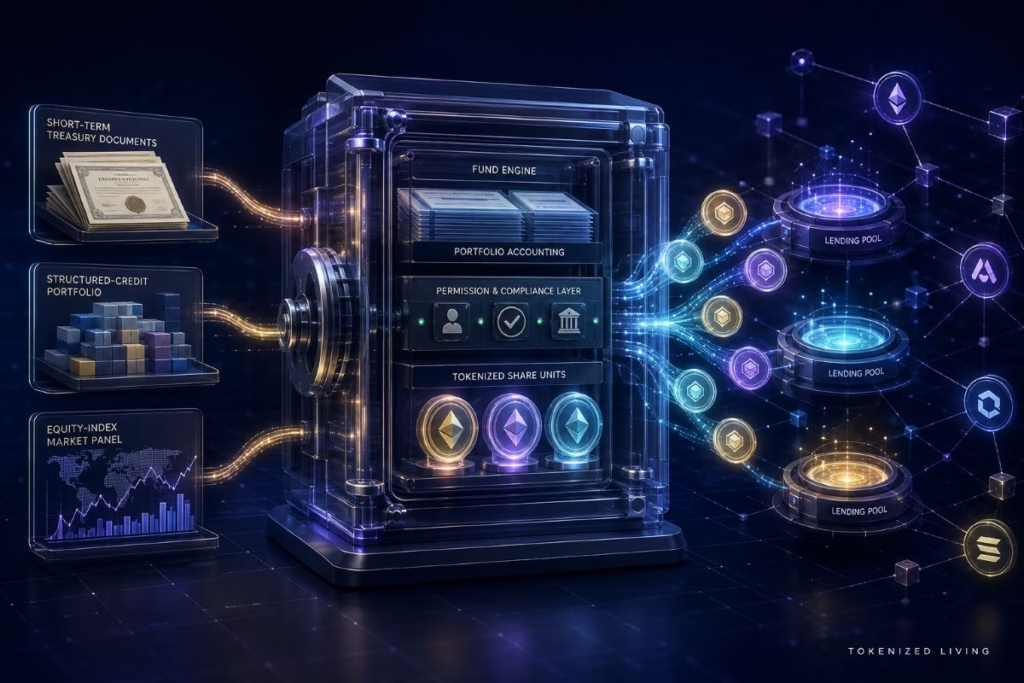
Centrifuge has evolved from an experimental DeFi lending protocol into a major institutional tokenization platform.
Its infrastructure supports tokenized Treasury funds, collateralised loan obligations, private credit, index products and onchain investment vaults. Furthermore, Centrifuge works with organisations including Janus Henderson, Apollo, S&P Dow Jones Indices, Sky, Aave and Morpho.
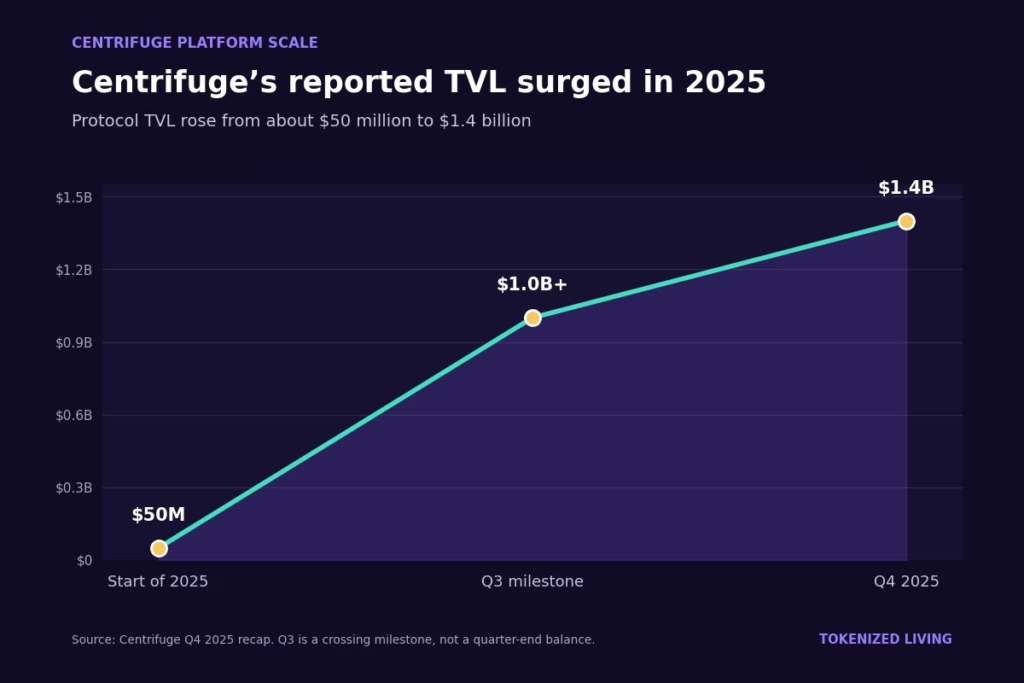
The company says more than $2 billion in real-world assets have been tokenized through its infrastructure. However, that figure should not be confused with current total value locked or assets under management.
Centrifuge has also moved far beyond Tinlake, the protocol described in many older reviews. Its current V3 infrastructure focuses on multichain fund issuance, onchain accounting, investor permissions and integration with decentralised finance.
Nevertheless, Centrifuge is not a simple retail investment marketplace.
Many underlying funds restrict access according to professional-investor status, location and KYC requirements. Its DeFi-compatible tokens introduce additional smart-contract, liquidity, cross-chain and regulatory risks.
Moreover, a major proposal unveiled in August 2026 could allow eligible CFG holders to exchange their tokens for private-company shares. That proposal remains unresolved.
This Centrifuge review examines the platform, its leading funds, deRWA tokens, investor access, fees and the risks surrounding CFG.
Last updated: August 30, 2026.
Important 2026 update: Centrifuge has proposed restructuring around private-company equity. Eligible CFG holders may eventually be able to subscribe for shares using their tokens. However, the proposal has not been completed, eligibility remains subject to legal requirements and the resulting shares would be illiquid for the foreseeable future.
Centrifuge Review: The Short Version
Centrifuge provides infrastructure for creating, managing and distributing tokenized financial products.
Its current services include:
- Tokenized fund creation
- Onchain share issuance
- Investor permissions and transfer controls
- Multichain distribution
- Fund accounting and NAV calculations
- Subscription and redemption vaults
- Portfolio-management tools
- DeFi-compatible asset wrappers
- White-labelled tokenization infrastructure
- Tokenized equity recordkeeping
- Reporting and asset verification
- Integration with lending and collateral protocols
According to the current Centrifuge documentation, more than $2 billion has been tokenized through the platform.
| Area | Assessment |
|---|---|
| Tokenization infrastructure | Strong |
| Institutional partnerships | Strong |
| DeFi integration | Exceptional |
| Onchain accounting | Advanced |
| Retail accessibility | Limited and product-specific |
| Public pricing | Limited |
| Secondary liquidity | Varies considerably |
| Smart-contract complexity | High |
| CFG outlook | Uncertain because of the equity proposal |
| Best suited to | Asset managers, protocols and eligible investors |
Centrifuge is one of the strongest technical platforms in this series. However, buying CFG does not provide ownership of the funds or assets using Centrifuge.
What Is Centrifuge?
Centrifuge launched in 2017 with the goal of connecting real-world assets with blockchain-based capital.
Its early systems focused on financing invoices, loans and other private-credit assets. Asset originators could represent financial claims onchain and use those claims to obtain liquidity.
That model helped prove that offchain credit could interact with DeFi.
However, the modern platform serves a much broader institutional market.
Centrifuge now helps asset managers and financial companies:
- Create tokenized investment products
- Issue blockchain-based fund shares
- Control who can invest
- Manage subscriptions and redemptions
- Calculate and publish fund values
- Distribute products across several networks
- Connect eligible assets with DeFi
- Operate tokenized portfolios
- Provide onchain reporting
- Support regulated tokenized equity
Centrifuge is therefore better understood as onchain asset-management infrastructure.
It is not simply a cryptocurrency protocol. Likewise, it is not a retail marketplace offering unrestricted access to every fund.
Readers unfamiliar with the wider process can review our guide explaining how to tokenize an asset.
What Happened to Tinlake?
Tinlake was Centrifuge’s original Ethereum-based securitization protocol.
It divided investment pools into two main tranches:
- DROP tokens: Senior exposure with priority during repayments
- TIN tokens: Junior exposure that absorbed losses first
Borrowers or asset originators could tokenize financial claims. Investors then supplied capital to the relevant pool.
Tinlake played an important historical role. It also connected selected real-world assets with MakerDAO.
However, Tinlake is now a legacy protocol.
Centrifuge’s own legacy documentation traces the transition from Tinlake to a Substrate-based Centrifuge Chain and then to the current V3 platform.
Therefore, presenting Tinlake as Centrifuge’s main product in 2026 is misleading.
The platform has moved towards EVM-native, multichain infrastructure designed for institutional funds and asset managers.
How Does Centrifuge Work?
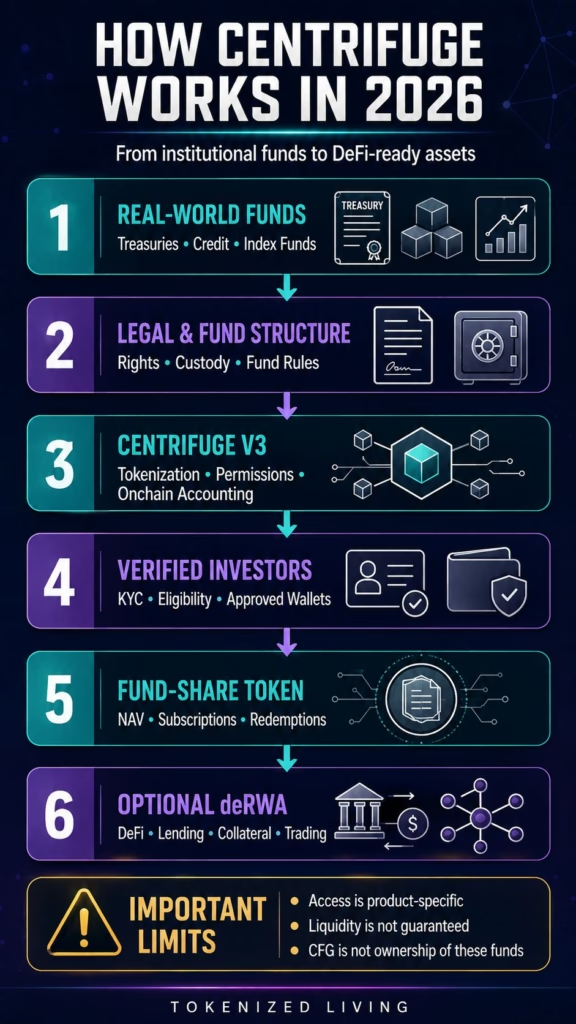
Each product has its own legal and operational structure. Nevertheless, a typical Centrifuge deployment follows several stages.
1. Create the Legal Investment Structure
The issuer first defines the underlying asset, investor rights and legal entity.
A token does not create ownership by itself. Legal agreements must connect the token with a fund share, debt claim, equity interest or another enforceable right.
Issuers may therefore need:
- Securities lawyers
- Fund administrators
- Custodians
- Asset managers
- Auditors
- Valuation providers
- KYC and AML services
- Banking or stablecoin partners
Centrifuge supplies infrastructure, but it does not eliminate these parties.
2. Configure the Tokenized Product
The issuer creates a Centrifuge pool and defines its share classes.
Different classes can carry different fees, rights, risks and redemption conditions.
The manager can also configure:
- Accepted investment currencies
- Minimum investments
- Transfer restrictions
- Investor permissions
- Lockup periods
- Subscription limits
- Redemption processes
- Management fees
- Administrative roles
Centrifuge’s RWA Launchpad provides pre-built components for these functions.
3. Verify Investors
Many products require identity verification.
Investors may need to provide:
- Government identification
- Address information
- Tax details
- Source-of-funds evidence
- Business documents
- Professional-investor verification
- Sanctions information
Approved wallets can join a product’s member list.
However, approval on one network does not automatically provide approval on every other network.
4. Deposit Investment Capital
Approved investors deposit a supported asset into a vault.
USDC frequently serves as the settlement currency. Nevertheless, each product decides which currencies and networks it accepts.
Some vaults execute deposits immediately. Others use request-based processing because the fund manager must move capital into offchain assets.
5. Receive Tokenized Fund Shares
The investor receives tokens representing shares in the relevant product.
These tokens may record:
- The number of shares
- The investor’s ownership position
- Transfer permissions
- Redemption rights
- Accumulated value
- The relevant share class
However, investors must still read the legal documents. The blockchain token does not replace the fund memorandum or subscription agreement.
6. Update the Fund’s Value
Centrifuge V3.1 introduced a more advanced onchain accounting system.
The platform can record assets, liabilities and investor equity using double-entry accounting. It can then calculate net asset value and distribute updated share prices across supported networks.
Centrifuge describes this architecture in its V3.1 technical overview.
Still, some inputs originate offchain.
Custodians, fund administrators, managers and verification services must provide accurate information about the underlying assets.
Blockchain can make published data easier to inspect. It cannot guarantee that the original information is true.
7. Process Redemptions
Investors eventually submit redemption requests.
Some products may offer same-day or faster processing. Others need several business days or longer.
Real-world assets cannot always settle immediately. Therefore, Centrifuge supports asynchronous vaults that separate the request, approval and final claim.
Its explanation of asynchronous vaults confirms that instant settlement is often unsuitable for institutional assets.
8. Use Eligible Tokens in DeFi
Selected tokens can enter lending, collateral and trading protocols.
For example, eligible Centrifuge assets have integrations involving Aave, Morpho, Sky and other onchain platforms.
This composability represents one of Centrifuge’s strongest advantages.
However, it also adds another layer of risk.
Centrifuge, Anemoy, deRWA and CFG Explained
These names describe different parts of the ecosystem.
| Name | Function |
|---|---|
| Centrifuge | Tokenization and onchain asset-management infrastructure |
| Anemoy | Asset-management and legal structuring for selected funds |
| JTRSY, JAAA and SPXA | Individual investment products |
| deRWA tokens | More transferable DeFi-compatible representations |
| CFG | The ecosystem token, currently subject to a proposed equity conversion |
Confusing these layers leads to serious mistakes.
An investor who buys CFG does not own shares in JTRSY or JAAA. Furthermore, a fund’s assets do not directly back the CFG token.
Similarly, an investment in JTRSY provides exposure to that specific Treasury fund. It does not represent equity in Centrifuge.
Centrifuge’s Main Tokenized Products
The available catalogue changes over time. Furthermore, each product has different eligibility and risk requirements.
Representative products include:
| Product | Exposure | Important limitation |
|---|---|---|
| JTRSY | Short-term US Treasury bills | Professional-investor and jurisdictional requirements |
| JAAA | AAA-rated collateralised loan obligations | Credit, liquidity and structural risk |
| SPXA | S&P 500 index strategy | Product and regional restrictions |
| deSPXA | DeFi-compatible SPXA exposure | Restricted jurisdictions and wrapper risk |
| ACRDX | Apollo diversified private-credit strategy | Private-credit and valuation risk |
| deJTRSY | DeFi-compatible JTRSY exposure | Liquidity and wrapper dependencies |
| deJAAA | DeFi-compatible JAAA exposure | CLO, DeFi and secondary-market risks |
Asset-manager involvement does not guarantee returns.
Investors must investigate the specific fund, not merely the Centrifuge technology supporting it.
JTRSY: Tokenized US Treasury Exposure
The Janus Henderson Anemoy Treasury Fund is Centrifuge’s best-known Treasury product.
JTRSY invests in short-term US Treasury bills. Janus Henderson acts as sub-investment manager, while Anemoy operates the fund structure.
The collaboration began with the Anemoy Liquid Treasury Fund before the product adopted the JTRSY name. Janus Henderson’s original announcement confirms the relationship.
Centrifuge reported that JTRSY crossed $1 billion during the first quarter of 2026. However, assets subsequently moved below that milestone.
That change matters.
AUM represents a point-in-time measurement. It can rise after subscriptions and fall after redemptions. Therefore, historical peak figures should not be presented as permanent current assets.
JTRSY has also received strong fund ratings. S&P initially assigned an AA+f/S1+ rating and subsequently upgraded the fund.
Nevertheless, a high fund rating does not guarantee against:
- Smart-contract failures
- Custody problems
- Stablecoin disruptions
- Redemption delays
- Operational mistakes
- Sanctions or regulatory restrictions
- Losses caused by fraud
- DeFi integration failures
Investors must separate the credit quality of the Treasury portfolio from the wider tokenization structure.
Our article covering BlackRock’s BUIDL tokenized fund provides another example of institutional Treasury exposure moving onchain.
JAAA: Tokenized AAA CLO Exposure
JAAA provides exposure to a strategy involving AAA-rated collateralised loan obligations.
CLOs package pools of corporate loans into different risk levels. Senior AAA tranches receive payment before lower-ranking tranches.
That structure generally reduces credit risk compared with junior CLO exposure. However, it does not eliminate risk.
JAAA launched with significant institutional backing. Centrifuge and Janus Henderson announced a proposed $1 billion allocation through Grove and the Sky ecosystem. Centrifuge’s JAAA announcement explains the structure.
However, an allocation, commitment and current AUM are not the same measurement.
Investors should avoid treating a headline commitment as permanently deployed capital.
JAAA also carries more complexity than a short-term Treasury fund. Important risks include:
- Corporate credit defaults
- CLO structure risk
- Interest-rate changes
- Manager selection
- Valuation uncertainty
- Redemption constraints
- Counterparty exposure
- DeFi liquidation risk
The AAA label applies to the underlying rated exposure. It does not transform every connected blockchain or DeFi protocol into an AAA-rated system.
SPXA and deSPXA
SPXA provides onchain exposure to an S&P 500 index strategy.
Centrifuge developed Proof-of-Index infrastructure with licensed data from S&P Dow Jones Indices. The system allows a fund to demonstrate that it follows the relevant index methodology without publishing every confidential operational detail.
Centrifuge later introduced deSPXA on Base.
The deRWA version aims to make the exposure easier to trade and use across DeFi. However, Centrifuge’s deSPXA announcement states that the product targets eligible non-US users.
Authorised participants manage primary creation and redemption.
Therefore, deSPXA should not be described as unrestricted global access to the S&P 500.
Moreover, the product introduces several layers of exposure:
- The index strategy
- The underlying securities
- The fund structure
- The token
- The deRWA wrapper
- The blockchain network
- The relevant DeFi protocols
- Secondary-market liquidity
Each layer can fail differently.
What Are deRWA Tokens?
Centrifuge created deRWA tokens to make institutional assets more usable within DeFi.
A traditional permissioned fund token may only move between approved wallets. That restriction makes integration with decentralised exchanges and lending protocols difficult.
A deRWA structure creates a more transferable token connected with the underlying fund exposure.
Potential uses include:
- Decentralised trading
- Lending collateral
- Stablecoin reserves
- Structured-yield strategies
- Onchain savings products
- Liquidity pools
- Cross-chain distribution
- Institutional treasury management
However, the wrapper does not erase securities laws or product restrictions.
“Freely transferable” describes the token’s technical design. It does not mean every person in every country can legally buy or use it.
Furthermore, minting and redeeming the underlying fund exposure may still depend on authorised or verified participants.
Does Centrifuge Provide Real DeFi Integration?
Yes. This area separates Centrifuge from many tokenization providers.
Several platforms can issue a digital security. Fewer have built products that actively connect with lending, collateral and liquidity protocols.
Centrifuge assets have entered ecosystems involving:
- Aave
- Morpho
- Sky
- M0
- Stellar applications
- Solana applications
- Base-based DeFi
- Stablecoin infrastructure
For example, JTRSY can serve as eligible collateral within selected institutional systems. Meanwhile, deRWA tokens can interact with approved lending and trading applications.
Still, DeFi integration creates new risks.
A secure underlying fund can suffer losses when used in an unsafe lending protocol. Investors may also face liquidations after borrowing against an asset.
Therefore, users must assess both the tokenized fund and every connected DeFi protocol.
Does Centrifuge Democratize Access to Institutional Assets?
Only partially.
Tokenization can reduce operational barriers. It can also make fund shares easier to distribute across different networks.
However, many Centrifuge products remain designed for professional, institutional or otherwise eligible investors.
Restrictions can involve:
- Investor classification
- Country of residence
- US-person status
- Minimum investment
- KYC approval
- Source-of-funds checks
- Wallet approval
- Sanctions screening
- Transfer restrictions
Direct access to JTRSY, for example, does not mean that every retail investor can open an account and invest.
deRWA tokens may widen secondary access. Nevertheless, buyers remain responsible for complying with local laws and platform rules.
Consequently, Centrifuge has improved the infrastructure for institutional asset distribution. It has not made every institutional fund universally accessible.
Readers looking for a broader purchasing explanation should review our guide to buying tokenized assets.
How to Invest Through Centrifuge
The exact process depends on the product.
1. Select the Investment
The investor reviews the available funds and tokenized strategies.
They should examine the underlying assets before considering yield or blockchain features.
2. Check Eligibility
The product documentation explains who can participate.
Investors must confirm jurisdiction, professional status and minimum-investment requirements.
3. Complete Verification
Eligible applicants complete KYC and AML checks.
Business investors may also need KYB verification and ownership documents.
4. Connect an Approved Wallet
The investor links a supported wallet.
The product may add that address to an approved member list.
5. Deposit the Supported Currency
The investor supplies USDC or another accepted currency.
Network and conversion costs may apply.
6. Receive Fund Tokens
After processing, the investor receives tokens representing their fund interest.
Timing depends on the product and vault structure.
7. Hold, Transfer or Use the Tokens
Some tokens can move between approved wallets. Others may integrate with DeFi or have a deRWA version.
However, every additional transaction can introduce fees and risks.
8. Request Redemption
The investor eventually returns the tokens and requests the settlement asset.
The fund may process redemptions immediately, on the same day or after a longer period.
Centrifuge Fees and Pricing
Centrifuge does not publish one universal investor fee schedule.
Costs depend on the individual fund, asset manager, network and method of access.
Investors should check for:
- Fund management fees
- Administration expenses
- Custody costs
- Performance fees
- Subscription charges
- Redemption fees
- Instant-liquidity charges
- Stablecoin conversion costs
- Blockchain transaction fees
- DeFi borrowing costs
- DEX trading fees
- Price slippage
- Cross-chain costs
- Foreign-exchange expenses
A historical allocation application for JTRSY stated a 0.25% annual management fee. However, investors must verify the current offering documents because fees and product terms can change.
Asset managers seeking Centrifuge infrastructure must request pricing directly.
Centrifuge Whitelabel and the RWA Launchpad reduce development work. Still, a complete launch may also require legal, regulatory, custody and administration services.
Therefore, the absence of simple public pricing makes early comparison difficult.
Which Blockchains Does Centrifuge Support?
Centrifuge moved away from its former Polkadot-based chain architecture during 2025.
V3 uses an EVM-native hub-and-spoke design. A central hub coordinates accounting, permissions and share prices while users interact through vaults on supported networks.
Products and integrations have reached networks including:
- Ethereum
- Base
- Arbitrum
- Avalanche
- BNB Chain
- Plume
- Solana
- Stellar
Further integrations involve cross-chain infrastructure from providers such as Wormhole and LayerZero.
However, not every product exists on every network.
Additionally, direct fund tokens and their DeFi wrappers may have different availability.
Businesses should examine our guide to choosing a blockchain for a tokenization project before focusing on network branding.
How Secure Is Centrifuge?
Centrifuge has invested heavily in security reviews.
The company reported more than 20 reviews of its core contracts by the end of 2025. Its current documentation also highlights an extensive audit history.
That record is positive. However, audits do not guarantee that every contract is free from vulnerabilities.
Centrifuge’s risk surface includes:
- Core smart contracts
- Vault extensions
- Manager permissions
- Cross-chain messaging
- Price oracles
- Stablecoins
- Wallet security
- DeFi integrations
- Fund administrators
- Custodians
- Asset managers
- Legal entities
- Offchain data providers
Multichain deployment increases distribution. It also creates more technical dependencies.
For example, a cross-chain messaging failure could delay transactions or produce inconsistent information between networks.
Likewise, a correct blockchain record can still contain inaccurate offchain data.
Serious investors should ask:
- Which contracts control the product?
- Who audited those contracts?
- Who can pause or upgrade them?
- Which administrators control investor permissions?
- How does the fund verify offchain assets?
- Which entity holds the underlying securities?
- What happens if an oracle fails?
- Which bridge or messaging provider does the product use?
- How does the fund handle compromised wallets?
- What incident-response process applies?
- Can the manager freeze or reassign tokens?
- Which legal documents establish ownership?
Security requires the entire structure to work—not only the blockchain.
What Is the CFG Token?
CFG has historically served as Centrifuge’s governance and ecosystem token.
During 2025, Centrifuge moved V3 to Ethereum and consolidated the former CFG and WCFG tokens into one Ethereum ERC-20 token.
The migration window closed on November 30, 2025. Centrifuge reported 91% participation.
The official migration announcement explains the change.
However, CFG does not represent:
- Ownership of JTRSY
- Ownership of JAAA
- A claim on Centrifuge’s tokenized assets
- Guaranteed protocol revenue
- Equity in Centrifuge
- A guaranteed right to future dividends
That distinction has become even more important because Centrifuge may replace CFG’s central economic role.
Major 2026 Update: The CFG-to-Equity Proposal
On August 17, 2026, Centrifuge introduced CP172.
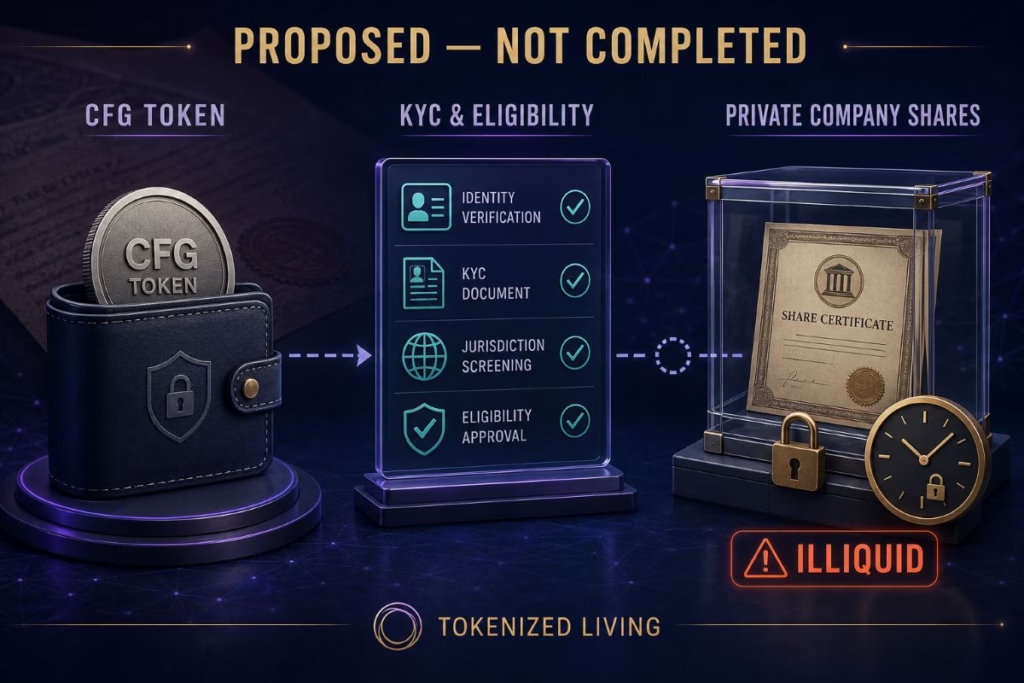
The proposal considers restructuring the Centrifuge Network Foundation into a Cayman Islands exempt company. Eligible CFG holders could then use their tokens to subscribe for company shares.
Centrifuge published detailed CP172 frequently asked questions on August 26.
The proposal includes several important points:
- The proposed ratio is one company share for every CFG surrendered.
- The ratio does not represent an independent company valuation.
- Every participant would need to complete KYC.
- Legal and jurisdictional eligibility would apply.
- Holders with at least 100,000 CFG could enter the shareholder register directly.
- Smaller eligible holders may receive exposure through a CoinList trust structure.
- Conversion would remain optional.
- No buyback is planned.
- The company does not expect near-term dividends.
- Future dilution could affect shareholders.
- Converted equity would remain illiquid for the foreseeable future.
- Centrifuge expects to wind down funding for public CFG liquidity after the conversion window.
- The 3% annual CFG inflation would end after conversion.
- Tokenized shares would legally be securities.
As of August 30, 2026, this remains a proposal. No completed conversion should be implied.
Important details may also change after governance discussions, board approval and legal structuring.
Why CP172 Matters to CFG Holders
CP172 creates several major questions.
Eligibility Risk
Some CFG holders may not qualify to receive private-company shares.
Restrictions could depend on location, investor classification and securities law.
Liquidity Risk
CFG currently trades on cryptocurrency markets. Private-company shares may have no active secondary market.
Centrifuge itself expects the equity to remain illiquid for the foreseeable future.
Valuation Risk
The proposed one-for-one ratio is only a conversion mechanism.
It does not establish what each company share is worth.
Dilution Risk
Centrifuge may issue additional shares to employees, investors or strategic partners.
Future fundraising could reduce each shareholder’s ownership percentage.
Tax Risk
Exchanging CFG for shares may trigger tax consequences.
These consequences could vary considerably between countries.
Remaining CFG Risk
Holders who do not convert can retain their CFG.
However, Centrifuge plans to reduce funding for token listings, market makers and other liquidity support after the conversion window.
That could weaken the market for unconverted tokens.
Governance Risk
Corporate shareholders would receive rights under the company’s constitutional documents and Cayman Islands law.
This structure differs from public-token governance.
Therefore, investors should not assume that corporate governance will reproduce the former DAO model.
Is Centrifuge Really Decentralized?
Centrifuge combines decentralised technology with controlled financial structures.
Its smart contracts operate on public blockchains. Moreover, some protocol decisions have involved CFG-holder governance.
However, not every decision is decentralised.
Different parties control different layers:
- Centrifuge developers control product development
- Asset managers control investment strategies
- Legal entities control fund structures
- Administrators manage official records
- Custodians hold underlying assets
- Managers process subscriptions and redemptions
- Smart-contract administrators may pause or upgrade systems
- Corporate boards make company decisions
- Token holders may vote on selected proposals
Consequently, claiming that “all decisions are transparent and democratic” is nonsense.
Centrifuge is better described as hybrid infrastructure. It uses open blockchain networks while retaining the controls required by regulated financial products.
Does Centrifuge Guarantee Liquidity?
No.
Centrifuge can improve transferability and connect assets with more markets. However, it cannot guarantee willing buyers.
Liquidity depends on:
- The underlying asset
- Redemption terms
- Available cash
- Market-maker participation
- Eligible investor numbers
- Trading volume
- DeFi collateral demand
- Stablecoin liquidity
- Authorised participants
- Regulatory restrictions
A Treasury fund may support faster redemptions than a private-credit fund.
Similarly, a deRWA token may trade continuously while its underlying fund calculates NAV once per business day.
That timing difference can create premiums or discounts.
Therefore, 24-hour trading should never be confused with 24-hour guaranteed redemption at NAV.
Our guide to blockchain-powered secondary markets examines this problem in more detail.
Centrifuge Advantages
- Established operating history
- More than $2 billion reportedly tokenized
- Strong institutional partnerships
- Advanced multichain infrastructure
- Onchain accounting and NAV tools
- Modern ERC-4626 and ERC-7540 vault support
- Deep DeFi integrations
- Treasury, credit and index products
- White-labelled tokenization infrastructure
- Extensive reported security reviews
- Fund and portfolio-management tools
- Transfer-agent expansion into tokenized equity
- Transparent onchain data
- Support for synchronous and asynchronous investments
- deRWA wrappers that improve composability
Centrifuge Disadvantages
- Many funds restrict retail access
- Product structures are complex
- No universal public pricing
- Tinlake-era information still causes confusion
- Liquidity varies between products
- Multichain systems introduce more dependencies
- deRWA wrappers add another risk layer
- Offchain data and custody remain necessary
- CFG does not represent ownership of tokenized assets
- CP172 creates major uncertainty for CFG holders
- Future company shares may remain illiquid
- Some CFG holders may not qualify for conversion
- Governance has become increasingly corporate
- Fund AUM and allocation headlines can be misleading
- Product availability changes frequently
What Are the Main Investor Risks?
Underlying Asset Risk
A tokenized fund can lose money because its actual investments perform poorly.
The blockchain cannot prevent credit defaults or falling asset prices.
Smart-Contract Risk
Coding errors could affect subscriptions, redemptions or transfers.
Audits reduce this risk but cannot eliminate it.
Offchain Verification Risk
The blockchain depends on information about assets held elsewhere.
Incorrect valuations or records could produce misleading token data.
Custody Risk
Banks, custodians and wallet providers may fail or make mistakes.
Self-custody also exposes investors to lost keys and fraudulent transactions.
Cross-Chain Risk
Messaging systems and bridges can suffer exploits, outages or configuration errors.
Liquidity Risk
Investors may struggle to redeem or sell tokens.
A listed token does not guarantee an active market.
Stablecoin Risk
Many investments settle through USDC or another stablecoin.
Investors therefore face issuer, banking and conversion risks.
Manager Risk
Asset managers control portfolio decisions.
Poor judgement can cause losses even when the tokenization technology works correctly.
Regulatory Risk
Different countries may classify and restrict the same token differently.
Rules can also change after an investor enters a product.
DeFi Risk
Lending, trading and collateral protocols can suffer exploits or liquidations.
A secure tokenized fund can lose value after entering an unsafe DeFi strategy.
CFG and Equity-Conversion Risk
CFG holders face uncertainty surrounding CP172, conversion eligibility, equity valuation and future token liquidity.
Centrifuge Versus Securitize
Centrifuge and Securitize both support institutional tokenization. However, their strongest capabilities differ.
| Area | Centrifuge | Securitize |
|---|---|---|
| Primary strength | Onchain asset management and DeFi composability | Vertically integrated regulated securities infrastructure |
| DeFi integration | Extensive | Growing |
| Fund administration | Through connected structures and partners | Dedicated regulated business |
| Secondary trading | DeFi and connected venues | Regulated Alternative Trading System |
| Multichain architecture | Core focus | Broad product-dependent support |
| Retail access | Limited and product-specific | Limited and product-specific |
| Governance token | CFG, subject to proposed conversion | No comparable public protocol token |
| Best suited to | Asset managers, DeFi protocols and institutional strategies | Asset managers and issuers needing regulated securities services |
Our complete Securitize review examines that platform separately.
Who Should Consider Centrifuge?
Centrifuge may suit:
- Institutional investors
- Professional investors
- Asset managers
- Private-credit funds
- Treasury managers
- DeFi protocols
- Stablecoin issuers
- Companies building tokenized funds
- Businesses needing multichain distribution
- Investors comfortable with blockchain infrastructure
- Issuers seeking white-labelled tokenization
- Organisations developing tokenized equity
It may not suit:
- Beginners seeking simple investments
- Retail investors who cannot satisfy eligibility requirements
- Anyone needing guaranteed liquidity
- Investors unwilling to complete KYC
- People who do not understand DeFi
- Users expecting permissionless access to every fund
- Investors unable to tolerate smart-contract risk
- CFG holders assuming tokens guarantee company ownership
- Anyone considering CP172 without professional tax and legal advice
Final Verdict: Is Centrifuge a Leading Tokenization Platform?
Yes. Centrifuge belongs among the leading institutional tokenization platforms in 2026.
Its technology has moved far beyond the original Tinlake protocol. V3 now supports multichain distribution, investor controls, onchain accounting, vaults and active portfolio management.
Furthermore, JTRSY, JAAA, SPXA and ACRDX demonstrate that Centrifuge can support serious financial products.
Its deepest advantage lies in DeFi composability.
Centrifuge does not simply place a fund share on a blockchain. It aims to make tokenized assets usable as collateral, in lending markets and inside multichain financial strategies.
However, that strength also increases complexity.
Investors must evaluate the fund, legal structure, token, blockchain, wrapper and connected DeFi protocols. Any one of these layers can fail.
Retail accessibility also remains limited. Tokenization can reduce operational barriers, but securities laws and fund eligibility still determine who can invest.
Finally, CP172 creates substantial uncertainty for CFG holders.
The proposed move from a public token towards private-company equity may create clearer economic rights for eligible participants. Nevertheless, it introduces KYC, eligibility, valuation, dilution and severe liquidity questions.
Therefore, Centrifuge deserves recognition for building advanced tokenization infrastructure—not for eliminating investment restrictions or risk.
For asset managers and institutional DeFi users, it offers one of the strongest technology stacks available. For ordinary investors, access remains complicated and product-specific.
Frequently Asked Questions
Is Centrifuge legitimate?
Centrifuge has operated since 2017 and supports tokenized products connected with major asset managers. It also reports more than $2 billion tokenized. However, investors must still investigate every individual fund and legal entity.
Is Tinlake still Centrifuge’s main protocol?
No. Centrifuge classifies Tinlake as a legacy protocol. Its current infrastructure centres on the EVM-native V3 platform.
Can retail investors use Centrifuge?
Access depends on the product and country. Many direct funds require professional or institutional eligibility. Some deRWA tokens may offer wider secondary access, but legal restrictions still apply.
Does CFG represent Centrifuge’s tokenized assets?
No. CFG does not give holders ownership of JTRSY, JAAA or other assets tokenized through the platform.
What is JTRSY?
JTRSY represents shares in a tokenized fund investing mainly in short-term US Treasury bills. Janus Henderson serves as sub-investment manager.
What is JAAA?
JAAA provides tokenized exposure to a strategy involving AAA-rated CLO tranches. It carries credit, liquidity, smart-contract and structural risks.
What are deRWA tokens?
deRWA tokens are more transferable representations designed to connect institutional asset exposure with DeFi. They add composability but also introduce wrapper, liquidity and protocol risks.
Does Centrifuge guarantee liquidity?
No. Centrifuge provides redemption and trading infrastructure, but it cannot guarantee buyers, market depth or immediate settlement.
Which blockchains does Centrifuge support?
Products and integrations span networks including Ethereum, Base, Arbitrum, Avalanche, BNB Chain, Plume, Solana and Stellar. Availability varies by product.
Is Centrifuge regulated?
Different legal entities and partners perform different roles. Centrifuge announced an SEC-registered transfer-agent operation for tokenized equity. Individual funds also operate under their own regulatory structures.
What is CP172?
CP172 proposes allowing eligible CFG holders to subscribe for shares in a restructured private company using their tokens. As of August 30, 2026, the proposal remains unresolved.
Will every CFG holder qualify for company shares?
Not necessarily. Participation would require KYC and compliance with jurisdiction-specific laws. Final eligibility rules have not yet been completed.
Will the proposed Centrifuge shares be liquid?
Centrifuge says shareholders should expect the shares to remain illiquid for the foreseeable future.
Is the proposed exchange rate one CFG for one share?
Yes. However, Centrifuge states that this ratio is only a mechanical conversion factor. It does not represent an independent company valuation.
Is Centrifuge fully decentralised?
No. It combines public blockchain infrastructure with controlled fund structures, asset managers, administrators, legal entities and corporate governance.
Is Centrifuge safer than a cryptocurrency exchange?
They serve different purposes. Centrifuge concentrates on tokenized financial products and onchain asset management. It still carries investment, operational, custody and smart-contract risks.
This article is for educational purposes only. It does not constitute investment, financial, tax or legal advice. Tokenized assets, DeFi products, CFG and any proposed private-company shares can result in substantial or complete losses.