
Updated; 30th August 2026.
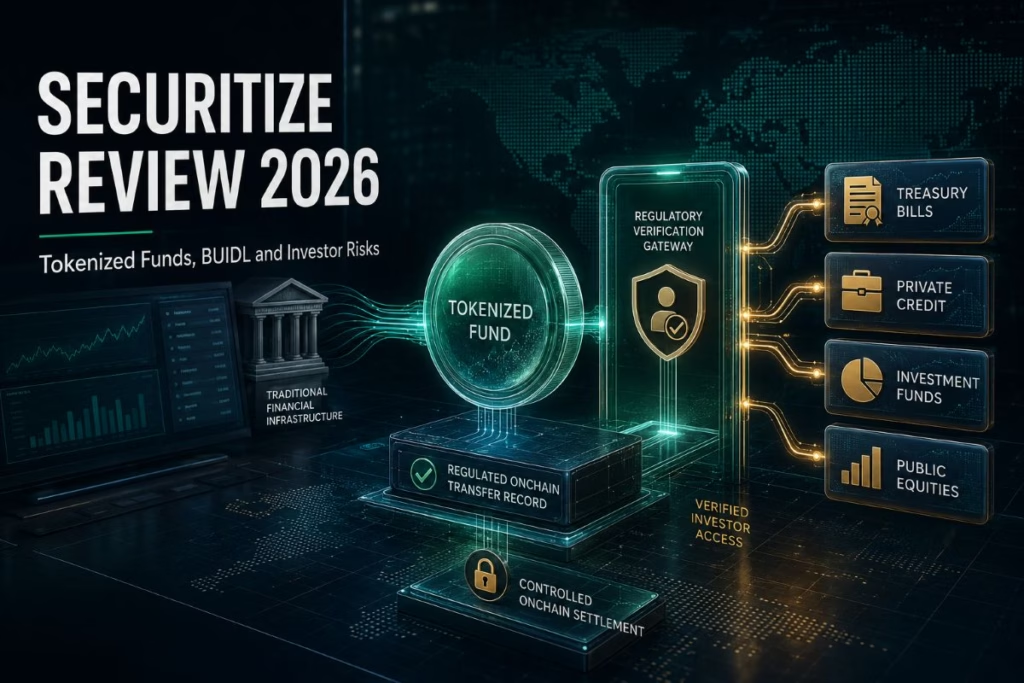
Securitize has grown from a digital securities startup into one of the largest regulated tokenization platforms.
Its technology supports tokenized funds from BlackRock, Apollo, Hamilton Lane, KKR, VanEck and other major asset managers. Furthermore, Securitize now operates regulated businesses covering issuance, transfer agency, fund administration, investment management and secondary trading.
The company also became publicly traded on the New York Stock Exchange under the ticker SECZ in July 2026.
However, the phrase “democratizing private markets” needs careful examination.
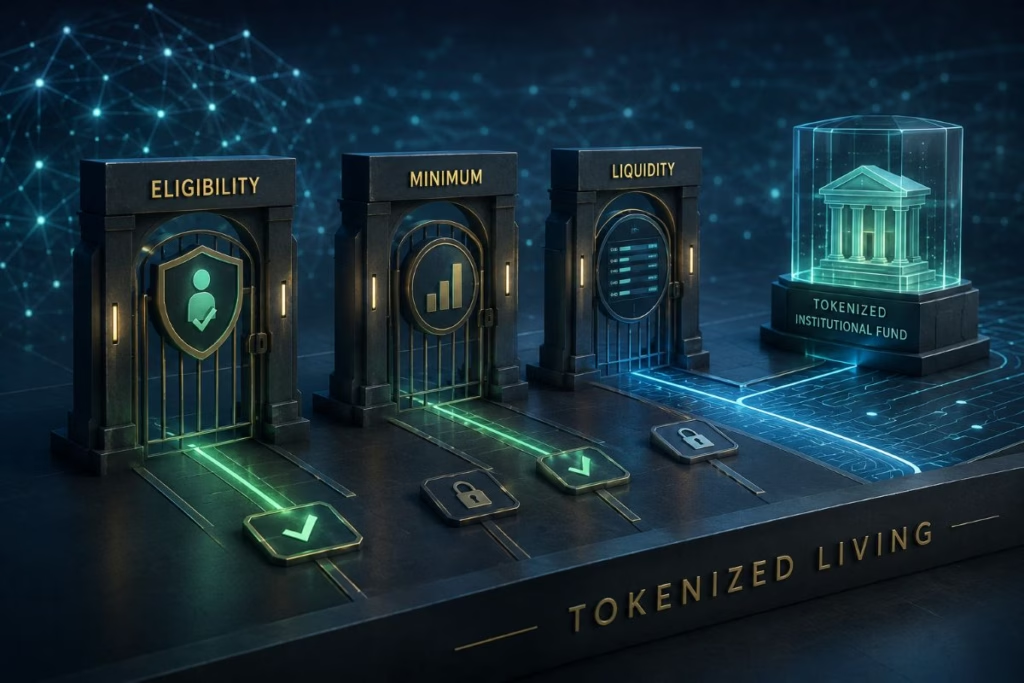
Some Securitize products have reduced investment minimums dramatically. Nevertheless, many opportunities remain limited to accredited investors, qualified purchasers or institutions. Tokenization can also improve transferability without creating reliable secondary-market liquidity.
This Securitize review examines what the platform offers, who can invest, how BUIDL works and which risks investors must understand.
Last updated: August 30, 2026.
Securitize Review 2026: The Short Version
Securitize provides end-to-end infrastructure for issuing, administering, distributing and trading tokenized securities.
Its regulated affiliates cover several stages of the investment lifecycle:
- Digital security issuance
- Investor onboarding
- KYC and AML checks
- Transfer-agent services
- Fund administration
- Investment management
- Broker-dealer services
- Alternative Trading System operations
- Tokenized security custody
- Distributions and corporate actions
- Blockchain-based ownership records
- Secondary-market trading for supported assets
According to its second-quarter 2026 results filed with the SEC, Securitize had $4.3 billion in tokenized assets under management on June 30, 2026. The company reported approximately $5 billion by July.
Securitize Fund Services also administered 663 active funds and $24.3 billion in assets. However, assets under administration should not be confused with tokenized assets under management.
| Area | Assessment |
|---|---|
| Regulatory infrastructure | Strong |
| Institutional partnerships | Exceptional |
| Token issuance and servicing | Strong |
| Retail accessibility | Limited |
| Secondary-market liquidity | Varies considerably |
| Public pricing transparency | Limited |
| Blockchain utility | Strong and expanding |
| Best suited to | Asset managers, institutions and eligible investors |
Securitize is one of the strongest companies in this platform series. However, ordinary investors should not assume every product is affordable or available to them.
What Is Securitize?
Carlos Domingo and Jamie Finn founded Securitize in 2017. The company created infrastructure for issuing and managing regulated securities on public blockchains.
Securitize does not simply create a token representing an asset. Its wider corporate group can support ownership records, investor verification, distributions, fund administration and regulated trading.
That breadth separates Securitize from basic token-creation platforms.
A business can technically create a blockchain token without much difficulty. The hard part involves connecting that token with legally enforceable ownership rights, verified investors and regulated financial processes.
Securitize concentrates on that harder problem.
Its platform serves three main groups:
- Asset managers seeking tokenization infrastructure
- Companies and Web3 organisations issuing tokenized securities
- Eligible investors seeking access to tokenized funds
Readers new to the process should first review our guide explaining how to tokenize an asset.
How Is Securitize Regulated?
Securitize operates through several separate legal entities. Each entity performs a different regulated or operational function.
Securitize Markets
Securitize Markets, LLC is a registered broker-dealer and a FINRA and SIPC member. Its registration can be checked through FINRA BrokerCheck.
The company also operates Securitize Markets ATS, an Alternative Trading System for supported digital securities.
An ATS provides a regulated trading venue. However, it does not guarantee that every listed security will attract active buyers and sellers.
In 2026, Securitize Markets received expanded FINRA approval. This approval allows it to custody tokenized securities and participate in underwriting and selling groups.
The expanded capabilities also support atomic settlement between tokenized securities and stablecoins. Atomic settlement means both sides of a transaction complete together or neither completes.
Securitize Transfer Agent
Securitize Transfer Agent, LLC is registered with the SEC as a transfer agent.
A transfer agent maintains official ownership records. It also processes transfers, distributions, redemptions and other corporate actions.
This function is especially important for tokenized securities. Blockchain records must remain connected with the issuer’s recognised shareholder or fund records.
Without that connection, a token may represent little more than an informal digital claim.
Securitize Capital
Securitize Capital, LLC operates as an investment adviser.
It manages or advises certain tokenized investment products. However, registration as an investment adviser does not represent an SEC endorsement or guarantee investment performance.
Securitize Fund Services
Securitize Fund Services provides fund administration and digital asset reporting.
These services can include accounting, investor reporting, transaction reconciliation and other operational functions.
The division serviced 663 active funds by June 2026. Its reported assets under administration reached $24.3 billion.
European Operations
Securitize Europe Brokerage and Markets operates as an authorised European investment firm.
It also operates a Trading and Settlement System under the European Union’s DLT Pilot Regime. This structure supports regulated digital securities infrastructure in Europe.
However, product access still depends on each investor’s country and eligibility. A European licence does not make every security available throughout Europe.
What Does Securitize Offer Asset Managers?
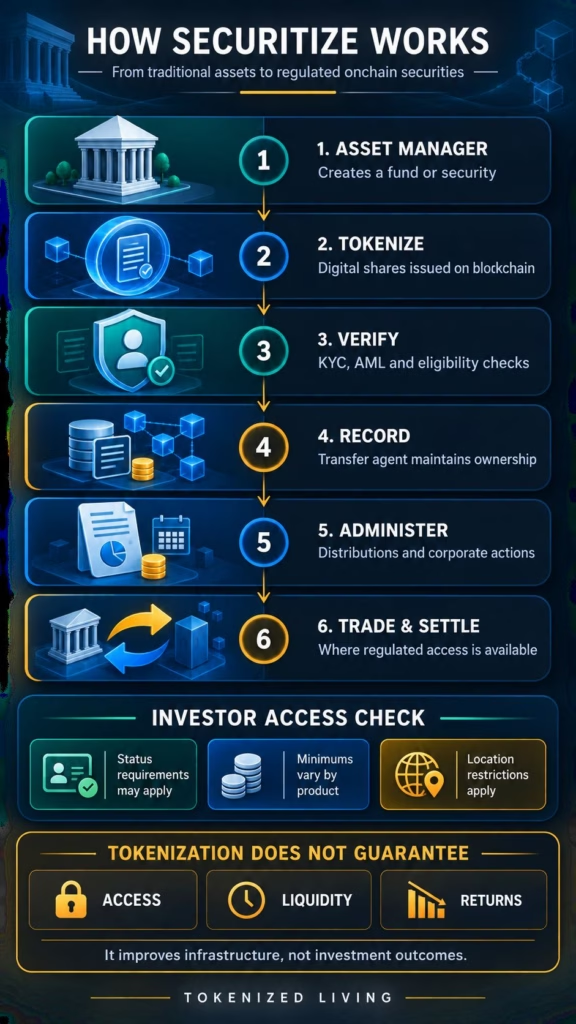
Securitize offers asset managers a connected tokenization stack.
Services can include:
- Creating the digital security
- Configuring transfer restrictions
- Verifying investors
- Managing subscriptions
- Recording token ownership
- Processing distributions
- Administering the fund
- Supporting permitted transfers
- Connecting assets with blockchain applications
- Providing access to regulated secondary trading
This model can reduce the need to connect several unrelated providers.
However, Securitize cannot remove every intermediary. Asset managers may still require lawyers, custodians, auditors, banks and specialist administrators.
In addition, blockchain technology does not change the underlying asset’s economics. A weak fund does not become a strong investment because its shares exist onchain.
What Can Investors Buy Through Securitize?
Securitize offers tokenized private-market and fixed-income products from several established asset managers.
The exact catalogue changes over time. Availability also depends on investor status, location and the individual offering documents.
Representative products include:
| Product or manager | Underlying exposure | Important limitation |
|---|---|---|
| BlackRock BUIDL | Cash, US Treasury bills and repurchase agreements | Primarily designed for institutional investors |
| VanEck VBILL | Short-term US Treasury securities | High minimum subscriptions and eligibility restrictions |
| Hamilton Lane funds | Private equity and private credit | Often restricted to eligible investors |
| KKR-linked fund | Private equity exposure | Private-market liquidity and eligibility constraints |
| Securitize STAC | AAA collateralised loan obligations | Credit, liquidity and blockchain risks |
| HINC with Neuberger | High-yield bonds, CLOs and leveraged loans | Accredited-investor and qualified-purchaser restrictions |
Asset-manager involvement does not eliminate risk. Investors still need to examine the actual fund, fees, strategy and redemption terms.
BlackRock BUIDL and Securitize
BlackRock launched the BlackRock USD Institutional Digital Liquidity Fund, commonly called BUIDL, with Securitize in March 2024.
BUIDL invests in cash, US Treasury bills and repurchase agreements. It seeks to maintain a stable value of $1 per token.
Income accrues daily and is distributed to investors as additional tokens each month.
Securitize handles several important parts of the infrastructure. These include tokenization, investor onboarding and transfer-agent functions.
Approved investors can also transfer BUIDL tokens to other approved investors. However, a technically available transfer does not always mean an immediate buyer exists.
BUIDL has since expanded across several public blockchain networks. It has also gained utility as collateral within selected institutional trading arrangements.
This is more significant than simply placing a fund record onchain. It demonstrates how a tokenized security can connect regulated finance with blockchain-based settlement and collateral systems.
Our dedicated guide examines BlackRock BUIDL and its Ethereum launch in more detail.
Does Securitize Really Democratize Private Markets?
The honest answer is: partially.
Securitize has helped reduce investment minimums for some products.
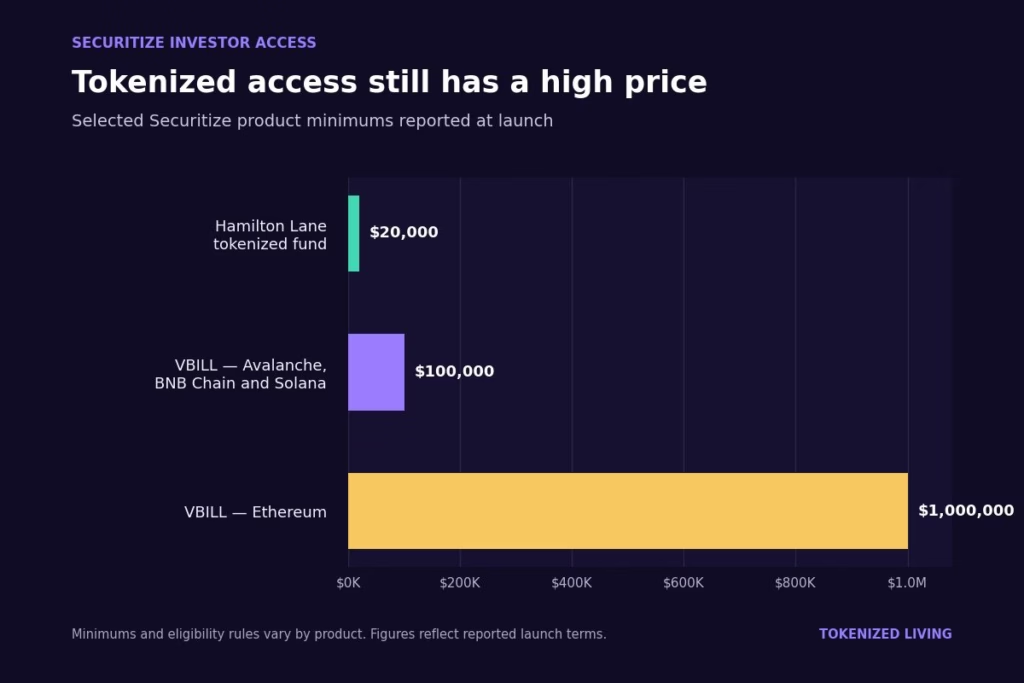
For example, a Hamilton Lane fund previously offered through Securitize lowered its minimum investment from approximately $5 million to $20,000. That represents a substantial improvement.
However, $20,000 is still beyond the reach of many investors. Moreover, other products have considerably higher requirements.
VanEck’s VBILL launched with minimum subscriptions of:
- $100,000 on Avalanche, BNB Chain and Solana
- $1 million on Ethereum
VBILL was also designed for institutional and qualified investors. These details appear in VanEck and Securitize’s launch announcement.
The HINC fixed-income fund launched in August 2026 with access limited to eligible accredited investors and qualified purchasers. It is not an ordinary retail bond fund.
Therefore, Securitize has broadened access compared with traditional private-market structures. Nevertheless, it has not opened every product to everyone.
A more accurate statement would be:
Securitize can reduce operational barriers and investment minimums, but legal eligibility and product-specific restrictions still control access.
How Investing Through Securitize Works
The exact process depends on the fund. However, investors generally move through several stages.
1. Create an Account
The investor creates a Securitize account and provides basic personal or business information.
2. Complete Identity Verification
Securitize conducts KYC and AML checks.
Applicants may need to provide identification, address information, tax details and evidence concerning the source of funds.
3. Confirm Investor Eligibility
Some products require accredited-investor or qualified-purchaser status.
In the United States, these classifications generally depend on income, net worth, assets or professional qualifications. Different rules apply to individuals and entities.
4. Review the Offering Documents
Investors must read the relevant private placement memorandum, subscription agreement and risk disclosures.
The token itself does not replace these legal documents.
5. Fund the Investment
Payment options vary. Certain products support bank transfers, stablecoins or conversions between fiat currency and USDC.
However, investors should confirm conversion costs, supported networks and custody requirements.
6. Receive the Tokenized Interest
After approval and settlement, the investor receives tokens representing an interest in the relevant security or fund.
The tokens may remain with an approved custodian or move to a permitted blockchain wallet.
7. Receive Distributions or Request Redemption
Income distributions, redemptions and transfers follow the fund’s rules.
Blockchain availability does not override redemption periods, transfer restrictions or investor-eligibility requirements.
Our guide explaining how to buy tokenized assets covers the wider purchasing process.
Does Securitize Provide Secondary-Market Liquidity?
Securitize operates an Alternative Trading System for supported digital securities.
That infrastructure can create a regulated route for secondary transactions. However, it cannot guarantee market depth.
Private-market assets remain difficult to sell for several reasons:
- A small number of eligible buyers
- Transfer restrictions
- Limited trading activity
- Long investment periods
- Complex valuations
- Fund-level redemption limits
- Buyer accreditation requirements
- Jurisdictional restrictions
Securitize’s own product disclosures state that private investments are generally illiquid. They also warn that any discussion of future liquidity may be speculative.
Therefore, the old claim that tokenization automatically “enhances liquidity” is too simplistic.
Tokenization can improve transferability, settlement and recordkeeping. Liquidity only improves when willing buyers, willing sellers and sufficient market activity also exist.
Our article about blockchain-powered secondary markets explains this distinction.
Which Blockchains Does Securitize Support?
Securitize operates across several public blockchain networks.
Individual products have launched on networks including:
- Ethereum
- Avalanche
- Arbitrum
- Aptos
- BNB Chain
- Polygon
- Solana
- Sui
- Optimism
- TRON
However, not every product exists on every blockchain.
Minimum investments, custody arrangements and transfer processes may also vary between networks. VBILL provides a clear example because its Ethereum minimum differed from its minimum on other chains.
Investors should never choose a tokenized fund solely because they prefer its blockchain.
The underlying asset, legal rights, fees, liquidity and redemption rules matter more than the network branding.
Securitize and Tokenized Public Equities
Securitize expanded beyond private funds during 2026.
The company began trading on the New York Stock Exchange under SECZ on July 2, 2026. It also placed a blockchain-based representation of its own publicly traded equity onchain.
In addition, Securitize announced relationships with:
- NYSE
- Computershare
- Continental Stock Transfer & Trust
- Cantor Fitzgerald
- Jump Trading
- Jupiter
These relationships aim to support issuer-sponsored tokenized public equities, onchain offerings and modernised settlement.
The issuer-sponsored structure matters. Tokens remain connected to the company’s official shareholder register and corporate actions.
That differs from synthetic tokens or third-party products that merely track a stock’s price.
However, much of this public-equity infrastructure remains under development. It should not be described as a completed replacement for traditional stock markets.
Securitize Fees and Investment Costs
Securitize does not publish one universal investor fee schedule for every product.
Costs vary according to the fund, asset manager, offering structure and transaction method.
Investors should check for:
- Fund management fees
- Administration expenses
- Performance or incentive fees
- Subscription charges
- Redemption fees
- Blockchain transaction fees
- Stablecoin conversion costs
- Custody charges
- Secondary-trading commissions
- Foreign-exchange costs
- Early-withdrawal restrictions
A lower minimum investment does not automatically make a product inexpensive.
Private funds can carry multiple layers of fees. Therefore, investors should examine the complete expense structure rather than focusing on blockchain transaction costs.
Asset managers seeking Securitize’s issuance services must request commercial terms directly. Public, standardised issuer pricing is not readily available.
Securitize’s Financial Position
Becoming a public company has created greater financial transparency.
Securitize reported the following for the second quarter of 2026:
- $14.4 million in revenue
- $21.7 million net loss
- $5.3 billion in aggregate transaction volume
- $4.3 billion tokenized AUM at quarter-end
- 663 active funds serviced
- $24.3 billion in assets under administration
After completing its business combination, the company reported approximately $350 million in cash and no debt.
The cash position gives Securitize resources for continued expansion. However, the quarterly loss shows that rapid asset growth has not yet produced consistent profitability.
That does not make Securitize unreliable. Nevertheless, readers should avoid confusing platform AUM with company earnings.
A business can administer billions in assets while still operating at a loss.
Securitize Advantages
- Broad regulated infrastructure
- Strong institutional partnerships
- SEC-registered transfer-agent services
- Registered broker-dealer and ATS
- Fund administration capabilities
- Multi-chain support
- Established tokenized fund catalogue
- Blockchain-based ownership records
- Support for distributions and corporate actions
- Expanding collateral and settlement integrations
- Greater transparency as a public company
- Infrastructure for both private and public securities
Securitize Disadvantages
- Many products exclude ordinary retail investors
- Some minimum investments remain extremely high
- Private-market liquidity is not guaranteed
- Product fees can be complex
- Investor access varies by country
- Not every asset trades actively on the ATS
- Blockchain introduces additional technical risks
- Public issuer pricing lacks transparency
- The company was not profitable in the second quarter of 2026
- Product availability and blockchain support can change
- Token ownership still depends on legal and operational systems
What Are the Main Investor Risks?
Underlying Investment Risk
A tokenized fund can lose value because of credit defaults, falling asset prices, interest-rate changes or poor management.
Tokenization does not protect investors from these risks.
Liquidity Risk
Investors may struggle to sell a private-market security. The existence of an ATS does not guarantee a buyer.
Smart-Contract Risk
Coding errors or administrative mistakes could interrupt transfers, distributions or redemptions.
Blockchain Risk
Network congestion, outages, upgrades or attacks could affect token operations.
Custody Risk
Investors or custodians could lose access to wallets or private keys. Third-party custodians also introduce operational and counterparty risks.
Regulatory Risk
Digital securities regulation continues to evolve. New interpretations could affect transfers, custody and investor access.
Stablecoin Risk
Some transactions use stablecoins such as USDC. Therefore, investors may face issuer, conversion and banking risks.
Valuation Risk
Private assets do not trade continuously on deep public markets. Reported values may depend on models, periodic appraisals or manager estimates.
Company Risk
Securitize provides important infrastructure, but investors ultimately own interests in specific funds or securities. They must examine every issuer separately.
The HINC launch disclosure highlights credit, liquidity, custody, smart-contract, cybersecurity and regulatory risks.
Who Should Consider Securitize?
Securitize may suit:
- Accredited investors
- Qualified purchasers
- Institutional investors
- Digital asset treasuries
- Investors seeking tokenized Treasury products
- Investors comfortable with private-market lockups
- Asset managers launching tokenized funds
- Public companies exploring tokenized shares
- Issuers requiring transfer-agent and fund-administration services
It may not suit:
- Beginners seeking simple low-cost investments
- Investors needing guaranteed daily liquidity
- People unable to meet accreditation requirements
- Investors unwilling to complete detailed KYC checks
- Anyone who does not understand private-market risks
- Users expecting permissionless cryptocurrency trading
- Investors who may need their money quickly
Final Verdict: Is Securitize a Leading Tokenization Platform?
Yes. Based on its regulated infrastructure, institutional relationships and tokenized assets, Securitize belongs among the strongest tokenization platforms operating in 2026.
The company has moved beyond experimental token issuance. It now connects asset managers, investors, transfer agency, fund administration, regulated trading and blockchain settlement.
BlackRock’s BUIDL remains its clearest success. Furthermore, partnerships with Apollo, Hamilton Lane, KKR, VanEck, BNY and Neuberger give the platform unusual institutional credibility.
However, “democratization” remains incomplete.
Some investment thresholds have fallen dramatically. Yet many leading products still require six-figure minimums, accredited-investor status or institutional eligibility.
Secondary trading infrastructure also does not guarantee liquidity.
Therefore, Securitize should be praised for building serious tokenization infrastructure—not credited with making private markets universally accessible.
For institutions and eligible investors, it is one of the most compelling platforms available. For ordinary retail investors, access remains fragmented and frequently out of reach.
Frequently Asked Questions
Is Securitize legitimate?
Securitize operates several regulated US entities, including a registered broker-dealer, transfer agent and investment adviser. It also operates an Alternative Trading System. However, regulatory registration does not guarantee that an investment will succeed.
Can anyone invest through Securitize?
No. Eligibility depends on the individual product, jurisdiction and investor status. Many offerings require accredited-investor or qualified-purchaser status.
What is the minimum investment on Securitize?
There is no universal minimum. Requirements vary by fund. Some products have lowered traditional private-market thresholds, while others require $100,000 or more.
Is BlackRock BUIDL available to retail investors?
BUIDL is primarily an institutional product. Investors must meet its eligibility, onboarding and minimum-investment requirements.
Does Securitize guarantee liquidity?
No. Securitize provides transfer and trading infrastructure, but buyers may not exist when an investor wants to sell.
Is Securitize publicly traded?
Yes. Securitize Corp. began trading on the New York Stock Exchange under SECZ in July 2026.
Is buying SECZ stock the same as investing in a Securitize tokenized fund?
No. SECZ represents equity in Securitize Corp. A tokenized fund represents an interest in that specific fund and its underlying assets.
Does SIPC membership protect tokenized investments from losses?
No. SIPC protection does not cover ordinary market losses. Coverage also depends on the asset, account structure and circumstances.
Can Securitize tokenize real estate?
Its infrastructure can support different regulated securities and real-world assets. However, Securitize currently places greater emphasis on tokenized funds, credit, Treasuries and equities than individual residential properties.
Is Securitize better than a cryptocurrency exchange?
They serve different purposes. Cryptocurrency exchanges focus on trading cryptoassets. Securitize concentrates on regulated securities, verified investors and legally structured ownership.
This article is for educational purposes only. It does not constitute investment, financial, tax or legal advice. Private-market and tokenized investments can result in the loss of some or all invested capital.