
Updated August 13, 2026
Choosing a blockchain for real-world asset tokenization is not a race to find the fastest or cheapest network.
That approach is backwards.
A tokenized asset may need to remain operational for years. During that time, the issuer must manage ownership records, investor eligibility, income distributions, corporate actions, custody, regulatory reporting and possible secondary trading.
The blockchain is only one part of that system.
A network offering tiny transaction fees is useless if qualified custodians do not support it. High transaction speed means little when investors cannot legally receive the token. Strong technology cannot repair weak ownership rights or create buyers for an illiquid asset.
Therefore, the best blockchain for tokenization depends on the asset, legal structure, investors, regulatory requirements and intended market.
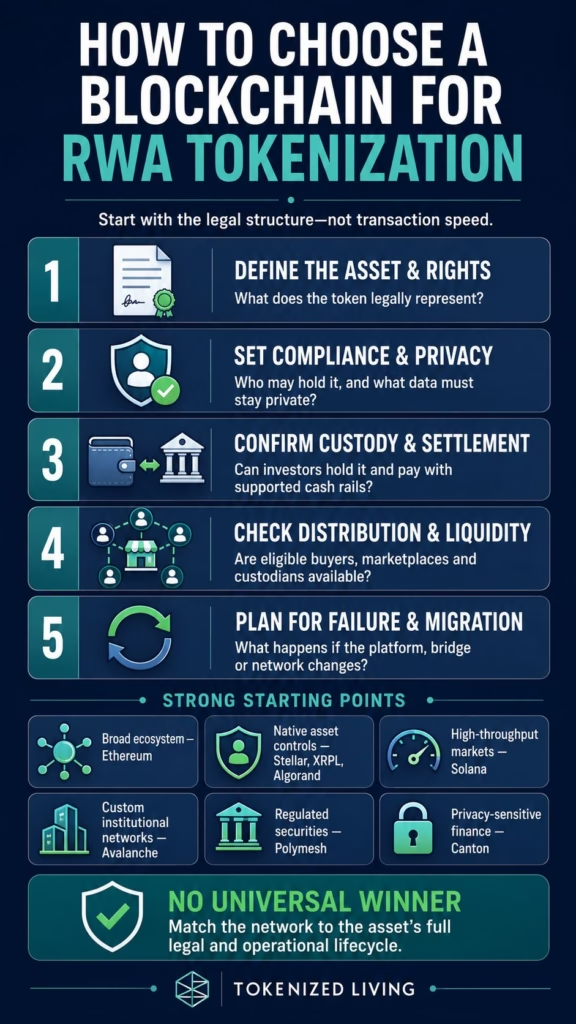
TL;DR: Ethereum offers the deepest overall tokenization ecosystem, but it is not automatically the best choice. Stellar, XRPL and Algorand provide useful native issuance controls. Solana focuses on high-throughput markets, while Avalanche supports customizable institutional networks. Polymesh is purpose-built for regulated securities, and Canton combines an open network with institutional privacy. Choose the legal and operating model first—then choose the blockchain.
This article provides general information and does not constitute legal, technical, financial or investment advice. Issuing tokenized assets can trigger securities, property, tax, data-protection and financial-services laws.
What Does a Blockchain Do in Asset Tokenization?
Asset tokenization uses digital tokens to represent ownership, financial claims, contractual rights or other interests connected to an asset.
Our guide to what tokenization means explains the concept in more detail.
Depending on the design, a blockchain may help:
- Issue and destroy tokens
- Record token balances
- Process transfers
- Enforce transfer restrictions
- Connect verified investors with approved wallets
- Automate distributions
- Record votes and corporate actions
- Settle transactions using stablecoins or tokenized cash
- Provide an auditable transaction history
- Connect the asset with marketplaces or financial applications
However, the blockchain does not automatically determine who legally owns the underlying asset.
A property still has a title. A bond still has an issuer. Gold requires storage, insurance and audits. Music royalties depend on copyright agreements and collection systems.
Consequently, the token needs a legally enforceable connection to the asset or financial claim.
That connection may involve:
- A special-purpose vehicle
- A fund or trust
- A property-owning company
- A regulated issuer
- A custodian
- A transfer agent
- A contractual royalty interest
- A redemption agreement
- A securities register
The blockchain records and processes the token. The legal structure gives that token meaning.
Start With the Asset, Not the Blockchain
Many weak tokenization projects choose a popular blockchain before establishing what the token represents.
That is a serious mistake.
Before comparing Ethereum, Stellar, XRPL or any other network, the issuer must answer several legal and commercial questions.
What is being tokenized?
The product could involve:
- Real estate equity
- Real estate debt
- A fund share
- A bond
- Private credit
- U.S. Treasuries
- Commodities
- Carbon credits
- Intellectual property
- Royalty income
- Collectibles
- Company shares
Each category creates different ownership, custody, valuation and regulatory requirements.
What does the token represent?
The token might provide:
- Equity in a legal entity
- A contractual income claim
- Debt owed by an issuer
- A fund unit
- A beneficial interest
- A redemption right
- Directly registered ownership
- A digital representation of an entitlement held elsewhere
These structures are not interchangeable.
The U.S. Securities and Exchange Commission has made clear that representing a security as a crypto asset does not remove its underlying legal character.
Putting shares, bonds or investment contracts on a blockchain does not make securities laws disappear.
Who may hold or transfer it?
An issuer may need to restrict ownership according to:
- Investor location
- Accreditation status
- Identity verification
- Anti-money-laundering checks
- Sanctions screening
- Holding periods
- Investor limits
- Suitability requirements
- Tax status
The blockchain or token standard must support those restrictions.
Which record is legally authoritative?
This question is frequently ignored.
The authoritative ownership record might be:
- The blockchain ledger
- A conventional securities register
- A transfer agent’s database
- A company membership register
- A land or property registry
- A synchronized combination of on-chain and off-chain records
If the blockchain and legal register disagree, the documents must explain which record takes priority and how errors are corrected.
Our beginner’s guide to RWA tokenization examines how these legal and technical layers work together.
Public, Permissioned and Private Tokenization Models
The old division between public, private and consortium blockchains is now too simplistic.
A public network can support a permissioned asset. Meanwhile, a private application can connect with an open network.
Public blockchain with open transfers
Anyone with a compatible wallet can potentially hold and transfer the token.
This model may suit unregulated assets, collectibles and some broadly available digital products.
It is usually unsuitable for regulated securities unless additional compliance controls are added.
Public blockchain with permissioned tokens
The network remains public, but only approved wallets can hold or transfer the asset.
This is increasingly common in RWA tokenization.
The token may use:
- Allowlists
- Identity credentials
- Transfer hooks
- Freeze controls
- Forced transfers
- Recovery functions
- Geographic restrictions
Public settlement and restricted ownership can exist together.
Purpose-built financial blockchain
Networks such as Stellar, XRPL and Polymesh provide financial-asset functions at the protocol or native-token level.
Issuers may not need to create every feature through custom smart contracts.
Custom or application-specific blockchain
An institution can operate a dedicated network with its own validators, permissions, fees and operating rules.
Avalanche L1s are one example of this approach.
More control also means more responsibility. Someone must operate, secure, upgrade and govern the network.
Privacy-enabled open network
Canton uses an open network while allowing applications and transactions to limit data visibility.
This model targets financial institutions that need interoperability without exposing every position and transaction to the public.
Conventional private or consortium network
Only approved organizations can operate nodes or access the system.
Private networks can provide confidentiality and control. However, they may offer limited external distribution, composability and independent liquidity.
Ten Factors That Matter More Than Headline Speed
A serious blockchain comparison should assess more than transaction fees and throughput.
1. Compliance and Issuer Controls
Regulated assets may need administrative controls that crypto investors normally dislike.
These can include:
- Minting and burning
- Pausing transfers
- Freezing wallets
- Approving investors
- Blocking prohibited transactions
- Recovering assets from lost wallets
- Replacing compromised tokens
- Enforcing holding periods
- Forcing transfers under a court or regulatory order
DTCC’s own tokenization plans include controls such as minting, burning, freezing, pausing, clawbacks and forced transfers. That is a useful indication of what institutional infrastructure may require. DTCC tokenization controls
A network that cannot support these functions may be unsuitable for regulated assets.
2. Token and Ownership Model
Some networks use smart-contract token standards. Others provide native asset issuance.
Neither design is automatically superior.
Smart contracts provide flexibility. However, every additional contract creates code, upgrade and security risk.
Native tokens may be simpler and easier to audit. Conversely, they may offer less customization.
The issuer should determine whether the project needs:
- Fungible tokens
- Non-fungible tokens
- Multiple share classes
- Transfer restrictions
- Dividend or income rights
- Voting
- Redemption
- Identity-linked ownership
- Corporate actions
- On-chain documentation
- Upgradeable rules
The token standard must fit the legal instrument instead of forcing the legal instrument into a fashionable technical format.
3. Security and Finality
A blockchain should have a strong operational history and a clear security model.
Issuers need to examine:
- Validator concentration
- Network uptime
- Finality guarantees
- Upgrade procedures
- Emergency governance
- Previous outages
- Smart-contract vulnerabilities
- Bridge dependencies
- Node requirements
- Network monitoring
Fast confirmation is not the same as legal settlement finality.
A transaction may become technically final on-chain while remaining subject to fraud claims, court orders, sanctions controls or errors in the legal register.
4. Custody and Wallet Support
Institutional investors may require regulated custodians rather than browser wallets.
Retail investors also need practical account recovery.
Before selecting a network, check whether it has:
- Qualified custody support
- Multi-signature accounts
- Institutional wallet providers
- Key-recovery procedures
- Hardware-wallet compatibility
- Transaction-policy controls
- Insurance options
- Reliable blockchain explorers
- Integration with investor portals
If investors cannot securely hold the token, the issuance has a distribution problem.
5. Cash and Settlement Infrastructure
Tokenized assets need a way to settle purchases and make distributions.
Possible settlement assets include:
- Regulated stablecoins
- Tokenized bank deposits
- Central bank money
- Conventional bank transfers
- Fiat balances held by a payment provider
A blockchain with strong stablecoin and payment infrastructure may be more useful than a technically faster network with no suitable settlement asset.
Issuers must also consider currency conversion, redemption, banking partners and geographic availability.
6. Investor Distribution
A network does not create investors.
Issuers should identify which wallets, platforms, exchanges, brokers and custodians their target audience already uses.
Questions include:
- Can investors access the network legally?
- Do supported wallets provide an acceptable user experience?
- Can the product accept fiat currency?
- Are suitable stablecoins available?
- Which marketplaces support the token?
- Can institutions integrate through existing custody providers?
- Will investors need to manage gas tokens?
A token that is technically global may still be commercially isolated.
7. Liquidity and Market Integration
Tokenization can make transfers possible. It cannot guarantee buyers.
Real liquidity requires:
- Eligible buyers
- Active marketplaces
- Market makers
- Reliable pricing
- Settlement assets
- Regulatory permission
- Custody support
- Adequate disclosure
- Transferable legal rights
DeFi integration may create additional utility for certain assets. Nevertheless, regulated securities cannot always move freely through decentralized exchanges or lending protocols.
The legal transfer rules must follow the token wherever it goes.
8. Privacy
Complete public transparency can create problems for institutions.
Publicly visible data may expose:
- Investor identities
- Portfolio positions
- Transaction amounts
- Trading strategies
- Commercial relationships
- Loan terms
- Collateral movements
Privacy tools must still allow appropriate access for auditors, regulators and authorized counterparties.
Institutions may therefore choose permissioned environments, privacy-preserving networks or systems that keep sensitive data off-chain.
9. Interoperability and Portability
Interoperability is useful, but it is frequently oversold.
Moving an ordinary crypto token between chains is already risky. Moving a regulated asset adds legal and operational complications.
An issuer must decide:
- Which token is the authoritative version
- Who locks, burns or reissues tokens
- Whether transferred tokens retain the same legal rights
- How investor restrictions continue on another network
- Who operates the bridge
- What happens if the bridge fails
- How duplicate ownership is prevented
- Whether custodians support each destination chain
A bridge cannot simply copy legal ownership.
10. Network Longevity and Exit Planning
Tokenized assets may outlive the blockchain product chosen to host them.
Before issuing, establish:
- How ownership data can be exported
- Whether tokens can migrate
- How contracts can be upgraded
- Who controls administrative keys
- What happens if a network is deprecated
- Whether investors can recover assets without the original platform
- How the legal register continues during migration
This is not a theoretical concern.
Polygon sunset its zkEVM Mainnet Beta sequencer in July 2026. Its recovery interface covers certain self-custodied assets, while assets held inside some smart contracts require separate action through their operators. Polygon Chain remains active, but the episode demonstrates why issuers must distinguish between products and maintain a migration plan. Polygon zkEVM sunset information
Best Blockchains for RWA Tokenization Compared
| Network | Strongest use case | Important controls | Main trade-off |
|---|---|---|---|
| Ethereum and selected L2s | Broad distribution, stablecoin settlement and DeFi integration | Programmable token standards and contract-based compliance | Mainnet costs, public data and fragmentation across L2s |
| Polygon Chain | Lower-cost EVM-compatible issuance and payments | Smart-contract allowlists and role-based controls | Separate network architecture, bridge dependencies and product-lifecycle risk |
| Stellar | Financial asset issuance, funds and cross-border settlement | Native authorization, revocation and freeze controls | Smaller general-purpose DeFi ecosystem than Ethereum |
| XRPL | Native financial asset issuance, settlement and integrated trading | Authorization, freeze controls, metadata and Multi-Purpose Tokens | Less arbitrary programmability than EVM ecosystems |
| Avalanche | Custom institutional networks and EVM deployments | Rules can be built into custom Avalanche L1s | Operating a custom network adds cost and governance responsibilities |
| Solana | High-throughput tokenized markets and consumer distribution | Token Extensions, transfer hooks, delegates and confidential transfers | Non-EVM tooling and specialized operational requirements |
| Algorand | Controlled asset issuance with predictable settlement | Native manager, freeze, clawback and reserve roles | Smaller distribution and liquidity ecosystem |
| Polymesh | Regulated securities and identity-controlled ownership | Identity and compliance functions at the protocol layer | Narrower general-purpose ecosystem |
| Canton | Privacy-sensitive institutional markets and synchronized workflows | Selective disclosure and application-level permissions | Specialist technology stack and less direct retail distribution |
No row in this table identifies a universal winner.
Ethereum: The Strongest Overall Ecosystem
Ethereum remains the most established public ecosystem for tokenized assets.
Its main advantage is not raw speed.
Ethereum provides access to:
- Widely supported token standards
- Institutional custody
- Major stablecoins
- Developer tools
- Security auditors
- Wallet infrastructure
- Exchanges
- DeFi applications
- Tokenization providers
- Layer 2 networks
The Ethereum Foundation’s institutional portal describes Ethereum and its L2 ecosystem as the dominant environment for tokenized RWAs and stablecoin settlement. Ethereum RWA infrastructure
Several compliance-oriented standards can restrict token ownership and transfers through smart contracts. Issuers can also connect tokenized assets with lending, collateral and trading applications where regulations permit.
However, Ethereum has disadvantages.
Mainnet transactions can be expensive during periods of congestion. Public activity also exposes transaction data unless privacy systems are added.
Layer 2 networks can lower costs, but they create another decision.
An issuer must evaluate the exact L2’s:
- Security model
- Sequencer
- bridge
- withdrawal process
- upgrade keys
- data availability
- custody support
- long-term viability
“Built on Ethereum” does not mean every associated network has identical security.
Ethereum may be suitable when: an issuer wants the widest infrastructure, strong custody support, stablecoin settlement, broad distribution and potential DeFi integration.
Polygon Chain: Lower-Cost EVM Infrastructure
Polygon Chain provides EVM compatibility with faster and cheaper transactions than Ethereum mainnet.
It is currently described in Polygon’s documentation as an EVM-compatible blockchain anchored to Ethereum through checkpoints. It should not be casually described as identical to an Ethereum rollup. Polygon Chain architecture
Its EVM compatibility allows developers to reuse Ethereum tools and smart-contract standards.
Potential advantages include:
- Low transaction costs
- Existing wallet support
- Stablecoin infrastructure
- Familiar Ethereum development tools
- Enterprise integrations
- Compliance logic through smart contracts
- Access to Polygon’s broader interoperability tools
Polygon can make sense for issuers needing frequent low-value transactions or more consumer-facing distribution.
Still, the issuer must analyze Polygon Chain as its own network.
Checkpointing, bridges, validators and recovery processes all matter.
Polygon may be suitable when: the project needs lower-cost EVM execution, payments integration and compatibility with established Ethereum development tools.
Stellar: Native Asset Issuance and Financial Distribution
Stellar was built around issuing and transferring digital assets.
Issuers can create tokens without writing a custom smart contract for basic asset functions.
Native controls allow them to approve, revoke or freeze assets. Soroban smart contracts can add more complex functionality when required.
Stellar also emphasizes:
- Low and predictable transaction costs
- Fast settlement
- Stablecoins
- Cross-border payments
- Regulated service providers
- Financial institution integrations
- Built-in decentralized exchange functions
- Distribution infrastructure across many countries
The network has supported products from financial institutions including Franklin Templeton and WisdomTree. Stellar also highlights a global distribution ecosystem extending across 180 countries. Stellar RWA tokenization
Its trade-off is ecosystem depth.
Ethereum has a larger general-purpose smart-contract, stablecoin and DeFi environment. Stellar’s advantage is more focused: issuing and moving financial assets efficiently.
Our Stellar tokenization guide explores the network in more detail.
Stellar may be suitable when: the project prioritizes native issuance, controlled transfers, stablecoins, financial products and cross-border settlement.
XRP Ledger: Built-In Issuance and Settlement
The XRP Ledger provides native tools for issuing and managing assets.
Its Multi-Purpose Token standard can support RWA issuance without requiring every project to create custom smart contracts.
XRPL provides:
- Fast settlement
- Low transaction costs
- Issuer authorization
- Freeze functions
- On-chain metadata
- Multi-signature accounts
- Escrow
- Delegated token management
- A native decentralized exchange
- Automated market-making functions
Its official documentation positions XRPL as financial infrastructure for issuing, managing and trading RWAs. XRPL RWA documentation
Native functions can reduce smart-contract risk and development overhead.
The trade-off is flexibility.
A fully programmable EVM environment may be better for products requiring extensive custom logic or deep integration with Ethereum-based DeFi.
XRPL is strongest when the token behaves primarily as a financial asset requiring issuance, transfers, payments and controlled trading.
Our article on XRPL real estate tokenization examines the ledger’s property-related ambitions.
XRPL may be suitable when: an issuer wants native asset controls, integrated trading and payment-focused infrastructure without building every function from scratch.
Avalanche: Custom Networks for Institutional Projects
Avalanche offers two relevant routes.
An issuer can use the public EVM-compatible C-Chain. Alternatively, an institution can launch a custom Avalanche L1 with its own validator, permission, fee and governance requirements.
A custom network may provide:
- Controlled validator participation
- Custom compliance rules
- Dedicated transaction capacity
- Predictable fees
- EVM compatibility
- Institutional privacy controls
- Application-specific governance
This appeals to banks, asset managers and market-infrastructure companies that want more control than a standard public smart-contract deployment provides.
Avalanche reported in July 2026 that Progmat had migrated its digital-securities platform to an Avalanche L1 covering more than ¥452 billion in assets. Avalanche institutional tokenization
Nevertheless, operating a custom blockchain is not a shortcut.
Someone must manage validators, upgrades, monitoring, incident response and integrations. A dedicated network can also become an isolated database if it lacks investors, settlement assets and market connections.
Avalanche may be suitable when: an institution needs EVM compatibility combined with a customizable network and has the resources to operate or outsource that infrastructure.
Solana: High-Throughput Tokenized Markets
Solana is increasingly used for tokenized Treasuries, equities, funds, commodities and private-market products.
Its primary advantages include:
- High transaction capacity
- Low fees
- Fast execution
- Large consumer-wallet ecosystem
- Stablecoin settlement
- Active trading infrastructure
- Connections with lending and collateral markets
Solana’s Token Extensions can support transfer hooks, default account states, permanent delegates, allowlists and other issuer controls. Its institutional material also highlights confidential-transfer features for protecting balances and transaction amounts. Solana RWA infrastructure
These features make Solana more credible for regulated assets than older descriptions suggest.
However, Solana is not EVM compatible.
Issuers need developers, auditors, custodians and operating procedures suited to its architecture. High throughput also does not eliminate the need for legal controls, asset servicing and recovery processes.
Solana may be suitable when: the project expects high transaction volumes, consumer-facing distribution or integration with active on-chain trading and lending markets.
Algorand: Simple and Controlled Native Assets
Algorand provides native asset issuance through Algorand Standard Assets.
An asset can include designated roles for:
- Management
- Freezing
- Clawbacks
- Reserve administration
These controls can help issuers manage regulated or recoverable assets without placing every function inside a complex smart contract.
Algorand also supports:
- Low transaction costs
- Fast finality
- Atomic asset transfers
- Role-based asset controls
- Smart-contract functionality
- Predictable settlement
Projects such as Lofty use Algorand for tokenized real estate, while other issuers have used it for funds, renewable energy and travel-related assets.
Importantly, Algorand is not an EVM chain. The old article’s description grouping it with EVM-compatible Layer 1 networks was wrong.
The trade-off is distribution.
Its developer, liquidity and custody ecosystem is smaller than Ethereum’s. An issuer must confirm that its target investors and service providers can support Algorand.
Algorand may be suitable when: the project values native asset controls, low costs, atomic settlement and a relatively straightforward issuance model.
Polymesh: Purpose-Built for Regulated Securities
Polymesh was created specifically for security tokens and regulated assets.
Unlike general-purpose networks, it embeds several financial-market requirements into the protocol.
These include:
- Identity
- Compliance rules
- Asset permissions
- Settlement
- Corporate actions
- Token administration
- Governance
Polymesh tokens can enforce ownership and transfer requirements without relying entirely on separate custom smart contracts. Polymesh asset tokenization
This design may reduce the amount of compliance infrastructure an issuer must assemble independently.
Yet specialization creates a trade-off.
Polymesh does not offer Ethereum’s broad consumer, DeFi and developer ecosystem. Issuers also remain responsible for satisfying the actual laws in every jurisdiction.
Protocol-level compliance tools assist legal compliance. They do not replace it.
Polymesh may be suitable when: the token represents a regulated security and identity-controlled ownership matters more than open DeFi access.
Canton: Privacy for Institutional Finance
Canton is an open blockchain network designed around privacy and regulated financial workflows.
Applications determine who can access them, while transaction data is shared only with the parties who require it.
Canton describes this as sub-transaction privacy.
For example, participants involved in one part of a transaction may see only the information necessary for that part. Auditors and regulators can receive appropriate access without publishing every position to the entire network.
Canton can support:
- Selective disclosure
- Institutional identity
- Private asset positions
- Synchronized transactions
- Delivery-versus-payment
- Application-level permissioning
- Connections between financial applications
The network is public, but individual applications may be permissioned or permissionless. Canton Network explanation
This architecture is attractive for wholesale markets where full public transparency could expose sensitive positions or trading strategies.
Its trade-off is accessibility.
Canton uses a specialist technology stack and is not primarily designed as a retail crypto ecosystem. Organizations may need Canton and Daml expertise, compatible custodians and institutional integrations.
Canton may be suitable when: banks, exchanges, custodians or asset managers require privacy, interoperability and controlled institutional workflows.
Where Does Chainlink Fit?
Chainlink is frequently included in lists of tokenization blockchains.
That is misleading.
Chainlink is primarily an oracle and interoperability infrastructure provider. A tokenized asset normally exists on another blockchain.
Chainlink may provide:
- Price data
- Proof of Reserve
- Off-chain reporting
- Cross-chain messaging
- Identity and compliance connections
- Automation
Those services can strengthen a tokenized product. They do not replace the issuance blockchain, custodian or legal structure.
Our Chainlink tokenization guide explains this distinction.
Which Blockchain Is Best for Each Use Case?
| Project requirement | Strong candidates |
|---|---|
| Broad public distribution and DeFi connections | Ethereum, selected Ethereum L2s or Solana |
| Lower-cost EVM-compatible issuance | Polygon Chain or Avalanche C-Chain |
| Native financial asset issuance | Stellar, XRPL or Algorand |
| Regulated security with protocol-level identity | Polymesh |
| Custom institutional network | Avalanche L1 |
| Privacy-sensitive wholesale finance | Canton |
| High-volume tokenized equities or funds | Solana or Ethereum ecosystem |
| Cross-border assets and payments | Stellar, XRPL, Polygon or Solana |
| Simple controlled asset with clawback functions | Algorand |
| Multi-chain tokenized fund | Ethereum ecosystem plus carefully controlled additional networks |
These are starting points, not final recommendations.
A property issuer targeting European investors has different requirements from a bank tokenizing bonds or a company issuing carbon credits.
Should You Build Your Own Blockchain?
Usually not.
Building a blockchain sounds impressive. In reality, most issuers need a compliant token and asset-management system—not an entirely new network.
A custom blockchain creates responsibility for:
- Validators
- Cybersecurity
- Governance
- Software upgrades
- Monitoring
- Disaster recovery
- Wallet support
- Custody integrations
- Blockchain explorers
- Developer tooling
- Settlement assets
- Liquidity connections
Building a network may make sense when a large institution needs dedicated capacity, privacy, custom governance or regulatory control.
For most property developers, fund managers and asset owners, using an established network and specialist tokenization provider is more realistic.
Platforms such as NYALA combine technology with legal and securities-management services. Our NYALA review illustrates why the blockchain is only one element of a complete issuance system.
Should an Asset Be Issued on Several Blockchains?
Multi-chain issuance can expand distribution.
It can also create a mess.
Before issuing the same asset across multiple networks, determine:
- Which token is canonical
- Whether total supply is synchronized
- Who controls minting and burning
- How duplicate ownership is prevented
- Which register is legally authoritative
- How investor permissions follow the token
- Whether bridges are necessary
- Who accepts bridge risk
- How corporate actions reach every chain
- How the issuer handles a network failure
A safer structure may use one authoritative issuance network and controlled representations on other chains.
Launching identical tokens independently on several networks without coordinated supply and legal records can create inconsistent ownership claims.
A Practical Blockchain Selection Process
Use this order when evaluating networks.
Step 1: Define the asset
Identify the asset, ownership chain, valuation method and cash flows.
Step 2: Determine the legal instrument
Decide whether investors receive equity, debt, fund units, revenue rights, beneficial interests or another claim.
Step 3: Identify eligible investors
Establish where investors live, which verification rules apply and whether transfer restrictions are necessary.
Step 4: Design the ownership register
Decide whether blockchain records are authoritative or synchronized with an off-chain register.
Step 5: Define required issuer powers
List the exact controls needed for freezes, recovery, redemptions, corporate actions and legal orders.
Step 6: Choose custody and settlement providers
Confirm that wallets, custodians, banks, stablecoins and payment providers support the proposed network.
Step 7: Plan distribution and trading
Identify how investors will buy, hold and potentially resell the asset.
Step 8: Compare technical networks
Only now should the issuer compare security, costs, throughput, privacy and programmability.
Step 9: Test failure scenarios
Model what happens if:
- A wallet is lost
- An investor dies
- A transfer violates regulations
- A smart contract fails
- The custodian closes
- The tokenization platform disappears
- The blockchain is deprecated
- A bridge is hacked
- The asset must migrate
Step 10: Run a limited pilot
Test the entire lifecycle—not merely token creation.
A serious pilot should include issuance, investor verification, settlement, distributions, transfers, recovery, reporting and redemption.
Minting a token is the easy part.
Questions to Ask Before Choosing a Blockchain
- What exact legal right does the token represent?
- Which ownership record is legally authoritative?
- Who may legally hold the token?
- Can the network enforce investor restrictions?
- Can the issuer freeze, recover or replace tokens?
- Which custodians support the network?
- Which settlement assets are available?
- How will investors enter and exit?
- Does real secondary-market demand exist?
- What information will be publicly visible?
- Can the asset survive failure of the tokenization platform?
- How can ownership data move to another system?
- Which party controls upgrades and administrative keys?
- How are corporate actions processed?
- What happens if the blockchain or bridge fails?
If a provider answers only with transaction speed and gas fees, it is not answering the important questions.
Red Flags
Avoid choosing a blockchain because:
- Its native cryptocurrency price is rising
- It offers the cheapest transactions
- A celebrity promotes it
- The foundation offers a temporary grant
- Marketing promises instant liquidity
- The team says regulation can be added later
- It claims smart contracts eliminate lawyers
- It says bridges make every asset automatically interoperable
- It has no institutional custody support
- The issuer cannot explain how tokens will migrate
- The blockchain requires investors to navigate an unnecessarily complicated crypto process
The wrong blockchain can increase costs, restrict distribution and trap the asset inside weak infrastructure.
Final Verdict
There is no single best blockchain for every tokenization project.
Ethereum currently offers the deepest overall ecosystem. Stellar, XRPL and Algorand provide strong native asset features. Polygon offers lower-cost EVM-compatible infrastructure, while Solana supports high-throughput markets.
Avalanche stands out for customizable institutional networks. Polymesh focuses directly on regulated securities, and Canton addresses the privacy requirements of institutional finance.
Nevertheless, choosing among them is not the first decision.
The issuer must first define the asset, legal claim, investor base, ownership register, custody structure and settlement process.
Only then can the blockchain be evaluated properly.
The best network is not the one with the most impressive transaction-speed figure.
It is the one that supports the asset’s complete legal and operational lifecycle—and gives the issuer a credible plan if that network, platform or market eventually changes.
This practical focus reflects the broader direction examined in our Tokenization 2026 overview. Tokenization is becoming financial infrastructure, and infrastructure must survive long after the marketing campaign ends.
Frequently Asked Questions
What is the best blockchain for RWA tokenization?
No blockchain is best for every RWA. Ethereum has the broadest overall ecosystem, while Stellar, XRPL, Algorand, Solana, Avalanche, Polymesh and Canton provide different advantages. The correct choice depends on legal rights, compliance, custody, investors and intended market.
Is Ethereum the best blockchain for tokenization?
Ethereum is often the strongest choice for broad distribution, institutional custody, stablecoin settlement and DeFi integration. However, transaction costs, public data and Layer 2 fragmentation may make another network more suitable.
Does asset tokenization require smart contracts?
No. Networks such as Stellar, XRPL, Algorand and Polymesh provide important asset-issuance and administrative functions natively. Smart contracts are useful when a project requires additional programmable logic.
Is a public or private blockchain better?
Public networks provide broader distribution and independent infrastructure. Private systems offer more control and confidentiality. Many regulated projects use a middle ground: permissioned tokens or applications operating on an open network.
Can tokenized assets move between blockchains?
Technically, they can be locked, burned, reissued or represented on other networks. Legally, the issuer must ensure that ownership rights, supply and compliance restrictions remain synchronized. A bridge alone does not transfer legal ownership.
Does a faster blockchain create more liquidity?
No. Liquidity depends on investors, marketplaces, pricing, custody, legal transferability and demand. A fast blockchain with no buyers remains illiquid.
Is Chainlink a blockchain for tokenizing assets?
Chainlink normally provides data, Proof of Reserve, automation and cross-chain infrastructure. The asset token itself usually exists on another blockchain such as Ethereum, Avalanche, Polygon or another supported network.
Should a company build its own blockchain?
Most companies should not. Building and operating a blockchain adds security, governance, integration and maintenance responsibilities. A custom network may suit large institutions with specific privacy or control requirements.
Can Bitcoin be used for asset tokenization?
Additional protocols and layers can represent assets connected to Bitcoin. However, Bitcoin is not normally the first choice for regulated RWA issuance requiring complex identity, transfer and corporate-action controls.
What matters most when selecting a blockchain?
Legal enforceability, compliance controls, custody, settlement, investor distribution and long-term recovery matter more than transaction speed or fees.