

Updated August 16, 2026
Tokenization in healthcare is frequently described as a way to protect patient records using blockchain.
That explanation is misleading.
Healthcare organizations already use tokenization to replace sensitive patient identifiers with non-sensitive tokens. This process can support secure research and record linkage without placing medical records on a blockchain.
Blockchain tokenization is a separate concept. It may involve digital access rights, pharmaceutical supply chains, automated processes or financial assets connected to healthcare.
Both approaches have potential. However, they solve different problems and introduce different risks.
This guide explains what healthcare tokenization actually means, where it already works and which blockchain applications remain experimental.
TL;DR: What Healthcare Tokenization Really Means
| Category | Current position |
|---|---|
| Primary meaning | Replacing sensitive patient identifiers with tokens |
| Established use | Privacy-preserving record linkage for research and analysis |
| Blockchain required? | No |
| Same as encryption? | No |
| Automatically anonymous? | No |
| Automatically HIPAA-compliant? | No |
| Blockchain applications | Supply-chain tracking, consent records, data integrity and process automation |
| Current blockchain maturity | Many healthcare data-sharing systems remain experimental |
| Main benefit | Reduces the need to share direct identifiers |
| Main risk | Re-identification, weak implementation or compromise of the token system |
| Key lesson | Tokenization is a privacy tool, not a complete security or compliance solution |
Important distinction: Most healthcare data tokenization does not involve cryptocurrency, NFTs or public blockchains.
What Is Tokenization in Healthcare?
Tokenization in healthcare usually means replacing sensitive information with a substitute value called a token.
For example, a system might replace a patient’s name, date of birth and identification number with a generated string.
The token has no useful meaning by itself.
Authorized systems may then use it to connect records relating to the same person. Consequently, researchers can combine information without routinely exchanging the patient’s direct identifiers.
Healthcare organizations may use tokenization with:
- electronic health records
- insurance claims
- pharmacy records
- laboratory results
- clinical trial data
- disease registries
- wearable-device information
- mortality records
- social determinants of health data
However, implementations vary.
Some systems keep a secure mapping between each token and the original identifier. Others generate consistent cryptographic tokens from standardized identifying information.
The design determines whether the token can be reversed, reproduced or linked across approved datasets.
Healthcare Uses Two Different Types of Tokenization
The word “tokenization” creates confusion because healthcare and blockchain professionals use it differently.
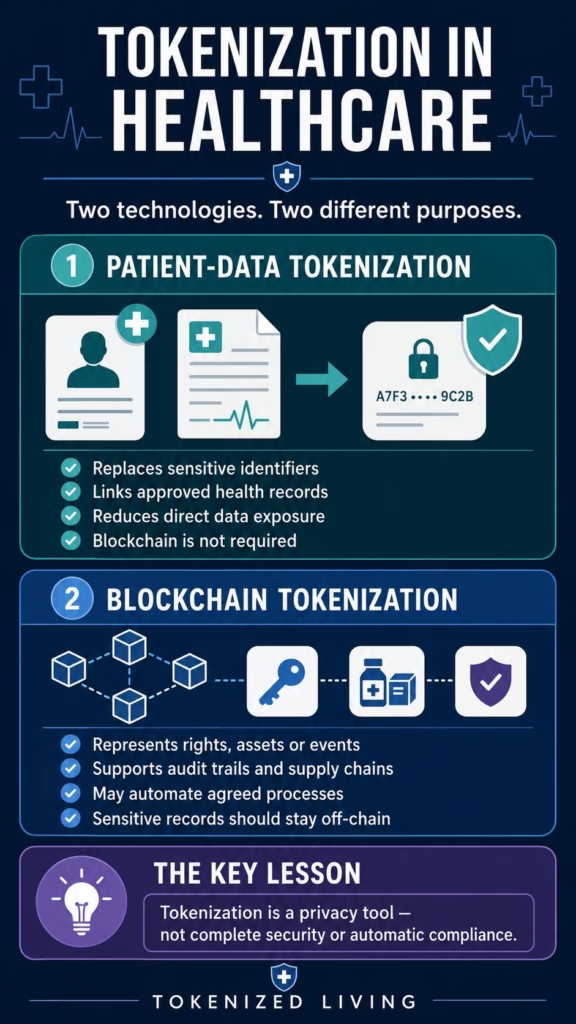
1. Patient-Data Tokenization
Patient-data tokenization replaces personally identifiable information with generated tokens.
Its purpose is to reduce exposure of names, addresses, identification numbers and other sensitive information.
A hospital, research organization or approved third party may maintain the tokenization system. Blockchain is not necessary.
2. Blockchain Tokenization
Blockchain tokenization creates digital tokens or on-chain records connected to an asset, right or process.
In healthcare, these might relate to:
- access permissions
- pharmaceutical products
- medical-equipment ownership
- healthcare receivables
- research funding
- insurance processes
- loyalty or participation rewards
This resembles the wider concept explained in our plain-English guide to tokenization.
However, a blockchain token does not automatically protect patient information. Nor does it make a healthcare system compliant with privacy laws.
| Patient-data tokenization | Blockchain tokenization |
|---|---|
| Protects or replaces sensitive identifiers | Represents rights, assets or system events |
| Usually operates in controlled databases | Uses a blockchain or distributed ledger |
| Supports secure data linkage | Supports shared records and programmable transactions |
| Does not require cryptocurrency | May use digital tokens or smart contracts |
| Focuses on privacy and data minimization | Focuses on coordination, ownership or automation |
| Already used in healthcare research | Many applications remain at pilot stage |
These two models can work together. Nevertheless, they should never be treated as the same technology.
How Patient-Data Tokenization Works
Consider a clinical trial sponsor that wants to study participants’ long-term health outcomes.
The sponsor holds clinical trial data. Meanwhile, hospitals, pharmacies and insurers hold later medical information.
Directly sharing patient names between every organization would create unnecessary privacy exposure.
A tokenized process can work differently:
- An authorized system receives approved identifying information.
- The system standardizes the information into a consistent format.
- A tokenization engine creates one or more patient tokens.
- Direct identifiers remain separate from the research dataset.
- Participating organizations apply compatible tokenization rules.
- Matching tokens identify records likely to concern the same person.
- Researchers receive linked clinical information without routinely receiving direct identifiers.
The original identifying information does not need to travel with every dataset.
As a result, tokenization can reduce the number of systems and people exposed to sensitive data.
A 2025 study on tokenization in clinical research described how participant information can become hashed tokens for privacy-preserving record linkage. The researchers also emphasized consent, re-identification risk and selecting an appropriate tokenization engine.
Those qualifications matter.
Creating a random-looking code does not make the process secure by default.
What Is Privacy-Preserving Record Linkage?
Privacy-preserving record linkage, or PPRL, helps identify records belonging to the same person across separate datasets.
Traditional record linkage might compare names, addresses or identification numbers directly.
PPRL aims to make those comparisons without revealing the original information to every participant.
For example, researchers may want to connect:
- clinical trial participation with later hospital admissions
- vaccination records with health outcomes
- prescription data with adverse drug events
- cancer registries with mortality records
- electronic health records with insurance claims
A token can act as a common linking value.
When two approved systems generate a matching token, researchers may connect the related records. Yet they do not need to see the patient’s name.
Recent research suggests that PPRL can link health records accurately while reducing direct disclosure. However, matching quality depends on the method, data quality and implementation.
Misspelled names, changed addresses and incomplete dates can create incorrect or missed matches. Therefore, tokenization does not solve poor data quality automatically.
Tokenization Versus Encryption
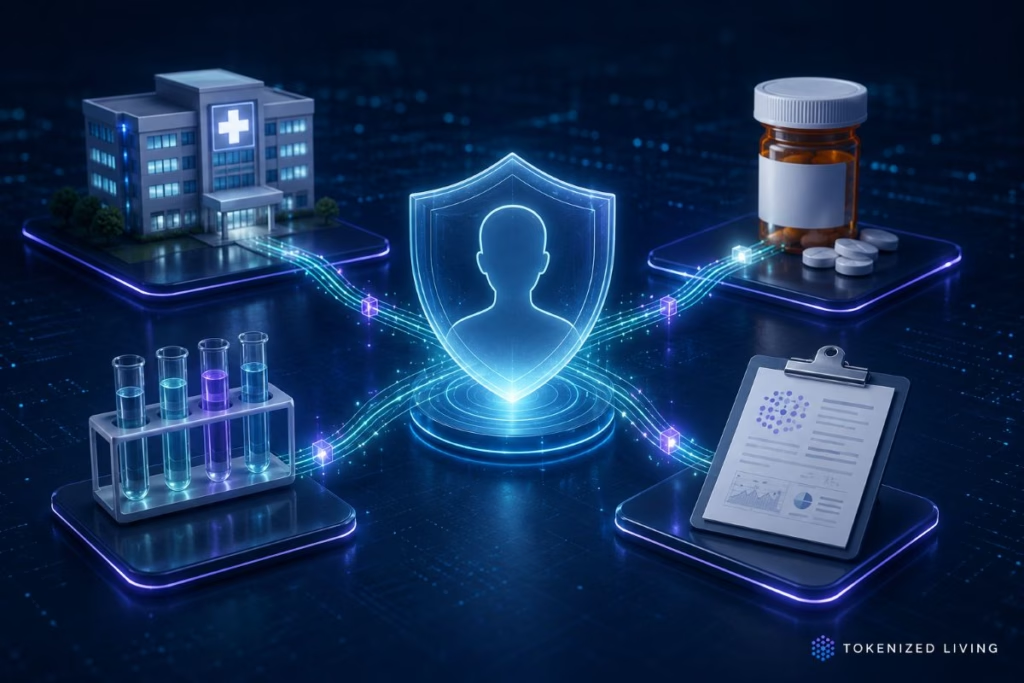
Tokenization and encryption both protect information, but they work differently.
Encryption transforms readable data into ciphertext using a cryptographic key. An authorized party can use the correct key to decrypt it.
Tokenization replaces the sensitive value with a substitute.
Depending on the system, a secure token vault may store the connection between the token and the original information. Other implementations use cryptographic methods to generate consistent linkage tokens.
| Method | What it does | Can the original be recovered? | Common healthcare use |
|---|---|---|---|
| Tokenization | Replaces sensitive data with a substitute | Sometimes, depending on the design | Record linkage and data minimization |
| Encryption | Converts data into unreadable ciphertext | Yes, with the correct key | Protecting stored and transmitted data |
| Hashing | Produces a fixed output from an input | Designed to be one-way | Integrity checks and some linkage systems |
| Pseudonymization | Replaces identifying information while retaining a way to reconnect it | Usually possible with additional information | Research and controlled data processing |
| De-identification | Reduces identification risk to a legally accepted standard | Depends on the method and context | Data sharing and secondary research |
| Anonymization | Attempts to prevent reasonably possible re-identification | Intended to be irreversible | Broader statistical use |
A secure healthcare system may use several of these methods together.
For instance, an organization might tokenize patient identifiers, encrypt the remaining dataset and apply strict access controls.
No single measure provides complete protection.
Is Tokenized Healthcare Data Anonymous?
Not necessarily.
A tokenized dataset may remain pseudonymous rather than anonymous.
If an organization retains a token vault, matching system or additional information, someone may still reconnect the records to an individual.
Re-identification may also occur when attackers combine supposedly protected records with outside information.
Rare diseases, unusual treatments, precise dates and small geographic areas can make individuals easier to identify. Therefore, removing names alone may not provide enough protection.
Under the European Union’s GDPR, pseudonymized data remains personal data when additional information could reconnect it to an identifiable person. The official GDPR summary describes pseudonymization as replacing identifying fields with artificial identifiers.
Tokenization can reduce risk. It does not automatically take the data outside privacy law.
Does Tokenization Make Healthcare Data HIPAA-Compliant?
No.
The United States HIPAA Privacy Rule provides two recognized methods for de-identifying protected health information:
- Safe Harbor
- Expert Determination
Safe Harbor requires the removal of specified identifiers and the absence of actual knowledge that the remaining information could identify someone.
Expert Determination requires a qualified expert to assess and document that the identification risk is very small.
The U.S. Department of Health and Human Services explains both methods in its de-identification guidance.
Tokenization may contribute to a privacy strategy. However, simply replacing a name with a token does not prove that either HIPAA method has been satisfied.
Organizations must also consider:
- access controls
- user authentication
- staff training
- data minimization
- audit logging
- contractual safeguards
- secure transmission
- incident response
- retention requirements
- re-identification risk
Furthermore, HIPAA does not govern every health application or technology company. The legal position depends on the organization, data and relationship involved.
Consequently, “HIPAA-compliant tokenization” should never be accepted as an unsupported marketing claim.
Benefits of Tokenization in Healthcare
Used correctly, tokenization offers several practical benefits.
Reduced Exposure of Direct Identifiers
Researchers and analysts may not need patient names to complete their work.
Replacing those identifiers limits how widely they travel.
If an unauthorized user accesses the analytical dataset, the exposed records may contain fewer immediately identifying details.
However, the event can still qualify as a serious security incident. Other fields may remain sensitive or identifiable.
Secure Record Linkage
Healthcare data often sits inside disconnected systems.
One provider may hold diagnoses. Another organization may hold pharmacy data, insurance claims or laboratory results.
Compatible tokens can help connect those records without exchanging direct identifiers each time.
This can create a more complete view of treatments and outcomes.
Better Clinical Research
Clinical trials usually examine participants for a limited period.
Tokenized linkage can help researchers study longer-term outcomes using real-world data. It may reveal later hospitalizations, medication changes or adverse events.
A recent paper on healthcare tokenization techniques identified applications across clinical research, pharmacovigilance and drug-safety monitoring.
Nevertheless, researchers still need an appropriate legal basis, governance structure and consent process.
Improved Pharmacovigilance
Drug-safety teams often need to compare multiple data sources.
Tokenized records may help connect a reported adverse event with prescription, treatment and outcome information.
Earlier identification of safety signals could support faster investigation. Yet the quality of the conclusion still depends on accurate data and sound analysis.
Data Minimization
Organizations should not collect or share more personal information than necessary.
Tokenization supports this principle by separating identity from analytical information.
A researcher studying treatment effectiveness may need age ranges, diagnoses and outcomes. The patient’s full name may add no analytical value.
Support for AI and Advanced Analytics
Healthcare organizations need large, diverse datasets to develop and evaluate analytical models.
Tokenization may help combine approved records while limiting the spread of direct identifiers.
Still, tokenized data does not remove bias, consent problems or re-identification risk. AI training datasets require separate quality and governance controls.
Blockchain Applications in Healthcare
Blockchain offers a different set of capabilities.
A distributed ledger can create a shared record among organizations that do not want one participant to control the entire system.
Smart contracts may also apply predefined rules to transactions.
Nevertheless, most healthcare processes do not need a blockchain. A secure conventional database will often remain simpler, cheaper and easier to correct.
Blockchain becomes more relevant when several independent organizations need:
- a shared transaction history
- verifiable data integrity
- coordinated business rules
- restricted access
- traceable changes
- limited dependence on one central operator
Even then, sensitive medical information should generally remain off-chain.
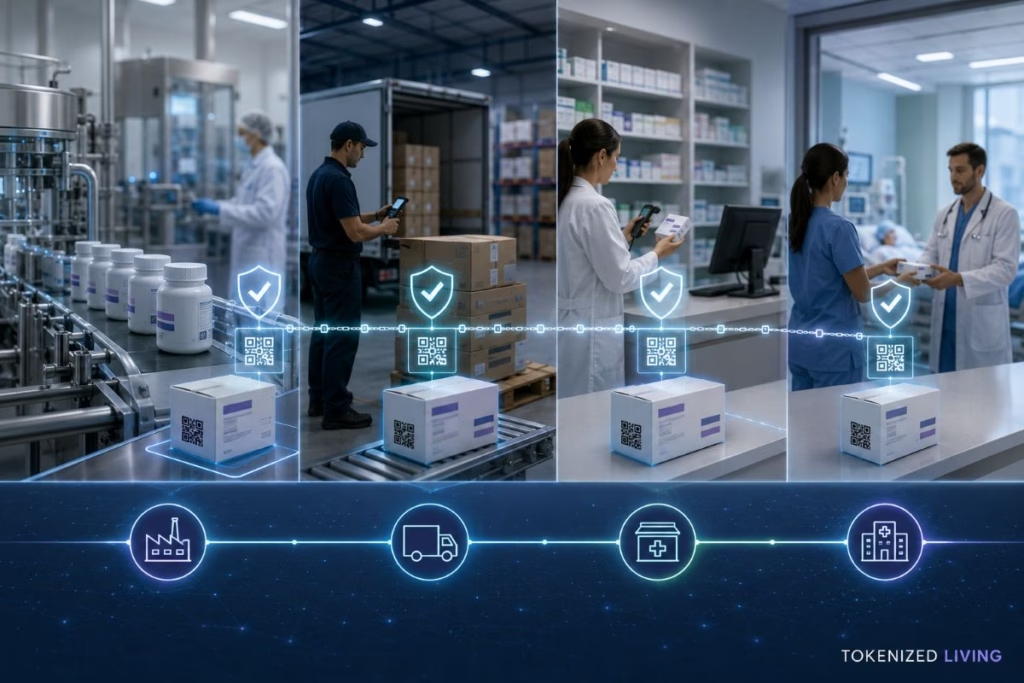
Pharmaceutical Supply-Chain Tracking
Counterfeit, stolen or diverted medicines create serious health risks.
The U.S. Drug Supply Chain Security Act requires an interoperable electronic system for identifying and tracing certain prescription drugs at package level. However, the law does not require blockchain.
The FDA’s DSCSA guidance focuses on product identification, tracing and rapid responses to illegitimate products.
Blockchain has been tested as one possible infrastructure.
For example, the MediLedger pilot explored blockchain-based tracking of prescription-medicine ownership. Its report found that blockchain could support package-level tracing, verification and investigations.
However, participation in an FDA pilot did not constitute FDA approval or endorsement. The FDA explicitly states that selection for a pilot should not be interpreted that way.
Therefore, the accurate conclusion is that blockchain has demonstrated technical potential for pharmaceutical tracing. It is not the only compliant solution.
Medical-Record Integrity
A blockchain can store a cryptographic proof showing that a record existed at a particular time and has not changed unexpectedly.
The medical record itself does not need to appear on-chain.
Instead, the system may store a hash or reference. Authorized users can later compare it with the off-chain record.
This can support:
- audit trails
- document integrity
- research provenance
- consent histories
- verification of medical credentials
However, blockchain only confirms that the stored proof matches the submitted information.
It cannot determine whether the original diagnosis was correct. Nor can it detect every falsified input.
An immutable record of bad data remains bad data.
Patient Consent and Access Management
Smart contracts could record when a patient grants or withdraws permission for specific data uses.
The blockchain may provide a traceable history of those decisions.
Nevertheless, healthcare consent is rarely a simple on-or-off switch.
Emergency access, legal obligations, research withdrawals, guardianship and changing patient capacity create exceptions. A smart contract cannot interpret every clinical or legal situation without external governance.
Patients may also lose wallet credentials or misunderstand a technical interface.
Therefore, blockchain can support consent administration. It cannot replace healthcare professionals, privacy teams or the law.
Insurance Claims and Billing
Healthcare billing involves providers, insurers, patients and intermediaries.
A shared ledger could help participating organizations confirm:
- whether a service occurred
- which party submitted a claim
- when an insurer received it
- which rules were applied
- whether a payment was approved
- where a dispute began
Smart contracts may automate limited steps when all parties agree on the data and rules.
However, claims frequently contain coding errors, coverage disputes and complex medical judgments. Automation cannot make those disagreements disappear.
Furthermore, a blockchain will not fix inaccurate input from a hospital, insurer or patient.
Healthcare Payments
Healthcare providers may use conventional payment tokenization to protect card or bank-account information.
This is closer to payment security than medical-record tokenization.
The payment processor replaces the financial account number with a token. Consequently, the provider may store fewer valuable payment credentials.
This approach does not require blockchain. It also does not protect the clinical information attached to the transaction.
Tokenized Healthcare Assets and Funding
Healthcare can also intersect with real-world asset tokenization.
Possible structures include:
- tokenized healthcare receivables
- fractional interests in medical equipment
- tokenized research-financing agreements
- pharmaceutical royalty rights
- healthcare-property investments
- debt issued by healthcare organizations
These are financial products, not privacy tools.
A token might represent a claim on loan repayments, equipment revenue or pharmaceutical royalties. Therefore, investors must examine the legal structure behind it.
Our beginner’s guide to real-world asset tokenization explains why a digital token is only as reliable as its underlying rights.
Healthcare-related assets introduce additional concerns:
- securities regulation
- patient confidentiality
- credit risk
- repayment priority
- research failure
- intellectual-property rights
- insurance reimbursement
- ethical conflicts
- limited secondary liquidity
Tokenizing a healthcare receivable does not guarantee payment. Similarly, a token linked to research funding does not guarantee that the treatment will succeed.
Can Patients Sell Their Health Data Through Tokens?
Blockchain projects have proposed markets where patients receive tokens for sharing health information.
The idea sounds attractive.
Patients generate valuable data, while technology and pharmaceutical companies may profit from its analysis. A token could theoretically record consent or distribute rewards.
However, the model creates difficult questions.
- Can a patient meaningfully understand every future use?
- Can consent truly be withdrawn after data has been copied?
- Could financial pressure push vulnerable people to share information?
- Who owns insights derived from combined datasets?
- What happens when genetic data reveals information about relatives?
- How does the system handle children or people unable to consent?
- Does a token payment compensate for long-term privacy risk?
Health information is not an ordinary commodity.
Moreover, privacy rights do not always equal full legal ownership of the underlying medical record. Laws vary by jurisdiction and record type.
Patient-reward tokens remain an experimental and ethically sensitive application. They should not be marketed as an automatic form of patient empowerment.
Major Risks of Tokenization in Healthcare
Tokenization reduces certain risks while creating others.
Compromise of the Token Vault or Key System
A reversible token may depend on a secure mapping database.
If attackers gain access to both the tokens and the mapping system, they may reconnect records with patients.
Security teams must separate systems, restrict privileges and monitor access.
Re-Identification
Removing names does not necessarily hide identity.
Attackers may combine dates, locations, diagnoses and public information to identify individuals.
Large linked datasets can increase analytical value. Unfortunately, they may also create richer re-identification opportunities.
Matching Errors
Record-linkage systems can connect the wrong people or fail to recognize the same person.
A false match may contaminate research. Worse, it could associate medical information with the wrong patient.
Organizations must measure and monitor linkage quality.
Vendor Dependence
A healthcare organization may become dependent on one tokenization provider.
Changing vendors can become difficult when token formats, matching rules and historical records are proprietary.
Contracts should explain data portability, service continuity and what happens if the provider fails.
Metadata Leakage
A blockchain may hide the content of a transaction while still exposing patterns.
Observers might see when an address interacts with a medical organization or how frequently events occur.
Even encrypted or hashed information can create privacy risks when combined with metadata.
Blockchain Immutability
Permanent records can conflict with correction, retention and deletion requirements.
Sensitive records should not be placed directly on a public blockchain.
Off-chain storage can reduce the problem, but system designers must still decide how to invalidate outdated references and correct errors.
Smart-Contract Vulnerabilities
Healthcare smart contracts can contain programming errors.
A flaw might expose permissions, block authorized access or automate an incorrect payment.
Code audits reduce risk but cannot guarantee a faultless system.
Weak Governance
Technology cannot answer every governance question.
Someone must decide:
- who operates the tokenization service
- who can reverse tokens
- who corrects records
- who grants access
- which organizations may join
- how disputes are resolved
- what happens after a breach
- how patients exercise their rights
Without clear accountability, decentralization can make responsibility harder to locate.
How Mature Is Blockchain Healthcare Tokenization?
The maturity depends on the application.
Patient-data tokenization and privacy-preserving record linkage already have practical research uses.
Blockchain-based healthcare data sharing is much less mature.
A 2025 systematic review of 334 studies found that most blockchain privacy solutions remained at proof-of-concept level. Only a limited number had reached prototype validation, and none in the review had achieved full clinical deployment maturity.
This does not prove that blockchain lacks value.
Instead, it reveals a large gap between academic designs and routine healthcare use.
Real deployment requires more than a working smart contract. It also needs:
- hospital integration
- reliable identity management
- clinical testing
- privacy compliance
- cybersecurity controls
- professional training
- patient support
- shared technical standards
- long-term funding
- accountable governance
Blockchain may handle one part of the system. Healthcare organizations must still build everything around it.
Does Healthcare Actually Need Blockchain?
Often, it does not.
If one hospital controls the data and trusts its own administrators, a conventional database may be the better choice.
Traditional systems usually offer:
- faster processing
- easier corrections
- simpler access recovery
- lower implementation costs
- established compliance tools
- clearer responsibility
Blockchain deserves consideration when several independent parties need a shared record and cannot rely comfortably on one central operator.
Even then, project leaders should ask:
- What problem requires a distributed ledger?
- Why would a conventional shared database fail?
- Which information will remain off-chain?
- Who controls network participation?
- How will patients correct inaccurate information?
- Who manages lost credentials?
- What happens if a smart contract fails?
- Which organization remains legally accountable?
- How will the system integrate with existing healthcare software?
- Does the expected benefit justify the added complexity?
If a project cannot answer those questions, it probably does not need blockchain.
Teams still considering a blockchain architecture should compare privacy, governance and interoperability before selecting a network. Our guide explains how to choose a blockchain for a tokenization project.
The Future of Tokenization in Healthcare
Healthcare tokenization will probably develop along two separate tracks.
The first involves privacy-preserving data use.
Hospitals, research organizations and pharmaceutical companies need safer ways to connect records. Tokenization can help them study treatments and outcomes without distributing direct identifiers unnecessarily.
That use is practical, although it still demands strong governance.
The second track involves blockchain-based coordination.
Supply-chain records, consent logs, credential verification and multi-party processes may benefit from shared ledgers. However, adoption will depend on interoperability, privacy and clear accountability.
The industry should avoid treating blockchain as a storage location for complete patient records.
A more credible model keeps sensitive information off-chain. The ledger then records limited proofs, permissions or transaction events.
Even that architecture will not remove the need for encryption, access control and compliance.
Final Verdict: Useful Technology, Dangerous Hype
Tokenization can make healthcare data sharing safer.
It can reduce the exposure of direct identifiers and support valuable research across disconnected datasets.
However, it cannot make data breaches a thing of the past.
Tokenized information may remain identifiable. Token vaults can be compromised. Matching systems can make errors, while weak governance can undermine technically sound systems.
Blockchain introduces a separate set of possibilities.
It may support pharmaceutical tracing, shared audit trails and limited process automation. Nevertheless, much of blockchain-based healthcare data sharing remains experimental.
The strongest healthcare systems will not use blockchain simply because it sounds innovative.
They will choose the least complex technology that solves the actual problem.
In many cases, that means combining tokenization with encryption, access controls and conventional databases.
Where blockchain provides a genuine multi-party advantage, it can become one useful layer.
It should never become a substitute for privacy, clinical accuracy or accountability.
Tokenization in Healthcare FAQs
What does tokenization mean in healthcare?
Tokenization usually means replacing sensitive patient identifiers with non-sensitive tokens. Authorized organizations can use those tokens to link records without sharing direct identifiers every time.
Does healthcare tokenization use blockchain?
Most patient-data tokenization does not require blockchain. Blockchain tokenization is a separate approach involving distributed records, digital rights, assets or automated processes.
Is tokenization the same as encryption?
No. Encryption transforms data into ciphertext that can be decrypted with a key. Tokenization replaces the original value with a substitute token.
Can tokenized healthcare data be re-identified?
Yes, in some circumstances. Re-identification may be possible through a token vault, additional information or links with outside datasets.
Does tokenization guarantee HIPAA compliance?
No. Tokenization can support privacy protection, but organizations must still meet applicable HIPAA requirements. De-identification requires Safe Harbor or Expert Determination under the HIPAA Privacy Rule.
Should medical records be stored on a public blockchain?
Generally, no. Sensitive medical information should normally remain in controlled off-chain systems. A blockchain may store limited proofs, references or permission records instead.
How does tokenization help clinical research?
It can connect clinical trial records with later healthcare data without routinely sharing participants’ direct identifiers. This may help researchers study long-term outcomes and drug safety.
Can blockchain prevent healthcare data breaches?
No. Blockchain does not secure every connected database, device, application or user account. Poor access control, software vulnerabilities and stolen credentials can still expose data.
Can patients make money by tokenizing their medical data?
Some experimental projects propose patient data rewards. However, the legal, privacy and ethical issues remain substantial. A token payment does not eliminate long-term data-use risks.
Is blockchain necessary for healthcare tokenization?
Usually not. Conventional tokenization systems can protect and link patient information. Blockchain only becomes useful when several independent parties genuinely need a shared, verifiable ledger.