
XRPL real estate tokenization is finally producing something more useful than bold price predictions.
Dubai has placed fractional property ownership on the XRP Ledger. Those digital records also connect with the Dubai Land Department. In 2026, the project moved into controlled secondary trading.
That is genuine progress.
However, it does not mean Ripple is capturing a $30 trillion real estate market. Nor does every property token give direct ownership. Rising XRPL use also does not guarantee rising demand for XRP.
The old version of this article blurred those distinctions. This rebuild separates the technology from the hype.
This article examines what Ripple, the XRP Ledger and their partners have actually delivered. More importantly, it explains what investors may own and where the risks remain.
TL;DR
- There is no solid evidence that Ripple has a current target to tokenize $30 trillion of real estate.
- Ripple and Boston Consulting Group now forecast about $19 trillion for the wider tokenized-asset market by 2033.
- Dubai provides the strongest XRPL property example. Its model links tokens with official land records.
- The Dubai pilot moved into controlled secondary trading in February 2026.
- Earlier Hong Kong and Colombia projects tested lending and land records. They were not open property-investment platforms.
- XRPL provides useful token, settlement and compliance tools. Property law still creates the ownership rights.
- Growth in XRPL activity may help the network. However, it does not automatically create major demand for XRP.
The key point: A blockchain can record and transfer a property token. Only a valid legal framework can make that token enforceable.
What Is XRPL Real Estate Tokenization?
XRPL real estate tokenization uses the XRP Ledger to record digital tokens linked to property.
Those tokens may represent:
- direct fractional ownership
- shares in a property-owning company
- rights to rental income
- property-backed debt
- collateral for a loan
- a digital land or title record
These structures are not interchangeable.
A token linked to a land registry may support direct ownership. By contrast, a token issued by a private company may only represent contractual rights.
If you are new to the topic, start with our plain-English guide to what tokenization means. You can also read the complete guide to tokenized real estate.
Why the $30 Trillion Claim Needs to Go
The original headline said Ripple was targeting a $30 trillion real estate market.
That claim does not stand up.
A 2023 story on Investing.com presented $30 trillion as the projected size of the real estate sector by 2030. It then framed that figure as a Ripple target. The page also states that AI helped generate the article.
Meanwhile, Ripple’s own 2023 material cited a Boston Consulting Group forecast of $16 trillion for tokenized real-world assets by 2030. That estimate covered many illiquid assets, not XRPL property alone.
The forecast has since changed again.
Ripple and Boston Consulting Group’s newer report projects that tokenized assets could reach about $19 trillion by 2033. Once again, that forecast covers the wider tokenized-asset market.
Dubai’s official property target is much smaller. The Dubai Land Department estimates tokenized property could reach AED 60 billion, or about $16 billion, by 2033.
That is still ambitious. However, it is not $30 trillion.
Market forecasts also measure possible industry growth. They do not show how much value one blockchain will capture.
Ripple, XRPL and XRP Are Not the Same Thing
Many articles use Ripple, XRPL and XRP as if they mean the same thing. They do not.
| Term | What it is | Role in tokenized real estate |
|---|---|---|
| Ripple | A private technology company | Supports projects, partnerships, custody and institutional infrastructure |
| XRP Ledger | A public blockchain network | Records token issuance, transfers, trades and other transactions |
| XRP | The ledger’s native digital asset | Pays small network costs and can act as a bridge asset |
Ripple contributes to XRPL development and adoption. However, it does not own the public network.
Likewise, a property can use XRPL without using XRP as the investment currency. Dubai’s pilot initially accepted UAE dirhams, not cryptocurrency.
That distinction matters when people connect every XRPL announcement with the XRP price.
What Does the XRP Ledger Bring to Property Tokenization?
Property tokenization needs more than a digital coin. It needs issuance, identity controls, settlement, custody and transfer rules.
XRPL includes several relevant tools.
Native Token Issuance
Issuers can create assets directly on the ledger. They do not need to build a separate smart contract for every basic token function.
XRPL also supports Multi-Purpose Tokens, known as MPTs. These can include metadata and transfer controls. However, XRPL’s documentation says MPTs still lack full feature parity with older trust-line tokens.
Therefore, investors should not treat every planned feature as finished infrastructure.
Compliance Controls
Property investments often require identity checks and investor restrictions.
XRPL can support approved-holder lists, credentials, freezes and permissioned markets. These controls can help issuers follow securities and property rules.
However, the blockchain does not decide who qualifies. Regulators, issuers and platform operators set those rules.
Built-In Trading Tools
XRPL includes a decentralized exchange and automated market makers. Tokens can trade against XRP or other issued assets.
Yet technical transferability is not the same as liquidity.
A marketplace needs real buyers, fair prices and enough trading depth. Otherwise, a sell button offers little value.
Fast Settlement and Low Network Costs
XRPL transactions normally settle within seconds. Network costs also remain low.
This can reduce administrative friction. Still, property fees, taxes, valuations and legal costs do not disappear.
Custody and Account Controls
Institutions can use multi-signature accounts and external custody services. Ripple Custody supports the Dubai project.
Custody can make the system easier for mainstream investors. On the other hand, it creates reliance on service providers.
Dubai Is the Strongest Real-World XRPL Property Case
Dubai provides the clearest evidence that XRPL real estate tokenization is moving beyond experiments.
In May 2025, the Dubai Land Department launched its pilot through PRYPCO Mint. The project also involved:
- the Virtual Assets Regulatory Authority
- the Central Bank of the UAE
- Dubai Future Foundation
- Ctrl Alt
- Zand Digital Bank
At launch, investors needed a valid UAE ID. The minimum investment was AED 2,000. In addition, all payments used UAE dirhams.
Therefore, investors did not need to buy XRP or manage a personal crypto wallet.
Most importantly, the legal structure went further than many tokenized-property platforms.
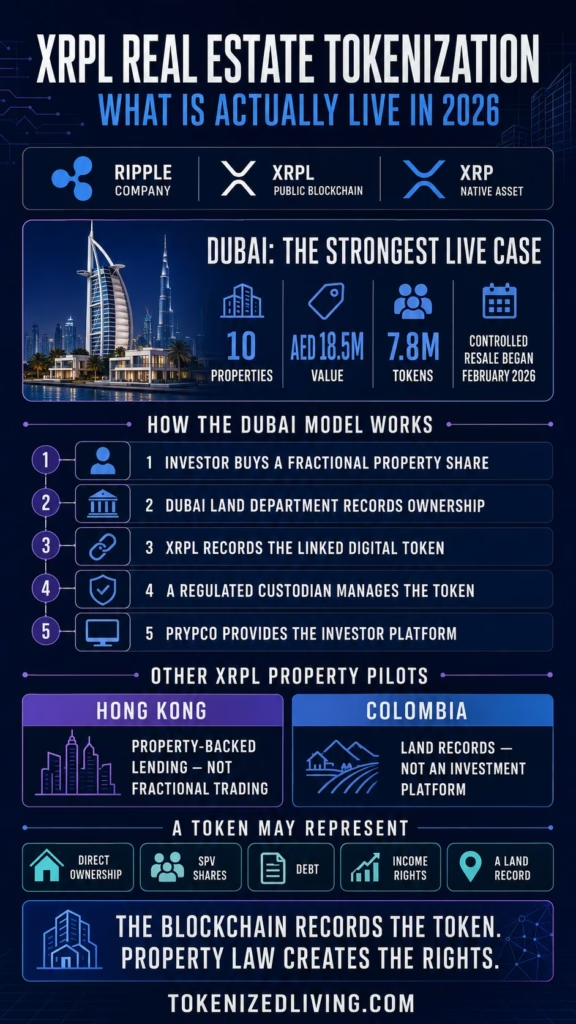
PRYPCO Mint’s terms say investors directly own a property share. DLD registers that share in proportion to the investment.
Investors’ tokens sit in a warm multi-party computation omnibus account. Ctrl Alt acts as custodian.
This creates an unusual hybrid model:
- Investors receive direct fractional property rights.
- DLD records those rights.
- XRPL records the linked digital tokens.
- A regulated custodian manages the tokens.
- PRYPCO provides the investor platform.
That legal and technical alignment matters far more than the token’s branding.
Early Demand Was Strong
PRYPCO’s first property attracted 224 investors from 44 nationalities. According to the Dubai Land Department, 70% entered Dubai property for the first time.
A second offering then sold out in one minute and 58 seconds. It attracted 149 investors from 35 nationalities. Meanwhile, the waiting list passed 10,700.
Those figures show demand.
However, sell-outs do not prove long-term returns or liquidity. They only show that investors wanted the first offerings.
What Changed in 2026?
In February 2026, the Dubai project entered Phase Two.
During Phase One, the partners tokenized ten properties worth more than $5 million, or AED 18.5 million. They issued about 7.8 million tokens.
Phase Two introduced controlled secondary-market trading. Eligible investors can now resell tokens within the regulated pilot.
According to Ctrl Alt’s Phase Two announcement, those transactions continue to use XRPL and Ripple Custody. The system also stays connected with official land-registry records.
This development is important for two reasons.
First, it tests whether digital ownership can move after the first sale. Second, it examines whether the official registry can remain aligned with each transfer.
Still, the scale remains small.
Ten properties and $5 million do not transform global real estate. They do, however, create a credible working model.
For a wider platform comparison, see our guide to tokenized real estate platforms in 2026.
What Did the Hong Kong Pilot Prove?
Hong Kong tested a different use case.
During the Hong Kong Monetary Authority’s e-HKD pilot, Fubon Bank and Ripple explored property-backed lending. The model connected tokenized real estate collateral with a digital home equity credit line.
However, the project faced a legal problem.
Hong Kong keeps title deeds in a centralized system. Therefore, the pilot shifted from tokenizing title deeds to tokenizing bank charges linked to property.
That detail is easy to miss.
The pilot did not create a public marketplace for fractional Hong Kong property. Instead, it tested how a bank might use blockchain records to support lending.
It also proved an important point: technology must adapt to local property law.
What Did the Colombia Project Prove?
Ripple also supported a land-record project in Colombia with Peersyst and the country’s Ministry of Information Technologies and Communications.
The project placed land ownership resolutions on XRPL. Its goal was better record-keeping and stronger protection against disputes or fraud.
Again, this was not a fractional investment platform.
Investors could not buy pieces of Colombian land through an XRPL marketplace. The project focused on land administration.
That still matters. Reliable records form part of any future tokenized-property system.
However, registry modernization and investable tokenization solve different problems.
What Do Investors Actually Own?
“Tokenized property” tells you almost nothing about your legal rights.
You need to inspect the structure behind the token.
| Structure | What the investor may own | Main question |
| Direct registered fraction | A legal share of the property | Does the land registry recognize each owner? |
| SPV or company token | Shares or membership rights in a property-owning entity | What rights do those shares provide? |
| Debt token | A claim against a borrower, often backed by property | What happens after default? |
| Income token | Contractual rights to rent or another cash flow | Who owes the payment? |
| Registry token | A digital record linked to a title or legal resolution | Does the token itself transfer ownership? |
| Collateral token | A record used to support a secured loan | Can the lender enforce the security? |
The Dubai pilot aims for direct registered fractional rights. By contrast, Hong Kong tested collateral. Colombia tested land records.
All three use property and blockchain. Yet they create very different outcomes.
Our guide to fractional ownership explains why the legal wrapper matters.

Does XRPL Real Estate Adoption Increase Demand for XRP?
Possibly, but the connection is weaker than many XRP promotions suggest.
XRPL accounts need a small amount of XRP. Transactions also burn tiny XRP fees.
In addition, the network can use XRP as a bridge between two assets. Its exchange searches for an efficient trading route.
However, XRPL can also trade one issued token against another. A property token could trade against a stablecoin without making XRP the main investment asset.
Dubai provides a clear example. Investors used dirhams, while the infrastructure handled the blockchain layer.
Therefore, more tokenized property could increase XRPL activity without creating equivalent buying pressure for XRP.
Its final effect depends on:
- how many investors use their own XRPL accounts
- whether trades use XRP as a bridge
- how much value settles through stablecoins
- whether platforms use custodial omnibus accounts
- the depth of XRP trading pairs
An XRPL adoption story is not automatically an XRP price story.
What XRPL Cannot Solve
XRPL can improve the digital infrastructure. It cannot fix a weak investment.
It cannot:
- make an overpriced property attractive
- prevent vacancies or repair costs
- guarantee rental income
- create buyers for a secondary market
- replace property law
- remove tax obligations
- protect investors from a failed platform
- guarantee accurate off-chain data
- ensure that XRP rises in value
This is why investors should assess the property first.
They should then review the ownership structure, fees, manager, custody and exit rules. Blockchain comes after those questions.
Key Risks to Watch
Legal-Linkage Risk
Every token must connect with enforceable rights. A blockchain entry alone may not prove legal ownership.
Liquidity Risk
Controlled secondary trading is progress. However, every seller still needs a buyer.
Custody Risk
Custodial accounts simplify access. They also add operational and counterparty risk.
Platform Risk
Investors rely on the platform for onboarding, documents, income, voting and exits.
Property Risk
Rental income can fall. Prices can decline. Repairs, vacancies and service charges can reduce returns.
Regulatory Risk
Eligibility rules can change. Cross-border investors may also face securities, tax and currency restrictions.
Registry and Data Risk
The blockchain only records the information it receives. Errors can still enter through valuations, identity systems or registry integrations.
For a deeper review, read the benefits and risks of tokenized real estate.
Final Verdict
XRPL real estate tokenization deserves attention in 2026.
Not because Ripple has captured a $30 trillion market. It has not.
The serious story is Dubai.
Dubai has linked fractional ownership, land records, regulated token issuance and custody. It has also started testing controlled secondary transfers.
That makes the project more credible than most property-token announcements.
However, it remains a pilot with limited scale. Hong Kong and Colombia also remain useful tests, not global investment markets.
XRPL provides fast and flexible infrastructure. Yet the blockchain is only one layer.
The real test is whether each token connects with enforceable rights, reliable property income and a workable exit.
That is where investors should focus.
XRPL also supports regulated financial products such as OpenEden TBILL and Ondo OUSG tokenized Treasury products.
FAQs
Is Ripple targeting a $30 trillion real estate market?
There is no reliable current evidence for that claim. A 2023 media story turned a broad market estimate into a Ripple target. Ripple and Boston Consulting Group now forecast about $19 trillion for the wider tokenized-asset market by 2033.
Is PRYPCO Mint using the XRP Ledger?
Yes. Dubai’s property-tokenization project records its ownership tokens on XRPL. Ctrl Alt provides tokenization infrastructure, while Ripple Custody supports custody.
Do investors need XRP to buy tokenized Dubai property?
Not during the original pilot. Investors paid in UAE dirhams. The blockchain operated behind the platform experience.
Do XRPL property tokens represent direct ownership?
It depends on the project. PRYPCO’s terms describe direct fractional ownership registered with the Dubai Land Department. Other tokens may represent company shares, debt, income rights, collateral or records.
Can investors easily sell XRPL property tokens?
Not necessarily. Dubai introduced controlled secondary trading in 2026. However, access rules apply, and liquidity still depends on buyer demand.
Is Ripple the same as the XRP Ledger?
No. Ripple is a private company. XRPL is a public blockchain network. XRP is the network’s native digital asset.
Does more XRPL tokenization guarantee a higher XRP price?
No. More activity may support network use, but property tokens can settle through fiat-facing platforms or issued assets. The effect on XRP depends on how the system routes trades and holds accounts.