
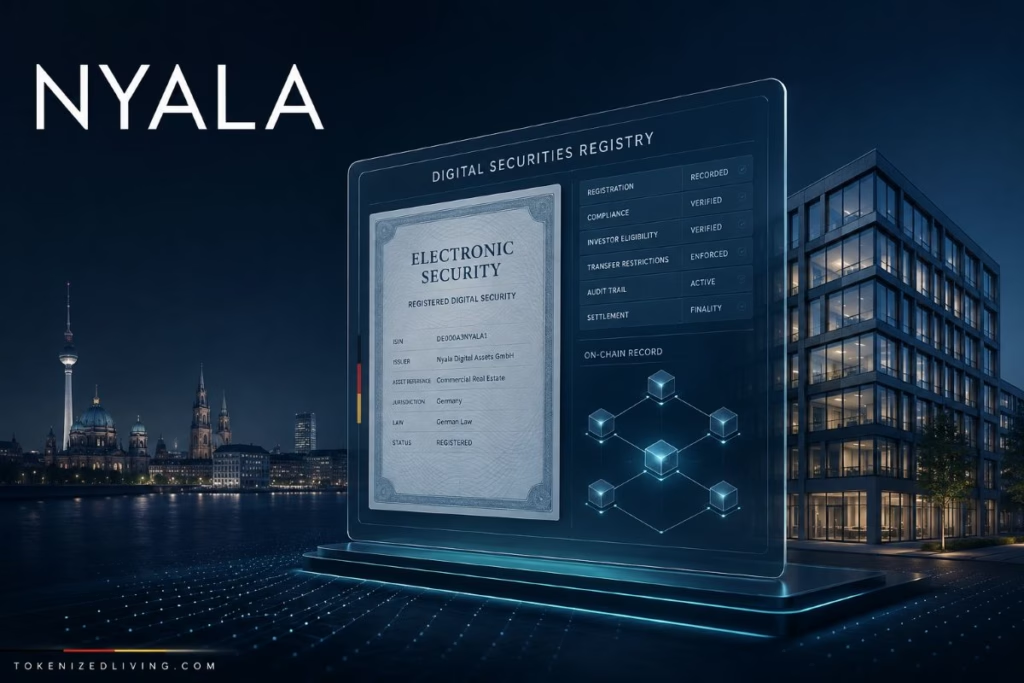
NYALA is easy to misunderstand.
It does not operate like RealT, Lofty or Reental. Retail investors cannot simply browse NYALA and buy fractions of listed properties.
Instead, NYALA provides infrastructure for companies issuing digital securities. Its clients include investment platforms, real estate businesses, fund managers, banks and private companies.
That distinction changes this entire NYALA tokenization platform review.
The company’s technology can help create, register, distribute and administer tokenized securities. However, blockchain does not determine what an investor owns.
The security’s legal documents and structure determine those rights.
Our verdict is cautiously positive. NYALA appears active, relevant and far more substantial than many tokenization projects.
However, its pricing remains private. Public evidence of secondary-market activity is also limited.
Therefore, NYALA deserves attention as B2B financial infrastructure. It should not be presented as a retail property-investment marketplace.
Review note: This assessment uses public platform documents, registry entries and an independent security report. We did not test NYALA as an issuer client.
TL;DR — NYALA Review 2026
| Category | Finding |
|---|---|
| Platform type | B2B tokenization and digital-securities infrastructure |
| Main users | Issuers, investment platforms, banks, fund managers and real estate businesses |
| Core services | Token issuance, investor onboarding, wallet infrastructure, registration, distribution and lifecycle management |
| Retail marketplace | No. Investors normally access offerings through an issuer or partner platform |
| Regulatory position | Smart Registry operates under BaFin supervision and preliminary authorization under Section 65 KWG |
| Reported scale | More than €160 million in digital assets and over 90 tokenized corporate bonds |
| Real estate role | Mainly tokenized securities used to finance property projects, including real estate bonds |
| Public pricing | No. NYALA provides tailored quotes |
| Main strength | Combines technology with a German electronic-securities registration route |
| Main weakness | Limited public pricing, trading-volume and investment-performance data |
| Verdict | Credible B2B infrastructure, but not a platform for browsing and buying property tokens |
What Is NYALA?
NYALA Digital Asset AG is a Berlin-based financial technology company founded in 2019.
The business supplies the infrastructure behind tokenized investment products. It does not usually sell those products directly to individual investors.
Think of NYALA as an operating system rather than an investment shopfront.
An issuer may use the system to structure a digital security. A crowdfunding platform could connect its own interface through NYALA’s API.
Meanwhile, investors may continue using the partner platform’s website. NYALA handles important processes behind that customer-facing experience.
Those processes can include:
- Creating and issuing tokens
- Opening and managing investor wallets
- Running identity and compliance workflows
- Processing transactions
- Registering eligible electronic securities
- Managing interest or other payments
- Connecting issuers with distribution partners
- Supporting permitted secondary transfers
This model differs from most platforms in our tokenized real estate platform comparison. Those companies mainly focus on individual investors.
NYALA primarily sells infrastructure to businesses.
For broader context, see our beginner’s guide to RWA tokenization.
How the NYALA Tokenization Platform Works
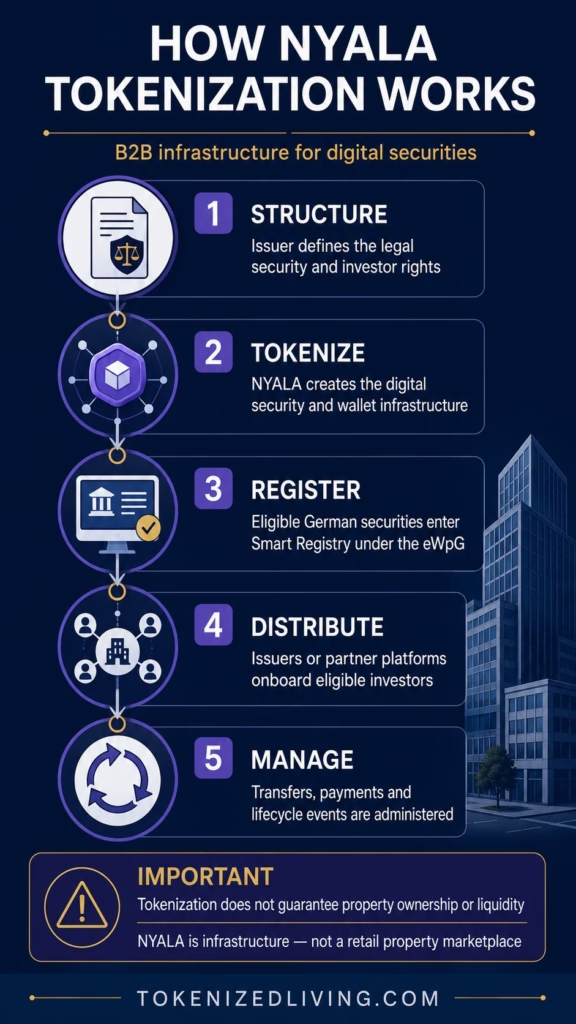
The exact process depends on the asset and legal structure. However, a typical issuance follows six broad stages.
1. The Issuer Creates the Legal Structure
Tokenization starts with law, not code.
The issuer must decide whether investors receive debt, equity, fund units, participation rights or another financial claim.
Lawyers and regulated providers may also need to prepare offering documents. Distribution rules, investor eligibility and payment terms must be defined.
NYALA can support the technical and registration process. It cannot make a weak investment economically sound.
2. The Digital Security Is Configured
The issuer can create a project through NYALA’s web portal. Larger platforms may instead connect through its REST API.
Details can include the security type, supply, payment rules and investor restrictions. Smart contracts then support the relevant on-chain functions.
If you need a simpler foundation first, read our guide explaining what tokenization means.
3. Investor Onboarding Takes Place
The issuer or distribution platform brings investors into the offering.
NYALA’s infrastructure can support wallet creation and identity-related workflows. It can also connect with integrated KYC and AML processes.
However, eligibility still depends on the offering and investor’s location. Creating a token does not remove securities-distribution rules.
4. The Security Is Issued and Registered
Eligible German electronic securities can enter a crypto securities register under the Electronic Securities Act, or eWpG.
Smart Registry GmbH provides this registration service within the NYALA group. The register records securities and publishes their issuance terms.
This step matters because the legal security does not rely on a paper certificate. Instead, the regulated register helps establish the official record.
5. NYALA Supports Ongoing Administration
Issuing the token is only the beginning.
Someone must still manage transfers, wallet events, corporate actions and investor records. Bonds may also require coupon payments and repayment at maturity.
NYALA’s platform aims to automate parts of that lifecycle. Even so, issuers remain responsible for meeting their financial obligations.
6. Secondary Transfers May Become Possible
NYALA also markets infrastructure for secondary trading. Its model seeks to connect platforms, investors, brokers and market makers.
That infrastructure could reduce transfer and settlement friction. Nevertheless, it cannot manufacture demand.
A token needs a willing buyer before it becomes liquid.
What Do NYALA Tokens Actually Represent?
There is no single “NYALA token” that gives every investor the same rights.
Each token represents the security created for a specific issuance. Consequently, investors must read that security’s terms.
| Instrument | What the investor may hold | What it does not automatically provide |
| Corporate bond | A debt claim against a company | Ownership of the company |
| Real estate bond | A debt claim used to finance a property project | A name on the property deed |
| Tokenized share | Equity rights defined by the share class | Guaranteed dividends or resale |
| Fund unit | An interest in a managed investment vehicle | Direct ownership of every underlying asset |
| Participation right | Contractual income or profit-sharing rights | Standard shareholder voting rights |
| Asset-backed security | A claim supported by a defined asset pool | Protection from borrower or structure failure |
This is the most important correction to the old article.
Tokenization does not always create fractional ownership. A divisible bond remains debt, even when blockchain tokens represent it.
Therefore, investors should never stop at the asset’s name. They must identify the legal issuer, instrument and repayment structure.
How NYALA Is Used for Real Estate Tokenization
Real estate remains one of NYALA’s supported sectors. However, its role needs careful explanation.
A developer may issue a tokenized bond to finance a property project. Investors then lend money under the bond’s terms.
They do not necessarily own part of the building.
For example, Smart Registry lists FOX Living – Apartments Braunschweig. The bond had a €1.53 million total issuance amount and an 8.75% coupon.
Its issuance date was August 1, 2026. The stated maturity date was July 31, 2028.
Those figures describe the registered security. They do not prove that the full amount was raised or repaid.
Furthermore, an advertised coupon is not a guaranteed return. Investors still face issuer, project, legal and liquidity risks.
NYALA says its real estate infrastructure can support investor onboarding, wallet creation, token distribution and automated payments. These tools may improve administration.
Still, they do not remove normal property-financing risk. Our commercial real estate tokenization guide explains these structures in more detail.
NYALA’s Main Products and Services
Tokenization Engine
Companies can use a web portal or API connection. The system supports token creation, wallet operations, transactions and smart contract management.
This flexibility suits both individual issuers and established investment platforms.
Smart Registry
Smart Registry GmbH maintains a crypto securities register under Germany’s eWpG framework.
Its public pages display registered securities, ISINs, issuance dates and terms. That transparency provides useful evidence that issuances exist.
However, registration does not approve an investment’s quality. It also does not guarantee that the issuer will repay investors.
EasyRaise
EasyRaise offers a white-label route for companies raising capital. NYALA developed the solution with Tokenforge and digital custodian Tangany.
The package combines an investor-facing subscription process with tokenization infrastructure. Therefore, businesses need not build every component themselves.
Co-Listing Network
NYALA’s co-listing system connects issuers with investment and crowdfunding platforms.
The company says participating platforms provide access to more than 270,000 investors. That figure represents potential distribution reach, not guaranteed funding.
Secondary-Market Infrastructure
NYALA markets an ecosystem for trading tokenized securities after issuance. Its website describes links between issuers, platforms, brokers and market makers.
The concept addresses a genuine market weakness. Private securities often lack efficient exit routes.
However, NYALA does not publish meaningful trading-volume, spread or market-depth data. We cannot confirm that investors currently receive reliable liquidity.

Is NYALA Regulated?
Yes, but the exact wording matters.
NYALA Digital Asset AG provides the wider technology platform. Its subsidiary, Smart Registry GmbH, provides crypto securities registration.
According to NYALA’s legal notice, Smart Registry supplies that financial service under preliminary authorization pursuant to Section 65 KWG.
BaFin and Deutsche Bundesbank are named as the competent supervisory authorities.
Therefore, calling Smart Registry BaFin-supervised is accurate. Calling the entire NYALA group “fully licensed for everything” would be misleading.
Germany’s eWpG has allowed certain securities to exist through electronic register entries since June 2021. The framework removes the need for a physical certificate.
Nevertheless, the law does not make every token compliant. The issuer, security type, offering documents and distribution route still matter.
Cross-border availability also requires separate analysis. German registration does not automatically let every person worldwide buy an offering.
Security and Custody
Security claims deserve evidence.
Hacken conducted a penetration test of NYALA’s internal API during May 2026. The final report recorded five findings.
No critical or high-severity findings appeared. One medium issue and one low issue were fixed.
Two observations were also fixed. NYALA accepted the remaining observation after review.
That result is encouraging, but its scope was limited. The assessment covered an internal API during a specific period.
It was not a guarantee covering every partner, smart contract, wallet or future platform change.
The old article also claimed NYALA used cold storage for investor assets. We found no adequate evidence supporting that blanket statement.
Custody may depend on the issuer, wallet model and external partners. Investors should check who controls the keys for each offering.
Is NYALA Still Active in 2026?
Yes. The public evidence shows continued activity.
Smart Registry listed new securities as recently as August 4, 2026. Its register also contains several real estate-related issuances from 2026.
NYALA reports more than €160 million in digital assets on its platform. It also reports over 90 tokenized corporate bonds.
Separately, NYALA’s Invesdor case study reports over 60 projects and 6,300 investor wallets. Those tokens had a total value above €50 million.
These figures are useful, although NYALA publishes them itself. They do not show default rates, investor returns or secondary-market exit performance.
Recent registrations prove the infrastructure remains active. They do not prove that every security is a good investment.
NYALA Fees and Costs
NYALA does not publish a standard price list.
The company says pricing depends on the selected service package. Setup, issuance and transaction fees may apply.
That approach is normal for enterprise infrastructure. Still, it prevents an independent cost comparison.
Prospective clients should request a written breakdown covering:
- Platform setup and integration
- Token creation and issuance
- Registry charges
- KYC and AML services
- Wallet creation and custody
- Investor onboarding
- Corporate actions and payments
- Distribution or co-listing
- Secondary-market connections
- Blockchain transaction costs
- Legal and document preparation
- Termination and data-export costs
The cheapest technology quote may not produce the cheapest compliant issuance. Legal, distribution and investor-servicing costs can exceed the blockchain expense.
Our guide on why companies tokenize assets explores that trade-off in more detail.
Does NYALA Guarantee Liquidity?
No.
NYALA can provide infrastructure that makes permitted transfers more efficient. It can also connect different market participants.
However, liquidity requires active buyers, sellers and suitable pricing. Regulatory restrictions may further reduce the eligible buyer pool.
Private securities can remain difficult to sell despite using blockchain. Thin trading may also produce wide price spreads.
Therefore, investors should ask for actual trading data. A “secondary market” label is not enough.
This problem affects the wider sector. Our guide to the benefits and risks of tokenized real estate explains why technical transferability and real liquidity differ.
NYALA Pros and Limitations
| Pros | Limitations |
| Active public securities register | No public standard pricing |
| German electronic-securities registration route | Preliminary-authorization wording needs careful explanation |
| Web portal and API options | Not a retail investment marketplace |
| Supports several regulated instrument types | Limited independent performance data |
| Recent securities registrations | No useful public secondary-market volume data |
| Public Hacken API assessment | Audit covered only a defined system and period |
| White-label onboarding and distribution tools | An issuer can still default despite sound technology |
| Relevant real estate-financing use cases | Tokenized property debt is not direct property ownership |
NYALA vs Retail Tokenized Real Estate Platforms
| Question | NYALA | Retail property platform | Blocksquare-style infrastructure |
| Main customer | Issuers and financial platforms | Individual investors | Property marketplaces and operators |
| Main function | Issue, register and administer digital securities | List and sell property-linked investments | Build tokenized real estate marketplaces |
| Investment catalogue | Not its primary model | Usually yes | Depends on partner marketplace |
| Real estate exposure | Often bonds or other property-financing securities | Varies by platform and legal structure | Property-linked economic rights |
| Investor relationship | Usually handled through an issuer or partner | Direct platform account | Usually handled by partner |
| Liquidity | Infrastructure and partner-dependent | Platform-dependent | Marketplace and ecosystem-dependent |
Blocksquare is the closer comparison because it also supplies B2B infrastructure. However, its model focuses more directly on property marketplaces.
Read our Blocksquare review for the full distinction.
Who Should Consider NYALA?
NYALA may suit:
- Crowdfunding platforms upgrading from traditional securities workflows
- Real estate developers issuing compliant digital debt
- Fund managers exploring tokenized units
- Banks testing digital-securities products
- Companies conducting tokenized equity or bond raises
- Platforms needing API-based wallet and issuance infrastructure
- Issuers seeking a German crypto securities register
However, NYALA may not suit:
- Retail investors looking for a property catalogue
- Buyers expecting direct ownership of real estate
- Issuers requiring transparent off-the-shelf pricing
- Projects seeking guaranteed secondary-market liquidity
- Companies hoping tokenization will replace legal or regulatory work
- Investors unwilling to assess the underlying issuer
Due-Diligence Questions to Ask
Before choosing NYALA, an issuer should ask:
- Which NYALA company provides each service?
- Which activities require external regulated partners?
- What does the quoted price exclude?
- Who controls investor wallets and recovery procedures?
- Which blockchain and token standard will the issuance use?
- How can data and assets migrate if the service ends?
- Which markets can legally receive the offering?
- What live secondary-market activity exists for comparable securities?
Before buying a NYALA-powered security, an investor should ask:
- What legal instrument does the token represent?
- Who owes the promised payments?
- Does collateral secure the security?
- Where do I rank if the issuer fails?
- Who holds the private keys?
- Can I transfer the token to another wallet?
- Who can legally buy it from me?
- What fees reduce my return?
The token itself is rarely the hardest part. The issuer, rights and exit route deserve more attention.
Final Verdict: Is NYALA Worth Considering?
NYALA shows several signs missing from weaker tokenization projects.
It has named legal entities, a public securities register and recent issuances. Moreover, its API has undergone an independent security assessment.
The platform also addresses real operational problems. Issuers need compliant registration, wallet infrastructure, investor onboarding and lifecycle management.
However, NYALA’s public information still leaves important gaps. Pricing remains private, while reliable secondary-market data is absent.
Its regulatory status also requires precise language. Smart Registry operates under supervision and preliminary authorization, according to NYALA’s legal notice.
For businesses, NYALA appears to be a serious infrastructure option worth evaluating. A final decision should follow legal, technical and commercial due diligence.
For retail investors, the verdict is different. NYALA is not a place to browse and purchase tokenized properties.
Instead, investors may encounter its technology behind another platform’s offering. At that point, the underlying security matters more than the NYALA name.
Bottom line: NYALA can improve how a security is issued and administered. It cannot guarantee the quality, repayment or liquidity of that security.
Frequently Asked Questions
Can individual investors buy assets directly from NYALA?
NYALA is primarily a B2B infrastructure provider, not a retail investment marketplace. Individual access normally comes through an issuer or partner platform.
Is NYALA a real estate investment platform?
Not in the usual retail sense. NYALA helps businesses issue and manage securities, including bonds used to finance real estate projects.
Do NYALA real estate tokens represent property ownership?
Not necessarily. Many examples involve debt securities, so investors hold a claim against an issuer rather than a property deed.
Is NYALA regulated by BaFin?
Smart Registry GmbH provides crypto securities registration under BaFin supervision. NYALA’s imprint states that it operates under preliminary Section 65 KWG authorization.
Does tokenization make NYALA securities liquid?
No. Tokenization may improve transferability, but investors still need eligible buyers and an active market.
Has NYALA undergone a security audit?
Hacken tested NYALA’s internal API in 2026. It found no critical or high-severity issues within that assessment’s scope.
How much does NYALA cost?
NYALA does not publish standard prices. Clients must request a quote based on their required services and integration.
Is NYALA still operating in 2026?
Yes. Smart Registry recorded new digital securities during August 2026, showing that the infrastructure remains active.
Primary Sources
- NYALA tokenization platform
- NYALA company background
- Smart Registry and registered securities
- NYALA legal notice and regulatory wording
- NYALA real estate solution
- NYALA secondary-market infrastructure
- NYALA platform FAQ
- NYALA’s Invesdor case study
- Hacken’s 2026 NYALA API assessment
This article is for educational purposes only. It does not provide financial, legal or investment advice.