
Most people talking about tokenized real estate are focused on flashy property listings.
That is the wrong place to look.
The real battle is happening underneath the surface.
Infrastructure.
Compliance.
Liquidity.
Legal enforceability.
Investor onboarding.
Settlement systems.
And that is exactly where Blocksquare has positioned itself.
While other platforms focus on selling fractions of apartments or rental homes, Blocksquare has spent the last few years building the machinery behind tokenized real estate marketplaces.
That may not sound exciting.
But in 2026, it might be one of the smartest positions in the entire real-world asset sector.
Because if tokenized real estate actually scales globally, somebody has to build the rails.
Blocksquare wants to be one of those companies.
TL;DR
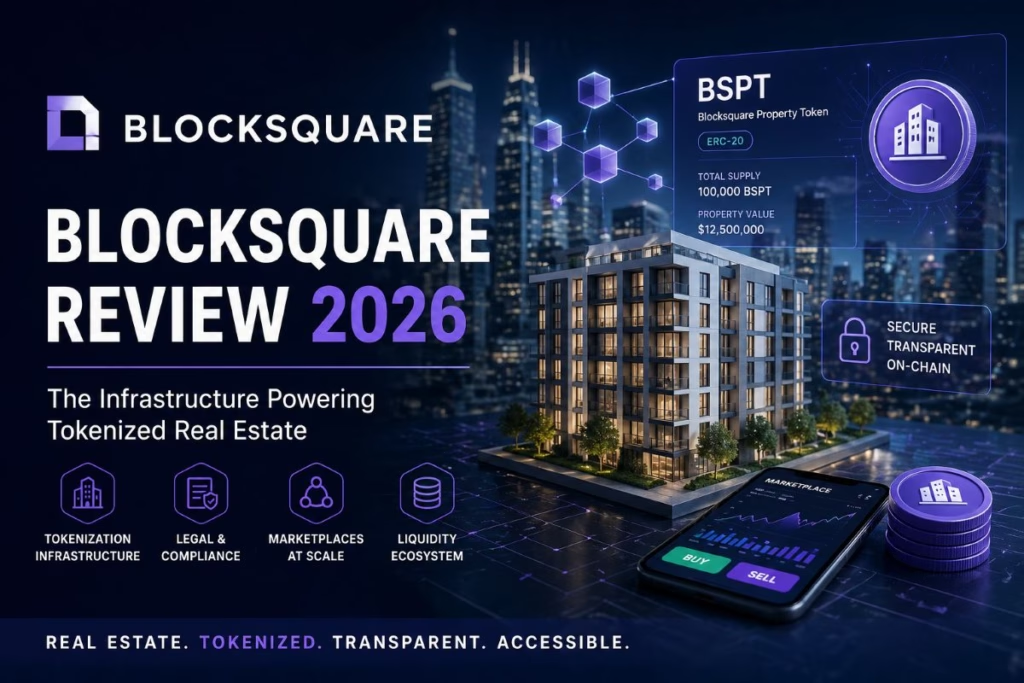
Blocksquare is not a typical real estate investment platform.
It is better described as tokenization infrastructure for property marketplaces.
Its system allows companies to tokenize property-linked economic rights using BSPT tokens, launch white-label investment portals, automate investor management, and connect tokenized assets to liquidity tools through Oceanpoint.
The project looks more serious than many real-world asset platforms because it focuses heavily on compliance, legal structure, and marketplace architecture.
However, the same problems still exist:
- liquidity remains limited
- regulations differ by country
- token ownership is not the same as direct deed ownership
- retail investors may misunderstand the risks
Blocksquare looks strongest as infrastructure.
Not as hype.
Why Blocksquare Matters More in 2026
Back in 2021 and 2022, tokenized real estate mostly felt like marketing.
Platforms promised “fractional ownership for everyone” while ignoring the hard parts.
Now the market is changing.
Institutions are entering the sector. Governments are experimenting with tokenized assets. Large financial firms are testing blockchain-based settlement systems.
That means the conversation has shifted.
The market no longer cares only about token creation.
Now it cares about:
- legal frameworks
- investor protections
- secondary trading
- settlement efficiency
- compliance automation
- scalable infrastructure
This is where Blocksquare suddenly becomes interesting.
Instead of trying to become the next Zillow, the company focused on becoming infrastructure for tokenized property platforms.
That is a very different strategy.
And honestly, probably the smarter one.
What Blocksquare Actually Does
Blocksquare helps companies launch tokenized real estate marketplaces.
Its infrastructure includes:
- property tokenization tools
- white-label marketplace systems
- investor onboarding
- compliance layers
- smart contract architecture
- payment integration
- token issuance systems
- marketplace reporting tools
In simple terms, Blocksquare provides the backend technology for real estate tokenization.
The company’s system revolves around something called BSPTs.
That stands for Blocksquare Property Tokens.
Each tokenized property can receive its own BSPT structure tied to the project’s legal and financial framework.
This is important because many tokenization projects remain vague about what investors actually own.
Blocksquare at least attempts to connect the token structure to enforceable legal documentation.
That does not eliminate risk.
But it is a lot more serious than projects that simply mint tokens and hope regulators ignore them.
How BSPT Tokens Work
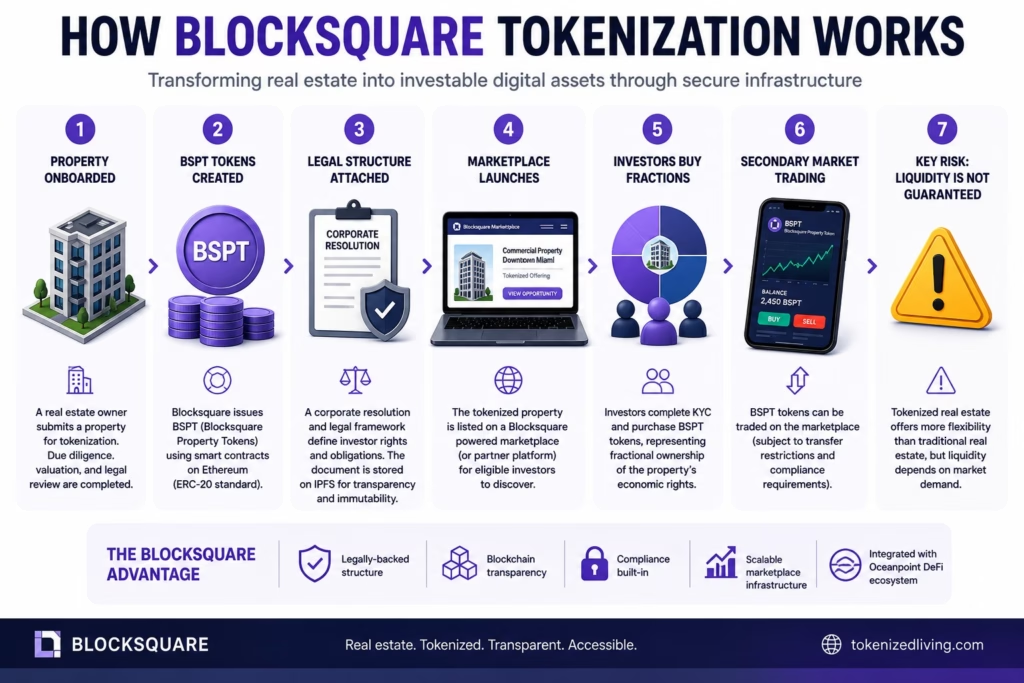
Blocksquare uses Ethereum-based ERC-20 smart contracts for its property token system.
Each property can have up to 100,000 BSPT tokens.
The idea is simple:
A property gets linked to a token structure.
The tokens represent defined economic rights connected to that property arrangement.
However, investors need to understand something critical.
This does NOT automatically mean direct property ownership.
That distinction matters.
In most cases, investors gain exposure to rights connected to a legal structure surrounding the property.
That could include:
- revenue participation
- resale participation
- debt exposure
- defined contractual rights
The exact structure depends on the marketplace operator and jurisdiction.
This is one area where many beginners get confused, especially those still learning how tokenized real estate actually works.
A blockchain token is not magical ownership technology.
The legal framework still matters more than the token itself.
The Corporate Resolution System Is the Real Story
Honestly, this is probably the most important part of Blocksquare’s model.
And almost nobody talks about it properly.
Blocksquare connects its property token structure to a corporate resolution stored on IPFS.
That legal document outlines the rights and obligations connected to the tokenized structure.
Why does this matter?
Because blockchain alone does not protect investors.
Courts do.
Contracts do.
Corporate structures do.
If tokenized real estate ever becomes mainstream, the winners will not simply be the companies with the prettiest websites.
The winners will be the companies that can survive legal scrutiny.
Recent legal risks in tokenized real estate have already shown how quickly property structures can come under pressure.
Blocksquare appears to understand that better than many competitors.
Marketplaces: The Bigger Opportunity
This is where the company becomes genuinely interesting.
Blocksquare is not trying to manage thousands of properties itself.
Instead, it allows other operators to launch their own tokenized real estate marketplaces.
That changes the business model completely.
Instead of competing for individual investors one property at a time, Blocksquare can potentially scale through infrastructure adoption.
Think about it like this:
Shopify became massive because it powered stores.
It did not need to own every product.
Blocksquare appears to be chasing a similar model for tokenized real estate infrastructure.
Now, to be clear, that does NOT mean it becomes the “Shopify of tokenization.”
People throw those comparisons around too easily.
But the infrastructure angle is far more scalable than trying to sell one tokenized apartment at a time.
Oceanpoint: Blocksquare’s DeFi Layer
Blocksquare also operates something called Oceanpoint.
This is the project’s DeFi and liquidity layer.
Oceanpoint introduces:
- staking systems
- governance tools
- marketplace support
- liquidity incentives
- ecosystem rewards
This part of the ecosystem is both interesting and risky.
Interesting because liquidity remains one of the biggest problems in tokenized real estate.
Risky because token incentives can sometimes create artificial activity.
And this is where we need to stay honest.
A liquidity reward is not the same as genuine market demand.
Many crypto projects learned that lesson the hard way.
Still, Oceanpoint shows that Blocksquare understands that the liquidity problem cannot simply be ignored.
That alone puts it ahead of many tokenization projects.
How Oceanpoint Has Evolved Since v0.5
When Oceanpoint v0.5 launched, Blocksquare reported that its infrastructure had supported more than $100 million in tokenized property across 118 assets and 21 countries. This was a significant milestone, but it represented property value tokenized through the ecosystem—not $100 million in liquid trading volume.
Version 0.5 primarily operated as a launchpad for emerging marketplace operators. Blocksquare has since positioned Oceanpoint more broadly as a property marketplace and liquidity layer. Its 2026 roadmap highlights simplified onboarding, curated property listings, pricing systems and additional liquidity tools.
However, better infrastructure cannot manufacture buyer demand. Oceanpoint may make property tokens easier to issue and transfer, but predictable exits still depend on active buyers, reliable pricing and sufficient market depth. Our guide to tokenized asset secondary markets explains why technically transferable tokens can still be difficult to sell.
The Liquidity Problem Still Exists
This is the uncomfortable truth across the entire sector.
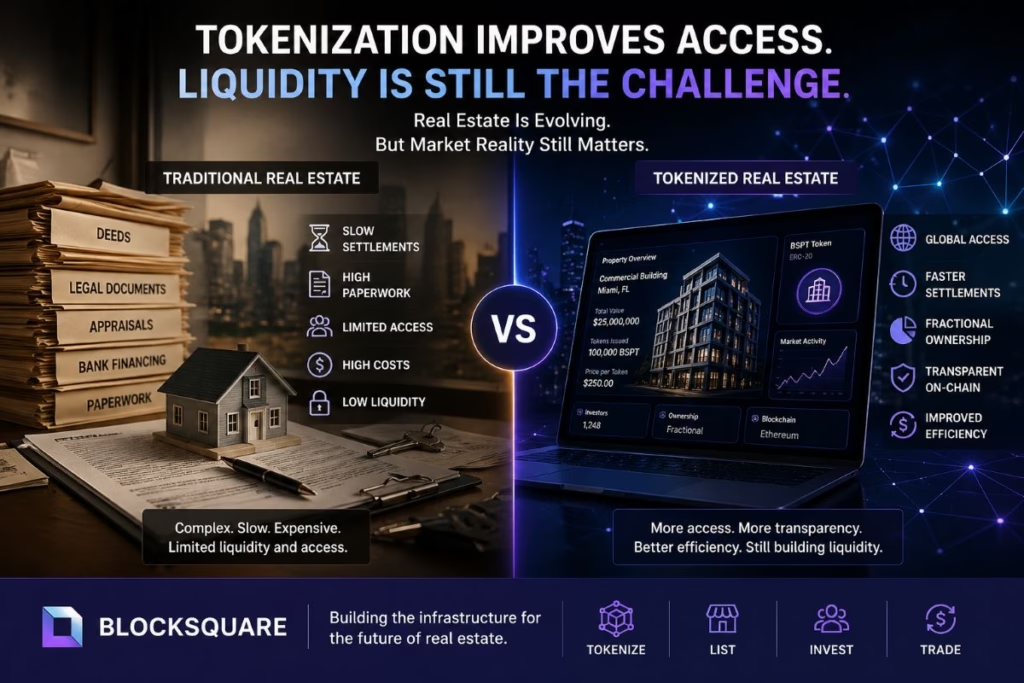
Tokenized real estate still struggles with liquidity.
A token can technically trade faster than a physical property sale.
But that does not mean buyers magically appear.
This is where many YouTube videos completely mislead people.
They talk about “instant property liquidity” as if tokenization removes market reality.
It does not.
If there are no buyers, liquidity disappears.
And because real estate tokens often include compliance restrictions and KYC requirements, secondary markets become even narrower.
Blocksquare has clearly spent years trying to improve this issue.
But nobody has fully solved it yet.
Not RealT.
Nor Reental.
Not Blocksquare.
Not anybody.
The Vera Capital Deal Changed Perception
One reason Blocksquare gained attention recently was its partnership with Vera Capital.
The plan involves tokenizing up to $1 billion in U.S. real estate assets.
That is a serious headline.
But this is where people need to calm down a little.
Announcements are not adoption.
The important questions come later:
- Will the properties attract investors?
- Can tokens trade properly?
- Can distributions work smoothly?
- Will secondary markets develop naturally?
- Can regulators stay comfortable with the structure?
Those questions matter far more than the press release itself.
Still, the deal signals something important:
Large-scale tokenization discussions are no longer theoretical.
What Blocksquare Gets Right
Blocksquare understands several things many competitors still ignore.
1. Infrastructure matters more than hype
The company focused on systems instead of marketing narratives.
That ages much better.
2. Legal structure matters
This alone separates Blocksquare from many weak RWA projects.
3. Marketplace scalability makes sense
Infrastructure businesses often scale better than single-platform investment models.
4. Compliance is unavoidable
A lot of early crypto projects tried pretending regulation would disappear.
That fantasy is over.
Blocksquare appears to be building with regulation in mind instead of fighting reality.
The Biggest Risks
Now the brutal part.
There are still major risks here.
Liquidity risk
Secondary markets remain thin across tokenized real estate.
Regulatory fragmentation
Every country treats tokenized assets differently.
That creates operational complexity.
Retail misunderstanding
Many investors still confuse token exposure with direct ownership.
They also underestimate the tax treatment of tokenized property across different jurisdictions.
Those are not always the same thing.
Ecosystem token speculation
Blocksquare’s BST ecosystem token introduces another layer of volatility and speculation.
Market adoption risk
The entire sector is still early.
Infrastructure only wins if adoption grows.
Comparison Table
| Platform | Main focus | Strength | Main limitation |
|---|---|---|---|
| Blocksquare | Tokenization infrastructure | Tools for businesses to launch property marketplaces | Liquidity depends on platform adoption and buyer demand |
| RealT | Former retail tokenized-rental platform | Important early example of direct fractional property access | Intention to enter voluntary liquidation announced in July 2026; distributions have been disrupted and recovery remains uncertain |
| Reental | Property-linked investments | Accessible international offering | Investor rights, liquidity and risk vary by project |
| Lofty | Fractional U.S. rental property | Low minimum investment and marketplace access | U.S.-focused, while resale still depends on active buyers |
Watch This Trend
The next phase of tokenized real estate probably will not be driven by retail investors first.
It will likely come from:
- private funds
- commercial real estate firms
- regional investment platforms
- regulated marketplaces
- cross-border settlement systems
That shift favors infrastructure companies.
Which is exactly why Blocksquare is becoming more relevant.
Market Insight
Most tokenized real estate companies still feel like crypto startups pretending to be property firms.
Blocksquare feels different.
It behaves more like a software infrastructure company entering financial services.
That may sound boring.
But boring infrastructure often becomes extremely valuable if adoption grows.
The internet winners were not always the loudest websites.
Sometimes they were the companies quietly building the rails underneath everything else.
Blocksquare’s Land Registry Milestone
One of Blocksquare’s most important milestones came in 2023, when it completed a notarized real estate tokenization process connected to Slovenia’s land registry. The milestone matters because it showed how tokenized property rights could connect with traditional legal infrastructure, rather than existing only as on-chain records.
Final Verdict
Blocksquare is one of the more credible infrastructure players in tokenized real estate heading into 2026.
Not because it promises unrealistic returns.
Nor because it solved liquidity.
Not because tokenization suddenly removes risk.
But because it appears focused on the hard problems:
- legal structure
- marketplace systems
- investor compliance
- scalability
- settlement infrastructure
That does not guarantee success.
Far from it.
The entire tokenized real estate sector is still experimental compared to traditional property markets.
But if tokenized real estate eventually becomes mainstream, infrastructure providers like Blocksquare could become far more important than most people realize today.
And honestly?
That may be the real investment narrative here.
Not the tokens.
The rails underneath them.
Pull Quote
“The companies building tokenized real estate infrastructure may become more valuable than the marketplaces themselves.”
FAQ
What is Blocksquare?
Blocksquare is a real estate tokenization infrastructure company that helps businesses launch tokenized property marketplaces.
What are BSPT tokens?
BSPT stands for Blocksquare Property Token. These are Ethereum-based tokens connected to property-linked legal and financial structures.
Does Blocksquare give direct real estate ownership?
Not necessarily. Investors usually gain exposure to contractual or economic rights associated with a property structure rather than direct deed ownership.
What is Oceanpoint?
Oceanpoint is Blocksquare’s DeFi and liquidity ecosystem connected to staking, governance, and marketplace incentives.
Is Blocksquare safe?
Blocksquare appears more structured and compliance-focused than many tokenization projects. However, investors still face liquidity, legal, platform, and market risk.
Is Blocksquare good for beginners?
The infrastructure side can be complex for beginners. Investors should carefully understand the marketplace, legal structure, and rights connected to each property token.