

Updated: September 29, 2026
Reental offers access to property investments through digital tokens. However, what you own depends on the contract behind each project. Its published structures include debt claims and interests in property-owning companies.
The platform’s appeal is understandable: relatively small entry amounts, professionally managed projects and a choice of payment schedules. The harder questions concern costs, legal rights and getting your money back.
Our assessment: Reental deserves consideration as a platform for researching individual property investments. Its convenience does not remove the need to assess each issuer, project and exit route.
This Reental review examines public product documents, help pages, company announcements and regulatory records. It does not include a completed investment or withdrawal test. Tokenized Living has no affiliate relationship with Reental.
For the underlying concepts, read our complete guide to tokenized real estate.
Reental at a Glance
| Question | What investors should know |
|---|---|
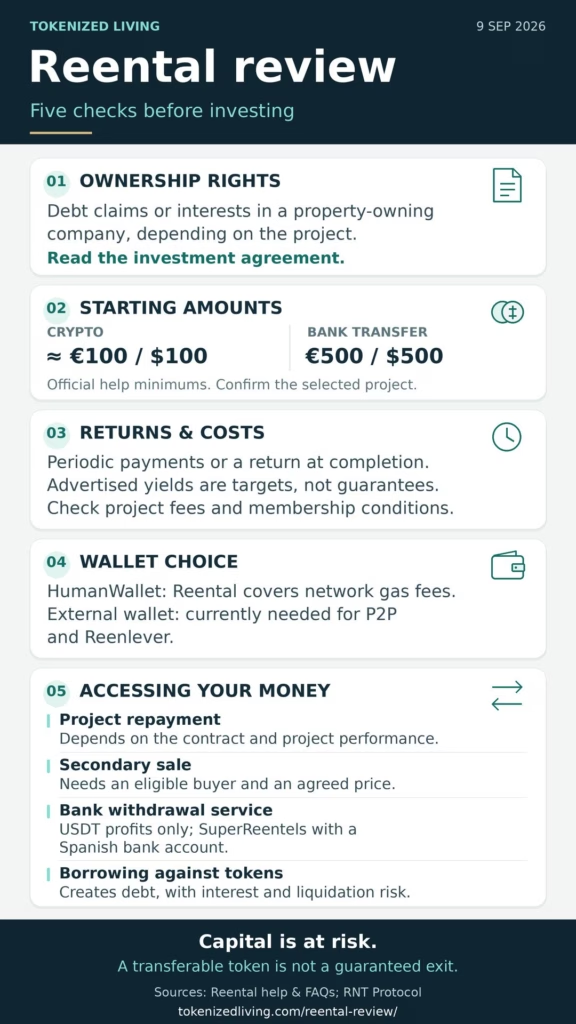
| Minimum investment | Official help states approximately €100/$100 through crypto or €500/$500 by bank transfer; confirm the selected project. |
| What does a token represent? | Rights defined by the issuing entity and investment agreement; the structure varies. |
| What produces returns? | The selected property’s business plan, which can involve development, renovation, rental operations or sale. |
| Is there a wallet requirement? | Yes, including for investments funded by bank transfer. |
| Can you exit early? | Potentially through an eligible secondary sale; a buyer and acceptable price are still necessary. |
| Are returns guaranteed? | No. Advertised returns are estimates, and capital can be lost. |
The sections below explain the sources and conditions behind these answers.
What Do You Actually Own Through Reental?
Reental’s official FAQ describes different investment structures in Spain and the United States. A separate Spanish regulatory record also identifies a bond issuance.
| Published structure | Investor’s interest | Property relationship |
|---|---|---|
| Spanish participatory loan described in Reental’s FAQ | A credit claim against the issuer, with returns linked to project performance. | The loan finances a property operation; it does not itself convey land title. |
| Reental Tourist Homes bond issue recorded by the CNMV | Non-convertible debt securities represented using distributed ledger technology. | The bond terms determine the investor’s claim and repayment rights. |
| US company model described in Reental’s FAQ | An interest in an LLC that holds the underlying asset. | The company owns the property; investors hold company interests. |
These examples do not establish the structure of every current offering. Projects in other countries require their own documents, and newer issuances may differ from older explanations.
Before subscribing, identify the legal issuer and obtain the investment agreement. Then establish whether your claim has security, what ranks ahead of it and who can enforce repayment.
A token balance alone cannot answer those questions. Nor does a photograph of a building establish that investors have a mortgage over it.
Is Reental Regulated?
There is concrete regulatory evidence, but it needs a precise description.
On December 19, 2025, the CNMV’s official register recorded Ursus-3 Capital’s role for a Reental Tourist Homes issuance. The entry concerns €322,500 of non-convertible bonds represented through distributed ledger technology.
Ursus-3 acts as the entity responsible for registering and maintaining the securities records, known as an ERIR. The CNMV expressly states that this registration does not validate the issuance conditions or the issuer’s information.
That record supports a specific issuance and registry arrangement. It does not justify describing every Reental investment as CNMV-approved or guaranteed.
For US offerings, Reental’s FAQ describes private placements using Regulation D and Regulation S exemptions. An exemption is a securities offering framework, not an investment endorsement.
The SEC’s private placement bulletin explains the associated concerns: restricted resale, limited disclosure and the possibility of losing the entire investment.
What Has Changed at Reental in 2026?
Two dated company updates provide useful context about the business behind the platform.
On August 5, 2026, Reental announced a $1.7 million corporate funding round, including Akka and Monte Bianco Naif. This funded the company; it was not a return paid to property investors.
In an August 19 company update, Reental reported $125 million tokenized across more than 120 projects. It also reported over 45 exits and 43,000 registered users.
These are company-reported activity figures, not an independently audited measure of investment performance. Registered users are not necessarily funded investors, and a completed exit does not reveal an investor’s net return.
The practical developments also matter: integrated wallets, different project payment schedules and access conditions for lending and secondary markets. Those features need to be assessed separately.
Minimum Investment, Eligibility and Wallet Choices
Why Do Reental Pages Mention Both €100 and €500?
Reental’s current investment help page distinguishes the payment routes:
- Crypto: one token, described as approximately €100/$100.
- Bank transfer: €500/$500.
Reental’s public payment guidance is inconsistent. Its investment help describes USDT on Polygon, while its MiCA explanation identifies USDC as the stablecoin used across its ecosystem.
Before transferring funds, confirm the accepted token, blockchain network and payment instructions in your account. Ask support to clarify any mismatch between the checkout and published guides.
A euro-denominated project and a dollar-denominated project are not identical currency exposures simply because both accept digital payments.
Who Can Invest?
Reental requires identity and anti-money-laundering checks. Its published eligibility rules say US tax residents must qualify as accredited investors.
Accreditation is a legal eligibility category, separate from completing identity verification. The SEC’s accredited investor explanation sets out the financial and professional qualifying routes.
Confirm both your eligibility and the offering’s country restrictions before transferring money. A platform accepting registrations internationally does not establish that every project is available to every applicant.
Existing investors should also check their verification status. Reental’s updated identity verification guide says previous users must complete the new process before making further investments or withdrawing earnings.
The process requires an identity document and a live selfie. Check that verification is complete before relying on access to withdrawals.
HumanWallet or an External Wallet?
Reental’s wallet guide describes HumanWallet, an integrated option using passkeys and device authentication. External choices include MetaMask, Rabby and compatible WalletConnect wallets.
A wallet is required even when you invest by bank transfer. Reental says it covers HumanWallet’s network fees, so those users do not need POL for gas.
However, the guide currently limits HumanWallet to the main Reental app. P2P, Reenlever and the separate decentralised app require an external wallet. Connected wallets also have separate balances; switching the active wallet does not transfer investments.
Reental’s HumanWallet security explanation describes it as non-custodial. Reental does not hold the access keys and cannot recover them if you lose access. Understand the recovery arrangements before funding it.
Reental Returns: Examine the Payment Schedule
Reental’s project catalogue includes development, renovation, developer financing and rental strategies. Therefore, “property income” should not automatically be read as rent from an occupied apartment.
Two Recent Projects Show the Difference
A September 7, 2026 company update describes Caribe 1 and Caribe 2, linked to one land-subdivision development in Mexico.
| Project | Advertised annual return | Estimated total return | Planned duration | Payment schedule |
|---|---|---|---|---|
| Caribe 1 | 13% at SuperReentel status; 11% and 10% at lower tiers. | 32.5% at SuperReentel status. | 30 months. | Monthly returns starting in month three. |
| Caribe 2 | 18% at SuperReentel status. | 45% at SuperReentel status. | 30 months. | Return paid at project closing. |
These are advertised targets, not realised results or confirmation of current availability. Membership conditions affect the quoted rates.
The annual-return label also needs care. Assuming one initial investment and all proceeds paid after 30 months, a 45% total gain equals approximately 16.0% compounded annually. The calculation is 1.45 raised to the power of 12/30, minus one.
That illustrative calculation is before additional costs and taxes. It explains why the advertised 18% annual figure should not be treated as an 18% compounded APY.

Questions Behind Any Return Target
Ask what funds the distributions, when they start and whether the forecast includes all project charges. Establish what happens if construction, leasing or the final sale takes longer than planned.
Regular payments and a profitable final exit are separate outcomes. A project can distribute money during its life and still return less principal than expected.
Our guide to passive income through tokenization explains why the underlying cash flow matters more than the payment technology.
Reental Fees: What Can Be Verified?
The public pages reviewed did not establish one current fee schedule covering every project and exit route. A single headline platform-fee percentage would therefore be misleading.
Reental’s coverage of HumanWallet gas is useful, but it does not establish that the underlying investment is free of charges.
| Cost area | What to establish before investing |
|---|---|
| Project and management costs | Obtain the budget and identify acquisition, structuring, management and any performance-related charges. |
| Quoted returns | Confirm which costs are already deducted, which remain payable and which membership tier the forecast assumes. |
| Blockchain transactions | HumanWallet gas is covered under current help guidance. External-wallet transactions can require POL. |
| Currency conversion and withdrawals | Request the applicable exchange rate, spread and any service or bank charges. |
| Secondary sale | Check marketplace charges and the price buyers actually offer, including any discount to your purchase price. |
| Membership and borrowing | Include any required token commitment and borrowing costs when evaluating enhanced benefits or leveraged returns. |
Treat these as questions for the selected offering, not a claim that every listed charge applies to every project.
Request a worked example showing the amount invested, deductions, payment dates and expected amount returned. Separate any tax withholding from platform fees; your final tax position depends on your circumstances and jurisdiction.
Can You Sell Reental Tokens or Withdraw Your Money?
There are three distinct transactions: receiving project payments, selling an investment and converting available earnings into bank money. Borrowing against tokens adds another option, with different obligations.
Project Completion and Secondary Sales
Contractual repayment depends on the project’s terms and performance. A planned completion date should not be treated as an unconditional cash withdrawal date.
The RNT P2P page describes a marketplace where participants create offers and settle matched trades. It also says property listing access depends on the promoter meeting RNT staking requirements.
Before relying on this route, confirm that your specific token is eligible and that your wallet can use the service. Then check actual buyer interest.
An available order form does not establish market depth. You may need to accept a lower price, wait for a buyer or continue holding the investment.
Our explanation of blockchain secondary markets explores the difference between transferring a token and finding liquidity.
Bank Withdrawals Have Specific Conditions
Reental’s bank withdrawal guide currently restricts this service to SuperReentels with a bank account in Spain.
The published guide describes converting USDT earnings into euros, with identity checks and proof of bank account ownership. Given the differing USDC guidance elsewhere on Reental’s website, confirm which balance the withdrawal service currently accepts.
This service does not provide early redemption of a property investment. Processing times vary with requests and bank handling, and the guide does not promise a universal completion time.
If you do not qualify, establish a suitable conversion and withdrawal route before investing. Do not assume that a service available to one membership group extends to every account.
Reenlever and RNT Lending Are Borrowing
Reental’s Reenlever explanation describes using eligible investment tokens as collateral for a loan.
Borrowing preserves exposure to the investment while creating a debt obligation. Interest, collateral requirements and liquidation risk must be assessed alongside the property’s performance.
Access is conditional too. Reental’s current lending access guide describes an approved-wallet requirement and a temporary activation window.
Neither a lending interface nor an advertised borrowing limit proves that funds will always be available when needed.
RNT Is Separate from a Property Investment Token
The RNT Protocol website describes RNT as a utility token used within its staking, governance and access arrangements. Holding RNT is different from holding an investment token issued for a specific property project.
Evaluate the two exposures separately. Property returns depend on the relevant investment agreement and business plan. RNT introduces its own market price, trading and staking risks.
Higher membership benefits also need an economic comparison. Any extra return should be assessed against the value committed to qualifying tokens and the conditions for keeping that status.
Do not use an advertised property yield alone to judge the return on a combined property-and-RNT position.
The Main Risks to Assess
Property Performance and Creditor Rights
Construction delays, missing permits, vacancies and weak sale prices can undermine a property’s business plan. The most relevant risks depend on whether the project is development, rental or financing.
Ask who controls spending, how progress is reported and what happens after a missed payment. For debt investments, check security and creditor priority. For company interests, examine distributions and decision-making rights.
Holding several tokens from one development does not diversify the underlying project risk.
Platform, Wallet and Currency Exposure
Investors depend on the issuer, project operators and service providers, as well as the blockchain. A working token contract cannot complete construction or resolve a legal dispute.
Stablecoin payments add another layer. A dollar-linked token does not remove euro-dollar exchange-rate exposure, and problems with the payment token can affect conversion or access.
Wallet access, transaction approvals and the correct network also matter. Optional borrowing increases the consequences of adverse changes because the debt remains payable even if project payments disappoint.
Our review of tokenization’s financial stability risks explains how traditional investment risks can interact with digital infrastructure.
Reental Pros and Cons
| Strengths | Limitations |
|---|---|
| Small crypto entry amount compared with buying a property outright. | Low entry costs do not make the investment low risk. |
| Bank funding and an integrated wallet can reduce setup friction. | Wallet compatibility and withdrawal eligibility differ by service. |
| Different property strategies and payment schedules. | Investors must interpret different legal structures and return assumptions. |
| Published project updates and identifiable issuance records. | Company statistics do not substitute for audited investor performance. |
| Secondary trading and collateral tools may offer additional options. | Buyer demand, eligibility and borrowing conditions limit their usefulness. |
Our Reental Review Verdict
Reental’s strongest proposition is access to individual property investments without directly managing a building. Its usefulness depends on whether a specific offering provides acceptable rights, costs and reporting.
It is better suited to investors who can evaluate private investments and tolerate delayed repayment. Anyone requiring dependable access to their capital should give the exit restrictions substantial weight.
Our main reservation is disclosure clarity across the full investment journey. Before committing, obtain project-specific answers on creditor rights, net returns, fees and how proceeds reach your bank.
Use our tokenized real estate platform comparison to compare those features across different investment models.
Frequently Asked Questions
What Is Reental’s Minimum Investment?
Current help guidance distinguishes approximately €100/$100 through crypto from €500/$500 by bank transfer. The selected project’s terms and checkout determine the applicable amount.
Does a Reental Token Give Me Direct Property Ownership?
Do not assume so. Published examples include issuer debt and company interests. The investment agreement defines your rights.
Does Every Reental Project Pay Monthly Rent?
No. Payment schedules and business models vary. Some projects make periodic distributions, while others target a payment at completion. A monthly payment is not necessarily rental income.
Can I Withdraw My Entire Investment Whenever I Want?
No unconditional withdrawal right was established in the public material reviewed. Project repayment, an eligible secondary sale and conversion of available profits are different processes.
Is Reental’s Bank Withdrawal Service Available to Everyone?
Its current guide limits the service to SuperReentels with Spanish bank accounts. It covers eligible USDT profits, rather than early redemption of the investment itself.