

September 7, 2026
Passive income from tokenized assets sounds almost effortless.
Buy a token. Wait for payments. Then sell whenever you want.
That is the sales pitch. Unfortunately, the reality is more complicated.
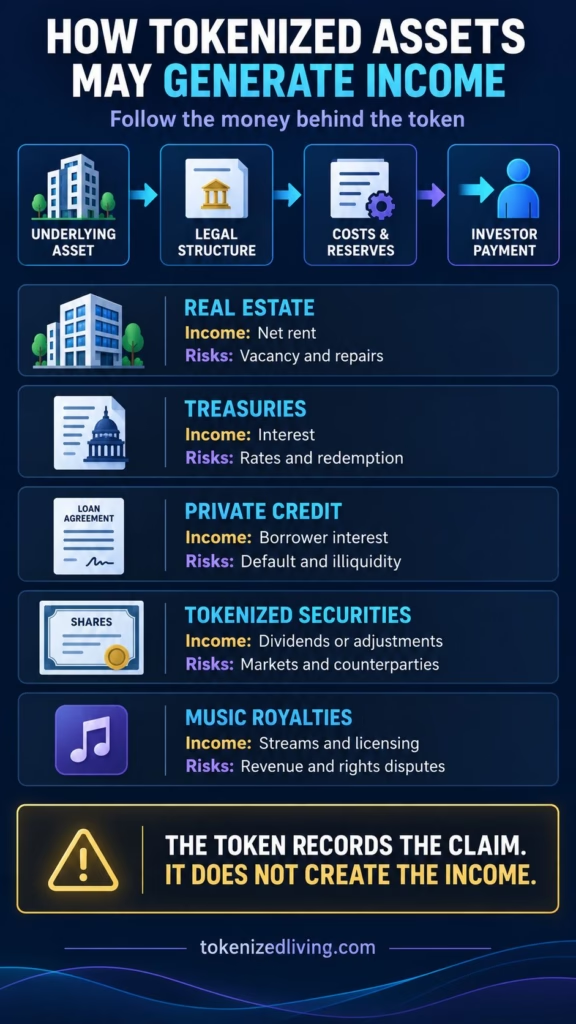
A token does not produce income by itself. Instead, income must come from rent, interest, company profits or royalty revenue.
Someone must also collect that money, deduct costs and distribute the remainder. Therefore, investors depend on the asset, issuer, manager and legal agreement.
Tokenization may improve access and record-keeping. However, it cannot guarantee payments, protect capital or create buyers.
The most important question is not whether an investment uses blockchain. It is where the money comes from and who owes it.
This guide explains how tokenized assets may generate income. It also examines the risks hidden behind headline yields.
TL;DR: Tokenized assets may generate rent, interest, dividends or royalties. However, each payment depends on an underlying asset and legal structure. Returns can fall or stop. Furthermore, a transferable token may still be difficult to sell. Investors should verify ownership rights, fees, payment priority, custody, liquidity and tax treatment before investing.
This article provides general information only. It does not provide financial, legal or tax advice.
What Does Passive Income From Tokenized Assets Mean?
Passive income normally means receiving money without managing the underlying asset each day.
For example, a property manager may collect rent and arrange repairs. Meanwhile, token holders may receive their share of available cash.
Likewise, a fund may hold short-term government securities. The fund can then distribute income or incorporate it into the token’s value.
However, “passive” describes the investor’s role. It does not mean the investment needs no work.
The asset still requires management. Additionally, investors must monitor performance, documents, fees and platform health.
Tokenization simply adds a digital ownership or record-keeping layer. Our beginner guide explains what tokenization means in more detail.
The Token Is Not the Source of the Yield
This distinction prevents most misunderstandings.
A blockchain can record who holds a token. Smart contracts may also help automate transfers or payment calculations.
Nevertheless, the blockchain does not create rent, interest or royalties.
An apartment needs a paying tenant. A borrower must repay a loan. A company needs enough cash to declare dividends.
Similarly, a song must generate royalty revenue before investors can receive a share.
If the underlying cash flow disappears, the token cannot replace it.
Therefore, investors should trace every promised payment back to its economic source.
Main Types of Income-Generating Tokenized Assets
Income-producing tokens do not all work alike. Their structures, payment rules and risks can differ completely.
| Tokenized asset | Possible income source | What the investor may hold | Main risks |
|---|---|---|---|
| Rental real estate | Net rent | LLC interest, shares, debt or contractual rights | Vacancy, repairs, management and weak liquidity |
| Treasury or money-market product | Interest from portfolio assets | Fund share, note or beneficial interest | Rate changes, issuer risk, restrictions and fees |
| Private credit | Borrower interest | Fund interest, loan participation or debt claim | Defaults, leverage, valuation and illiquidity |
| Tokenized equity | Company dividends or economic adjustments | Issuer-backed share or third-party claim | Market losses, counterparty risk and unclear shareholder rights |
| Music royalties | Streaming, performance or licensing revenue | Contractual revenue share or rights interest | Uncertain revenue, rights disputes and limited resale demand |
| DeFi position using an RWA token | Borrower interest, trading fees or incentives | Protocol receipt or liquidity position | Smart contracts, liquidation, depegging and incentive collapse |
The label “RWA token” does not reveal which structure applies. Investors must read the offering documents.
1. Rental Income From Tokenized Real Estate
Tokenized real estate provides the easiest income model to understand.
A tenant pays rent. The manager deducts expenses. Eligible investors may then receive part of the remaining cash.
Those expenses can include:
- Property management
- Repairs and maintenance
- Insurance
- Property taxes
- Platform charges
- Legal and accounting costs
- Debt repayments
- Cash reserves
Consequently, gross rental yield does not equal investor income.
Imagine a property interest worth $10,000 produces $800 in annual gross rent. That represents an 8% gross yield.
Now assume expenses consume $300. The investor receives $500 before personal taxes, producing a 5% net yield.
This example is illustrative. Real results will vary, and distributions can stop entirely.
Platforms may pay daily, weekly or monthly. For example, Lofty says it calculates and credits rental income daily.
However, payment frequency does not improve the property’s economics. Daily pieces of a weak return remain a weak return.
Our separate guide explains how passive income from tokenized real estate works. Investors can also examine the structure in our Lofty review.
2. Income From Tokenized Treasuries and Money-Market Funds
Tokenized Treasury products have become a major part of the real-world asset market.
These products generally hold Treasury bills, government securities or regulated money-market funds. Interest from those holdings supports the investor’s return.
Yet products deliver that return differently.
Some distribute dividends. Others increase the token’s redemption value. A separate structure may use additional tokens to reflect accrued income.
For example, the Franklin OnChain U.S. Government Money Fund uses blockchain-integrated records for fund shares. SEC materials explain that its system records dividend rates and distributions.
Meanwhile, Ondo’s OUSG documentation says yield becomes incorporated into the token’s price. Therefore, holding OUSG does not resemble receiving rent into an account.
The differences affect cash flow, accounting and tax treatment.
Additionally, Treasury-backed does not mean risk-free. Investors may face:
- Fund and issuer risk
- Custody risk
- Smart-contract risk
- Eligibility restrictions
- Redemption delays or limits
- Management fees
- Interest-rate changes
- Stablecoin or settlement risk
Investors should also distinguish a fund share from an unsecured token referencing Treasury returns.
The assets may sound similar. Nevertheless, the investor’s legal claim could be much weaker.
3. Interest From Tokenized Private Credit
Private credit involves lending outside public bond markets.
The borrower pays interest under a loan agreement. A tokenized fund or feeder vehicle may pass some returns to eligible investors.
Tokenization can reduce administrative friction. It may also lower investment minimums for certain products.
For example, Hamilton Lane and Securitize launched a tokenized feeder for a senior private-credit fund. The structure reduced the stated minimum from $2 million to $10,000 at launch.
However, a lower minimum only improves access. It does not make the loans safer.
Private-credit investors still face borrower defaults, leverage, valuation uncertainty and economic downturns. Furthermore, redemptions may depend on fund rules and available liquidity.
The SEC warns that private placements can involve limited disclosure and high illiquidity. Some investors may need to hold them indefinitely.
Therefore, investors should examine loan seniority, collateral, default history and redemption terms. A projected yield alone tells them almost nothing.
4. Dividends From Tokenized Securities
Tokenized securities can include shares, bonds and fund interests recorded through blockchain infrastructure.
If a token represents an issuer-backed share, holders may receive the rights defined by that security. Those rights could include dividends, voting or redemption.
However, a third-party token may only track an existing security’s economic performance. Its holder may have a claim against the token issuer instead.
That difference is enormous.
The SEC’s 2026 statement on tokenized securities separates issuer-sponsored tokens from third-party models. It also confirms that securities laws still apply.
Investors should therefore ask:
- Is this the issuer’s official security?
- Does the token confer shareholder rights?
- Who receives the original dividend?
- Does the holder receive cash, more tokens or a price adjustment?
- What happens if the token issuer fails?
- Can the holder redeem for the underlying security?
A token tracking a stock is not automatically the stock. Likewise, economic exposure does not always create legal ownership.
Dividends are never guaranteed either. A company can reduce or cancel them.
5. Revenue From Tokenized Music Royalties
Music tokens may represent a contractual share of specified royalty revenue.
That revenue could come from streaming, radio performance, synchronization licences or other commercial uses.
However, buying a music NFT does not automatically provide royalty income.
Some tokens only provide artwork, access or fan benefits. Others connect to a defined income stream through a contract.
Investors must identify:
- Which rights generate the payment
- How long the entitlement lasts
- Which countries and revenue sources apply
- Who collects and audits the royalties
- Which fees come out first
- Whether earlier rights holders have priority
- How disputes or missing payments get handled
Music revenue can change quickly. One viral song may fade, while catalogue income can also decline gradually.
Moreover, copyright disputes can interrupt distributions. A blockchain record cannot settle an ownership conflict by itself.
Our detailed guide explains how tokenized music royalties work.
6. DeFi Yield Is a Separate Risk Layer
The old version of this article mixed real-world asset income with staking and yield farming.
That comparison was misleading.
Staking normally rewards participants for supporting a proof-of-stake blockchain. It does not represent income from a property or Treasury bill.
Meanwhile, DeFi lending yield may come from borrowers. Liquidity-pool returns can include trading fees and temporary token incentives.
An investor can sometimes deposit an RWA token into a DeFi protocol. However, that creates a second investment layer.
The investor now faces the underlying asset’s risks plus:
- Protocol failure
- Smart-contract exploits
- Oracle errors
- Liquidation
- Stablecoin depegging
- Governance changes
- Unsustainable reward tokens
Therefore, a higher combined yield may simply reflect additional risk.
Investors should never describe protocol incentives as rent, dividends or Treasury interest. The money comes from somewhere else.
Which Tokenized Assets Do Not Produce Income?
Not every tokenized asset generates cash flow.
Tokenized gold normally depends on price appreciation. Likewise, art, wine and collectables usually need a profitable resale.
A tokenized asset can rise in value without producing income. Conversely, an income-producing asset can lose market value.
Investors should separate three measurements:
- Income yield: Cash or value distributed during the holding period
- Capital return: Change in the token’s market or redemption value
- Total return: Income plus price changes, after costs
Promoters often blur these figures. That makes weak opportunities look stronger.
Does Tokenization Increase Investment Returns?
Not automatically.
Tokenization may lower some administrative and settlement costs. It can also make smaller investment sizes practical.
However, the technology does not improve tenant quality, borrower credit or company profits.
New expenses may also appear. These include platform charges, token issuance costs, custody fees and blockchain transaction costs.
Therefore, investors should compare net returns after every layer of cost.
A conventional fund or REIT may offer cheaper access and stronger liquidity. Newer technology does not guarantee a better investment.
Understanding What the Token Represents
Ownership language causes serious problems in this market.
A token may represent:
- Direct ownership recorded through an approved system
- Shares in a property-owning company
- Units in a regulated fund
- A debt claim against an issuer
- Contractual rights to specified income
- A receipt linked to an asset held elsewhere
- Synthetic exposure created by an unrelated third party
These structures do not provide equal protection.
Before investing, read the legal documents. Marketing language and blockchain data cannot replace them.
Our guide to fractional ownership explains why a small economic interest may not equal direct asset ownership.

Liquidity: Transferable Does Not Mean Sellable
Tokenization can make transfers technically easier.
Still, liquidity requires willing buyers, fair pricing and legal permission to trade.
A marketplace may exist without meaningful volume. Furthermore, transfer restrictions may limit eligible buyers.
Private funds can also impose notice periods, redemption windows or gates. Consequently, investors may wait much longer than expected.
Never place emergency money into an asset with uncertain liquidity.
Before buying, ask:
- Where can I sell?
- Who can legally buy?
- How many transactions occur there?
- What spread or discount might apply?
- Can the issuer suspend redemptions?
- What happens if the platform closes?
A “sell” button does not guarantee an exit.
Fees Can Destroy the Headline Yield
Income claims often highlight the gross figure.
Investors receive the net result.
Possible deductions include management fees, servicing costs, reserves, custody charges and transaction expenses. Foreign-exchange costs may reduce returns further.
Additionally, a platform could charge entry or exit fees. Spreads can create another hidden cost.
Compare projected income against every recurring and one-off expense. Then stress-test the investment with lower revenue and higher costs.
If the return only works under perfect assumptions, it does not work.
Tax Treatment Depends on the Structure
There is no universal “tokenized income tax.”
Authorities normally examine the underlying rights, payment type and investor’s location.
One payment may count as interest. Another may represent a dividend, rental distribution, partnership allocation or capital gain.
Cross-border holdings may also create withholding taxes and reporting obligations. Additionally, reinvested income can remain taxable in some jurisdictions.
The token’s blockchain does not decide the result.
Keep records of purchases, distributions, fees, conversions and sales. Then seek qualified advice for your jurisdiction.
A Due-Diligence Checklist for Income-Producing Tokens
Do not start with the advertised yield. Start with these questions.
The asset
- What produces the income?
- Does the asset already generate cash?
- How stable is that cash flow?
- Which costs come out before investors receive anything?
The legal claim
- What does the token legally represent?
- Who owes the payment?
- Where does the investor rank if something fails?
- Can the issuer change or suspend distributions?
The operator
- Who manages the asset?
- Who holds investor money and underlying assets?
- Are reports independently audited?
- What happens if the platform becomes insolvent?
The exit
- Where can the token trade?
- Is there evidence of genuine buyer demand?
- Do lockups or investor restrictions apply?
- Can redemptions face delays, gates or discounts?
The return
- Is the quoted figure gross or net?
- Is it historical, projected or contractually fixed?
- Which fees and taxes reduce it?
- Could the investor lose the principal?
If a platform cannot answer these questions clearly, walk away.
Who Might Consider Tokenized Income Assets?
These products may interest experienced investors who understand digital custody and private-market risk.
They may also suit people seeking small exposure to several income sources. However, eligibility and minimum investments vary widely.
The strongest candidate can tolerate illiquidity and possible losses. They also understand that headline yield never replaces due diligence.
Before purchasing anything, follow our step-by-step guide to buying tokenized assets.
Who Should Avoid Them?
Avoid tokenized income assets if you need dependable monthly cash.
They are also unsuitable for emergency savings. The payment can fall precisely when access to principal becomes difficult.
Beginners should pause if they cannot explain the legal structure. Likewise, investors should avoid platforms that hide fees or ownership documents.
Anyone attracted mainly by double-digit yield should be especially careful.
High income often signals high risk. It does not represent free money.
Final Thoughts
Passive income from tokenized assets is possible.
Nevertheless, the token never creates the underlying return.
Rent must come from tenants. Interest requires solvent borrowers. Dividends need company cash, while royalties depend on commercial use.
Tokenization may improve access, administration and payment processing. However, it also introduces platform, custody and smart-contract risks.
The best opportunities explain the entire income chain clearly. They show what investors own, who pays them and which costs come first.
Weak offerings lead with yield and hide everything underneath it.
Ignore the blockchain excitement for a moment. Follow the money, read the documents and assume liquidity will be worse than advertised.
That approach is less exciting. It is also far more likely to protect your capital.
Frequently Asked Questions
Can tokenized assets generate passive income?
Yes. Some tokenized assets may distribute rent, interest, dividends or royalties. However, payments depend on the underlying asset and legal agreement.
Is passive income from tokenization guaranteed?
No. Revenue can fall, costs can rise and issuers can fail. Investors may also lose some or all of their principal.
What are the best tokenized assets for income?
No category is automatically best. Treasury funds may carry lower asset risk, while property and private credit may offer different returns. Structure, fees, liquidity and investor eligibility matter more than the label.
Do tokenized stocks pay dividends?
Some issuer-backed tokenized shares may provide dividend rights. Third-party tokens may instead use cash payments, additional tokens or price adjustments. Investors must check the terms.
Can tokenized real estate produce rental income?
Yes. Certain structures distribute available rent after expenses. Vacancies, repairs, taxes, management and platform fees can reduce or stop those payments.
Are tokenized Treasury products risk-free?
No. Government securities may carry low credit risk, but the product adds issuer, fund, custody, technology and redemption risks.
Can I sell an income-producing token whenever I want?
Not necessarily. A token may be transferable but lack buyers. Legal restrictions, lockups and redemption rules can also delay an exit.
Is DeFi yield the same as RWA income?
No. RWA income comes from an off-chain asset or financial claim. DeFi yield may come from borrowers, trading fees or token incentives.
How are tokenized asset payments taxed?
Tax treatment depends on the payment, legal structure and investor’s jurisdiction. Income could qualify as interest, dividends, rent, partnership income or gains.
What should I check first?
Identify the income source and legal claim. Then examine costs, payment priority, platform risk, custody, liquidity and tax treatment.