
Updated date: September 8, 2026
Coinbase tokenized stocks have moved beyond the proposal stage. On August 24, 2026, Coinbase-issued stock tokens launched on Base for eligible users outside the United States. The initial group included Apple, Nvidia, Meta and Alphabet. Chainlink’s launch announcement confirmed the rollout and its pricing infrastructure.
However, access to a stock token does not automatically provide every right associated with the underlying share. Investors must understand custody, eligibility, dividend treatment and redemption before treating these products as substitutes for a brokerage account.
The U.S. position also requires care. Coinbase’s conventional stock-trading service, its Base tokens and its equity perpetuals are separate products.
What Has Coinbase Launched on Base?
The launch brought familiar equities into supported blockchain wallets and decentralized-finance applications. Its first stock tokens included AAPLc, NVDAc, METAc and GOOGLc.
According to Base’s launch explanation, institutional authorized participants acquire the underlying shares, which enter custody with Alpaca. An ADGM structure connects those assets with the tokens available on Base.
Eligible holders can transfer supported tokens between wallets and use participating trading or lending applications. Nevertheless, each application has its own terms, liquidity and risks.
The initial four-stock lineup should not be mistaken for a permanent catalogue. Readers can check the official Base stock directory for supported assets and venues.
For a broader introduction, our guide explains how tokenization connects digital records with underlying assets.
Three Coinbase Stock Products With Different Rights
Similar branding can conceal significant differences. Identify the product before comparing trading hours, ownership or investor protections.
| Product | What the investor holds | Key distinction |
|---|---|---|
| Coinbase brokerage stocks and ETFs | Securities held through a brokerage account | Conventional securities trading, including eligible extended-hours stocks |
| Coinbase tokenized stocks on Base | Certificates connected to underlying shares through an issuing structure | Wallet transfers and supported DeFi use; eligibility and rights remain conditional |
| Coinbase stock perpetual futures | Derivative contracts tracking equities or equity baskets | Price exposure without ownership of the underlying shares |
Coinbase offers U.S. customers conventional stocks and ETFs through Coinbase Capital Markets. Its brokerage announcement describes 24/5 trading for eligible securities and separates that business from planned tokenized products.
Meanwhile, Coinbase’s stock-perpetual explanation describes USDC-settled contracts with funding payments. Buying one of those contracts does not make the trader a shareholder.
Consequently, a headline about Coinbase adding stocks needs more detail before it tells investors anything useful.
What Do Coinbase Tokenized Stock Holders Own?
The legal documents provide a more precise description than the phrase “stocks onchain.”
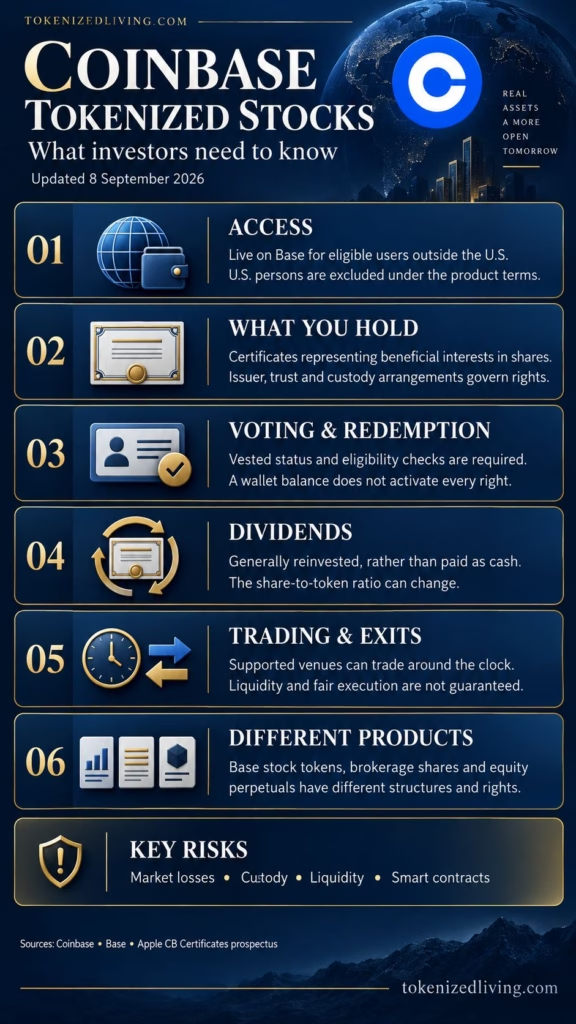
For example, the Apple certificate prospectus identifies Coinbase Onchain SPV Ltd as the issuer. It describes certificates representing beneficial interests in Apple shares through a trust arrangement.
Holders therefore depend on the certificate structure and its supporting records. A token transfer does not automatically put the buyer’s name on Apple’s shareholder register.
Voting and Redemption Require Eligibility Checks
The prospectus distinguishes between vested and unvested holders. Here, vesting means meeting the issuer’s eligibility and registration requirements.
Unvested holders can have an economic interest, but they cannot exercise redemption or voting rights until they satisfy the applicable conditions. Those conditions include identity, anti-money-laundering and jurisdiction checks.
Furthermore, the prospectus says the legal register takes precedence over blockchain data. A wallet balance alone therefore does not settle every ownership question.
Coinbase’s Abu Dhabi announcement and accompanying disclosures also explain that certain rights require vested status. Redemption can require a compatible brokerage or bank account.
This structure deserves careful reading. Investors should establish which rights they can actually exercise before buying.
How Do Dividends and Stock Splits Work?
Coinbase’s disclosures say dividends are automatically reinvested, with holders benefiting economically from that reinvestment. Investors should therefore avoid expecting regular cash dividends to arrive in their wallets.
The tokens use Base’s B20 standard, which extends ERC-20 functionality. Its technical documentation explains that a multiplier adjusts the relationship between token units and underlying shares.
For example, a hypothetical multiplier of 1.02 would associate 100 tokens with 102 shares. The wallet’s token count could remain unchanged. This illustrates the mechanism; it is not a promised return.
As a result, “one token equals one share” should not be treated as a permanent rule. Corporate actions can alter the ratio.
Our guide to income from tokenized assets explores the wider difference between cash distributions and economic benefits reflected in an investment’s value.
Can U.S. Investors Buy Coinbase Tokenized Stocks?
The Base launch materials limit availability to eligible jurisdictions outside the United States. The Apple prospectus also excludes U.S. persons under its specified definitions. Coinbase’s domestic brokerage service has separate access rules.
Coinbase announced its ADGM regulatory permission on August 11, 2026. That provides a basis for its international tokenization business; it does not establish permission to offer the same product to U.S. retail investors.
For other countries, eligibility still depends on local requirements, the product documents and the chosen venue. A working wallet connection does not establish legal access.
What Happened to the Original SEC Proposal?
In Reuters’ June 17, 2025 report, Coinbase chief legal officer Paul Grewal discussed seeking a U.S. route for tokenized equities. At that point, he did not confirm whether Coinbase had submitted a formal request or specify a launch date.
A no-action letter was one possible route discussed. The SEC’s investor guidance explains that such a letter records a staff position about recommending enforcement, based on specified facts. Staff can change that position.
It should therefore not be described as blanket SEC approval or a permanent guarantee against enforcement.
More recently, Reuters reported on September 3, 2026 that Coinbase had filed SEC registration documents concerning equity perpetuals. That development concerns derivatives. A filing is not approval, and it does not establish U.S. access to the Base stock tokens.
What Can Tokenization Improve?
For eligible investors, the practical attraction is portability. Supported tokens can move between wallets and interact with applications beyond a conventional brokerage interface.
Continuous trading can also help people react across time zones. However, a token pool operating through the weekend does not mean the underlying stock exchange stays open.
Settlement needs similar precision. Most applicable U.S. securities transactions moved to T+1 on May 28, 2024, as the SEC explains. That means settlement normally occurs one business day after trading.
A blockchain transfer can complete much faster. Nevertheless, moving a token, delivering an underlying share and processing redemption are different operations. Custodians and legal records still matter.
Costs also deserve comparison. Depending on the transaction, investors may face venue fees, spreads, network charges, currency conversion or redemption costs. The brokerage service’s commission policy should not be assumed to apply across independent DeFi venues.
The Main Risks of Coinbase Tokenized Stocks
The underlying stocks can lose value. Tokenization also adds risks involving the issuer, technology and trading venue.
Liquidity and Price Gaps
Continuous access is only useful when a market offers acceptable execution. Thin pools can produce slippage, while token prices can diverge from the underlying shares.
Base’s price-feed documentation says the launch feeds retain their last values during certain market closures. Consequently, investors and lending applications must distinguish a displayed reference price from a fresh, executable market price.
Our guide to tokenized secondary markets explains why transferability and liquidity are different qualities.
Issuer, Custody and Redemption Risk
Investors rely on organizations outside the blockchain to hold assets and administer rights. Operational failures, insolvency or disputes can interrupt that chain.
SEC staff’s January 2026 statement on tokenized securities distinguishes issuer-sponsored securities from third-party structures. It explains that rights can differ and additional third-party risks may arise.
Redemption also requires more than sending tokens to an address. Eligibility, processing procedures and available accounts can affect the outcome.

DeFi, Wallet and Administrative Risk
Using a stock token as loan collateral introduces additional risks. Falling collateral values can trigger liquidation, while lending and trading applications add their own operational dependencies.
Self-custody also places responsibility on the holder. Lost keys, malicious approvals and unsupported transfers can cause losses.
Moreover, B20 supports compliance policies and functions that can be paused. Technical portability should not be confused with an unconditional ability to transfer at any time.
Connections between securities, collateral and lending markets also matter beyond individual accounts. We examine those broader issues in our article on tokenization and financial stability.
What Should Investors Check Before Buying?
Start with the exact product and its documents. Then check:
- Eligibility: Does the offering permit someone with your residence and investor status to hold and use it?
- Identity: Does the token address match the issuer’s official information?
- Rights: Can you meet the requirements for voting, registration and redemption?
- Income: Are dividends paid in cash, reinvested or reflected through another adjustment?
- Exit costs: What spreads, fees and processing conditions apply when selling or redeeming?
- Extra exposure: Will the transaction involve borrowing, a liquidity pool or another protocol?
These checks are especially useful when a familiar company name appears beside an unfamiliar token symbol. Our guide to buying tokenized assets sets out the wider purchase process.
Readers comparing providers can also examine our Kraken xStocks review. Similar price exposure can come with different issuers, documents and exit arrangements.
| Our Robinhood Stock Tokens review compares its European derivatives with its separate wallet-based debt securities. |
Frequently Asked Questions
Are Coinbase tokenized stocks the same as brokerage shares?
They use a different holding structure. Coinbase’s Base products connect certificates with underlying shares and support blockchain transfers. Brokerage shares sit within the broker’s securities-account arrangements. Investors should compare the rights and protections of each specific product.
Do holders automatically receive voting rights?
No. Coinbase’s disclosures make certain rights conditional on vested status. Holders must satisfy the applicable verification and eligibility requirements before exercising those rights.
Does the Base launch mean the SEC approved U.S. retail access?
No. The launch materials describe an offering for eligible users outside the United States. Coinbase’s U.S. brokerage business and its filings concerning equity perpetuals are separate matters.
Does 24/7 trading guarantee that I can sell at the stock’s quoted price?
No. Execution depends on the venue, available liquidity and market conditions. Spreads and price gaps can increase while the underlying stock market is closed.