

Updated: September 4, 2026
Tokenization could change how financial assets are issued, traded and settled.
The relationship between tokenization and financial stability is more complicated than industry marketing suggests.
However, faster infrastructure does not automatically create a safer financial system.
Digital tokens can still carry traditional credit, market and liquidity risks. Moreover, shared ledgers can introduce new dependencies involving code, data providers and network operators.
The central question is therefore not whether tokenization is good or bad. Instead, policymakers must determine where risk moves when financial activity shifts onto programmable platforms.
The Financial Stability Board currently sees no material systemic threat from tokenized finance. Adoption remains too limited. Nevertheless, the FSB warns that vulnerabilities could grow alongside scale, complexity and connections with traditional markets.
TL;DR
- Tokenization does not currently pose a material threat to global financial stability.
- The market remains small compared with conventional financial markets.
- Tokenization may reduce reconciliation costs and some settlement exposures.
- However, faster settlement can increase intraday liquidity demands.
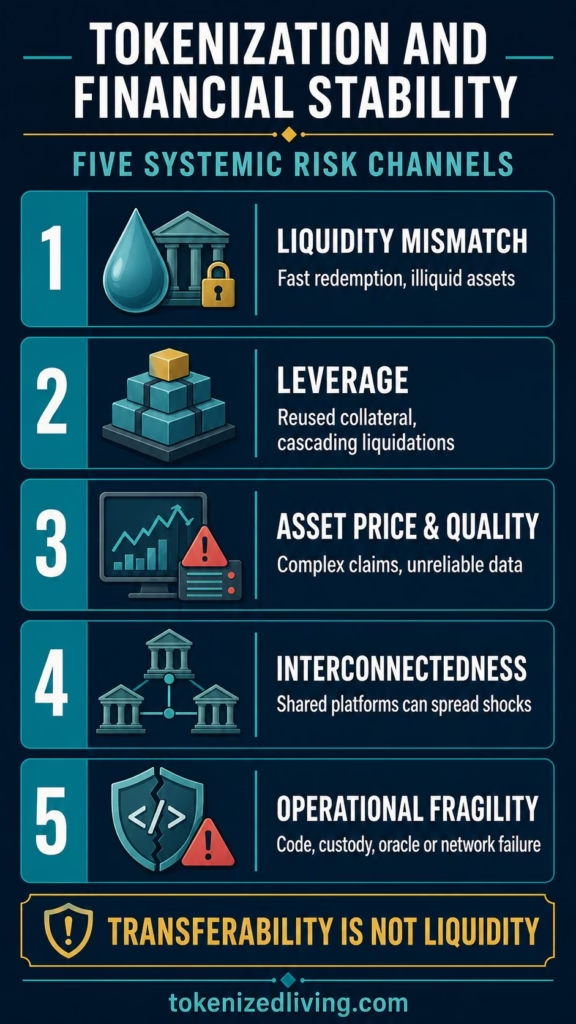
- The FSB identifies five main vulnerabilities: liquidity mismatch, leverage, asset quality, interconnectedness and operational fragility.
- Programmable liquidations could transmit market stress faster than traditional processes.
- Shared infrastructure can reduce duplication but also create concentrated failure points.
- Safe settlement assets, legal certainty and strong governance remain essential.
- A transferable token does not guarantee genuine market liquidity.
- Regulation should follow the economic activity and risk, not the technology label.
Tokenization can reduce certain frictions while moving other risks into infrastructure, software and governance.
What Does Financial Stability Mean?
Financial stability does not mean that every investment succeeds. Individual companies can fail without threatening the wider economy.
Instead, a stable financial system continues providing payments, credit, investment and settlement services during periods of stress. It also contains losses without triggering widespread disruption.
A tokenized property falling in value is therefore an investment loss. By contrast, the failure of a major settlement platform could affect many institutions simultaneously.
That distinction matters throughout this article.
Readers who need the underlying concept first can start with our guide explaining what tokenization is. This article concentrates on system-wide consequences rather than basic mechanics.
How Tokenization Changes Financial Infrastructure
Tokenization represents an asset, liability or financial claim on a programmable digital ledger.
For example, a token might represent a bond, fund unit, bank deposit or interest in a property-owning company. The token can support issuance, recordkeeping, transfers and selected compliance processes.
However, the legal asset does not disappear. Neither do issuers, custodians, banks, asset managers or regulators.
The important change concerns the infrastructure connecting those parties.
Traditional markets often process execution, clearing and settlement through separate systems. Each institution may maintain its own records. Consequently, firms spend time reconciling information and resolving differences.
Shared ledgers can place several functions on one platform. In addition, smart contracts can automate payments, collateral movements and transfer restrictions.
The IMF’s 2026 analysis of tokenized finance describes this as a structural change in financial architecture. Risk may shift from institutional balance sheets and manual processes toward software, data and shared infrastructure.
Therefore, tokenization changes more than transaction speed. It can change who controls financial processes, where failures originate and how quickly stress spreads.
Is Tokenization a Systemic Threat Today?
No. Available evidence does not support that claim.
The FSB concluded that DLT-based tokenization remained too small to create material financial stability risk. Moreover, most institutional projects used permissioned networks with limited programmability and weak connections between platforms.
The market has grown since that 2024 assessment. Even so, it remains tiny beside conventional finance.
The European Central Bank estimated that tokenized assets on public blockchains reached €38 billion in February 2026. The calculation excluded repos. By comparison, the ECB cited approximately €241 trillion in global financial assets at the end of 2025.
Those figures do not capture every private or permissioned network. Nevertheless, they show the current difference in scale.
In April 2025, an FSB official described coordination and viable business models as more immediate barriers than financial stability. Therefore, predictions of an approaching tokenization crisis are premature.
However, present size does not remove future risk. Financial stability authorities monitor vulnerabilities before they become systemic.
Potential Financial Stability Benefits
Tokenization could strengthen parts of the financial system. Yet most benefits depend on careful design and broad participation.
Faster and More Coordinated Settlement
Tokenized platforms can coordinate delivery and payment through one process. Consequently, atomic settlement may reduce principal risk between counterparties.
Shorter settlement also releases collateral sooner. Furthermore, shared records may reduce reconciliation work and operational errors.
Still, speed has a cost. Gross settlement can require participants to prefund transactions rather than netting obligations later.
Better Collateral Mobility
Programmable assets can support faster collateral transfers. Institutions may respond to margin requirements without moving through several disconnected systems.
As a result, firms could use eligible collateral more efficiently. However, rapid mobility can also accelerate withdrawals during stress.
More Timely Information
A well-designed shared ledger can provide authorized participants with synchronized records. Regulators may also receive more timely data.
Nevertheless, ledger data can remain incomplete. Off-chain custody, internal exchange transfers and legal ownership records may sit elsewhere.
Programmable Compliance
Smart contracts can restrict transfers to approved participants. They may also automate selected reporting, payment and corporate-action processes.
However, code cannot resolve every legal or supervisory judgment. Complex cases still require accountable institutions and human decisions.
Wider Access Through Fractionalization
Tokenization can divide financial interests into smaller units. Therefore, some investors may access assets that previously required larger commitments.
Yet a smaller unit does not improve the underlying asset. Nor does it guarantee fair pricing, suitable disclosure or a working exit market.
The Five Main Financial Stability Vulnerabilities
The FSB groups tokenization’s potential vulnerabilities into five categories. These risks already exist in traditional finance. However, DLT can change their speed, visibility and transmission channels.
| Vulnerability | How tokenization could amplify it | Possible consequence |
|---|---|---|
| Liquidity and maturity mismatch | Tokens promise faster access than underlying assets can support | Runs, forced sales and price spirals |
| Leverage | Tokens get reused as collateral across connected contracts | Hidden borrowing and cascading liquidations |
| Asset price and quality | Complex structures or unreliable data obscure value | Mispricing, losses and redemption pressure |
| Interconnectedness | Shared platforms connect institutions, markets and services | Wider and faster contagion |
| Operational fragility | Finance depends on code, keys, oracles and network operators | Outages, incorrect execution or settlement failure |
1. Liquidity and Maturity Mismatch
Tokenization can make an interest technically transferable. However, technical transferability is not the same as market liquidity.
A token may trade continuously while its reference asset trades infrequently. For example, real estate, private credit and private equity can take months to sell.
Problems grow when an issuer promises quick redemption against illiquid assets. During stress, many holders may request cash together. Consequently, the issuer may need to sell assets at depressed prices.
Those sales can push prices lower and trigger further redemptions. This familiar run dynamic already exists in banking and investment funds.
Moreover, faster settlement can increase funding pressure. A platform settling every trade immediately may require more prefunding than a system that nets obligations.
Therefore, tokenization may reduce counterparty exposure while increasing liquidity demands. The trade-off matters more than the advertised settlement speed.
2. Leverage and Reused Collateral
Tokens can move between smart contracts and platforms. This composability may help institutions use collateral efficiently.
However, the same asset could support several linked borrowing arrangements. Rehypothecation occurs when collateral received by one party gets reused in another transaction.
If firms cannot trace those chains, leverage can accumulate unnoticed. In addition, weak valuation methods may support excessive borrowing against poor-quality assets.
Falling prices can then trigger automated margin calls. Smart contracts may liquidate collateral immediately, even while the reference market remains closed.
Consequently, forced selling could accelerate before institutions or authorities can intervene.
3. Asset Price and Quality Risk
A blockchain can preserve submitted records. It cannot guarantee that those records describe a valuable or legally enforceable asset.
Token issuers may package several claims into complex products. Furthermore, smart contracts can combine those tokens with lending, derivatives and collateral arrangements.
Investors may struggle to identify the underlying exposures. They must also assess the issuer, custodian, legal wrapper and redemption mechanism.
Oracles create another weakness. These services deliver external information, such as asset prices, interest rates or corporate events, to smart contracts.
Incorrect or manipulated data can trigger incorrect payments or liquidations. Therefore, an immutable transaction can still be based on false information.
Prices may also diverge between a token and its reference asset. Different trading hours, legal rights, issuer credit and redemption restrictions can all create gaps.
4. Interconnectedness and Concentration
A large tokenization platform could combine issuance, trading, custody and settlement. That integration may reduce duplication.
Conversely, it can create a powerful point of failure.
Many institutions might depend on the same ledger, custodian, bridge, cloud provider or oracle. An outage could then interrupt several markets at once.
Programmable connections may also transmit shocks automatically. Trouble in one asset could trigger margin calls, collateral sales or withdrawals elsewhere.
Moreover, cross-border platforms can connect institutions operating under different rules. Regulatory gaps may encourage activity to move toward weaker jurisdictions.
Interoperability presents a difficult trade-off. Too little connectivity fragments liquidity. Yet tightly connected networks may transmit failures more widely.
5. Operational Fragility
Tokenized finance still depends on software and organizations. Neither is infallible.
Smart contracts can contain coding errors. Private keys can be lost or stolen. Validators can fail, while network congestion can delay transactions.
In addition, institutions must reconcile blockchain records with conventional systems. A mismatch between the two can create uncertainty over ownership or settlement.
Permissionless networks raise accountability questions. No single operator may control upgrades, reversals or finality.
Meanwhile, permissioned networks concentrate responsibility among identified operators. That arrangement can improve governance, but users become dependent on those entities.
Always-on markets add another burden. Institutions need staffing, liquidity and incident-response capabilities outside conventional business hours.
Three Risks That Became Clearer in 2026
The FSB’s five categories remain useful. However, newer research gives three issues greater prominence.
Risk Moves From Institutions to Infrastructure
Traditional supervision focuses heavily on banks, brokers, funds and clearing houses. Tokenized systems may place critical functions inside shared code and platforms.
The IMF therefore argues that authorities must govern infrastructure with institutional-level rigor. Audits, upgrade procedures, data controls and emergency powers become financial stability tools.
If many firms use the same system, its operator may become systemically important. Consequently, regulators need visibility beyond the token issuer.
Faster Finance Can Become More Procyclical
Instant settlement reduces waiting periods. Nevertheless, those delays sometimes allow firms to net payments, mobilize funding or correct errors.
Automation can also remove discretion. A price decline may trigger margin calls, collateral transfers and asset sales without human review.
Therefore, a tokenized market can compress a slow-moving liquidity problem into hours or minutes. Faster does not always mean safer.
Fragmentation Can Undermine Liquidity
Separate networks may issue similar tokens using incompatible standards. Consequently, liquidity, collateral and settlement balances become trapped in different systems.
The ECB has warned that non-interoperable networks could fragment liquidity and limit competition. However, one dominant network could create concentration and lock-in.
The goal is therefore resilient interoperability. Systems must connect without hiding risk or creating fragile bridges.
Settlement Assets Matter as Much as Tokenized Securities
A tokenized security still needs a payment asset.
One party delivers the security. The other party must deliver money with dependable value and legal finality.
Central bank money generally provides the safest settlement anchor. Commercial bank money can also support regulated settlement, subject to credit and liquidity controls.
By contrast, some privately issued settlement tokens carry redemption, reserve and issuer risks. A loss of confidence can push them away from par.
The BIS and CPMI report on tokenization explains that traditional infrastructure risks also apply to token arrangements, although they may emerge differently.
This issue is not theoretical. The United Kingdom’s tokenized-deposit pilot examines whether existing bank deposits can support programmable payments and digital-asset settlement.
Meanwhile, Europe plans to connect DLT transactions with central bank money through its Pontes project. These initiatives recognize a basic fact: moving securities on-chain solves only half the transaction.
How an Isolated Failure Could Become Systemic
Not every token failure threatens financial stability. Several transmission stages would usually need to develop.
| Stage | What happens |
|---|---|
| 1. Weakness | An asset loses value, an oracle fails or a platform suffers an outage |
| 2. Amplification | Leverage, redemptions or automated margin calls increase losses |
| 3. Transmission | Shared infrastructure and connected contracts spread the shock |
| 4. Market disruption | Liquidity disappears and institutions sell assets to raise cash |
| 5. Economic effect | Credit, payments or investment services become impaired |
For example, one property token losing value would not destabilize global finance. However, a large platform could connect property funds, lenders, custodians and settlement providers.
If leveraged investors used those tokens as collateral, falling values could trigger forced sales. Moreover, the same institutions might sell conventional assets to meet cash demands.
The shock would become systemic only after crossing into important markets or services.

Why Fractional Ownership Provides a Useful Stress Test
Fractionalization can distribute one asset among many investors. Tokenization may then make those interests easier to administer or transfer.
However, the digital layer does not change the asset’s economic reality.
A holiday property, artwork or private loan may remain illiquid. Smaller tokens can create the appearance of easy resale, although no deep buyer market exists.
Vacation-property arrangements offer a simple example. Our comparison of fractional ownership versus timeshares explains how ownership rights, usage rights and exit restrictions can differ. Those distinctions still matter when interests receive digital tokens.
Furthermore, tokenholders may own company shares, debt claims or contractual rights rather than the underlying asset. The fractional ownership agreement guide explains the clauses governing control, costs, transfers and failure.
At investor level, unclear agreements create legal and liquidity risk. At scale, thousands of similar claims could create correlated redemptions or concentrated platform exposure.
Therefore, fractional ownership shows why a token cannot replace due diligence.
Traditional Finance Risk Versus Tokenized Finance Risk
Tokenization rarely invents an entirely new economic risk. More often, it changes the mechanism or location of an existing one.
| Traditional risk | Tokenized version |
|---|---|
| Fund promises redemptions against illiquid assets | Token offers continuous transfers or rapid redemption against the same assets |
| Collateral gets reused through intermediaries | Tokens move through connected smart contracts and lending arrangements |
| Incorrect market data affects trading | A faulty oracle automatically triggers contract execution |
| One infrastructure provider becomes critical | A ledger, bridge, custodian or cloud provider supports many markets |
| Margin calls cause forced selling | Automated liquidations accelerate the same process |
| Records differ across institutions | On-chain and off-chain records conflict |
This comparison prevents two mistakes.
First, blockchain does not eliminate ordinary financial risk. Second, every technical difference does not require an entirely new regulatory system.
The IOSCO report on tokenized financial assets supports a technology-neutral approach. Existing investor-protection and market-integrity principles remain relevant, although DLT may require tailored controls.
When Could Tokenization Become Systemically Important?
Tokenization would need more than rapid market growth. It would also require connections capable of amplifying and transmitting distress.
Warning conditions include:
- large banks, funds or payment providers becoming heavily exposed
- widespread use of tokenized assets as collateral
- extensive reuse of the same collateral
- rapid redemptions against illiquid reference assets
- dominant platforms controlling several critical functions
- dependence on a small number of custodians, oracles or network operators
- strong links between tokenized and conventional markets
- complex smart contracts obscuring leverage and counterparty exposures
- unreliable settlement assets or unclear payment finality
- inadequate recovery, resolution and emergency procedures
Scale alone is therefore an incomplete measure. A smaller market can still matter if it performs a critical settlement or payment function.
Conversely, a larger market may remain contained when leverage stays low and links remain limited.
What Should Regulators Monitor?
Reliable supervision starts with reliable information. Unfortunately, authorities still lack consistent tokenization data.
Useful indicators include:
- market size and transaction volumes
- asset classes and investor profiles
- leverage and collateral reuse
- redemption terms and liquidity buffers
- cross-border activity
- connections with banks, funds and financial infrastructure
- concentration among platforms and service providers
- settlement assets used on each network
- bridge and interoperability exposures
- smart-contract complexity and automated liquidation activity
- outages, cyber incidents and failed transactions
Permissioned networks may complicate monitoring because activity is not publicly visible. Public blockchains provide accessible transaction data, but wallet addresses may not reveal the parties or economic purpose.
Therefore, on-chain data cannot replace regulatory reporting.
Safeguards for Tokenized Financial Markets
No single control can remove every vulnerability. Instead, safe tokenization requires several layers.
Clear Legal Rights
Documents must identify the issuer, asset, holder rights and governing law. They should also explain custody, insolvency, redemption and settlement finality.
Without enforceable rights, a perfect ledger records an uncertain claim.
Sound Liquidity Management
Issuers should align redemption terms with underlying asset liquidity. Market participants must also plan for intraday and 24/7 funding needs.
Moreover, stress tests should consider closed reference markets and continuous token trading.
Limits on Leverage and Collateral Reuse
Institutions need visibility across connected contracts. Appropriate haircuts and concentration limits can reduce excessive borrowing.
In addition, managers should test how automated liquidations behave during extreme volatility.
Safe Settlement Arrangements
Platforms need a settlement asset with clear legal status and controlled credit risk. Delivery-versus-payment should also achieve recognized finality.
Otherwise, technical completion may not equal legal settlement.
Strong Governance of Code and Data
Critical smart contracts require independent testing, audits and controlled upgrades. Oracle governance must cover data quality, manipulation and outages.
Systemically important processes also need predefined pause and recovery procedures. Automation without accountable control is reckless.
When platforms also use artificial intelligence, additional concerns arise around unreliable data, model errors and automated decisions, as our analysis of AI’s role in tokenized finance explains.
Operational Resilience
Platforms should maintain redundancy, key-recovery procedures and tested incident plans. Institutions also need a workable alternative if the DLT system fails.
However, a backup system offers little protection unless firms test it under realistic conditions.
Cross-Border Coordination
Tokenized markets can operate continuously across jurisdictions. Consequently, regulators need compatible reporting, supervision and crisis communication.
Otherwise, gaps between national rules can hide risk and delay intervention.
What Should Investors and Institutions Check?
Most readers will never assess global systemic risk directly. Nevertheless, the same weaknesses appear at product level.
Before using a tokenized platform, check:
- what legal asset or claim the token represents
- who owns and safeguards the underlying asset
- whether the token can be redeemed
- who provides market liquidity
- what happens when buyers disappear
- which asset completes the payment side
- whether the platform uses leverage or collateral reuse
- who supplies prices and other off-chain data
- which parties control upgrades and transaction pauses
- whether ownership records exist outside the blockchain
- what happens after an issuer, custodian or platform failure
Institutional branding does not answer those questions. For example, our analysis of Deutsche Bank’s tokenization infrastructure distinguishes a serious pilot from a proven commercial system.
Similarly, tokenized real estate can still carry property, platform and legal risks. Our guide to the benefits and risks of tokenized real estate examines those investor-level concerns.
Final Verdict
Tokenization does not currently threaten global financial stability. The market remains small, fragmented and only partly connected to traditional finance.
Nevertheless, dismissing the risks would be shortsighted.
Tokenization can reduce reconciliation work and some counterparty exposures. It may also improve collateral mobility and automate selected processes.
However, those gains redistribute risk. Faster settlement increases liquidity demands, while automation can accelerate forced selling. Shared infrastructure can improve coordination but create concentrated failure points.
Therefore, the safest model will not be the most decentralized or the fastest by default. It will combine efficient technology with enforceable rights, sound money, resilient infrastructure and accountable governance.
The token is only one component. Financial stability depends on the entire system supporting it.
Frequently Asked Questions
Does tokenization currently threaten financial stability?
No. The FSB says current adoption remains too small to create material global financial stability risk. However, risks could grow with scale, leverage, complexity and interconnectedness.
What are the five main financial stability risks of tokenization?
The FSB identifies liquidity and maturity mismatch, leverage, asset price and quality risk, interconnectedness, and operational fragility.
Can tokenization reduce settlement risk?
Yes. Atomic delivery-versus-payment can reduce principal risk between counterparties. Nevertheless, faster gross settlement may increase prefunding and intraday liquidity requirements.
Does tokenization create liquidity?
No. A token can improve technical transferability, but genuine liquidity still requires buyers, sellers, reliable pricing and compliant trading venues.
Why can smart contracts increase systemic risk?
Smart contracts can execute margin calls or collateral sales automatically. Consequently, faulty data or falling prices may trigger rapid, connected liquidations.
Why do settlement assets matter?
A tokenized security needs reliable money for payment. Weak settlement assets can introduce credit, liquidity, redemption and finality risks.
Are permissioned blockchains safer for financial institutions?
They can provide clearer governance, known participants and faster consensus. However, they may also concentrate control and reduce public visibility.
Can regulation use existing financial rules?
Often, yes. Existing rules for securities, banks, funds and market infrastructure remain relevant. Still, regulators may need tailored controls for code, oracles and continuous operations.
How could one tokenized platform become systemically important?
A platform could become critical by serving many institutions or combining issuance, trading, custody and settlement. Its failure could then disrupt several markets simultaneously.
What should authorities monitor?
Authorities should monitor adoption, liquidity, leverage, collateral reuse, concentration, cross-border activity, interoperability, settlement assets and operational incidents.
This article provides general educational information. It does not provide financial, investment, legal or regulatory advice.