
Updated date: September 8, 2026
China’s stablecoin policy needs a more careful explanation than a simple shift from prohibition to adoption.
Mainland China restricts private stablecoin activity. Meanwhile, Hong Kong has licensed issuers and begun an institutional rollout of a Hong Kong dollar stablecoin. The digital yuan, or e-CNY, has also moved toward a deposit model.
These developments involve different currencies, legal claims and access rules. Understanding those differences matters before treating any announcement as an opportunity to invest in tokenized assets.
What Happened to China’s Stablecoin Pivot?
On August 21, 2025, Reuters reported that China was considering yuan-backed stablecoins. Its sources described a possible roadmap to expand international use of the renminbi.
That report concerned a proposal. It did not establish that regulators had approved issuance or opened investment access.
However, the earlier version of this article left the proposed roadmap sounding imminent. Its references to approval happening within the month became outdated.
The useful question today is which activities have permission, which products are operating and who can access them.
What China’s 2026 Rules Actually Say
On February 6, 2026, the People’s Bank of China and seven other authorities issued a joint notice on virtual currencies and RWA tokenization.
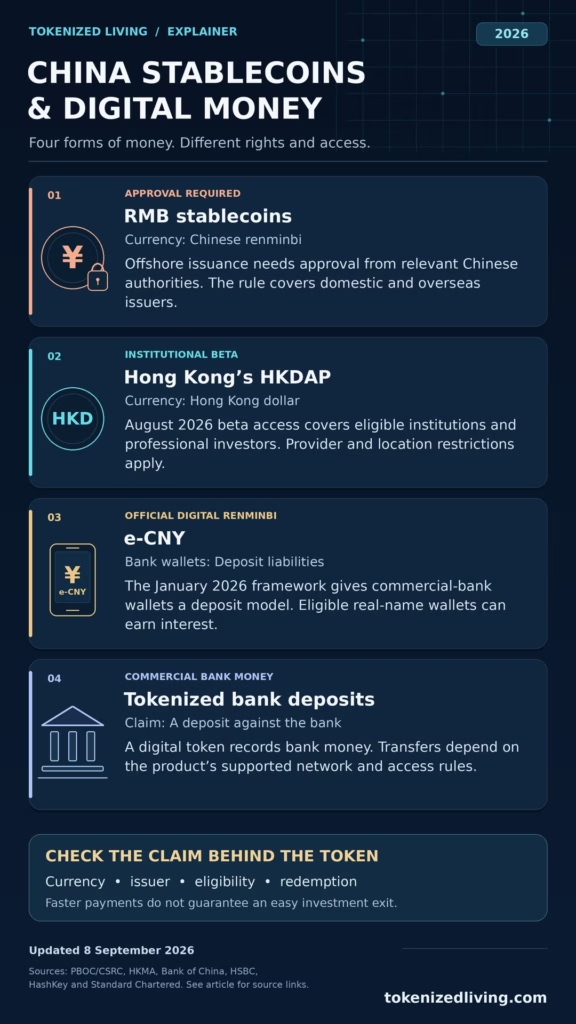
It maintains the prohibition on mainland virtual-currency business activities. Overseas issuance of RMB-pegged stablecoins requires approval from the relevant Chinese authorities, whether the issuer is domestic or foreign.
Domestic RWA tokenization is also prohibited, except for approved activity conducted through specified financial infrastructure. Offshore activity involving mainland assets faces additional controls.
An approval requirement leaves room for specifically authorized arrangements. It does not establish permission for a general RMB stablecoin rollout.
Consequently, descriptions of Hong Kong as a testing ground before inevitable mainland adoption go beyond what these rules establish.
Hong Kong’s Stablecoin Regime Is Operating
Hong Kong’s Stablecoins Ordinance took effect on August 1, 2025.
Broadly, the licensing requirement covers issuing fiat-referenced stablecoins in Hong Kong in the course of business. It also covers issuing Hong Kong dollar-referenced stablecoins outside Hong Kong. Offering and marketing activities have additional restrictions under the Hong Kong framework.
Therefore, saying the law licenses every fiat-referenced stablecoin issuer worldwide would be inaccurate.
On April 10, 2026, the HKMA granted its first issuer licences to HSBC and Anchorpoint Financial. Readers can check the HKMA’s register of licensed stablecoin issuers for the relevant legal entities.
Anchorpoint is a joint venture involving Standard Chartered Bank Hong Kong, HKT and Animoca Brands. Its licensing announcement identified HKDAP, meaning HKD At Par, as its planned Hong Kong dollar stablecoin.
HKDAP Has Entered Institutional Beta Access
By August 2026, HKDAP had progressed beyond a licensing announcement.
On August 12, HashKey Exchange announced access to HKDAP for eligible institutions and professional investors. The company also reported completing an initial minting and redemption transaction with eligible clients.
Later, on August 24, Standard Chartered announced that it had become an authorized HKDAP distributor. Its identified applications included tokenized money market fund settlement, corporate treasury transfers and cross-border payments.
Those announcements establish concrete progress. Nevertheless, they describe a phased rollout with eligibility requirements. They do not establish unrestricted retail or mainland access.
HSBC Announced a Separate HKD Stablecoin Plan
In its April 10 announcement, HSBC outlined a planned launch in the second half of 2026. The proposed channels included PayMe and the HSBC Hong Kong app.
Its planned uses covered payments and subscriptions to tokenized investments, with the latter subject to relevant regulatory approvals.
That announcement records a timetable and intended uses. Availability should be checked against the bank’s current product notices before assuming a service is open.
The bank’s HSBC Gold Token is a separate gold investment. A gold token and an HKD stablecoin represent different assets and serve different purposes.
e-CNY Changed in January 2026
Older explanations often described e-CNY simply as a non-interest-bearing digital version of central-bank cash.
That description now needs qualification.
According to the Chinese government’s December 2025 account of the PBOC framework, changes took effect on January 1, 2026. Digital yuan held in commercial-bank wallets became bank deposit liabilities under the new arrangements.
The framework also brings those balances into banks’ asset-liability management and provides deposit-insurance protection under the applicable rules.
Interest is another practical change. Bank of China announced that its real-name digital yuan wallets would earn interest from January 1, 2026. The bank applies its published demand-deposit rate and corresponding interest-calculation rules.
However, e-CNY remains part of China’s official digital-renminbi system. It should not be confused with an independently issued token that promises to track the yuan.
Wallet type and operating institution matter when checking the precise features available.
RMB Stablecoins, HKD Stablecoins and Digital Deposits Compared
| Form of digital money | What it represents | Key distinction |
|---|---|---|
| RMB-pegged stablecoin | An issuer’s token designed to track the renminbi | Overseas issuance requires relevant Chinese approval |
| HKD stablecoin, such as HKDAP | A token designed to track the Hong Kong dollar | HKD denomination does not provide RMB exposure |
| e-CNY in a commercial-bank wallet | Digital renminbi treated as a bank deposit liability under the 2026 framework | Operates within the official e-CNY system |
| Tokenized bank deposit | A digital representation of a customer’s bank deposit | The customer retains a claim against the bank |
The token’s currency, issuer and legal structure deserve separate checks. A familiar bank name or a blockchain label cannot answer all three questions.
Tokenized Deposits Offer Another Settlement Route
Banks can also support digital settlement through tokenized deposits.
For example, HSBC’s Tokenised Deposit Service converts designated deposits into digital tokens within its private blockchain network. Participating corporate customers can move funds between supported locations, subject to the service’s eligibility and local restrictions.
The underlying claim remains a bank deposit. Access also depends on the participating banking network.
Our guide to the UK’s tokenized-deposit pilot examines another approach to connecting bank money with programmable payments.
Together, these examples show why stablecoin adoption is only one part of the wider digital-money story.
What This Means for Tokenized Real Estate and RWAs
Digital money can help coordinate payment with the transfer of a tokenized asset.
For example, imagine an eligible institution subscribing to a tokenized fund. A compatible settlement system could exchange the payment and fund token together. This may reduce the interval between paying and receiving the investment.
However, that outcome depends on the product, network connections and legal settlement arrangements. A stablecoin cannot make incompatible systems work together automatically.
Our Hong Kong tokenized-securities guide explains how banks, funds and settlement infrastructure are developing alongside these payment options.
Mainland Assets Require Additional Scrutiny
On February 6, 2026, China’s securities regulator also introduced guidelines for offshore tokenized asset-backed securities supported by mainland assets.
These cover offshore tokenized interests supported by cash flows from mainland assets or related rights. Before conducting the business, the mainland entity controlling the underlying assets must file with the CSRC.
The submission must explain the assets and token issuance structure. Other requirements cover cross-border investment, foreign exchange and data security. Significant ownership disputes or assets that cannot legally be transferred can prevent an offering.
This is a specific regulatory route for a defined activity. A Hong Kong stablecoin licence cannot substitute for the permissions and filings required by the underlying asset transaction.
Faster Payment Does Not Guarantee a Property Exit
Consider a token connected to rental property.
Even if its payment can settle quickly, an investor still needs an eligible buyer. Valuation disagreements, transfer restrictions and weak demand can make an exit difficult.
The distinction between transfer speed and market demand is central to our guide to tokenized asset secondary markets.
Likewise, a payment token cannot repair missing ownership rights or weak property management. Those risks remain part of the underlying investment.

What Investors and Businesses Should Check
Start with the actual product and its documents, then examine the technology supporting it.
Useful questions include:
- Currency: Does the token track RMB, HKD or another asset?
- Issuer: Which legal entity owes the obligation, and is its authorization verifiable?
- Eligibility: Can someone with your residence and investor classification use the service?
- Redemption: Who can redeem, through which channel, and at what cost?
- Ownership: Does the token represent money, a deposit, a security or another contractual claim?
- Settlement: When does the transfer become legally final, and what happens if a participant fails?
Reserve quality, custody and operational resilience also deserve attention. The Financial Stability Board’s analysis identifies liquidity and operational vulnerabilities that tokenization can retain or amplify.
Our explanation of tokenization and financial stability examines why improved infrastructure still requires effective risk management.
China Stablecoins FAQs
Has China approved a general RMB stablecoin rollout?
The February 2026 rules require approval for overseas RMB stablecoin issuance. They do not announce general authorization. A specific product needs evidence of the relevant permissions.
Is HKDAP backed by the Chinese yuan?
HKDAP is designed to track the Hong Kong dollar. It is a different currency exposure from a renminbi-pegged token.
Does e-CNY pay interest?
Eligible real-name wallets at participating commercial banks can earn interest under arrangements introduced in January 2026. Check the wallet operator’s terms and applicable rate.
Can mainland residents automatically use Hong Kong stablecoin services?
Access depends on the provider and jurisdiction. For example, HashKey’s August 2026 announcement explicitly states that it does not serve mainland China. Hong Kong licensing does not remove such restrictions.
Does a stablecoin make tokenized property liquid?
A faster payment method does not create buyers. Property tokens can remain difficult to sell because of limited demand, transfer restrictions or problems with the underlying investment.
This article provides general information, not personalized financial or legal advice.