
Updated September 16, 2026
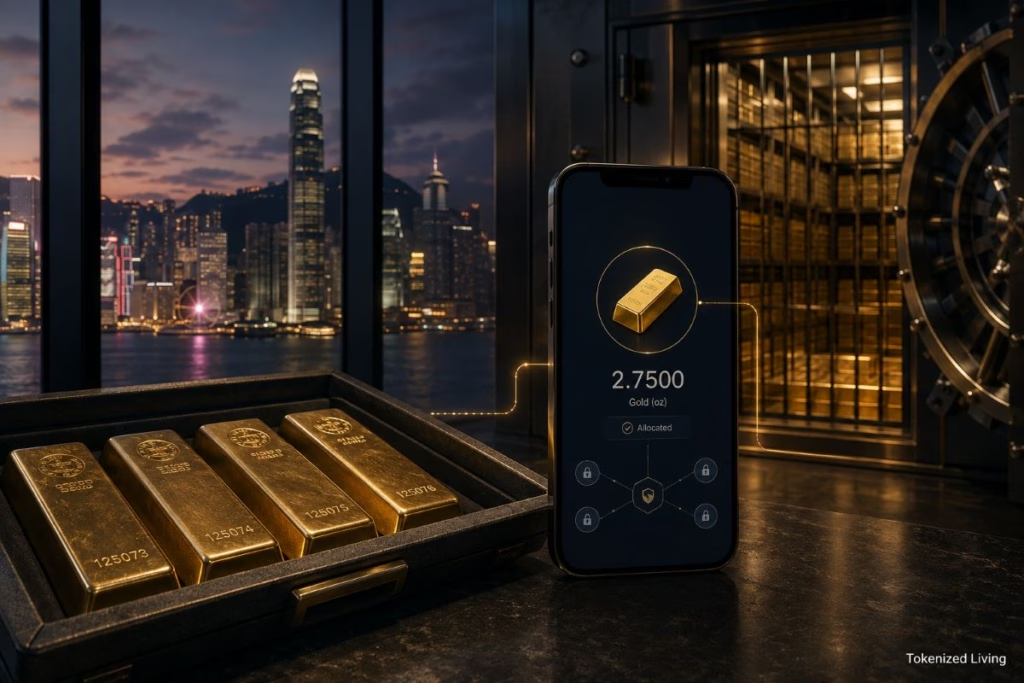
HSBC Gold Token has become one of the clearest examples of a global bank bringing asset tokenization to retail customers.
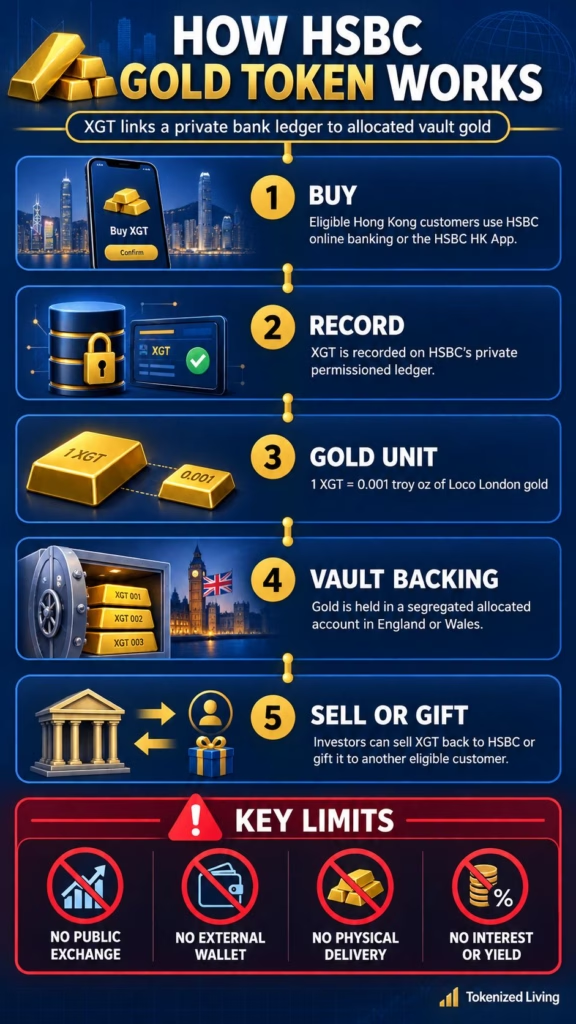
Eligible HSBC Hong Kong customers can buy fractional ownership of physical gold through online banking or the HSBC HK app. The bank records that ownership on its private distributed ledger.
In its Q1 2026 results, HSBC reported that the product had surpassed $1 billion in cumulative traded value.
However, HSBC Gold Token is not a publicly traded cryptocurrency.
Customers cannot withdraw XGT to MetaMask, trade it on independent exchanges or redeem it for physical bullion. Instead, investors operate inside HSBC’s controlled banking environment.
That structure offers convenience and institutional custody. Nevertheless, it also gives HSBC significant control over pricing, transfers, settlement and access.
This HSBC Gold Token review explains what investors actually own, how the product works and which risks deserve attention.
This article provides general information and does not constitute financial, legal or tax advice.
TL;DR
- HSBC Gold Token gives eligible Hong Kong customers fractional ownership of physical gold.
- The internal product code is XGT.
- One XGT represents 0.001 troy ounce of Loco London gold.
- HSBC records ownership on an in-house private permissioned ledger.
- Investors cannot transfer XGT to external cryptocurrency wallets.
- There is no public exchange or independent trading market for XGT.
- Investors generally exit by selling their gold interest back to HSBC.
- HSBC embeds a margin of up to 2% during gold trading hours and 5% outside those hours.
- Customers cannot take physical delivery of the underlying gold.
- Eligible customers can gift XGT through the HSBC HK app, subject to the recipient meeting HSBC’s requirements.
- HSBC says it stores the allocated gold separately inside an HSBC Bank plc vault in England and Wales.
- The product does not pay interest and does not protect investors against losses.
What Is the HSBC Gold Token?
The Hongkong and Shanghai Banking Corporation Limited issues HSBC Gold Token. HSBC classifies it as a paper gold scheme in its Key Facts Statement.
Eligible customers can buy fractional ownership of allocated physical gold through HSBC’s digital banking services. The product’s terms define the rights and restrictions attached to that ownership.
The bank launched the retail product in Hong Kong during 2024. HSBC had previously used distributed ledger technology to provide tokenized gold services to institutional customers.
Each HSBC Gold Token represents a fractional ownership record covering 0.001 troy ounce of gold.
HSBC uses the internal code XGT to identify the token. However, XGT is not a cryptocurrency ticker that investors can search for on public exchanges.
The physical gold remains inside an HSBC-operated vault. Meanwhile, HSBC’s private ledger records which customers own each fraction.
This arrangement provides a practical example of how tokenization works inside a regulated banking environment.
How Does HSBC Gold Token Work?
The product connects three main components:
- Physical gold stored in an institutional vault.
- Fractional ownership assigned to eligible investors.
- Digital records maintained on HSBC’s distributed ledger.
An investor first activates an HSBC Hong Kong investment account. They can then submit an order through the HSBC HK app or online banking.
HSBC calculates the purchase price in Hong Kong dollars. That price reflects the underlying gold price, HSBC’s USD/HKD exchange rate and the bank’s margin.
After settlement, the ledger assigns the investor’s fractional ownership to specific allocated gold.
The investor can later sell that interest back to HSBC. Alternatively, they can transfer it to another eligible customer through the HSBC HK app.
According to the HSBC Gold Token Principal Brochure, orders received before 5:00 pm Hong Kong time normally settle on T+1. Those received at or after that time normally settle on T+2.
T+1 means the first settlement business day after the trade date; T+2 means the second. These are weekdays when banks and foreign-exchange markets are open in London, Hong Kong and New York.
An account balance may appear before the gold allocation completes. Until settlement assigns the gold, the investor remains exposed to HSBC’s credit risk.
What Does One XGT Represent?
One XGT represents a fractional ownership record covering 0.001 troy ounce of Loco London gold.
That equals approximately 0.0311 grams.
HSBC uses London Good Delivery bars that meet standards established by the London Bullion Market Association.
These bars generally contain around 400 troy ounces. However, permitted weights range from 350 to 430 fine troy ounces.
Each bar must also meet requirements covering purity, markings, dimensions and physical appearance. Several investors may hold fractional interests in the same bar.
HSBC stores the gold at vault premises operated by HSBC Bank plc in England and Wales.
Gold trades internationally in US dollars. However, HSBC prices the retail product in Hong Kong dollars using an exchange rate determined by the bank.
Consequently, an investor’s result can reflect:
- Movements in the gold price.
- HSBC’s USD/HKD conversion rate.
- The bank’s embedded margin.
- The timing of the purchase and sale.
What Does an Investor Legally Own?
HSBC describes the product as fractional ownership of allocated physical gold.
Allocated gold refers to identifiable bullion held separately from other assets. In contrast, unallocated gold generally represents a claim against a provider without ownership of specific bars.
HSBC says the gold backing XGT sits inside a segregated allocated gold account. The bank’s ledger records bar details and each investor’s fractional interest.
However, the token itself does not independently contain ownership rights.
The 2026 Principal Brochure explains that HSBC Gold Tokens act as evidential records of fractional ownership. The underlying gold interest provides the economic value.
The ledger records are legally definitive and final under normal circumstances.
Nevertheless, HSBC may substitute one gold bar for another equivalent bar. This can happen as part of the daily allocation process. The investor’s total gold weight should remain unchanged, although the specific bar may change.
The product therefore offers allocated fractional ownership without giving investors direct possession or control of an individual gold bar.
Is XGT a Public Blockchain Token?
No.
HSBC Gold Token operates on an in-house private permissioned ledger controlled by HSBC and its affiliates.
Public blockchain tokens such as PAXG and XAUT can move between compatible self-custody wallets. They may also trade across multiple exchanges and decentralized finance platforms.
XGT does not provide that level of openness.
Retail customers cannot:
- Withdraw XGT to MetaMask or another personal wallet.
- Inspect their ownership on a public blockchain explorer.
- Trade XGT through an independent exchange.
- Use XGT in decentralized finance.
- Move the token freely outside HSBC’s infrastructure.
HSBC controls access to the ledger, authenticates transactions and maintains backup records in conventional databases.
The product documents also state that XGT is not expected to qualify as a virtual asset under Hong Kong’s anti-money-laundering legislation. Moreover, it is not expected to qualify as a specified stablecoin.
This is asset tokenization, but it is not crypto-native tokenization.
For a broader explanation of these infrastructure choices, see our guide to choosing a blockchain for tokenization.
How Can Customers Buy and Sell XGT?
Eligible customers can buy and sell HSBC Gold Token through:
- The HSBC HK app.
- HSBC Online Banking.
Customers need sufficient Hong Kong dollars inside a linked HSBC account.
When buying, the investor pays HSBC’s bank sell price. When selling, they receive HSBC’s bank buy price.
HSBC may purchase or sell corresponding gold in the wholesale market. It then updates the private ledger and underlying vault records during settlement.
There is no independent public market for XGT. Therefore, investors generally depend on HSBC to provide both sides of the transaction.
HSBC can also suspend or defer dealing under certain market, operational or regulatory conditions.
This creates a significant difference from publicly traded gold tokens. PAXG and XAUT may trade through several venues, while HSBC remains XGT’s central gateway.
What Are the HSBC Gold Token Fees?
HSBC states that it does not charge separate handling, ledger or storage fees.
However, that does not make the product free.
HSBC includes its charges inside the buying and selling prices through a bank margin.
The bank uses the following basic structure:
Purchase price:
Gold value × HSBC exchange rate × (1 + bank margin)
Selling price:
Gold value × HSBC exchange rate × (1 − bank margin)
The current maximum margins are:
| Instruction time | Maximum HSBC margin |
|---|---|
| During gold trading hours | 2% |
| Outside gold trading hours | 5% |
For example, suppose the reference value of an XGT holding equals HKD100.
With a 2% margin, HSBC could sell it for HKD102 and buy it back for HKD98. Therefore, an immediate round trip could lose close to HKD4 before the gold price moves.
Outside traditional trading hours, the potential difference becomes much larger. A 5% margin could produce a bank sell price of HKD105 and a bank buy price of HKD95.
The exact margin can be lower than the maximum. Nevertheless, investors should check both quoted prices before confirming an order.
The lack of a separate fee should not distract investors from the embedded spread.
When Are Gold Trading Hours?
HSBC generally defines traditional gold trading hours as Monday, 7:00 am, through Friday, midnight, in Hong Kong time. The daily period from 5:00 am to 7:00 am is excluded.
The 2% maximum margin also requires banks and foreign-exchange markets to be open in both London and Hong Kong. Relevant public holidays can therefore fall outside gold trading hours.
Outside those hours, the maximum margin rises to 5%. That includes weekends and the daily break, as well as relevant holiday closures.
Instructions can normally be submitted 24/7, although HSBC may suspend dealing. Check the current trading hours and quoted prices before confirming an order.
Who Can Buy HSBC Gold Token?
HSBC Gold Token is a Hong Kong retail banking product.
A customer generally needs:
- An active HSBC Hong Kong investment account.
- A Hong Kong residential address registered with HSBC.
- A linked Hong Kong dollar account.
- Access to HSBC Online Banking or the HSBC HK app.
- Completion of the bank’s eligibility and identity checks.
HSBC states that US citizens, US residents, US taxpayers and people with US nationality or a US address are not eligible.
The product is not promoted outside Hong Kong.
Therefore, HSBC customers in the United Kingdom, Europe, Thailand or other regions should not assume their local accounts provide access.
Can Customers Transfer or Gift XGT?
HSBC generally defines traditional gold trading hours as Monday, 7:00 am, through Friday, midnight, in Hong Kong time. The daily period from 5:00 am to 7:00 am is excluded.
The 2% maximum margin also requires banks and foreign-exchange markets to be open in both London and Hong Kong. Relevant public holidays can therefore fall outside gold trading hours.
Outside those hours, the maximum margin rises to 5%. That includes weekends and the daily break, as well as relevant holiday closures.
Instructions can normally be submitted 24/7, although HSBC may suspend dealing. Check the current trading hours and quoted prices before confirming an order.
Can Investors Redeem XGT for Physical Gold?
No.
HSBC explicitly states that investors cannot take physical delivery of the underlying gold.
This remains true regardless of how many XGT tokens someone owns.
Investors generally realize their investment by selling the gold interest back to HSBC. The bank then pays the proceeds into the customer’s linked account.
Even during an HSBC insolvency event, investors would not receive physical bars.
Instead, an appointed disposal agent would liquidate the gold and distribute the proceeds according to the product documents and applicable resolution rules.
Therefore, HSBC Gold Token provides fractional gold ownership without a route to physical possession.
Anyone who ultimately wants bars or coins should choose a different gold product.
How Does HSBC Verify the Gold Backing?
HSBC says it holds the underlying bullion in a segregated allocated account.
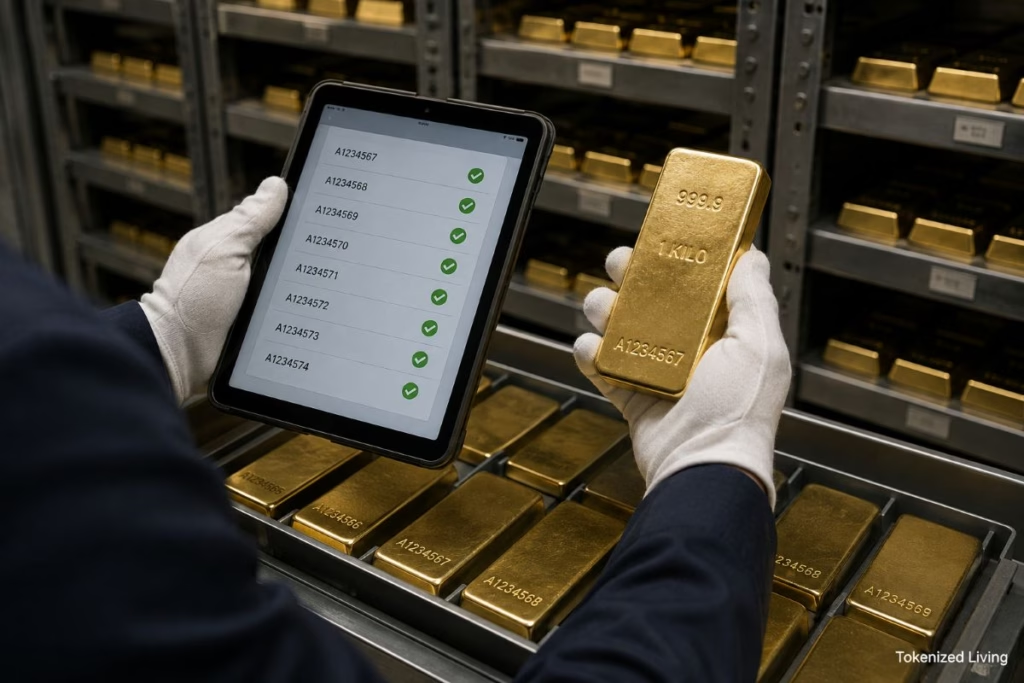
The vault operator performs a daily allocation process and sends details of allocated bars to the ledger. If the vault lacks enough gold to support additional token assignments, HSBC may suspend tokenization.
According to the Principal Brochure:
- An independent inspector performs a complete bar count at least annually.
- HSBC conducts quarterly checks using random samples.
- HSBC’s external auditor performs sample inventory checks.
- The ledger undergoes internal reviews and an independent third-party audit at least annually.
- HSBC reconciles vault inventory records with ledger records.
- The bank backs up ledger data daily.
These controls provide more structure than a vague promise of gold backing.
Still, audits and reconciliations cannot eliminate every risk. Investors continue to depend on HSBC, the vault operator, the ledger and the accuracy of the bank’s procedures.
Is the Gold Insured?
HSBC Group maintains insurance covering assets held within the relevant vault premises.
The bank says this policy covers risks such as criminal activity, civil liability and cyber incidents. HSBC reviews the coverage annually.
However, the insurance does not guarantee compensation for every possible loss.
The Principal Brochure warns that coverage may prove insufficient during extreme events. In that situation, HSBC may allocate uninsured gold losses among investors on a proportional basis.
Therefore, “insured gold” does not mean that investors face no custody risk.
What Happens If HSBC Becomes Insolvent?
HSBC says it holds the allocated gold separately from the bank’s other assets.
That segregation provides an important layer of protection. Nevertheless, it does not give investors the right to collect physical bullion during insolvency.
The product appoints a disposal agent to liquidate the gold after a defined liquidation event. The agent would then distribute the proceeds to investors.
However, Hong Kong’s financial-resolution framework can affect contractual and property rights. Resolution authorities may also change the timing, value or priority of payments.
HSBC’s documents warn that investors could still suffer substantial losses.
This is not the same as holding gold bars personally. It is also not the same as keeping money in a protected bank deposit.
HSBC Gold Token vs PAXG and XAUT
HSBC Gold Token, PAXG and XAUT all connect digital records with vaulted gold. However, the products operate through very different systems.
| Feature | HSBC Gold Token | PAXG | XAUT |
|---|---|---|---|
| Product code | XGT | PAXG | XAUT |
| Gold represented | 0.001 troy ounce per token | One troy ounce per full token | One troy ounce per full token |
| Ledger | Private HSBC ledger | Public blockchains | Public blockchains |
| Self-custody | No | Yes | Yes |
| Independent exchange trading | No | Available through supported venues | Available through supported venues |
| External wallet transfers | No | Yes | Yes |
| Physical delivery | Unavailable | Available subject to large minimums | Available subject to whole-bar requirements |
| Primary exit | Sell back to HSBC | Exchange sale or issuer redemption | Exchange sale or issuer redemption |
| Main access restriction | Eligible HSBC Hong Kong customers | Jurisdiction and platform dependent | Jurisdiction and platform dependent |
| Pricing | HSBC quote with embedded margin | Market price and venue spread | Market price and venue spread |
The full differences between PAXG and XAUT appear in our tokenized gold guide.
HSBC’s product offers familiar bank access without requiring private keys. In contrast, public tokens offer greater portability and trading choice.
Neither structure eliminates risk. They simply distribute control differently.
What Are the Benefits of HSBC Gold Token?
Low minimum investment
One XGT represents only 0.001 troy ounce. Therefore, investors can start with a small amount.
Allocated physical gold
HSBC connects the ownership records to identifiable London Good Delivery bars held in a segregated account.
No personal storage requirements
Investors do not need to store or insure bullion at home.
Familiar banking access
Customers can use the same HSBC app and online banking environment that they already know.
No private-key management
HSBC controls the ledger infrastructure. As a result, customers do not risk losing their investment because they misplaced a wallet recovery phrase.
Internal transfers
Eligible customers can gift XGT to another qualifying recipient through the HSBC HK app. The recipient must provide no payment or other consideration for the gift.
Institutional controls
The product includes vault reconciliations, bar counts, ledger backups and periodic audits.
What Are the Main Risks?
Gold-price risk
XGT follows the value of gold, which can rise or fall sharply.
The product offers no principal protection. Therefore, investors can lose money even if HSBC’s systems operate correctly.
HSBC pricing risk
There is no independent market for XGT.
HSBC determines the gold reference price, exchange rate and bank margin used in each quote.
Embedded-margin risk
Margins can reach 2% during gold trading hours and 5% outside them.
This creates a potentially significant gap between buying and selling prices.
No physical delivery
Customers cannot collect the gold, even if their token balance represents a complete bar.
Limited transferability
XGT cannot move to external wallets, exchanges or decentralized applications.
Dealing-suspension risk
HSBC may suspend purchases or sales during market disruptions, technical failures or other specified events.
Custody and insurance risk
The gold can still face theft, damage, restricted access or uninsured loss.
Ledger and cybersecurity risk
A software fault, cyberattack or data problem could interrupt transactions or affect ownership records.
HSBC maintains conventional database backups, but that also illustrates the product’s reliance on the bank.
Bank and settlement risk
Ownership allocation does not complete instantly. Before settlement, customers remain exposed to HSBC’s creditworthiness.
Regulatory risk
Changes in Hong Kong or international regulation could affect access, transfers or product terms.
What Was HSBC’s Quantum-Security Experiment?
In September 2024, HSBC announced that it had tested quantum-resistant security technology for tokenized gold.
The experiment used post-quantum cryptography to protect transactions against future attacks from powerful quantum computers.
HSBC also demonstrated the technical ability to convert gold tokens into ERC-20-compatible tokens. This showed how different distributed ledgers might communicate in the future.
However, the project was a technical pilot.
It did not convert retail XGT into a publicly transferable Ethereum token. Customers still cannot withdraw their HSBC Gold Tokens to external wallets.
The experiment shows that HSBC is considering long-term cybersecurity and interoperability. It does not change the product’s current restrictions. HSBC quantum-security pilot
What Does the $1 Billion Milestone Mean?
HSBC’s Q1 2026 results presentation reported that Gold Token had surpassed $1 billion in cumulative traded value.
Keep the explanation distinguishing traded value from assets under management and market capitalization.
That figure indicates meaningful customer activity and commercial adoption.
However, traded value is not the same as assets under management or market capitalization.
The same gold interest can contribute to cumulative traded value each time someone buys and sells it. Therefore, the figure does not mean HSBC holds $1 billion of retail gold for XGT customers.
Still, the milestone matters.
It shows that tokenization can attract retail participation when a familiar financial institution places the product inside an existing banking app.
This development also supports Hong Kong’s broader push into tokenized securities and digital finance.
Who Might Consider HSBC Gold Token?
The product may suit an eligible Hong Kong customer who:
- Wants fractional gold exposure.
- Prefers using an established banking app.
- Does not want to manage cryptocurrency wallets.
- Accepts HSBC’s quoted prices and margins.
- Does not need physical delivery.
- Values institutional custody and internal controls.
It may be unsuitable for someone who:
- Lives outside Hong Kong.
- Wants to hold tokens in a personal wallet.
- Requires independent exchange pricing.
- Wants access to decentralized finance.
- Plans to redeem for physical bullion.
- Wants an investment that produces interest.
- Cannot accept margins of up to 5%.
Final Verdict
HSBC Gold Token gives eligible Hong Kong customers a convenient way to buy small amounts of allocated physical gold. Its main appeal is familiar banking access, with custody and recordkeeping handled within HSBC’s system.
The practical trade-offs are HSBC’s pricing, restricted transfers and dependence on the bank for an exit. Investors should compare the quoted buying and selling prices before placing an order.
XGT may suit someone who values bank access and accepts those limits. Anyone seeking self-custody or physical delivery should compare other products and their eligibility, custody and redemption conditions.
The decision comes down to ownership rights, costs and access. Tokenization alone does not make the product cheaper, safer or more suitable.
Frequently Asked Questions
Is HSBC Gold Token a cryptocurrency?
No. XGT operates on HSBC’s private permissioned ledger. The product documents state that it is not expected to qualify as a virtual asset or specified stablecoin under the relevant Hong Kong legislation.
How much gold does one XGT represent?
One XGT represents a fractional ownership record covering 0.001 troy ounce of Loco London gold.
Can I transfer XGT to MetaMask?
No. Retail customers cannot withdraw HSBC Gold Token to MetaMask or another external blockchain wallet.
Can I redeem XGT for physical gold?
No. HSBC does not permit investors to take physical delivery of the underlying gold.
What does HSBC charge?
HSBC does not list a separate storage or ledger fee. However, it embeds a bank margin within its buying and selling prices. The current maximum is 2% during gold trading hours and 5% outside them.
Can anyone buy HSBC Gold Token?
No. Investors need an eligible HSBC Hong Kong investment account and a registered Hong Kong residential address. US persons and people with US addresses are excluded.
Can I send XGT to another person?
Eligible customers can initiate a gift transfer through the HSBC HK app. The recipient must satisfy HSBC’s requirements and accept the transfer within 13 calendar days.
Does HSBC Gold Token pay interest?
No. The product does not provide interest, dividends or yield.
Is HSBC Gold Token protected like a bank deposit?
No. XGT is an investment product rather than a bank deposit. It does not provide principal protection, and its value can fall.
Does SFC authorization make the product risk-free?
No. The SFC authorized the issue of the offering documents. That authorization does not represent an endorsement, performance guarantee or confirmation that the product suits every investor.