

Updated August 18, 2026
Tokenized gold has developed from a small cryptocurrency niche into a multibillion-dollar real-world asset market.
The basic idea sounds simple. An issuer places physical gold in a vault and creates blockchain tokens representing that bullion. Investors can then buy, hold or transfer fractions of the gold without handling a physical bar.
However, the gold itself does not move onto a blockchain.
Instead, the token represents rights connected to bullion held by an issuer and custodian. Therefore, investors must examine more than the token’s price. They also need to understand the legal structure, reserve verification, custody arrangements and redemption rules.
As of August 18, 2026, CoinGecko valued the tokenized-gold category at approximately $5.17 billion. Tether Gold and PAX Gold represented close to 90% of that total.
This guide explains how tokenized gold works, compares PAXG and XAUT, and examines the risks that investors frequently overlook.
This article provides general information and does not constitute personalized financial, legal or tax advice.
TL;DR
- Tokenized gold uses blockchain tokens to represent rights linked to physical gold stored in vaults.
- One full PAXG or XAUT token represents one fine troy ounce of gold.
- Investors can normally buy fractions of a token through supported exchanges.
- PAXG and XAUT have different issuers, regulators, vault locations and redemption requirements.
- Blockchain records can show token ownership and supply. However, they cannot prove that gold exists inside a vault.
- Investors still depend on issuers, custodians, auditors, legal agreements and trading platforms.
- Physical redemption usually requires hundreds of tokens, making it impractical for most retail investors.
- Tokenized gold does not generate interest by itself.
What Is Tokenized Gold?
Tokenized gold is a digital token that represents ownership rights or an economic claim linked to physical gold.
The World Gold Council defines tokenized gold as ownership of physical gold represented by digital tokens on a blockchain.
Each token normally corresponds to a fixed weight of bullion. For example, one PAXG or XAUT represents one fine troy ounce.
Investors can also buy fractions of these tokens. Therefore, someone does not need enough money to purchase an entire ounce or wholesale gold bar.
Tokenized gold provides one practical example of how real-world asset tokenization works. The physical asset remains off-chain, while the blockchain records transfers of its digital representation.
That distinction matters. Blockchain can improve the transfer and settlement process. Nevertheless, it cannot remove the physical vault, custodian or legal agreement behind the token.
How Does Gold Tokenization Work?
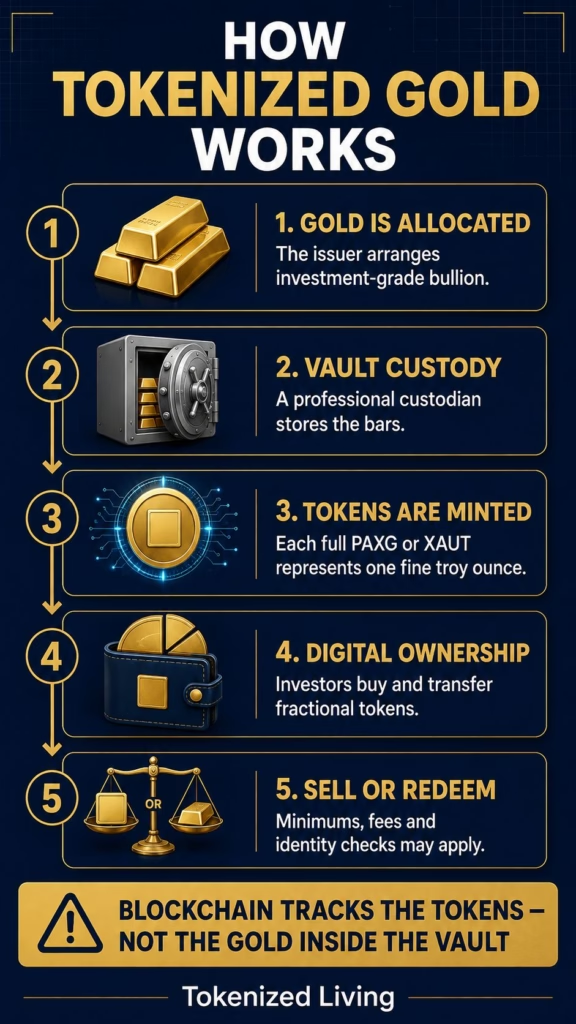
A typical tokenized-gold product follows several stages.
1. The issuer arranges physical gold
The issuer purchases or allocates investment-grade bullion. A professional custodian then stores the bars in one or more secure vaults.
Major products generally use bars that meet London Bullion Market Association standards. A London Good Delivery gold bar usually weighs around 400 troy ounces, although its permitted weight can range from 350 to 430 fine troy ounces.
The LBMA Good Delivery system sets requirements covering weight, purity, markings and physical appearance.
2. The issuer creates tokens
The issuer mints blockchain tokens that correspond to the gold held in reserve.
Ideally, the total gold backing should equal or exceed the amount represented by circulating tokens. However, investors should verify this through current reserve reports rather than relying on marketing claims.
3. Investors purchase fractions
Investors may buy tokens directly from an issuer or through an exchange. Direct issuer access usually requires identity checks and may involve high minimum purchases.
Meanwhile, exchanges can offer much smaller fractions. Their minimum order sizes depend on the individual platform.
4. Blockchain records token transfers
The blockchain records movements between compatible wallets. This can enable near-instant transfers without moving the underlying bullion.
However, a blockchain transaction only proves that a token moved. It does not independently prove that a gold bar remains inside a particular vault.
5. Holders sell or redeem their tokens
Most retail investors sell their tokens through exchanges.
Direct physical redemption may also be available. However, holders must satisfy the issuer’s eligibility, identity, minimum balance and fee requirements.
In practice, the minimum can equal an entire wholesale gold bar.
How Large Is the Tokenized-Gold Market?
The market has expanded rapidly since the original version of this article reported a $1 billion milestone.
On August 18, 2026, CoinGecko’s tokenized-gold category reported the following approximate figures:
| Market measure | Approximate value |
|---|---|
| Total tokenized-gold market | $5.17 billion |
| Tether Gold market capitalization | $2.70 billion |
| PAX Gold market capitalization | $1.93 billion |
| Combined PAXG and XAUT share | Around 90% |
These numbers change with token supply and the price of gold. Therefore, market capitalization does not measure fresh investment alone. A rising gold price can increase the sector’s value even without additional token issuance.
The market approached $6 billion during early 2026. At that point, it had grown more than fourfold since the end of 2024, according to Reuters.
Despite this growth, tokenized gold remains much smaller than the established gold ETF market. The World Gold Council reported approximately $530 billion in global gold ETF assets during July 2026.
Tokenized products have momentum, but they have not replaced traditional gold investment channels.
Why Is Tokenized Gold Growing?
Several factors have supported the market’s expansion.
First, tokenized gold gives cryptocurrency users exposure to bullion without leaving blockchain-based markets. Investors can hold gold tokens beside stablecoins and other digital assets.
Moreover, transfers can occur outside traditional market hours. Investors can move tokens between compatible wallets without waiting for a broker or securities settlement system.
Fractional ownership also lowers the entry point. A wholesale gold bar may cost more than $1 million, while exchanges can sell small fractions of a gold token.
In addition, high gold prices and geopolitical uncertainty have increased interest in traditional safe-haven assets. Tokenization gives digitally native investors another way to access that market.
Still, gold does not always rise during inflation or market stress. Its price can fall sharply, and tokenization does not remove that risk.
What Is PAX Gold?
PAX Gold, commonly known as PAXG, is issued by Paxos Trust Company, N.A.
One PAXG represents one fine troy ounce of a London Good Delivery gold bar. Professional vaults hold the underlying bullion in London.
Paxos operates as a U.S. national trust bank regulated by the Office of the Comptroller of the Currency. According to the official PAXG information, the company holds its gold reserves separately from its corporate assets and publishes monthly third-party attestations.
PAXG operates on Ethereum and Solana. Moreover, holders using compatible on-chain wallets can use Paxos’ allocation tool to view details connected to their gold, including bar serial numbers, weight and purity.
This tool does not cover tokens held through every centralized exchange. In those situations, the exchange may hold the underlying PAXG in an omnibus wallet.
Can PAXG Be Redeemed for Physical Gold?
Paxos allows eligible customers to redeem PAXG for physical gold. However, the process is not designed for someone holding a fraction of one token.
The current PAXG terms require at least 430 PAXG for an allocated London Good Delivery bar. Customers must also cover applicable fees and delivery arrangements.
Consequently, direct physical redemption could require gold worth well over $1 million.
Smaller holders can usually sell their PAXG or convert it through a supported service. Nevertheless, availability depends on their location and platform.
What Is Tether Gold?
Tether Gold, known as XAUT or XAU₮, is issued by TG Commodities S.A. de C.V.
One full XAUT represents one fine troy ounce of gold contained in a London Good Delivery bar. The issuer says its gold reserves are stored in Switzerland.
TG Commodities operates as a registered Stablecoin Issuer and Digital Asset Service Provider under El Salvador’s Digital Asset Issuance Law.
According to Tether’s Q2 2026 report, XAUT had approximately 707,747 fine troy ounces of physical gold in reserve. That equalled around 22 metric tonnes. The issuer reported maintaining at least one fine troy ounce for every token in circulation.
Tether publishes XAUT reserve information and provides an allocation lookup service for holders.
The current XAUT FAQ lists Ethereum and BNB Chain as supported networks. However, investors should always confirm the network and official contract address before transferring funds.
Can XAUT Be Redeemed for Physical Gold?
Verified customers may redeem XAUT for physical gold under the issuer’s terms.
However, physical delivery generally requires enough XAUT to cover a complete allocated bar. The precise weight varies because London Good Delivery bars do not all contain exactly 400 ounces.
Tether’s gold-token terms also limit physical delivery to addresses in Switzerland. Fees, identity checks and other conditions apply.
Furthermore, the issuer platform currently requires a direct purchase of at least 50 XAUT. Exchanges may provide access to much smaller fractions.
Therefore, most retail holders will probably exit by selling their tokens rather than collecting bullion.
PAXG vs XAUT: What Is the Difference?
PAXG and XAUT follow a similar basic model. Nevertheless, their legal, regulatory and operational structures differ.
| Feature | PAX Gold | Tether Gold |
|---|---|---|
| Symbol | PAXG | XAUT |
| Issuer | Paxos Trust Company, N.A. | TG Commodities S.A. de C.V. |
| Regulatory position | U.S. national trust bank under OCC oversight | Registered in El Salvador under its Digital Asset Issuance Law |
| Gold represented | One fine troy ounce per full token | One fine troy ounce per full token |
| Gold location | London | Switzerland |
| Main listed networks | Ethereum and Solana | Ethereum and BNB Chain |
| Reserve information | Monthly third-party attestations and allocation lookup | Published reserve reports and allocation lookup |
| Direct purchase minimum | From 0.01 PAXG through Paxos | 50 XAUT through the issuer platform |
| Physical redemption | Minimum 430 PAXG under current terms | Enough XAUT for a complete allocated bar |
| Delivery considerations | Customer arranges delivery and pays applicable costs | Physical delivery within Switzerland under current terms |
Network support, fees and product availability can change. Therefore, investors should check the latest issuer documents before making a decision.
PAXG may appeal to investors who prioritize U.S. federal oversight and monthly attestations. Meanwhile, XAUT currently has the larger market capitalization and a different geographical and regulatory structure.
Neither product is automatically suitable for everyone.
Do Token Holders Actually Own Gold?
This is the most important question in the entire article.
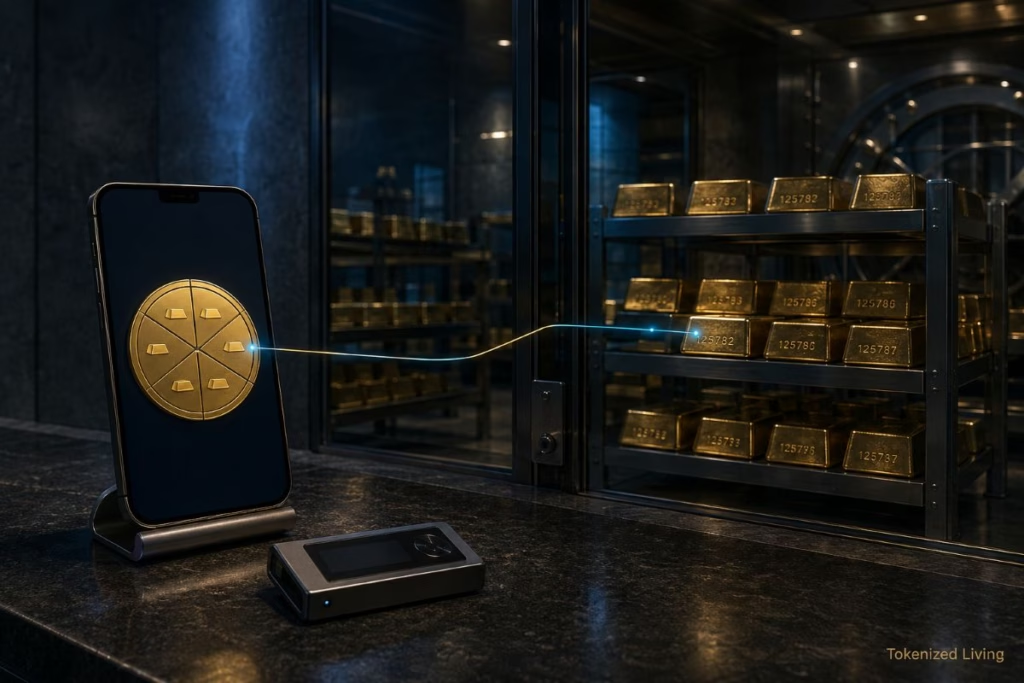
An issuer may describe its product as ownership of allocated gold. However, investors must determine how that ownership works under the applicable legal agreement.
Allocated gold connects a customer’s interest to identifiable bars. In contrast, an unallocated gold account usually creates a general claim against a provider.
The distinction becomes especially important during insolvency or a legal dispute.
Investors should examine:
- Who legally owns the bullion?
- Does the holder own a direct interest or a contractual claim?
- Does the custodian separate customer gold from company assets?
- What happens if the issuer becomes insolvent?
- Which country’s law governs the agreement?
- Can the holder enforce their rights directly?
- Does an exchange hold the token on the investor’s behalf?
Holding PAXG or XAUT in a personal wallet may provide direct control over the token. Yet self-custody does not place the physical gold inside that wallet.
Furthermore, holding the token through a centralized exchange adds another counterparty. The investor may have a claim against the exchange rather than direct control over the blockchain token.
Tokenization can improve recordkeeping. It cannot make legal agreements irrelevant.
How Can Investors Verify the Gold Backing?
Blockchain transparency solves only part of the verification problem.
Anyone can inspect a public blockchain and review token transfers. However, the blockchain cannot see through a vault door.
Therefore, a credible tokenized-gold product needs several layers of evidence.
Reserve reports or attestations
Check how often the issuer publishes reserve information. Also determine whether management prepared the report or an independent firm examined it.
An attestation usually confirms information at a specific date. It does not necessarily provide the same scope as a complete financial audit.
Token supply
Compare circulating supply with the amount of gold held in reserve.
Also check whether reserve reports include unsold tokens, treasury holdings or other amounts that do not circulate publicly.
Bar allocation
A credible allocation system should identify the bullion connected to token holders. Useful information can include bar serial numbers, refiner, weight and purity.
Custody arrangements
Find out where the issuer stores its gold and which entity controls it.
Additionally, examine whether insurance covers theft, loss, damage, fraud and transportation. Insurance policies frequently contain exclusions.
Redemption terms
Reserve backing has limited practical value if ordinary holders cannot enforce redemption rights.
Check the minimum amount, fees, delivery location, identity requirements and supported jurisdictions.
Official contract addresses
Scammers can create worthless tokens using the same name or symbol as a genuine product.
Always obtain the contract address from the issuer’s official website. Never rely solely on a token name displayed inside a wallet.
Tokenized Gold vs Physical Gold vs Gold ETFs
Each method provides gold exposure through a different ownership and custody model.
| Feature | Tokenized gold | Physical gold | Physically backed gold ETF |
|---|---|---|---|
| Form of ownership | Token-linked rights or claim | Direct possession of bars or coins | Shares in a fund or product |
| Trading access | Potentially available continuously | Depends on dealer | Exchange trading hours |
| Fractional access | Usually high | Limited by product size | One share or fractional shares |
| Storage | Issuer and custodian | Investor or private vault | Fund custodian |
| Main additional risks | Issuer, custodian, blockchain, wallet and exchange | Theft, loss, storage and dealer premiums | Fund, custodian, brokerage and tracking costs |
| Physical redemption | Possible but often impractical | Already physically held | Usually unavailable to retail holders |
| DeFi use | Possible where supported | No | Generally no |
| Ongoing fees | Product, exchange, network or custody costs may apply | Storage and insurance may apply | Annual expense ratio |
The World Gold Council explains that physically backed gold ETFs allow investors to buy gold exposure through a conventional brokerage account. However, ETF investors own shares in a financial product rather than blockchain tokens.
Physical gold removes blockchain and issuer risk once the investor takes possession. Nevertheless, it creates storage, insurance, security and resale challenges.
Tokenized gold sits between these models. It combines professionally vaulted bullion with blockchain transferability, but it also introduces more technical and counterparty dependencies.
What Are the Benefits of Tokenized Gold?
Fractional access
Investors can buy small fractions of an ounce. Therefore, they do not need the capital required for a large bar.
Faster transfers
Blockchain tokens can move between compatible wallets without physically transporting bullion.
Wider trading hours
Some cryptocurrency markets operate continuously. This allows trading outside normal stock-exchange hours.
However, liquidity may become thinner during weekends or periods when traditional gold markets are closed.
Easier self-custody
Investors can hold tokens in compatible personal wallets.
Still, losing a private key can permanently remove access. Self-custody transfers responsibility from an institution to the holder.
Potential DeFi use
Some decentralized finance services accept tokenized gold as collateral or provide trading pools.
This feature makes gold more usable within blockchain markets. Yet every additional smart contract creates another potential source of loss.
Reduced physical handling
The custodian manages the underlying bullion. As a result, investors do not need to store coins or bars at home.
What Are the Main Risks?
Gold-price risk
Tokenized gold tracks an asset whose price can rise or fall.
A gold token is not a dollar stablecoin. Therefore, its value does not remain fixed.
Issuer risk
Investors depend on the issuer to maintain accurate records, adequate reserves and enforceable redemption arrangements.
If the issuer fails, token holders may face lengthy legal proceedings.
Custody risk
The gold remains in a physical vault. Theft, fraud, damage, confiscation or access restrictions could affect the reserves.
Legal-ownership risk
Marketing language may not explain how courts would treat token holders during insolvency.
The applicable jurisdiction and contractual terms determine those rights.
Redemption risk
Direct redemption can require hundreds of tokens. Consequently, claims of physical redeemability may have little practical value for small investors.
Smart-contract and network risk
A software vulnerability, blockchain failure or incorrect transfer can cause losses.
Furthermore, sending tokens through an unsupported network may make recovery impossible.
Exchange risk
Centralized exchanges can freeze withdrawals, suffer hacks or become insolvent.
Leaving tokens on an exchange means trusting both the gold-token issuer and the trading platform.
Liquidity and tracking risk
A gold token can temporarily trade above or below the value of its underlying bullion.
Low liquidity, market stress and wide bid-and-ask spreads can increase that difference.
Regulatory and tax risk
Countries can classify and tax gold-backed tokens differently. Rules may also depend on the investor’s residency and holding method.
Therefore, investors should not assume that a token receives the same treatment as physical bullion or a gold ETF.
Does Tokenized Gold Generate Yield?
Gold does not produce rent, dividends or interest.
Therefore, a gold token does not generate yield merely because it exists on a blockchain.
Some platforms may offer interest for lending, depositing or using tokenized gold as collateral. However, that return comes from borrowers, trading activity, leverage or token incentives.
It does not come from the underlying bullion.
Any yield product adds counterparty, smart-contract, liquidation and liquidity risks. A platform offering unusually high returns on gold should receive particularly close scrutiny.
How to Evaluate a Tokenized-Gold Product
Before purchasing any gold-backed token, ask these questions:
- Who issues the token?
- Which regulator oversees the issuer?
- What legal right does each token represent?
- Is the gold allocated to identifiable bars?
- Who holds the bullion?
- Where are the vaults located?
- How often are reserves independently examined?
- Can token holders inspect allocation information?
- What happens if the issuer becomes insolvent?
- What is the minimum physical redemption amount?
- Which fees apply?
- Can residents of your country use the product?
- Which blockchain and contract address are official?
- How liquid is the token on your chosen exchange?
- Will you hold it personally or through a custodian?
A credible issuer should provide clear answers. Vague statements about “blockchain transparency” are not enough.
Can Banks Issue Tokenized Gold?
Banks and established financial institutions have also started testing digitally represented gold.
For example, HSBC introduced a retail gold token for eligible customers in Hong Kong. The product uses the bank’s Orion digital-assets platform rather than the same public-token model used by PAXG and XAUT.
The HSBC Gold Token shows that tokenized gold can exist within regulated banking systems as well as public cryptocurrency markets.
However, bank-issued products may remain inside controlled platforms. As a result, they may not offer the same self-custody or decentralized-finance options as public blockchain tokens.
This difference illustrates why investors must look beyond the word “tokenized.” The blockchain and platform structure can materially affect access, transferability and control.
Who Might Consider Tokenized Gold?
Tokenized gold may suit someone who:
- Already uses blockchain wallets.
- Wants fractional gold exposure.
- Values continuous transferability.
- Understands self-custody and network fees.
- Accepts issuer and custodian risk.
- Wants to use gold within compatible on-chain markets.
It may be unsuitable for someone who:
- Wants physical bullion in their immediate possession.
- Does not understand wallets or private keys.
- Prefers a traditional brokerage account.
- Needs guaranteed retail physical redemption.
- Wants an investment that produces income.
- Cannot tolerate uncertain regulatory or tax treatment.
The convenience of a token does not make it the safest gold product for every investor.
Final Verdict
Tokenized gold has become one of the clearest examples of real-world asset tokenization gaining genuine market adoption.
PAXG and XAUT allow investors to buy fractional exposure, transfer tokens between compatible wallets and access gold through blockchain markets. Their growth above a combined $4.5 billion shows meaningful demand.
However, tokenization does not eliminate trust.
Investors still rely on issuers to maintain reserves, custodians to protect the bullion and legal agreements to enforce ownership rights. Meanwhile, wallets, exchanges and smart contracts add risks that physical gold does not have.
The most important question is not simply whether a token claims 1:1 backing.
It is whether the holder can verify, control and legally enforce the rights that the token supposedly represents.
Frequently Asked Questions
Is tokenized gold a cryptocurrency?
Tokenized gold uses cryptocurrency infrastructure, but its value links to physical bullion rather than an independent monetary network. It behaves differently from assets such as Bitcoin.
Is every gold token backed by physical gold?
No. Some tokens represent allocated bullion, while others may use pooled reserves, derivatives or synthetic price exposure. Investors must examine each product separately.
Is PAXG better than XAUT?
Neither token is universally better. PAXG offers U.S. federal oversight, monthly attestations and London custody. XAUT has a larger market capitalization and uses a different issuer, jurisdiction and vault structure. The appropriate choice depends on access, liquidity and risk priorities.
Can I redeem PAXG or XAUT for physical gold?
Both issuers provide physical redemption under specific conditions. However, the minimum amount can equal a complete wholesale gold bar. That makes direct delivery impractical for most retail investors.
Does tokenized gold always match the gold price?
The tokens aim to follow bullion prices. Nevertheless, exchange liquidity, spreads, fees and market stress can create temporary premiums or discounts.
Is tokenized gold safe?
Tokenized gold can remove the need for personal bullion storage. However, it adds issuer, custodian, exchange, wallet, smart-contract and regulatory risks.
Does tokenized gold pay interest?
No. Physical gold does not generate income. Any yield offered through lending or DeFi comes from additional financial activity and introduces additional risk.