
Updated: 10th September 2026.
Tokenization can be worthwhile when it improves how an asset is financed, distributed or administered. However, those improvements need to justify the added costs and responsibilities.
This guide answers “why tokenize your assets?” for property owners, businesses and fund managers considering an issuance. The decision starts with the asset, the intended investors and the problem you want to solve.
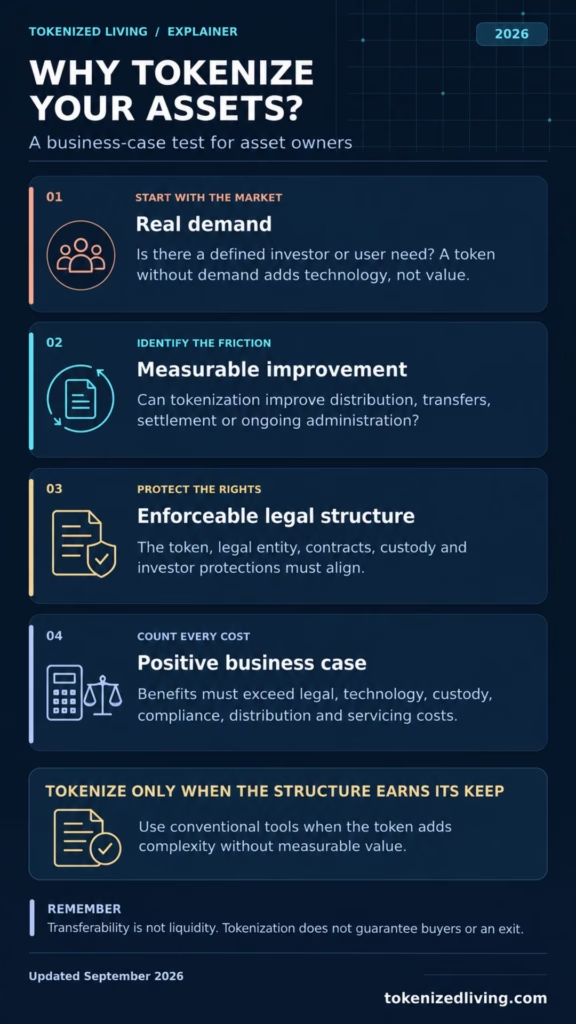
The practical test: identify a measurable benefit, compare conventional alternatives and calculate the full cost of delivering it. A token should serve a viable investment structure and a workable business plan.
For the basic terminology, start with our plain-English explanation of tokenization.
What Are You Actually Tokenizing?
An asset owner first needs to define the rights offered to investors. Possible structures include interests in a property company, fund units, debt securities or contractual rights to income.
These choices have different consequences. Selling equity can share economic ownership and decision-making rights. Issuing debt creates repayment obligations under the relevant agreement.
The physical asset may remain with its existing owner or move into another legal entity, depending on the structure. Creating tokens alone does not transfer property title.
Before choosing technology, establish who owns the asset, who issues the investment and what investors can claim. Also determine whether existing financing agreements or ownership restrictions affect the proposed transaction.
Our guide to fractional ownership agreements covers relevant clauses on control, expenses, transfers and exit rights.
Ownership Records Need a Defined Legal Role
Decide whether the blockchain will hold the authoritative investor register or support a separate official record. If both exist, specify how differences will be resolved.
Then document how transfers, disputed transactions, inheritance and lost wallet access will be handled. Recovery arrangements depend on the structure; they should be designed before investors need them.
These decisions shape the platform requirements. Starting with a token contract and adding legal rights later reverses that order.
Where Tokenization Can Add Business Value
Reaching Investors Through Suitable Distribution Channels
A digital investment format may help an issuer reach investors who already use compatible platforms and wallets. Smaller subscription amounts can also broaden participation where the offering permits it.
However, a lower minimum is only useful when enough eligible investors want the product. Identify the distribution partners, target audience and likely fundraising costs before issuing tokens.
Ask prospective partners for evidence of funded subscriptions in comparable offerings. Account registrations, social followers and wallet connections measure different things.
Furthermore, international interest requires a country-by-country offering assessment. Website access does not establish permission to market or sell an investment everywhere.
Reducing Repeated Administrative Work
Consider a fund with frequent subscriptions, transfers and distributions. Its administrator may repeatedly check eligibility, update records and reconcile information across providers.
An integrated tokenization system could reduce some duplication. The useful measure is how much work it actually removes from the complete process.
For example, compare staff hours per distribution, transfer errors and reconciliation time before and after a pilot. Include exceptions that still require manual attention.
By contrast, if a new blockchain record must be reconciled against every existing system, the project may add work. A shared ledger only helps when the relevant parties can use it effectively.
Our guide to AI and asset tokenization explores how AI can support document review, transaction monitoring and reconciliation, while explaining where human oversight remains necessary.
Improving Transfers and Collateral Workflows
Some businesses value quicker movement of investment positions between approved participants. Others want holdings to be usable within a compatible financing service.
Evaluate the complete transaction: investor approval, asset transfer, payment, settlement and reporting. A fast token transfer addresses only part of that sequence.
For collateral use, identify the lender or market that will accept the token. Obtain the eligibility rules, valuation approach and financing terms before assigning value to this feature.
Our guide to blockchain secondary markets explains why transfer capability and actual liquidity need separate assessment.
Two Examples That Clarify the Business Case
FCA Fund Rules: Operational Improvements Can Have Different Sources
On April 30, 2026, the UK Financial Conduct Authority published its final fund-tokenization guidance and optional Direct to Fund dealing rules.
The guidance addresses the use of distributed ledger technology by authorised fund managers, including keeping the unitholder register on DLT. The direct-dealing model allows investors to transact with the fund itself.
Crucially, Direct to Fund can apply to both conventional and tokenized funds. The FCA policy statement therefore provides a useful comparison when assessing where an efficiency gain comes from.
For an issuer, the lesson is to evaluate each improvement separately. Better dealing arrangements, updated administration and blockchain records may contribute different benefits.
BNY and Goldman Sachs: A Token Can Mirror an Existing Record
The BNY and Goldman Sachs announcement of July 23, 2025 described a different approach.
Investors could subscribe to selected money market funds through BNY’s platforms. GS DAP created corresponding mirror tokens, while BNY continued maintaining official books, records and settlement.
The original announcement linked this arrangement to potential future improvements in transferability and use of fund holdings. It did not establish that all existing processes had moved onto blockchain.
This illustrates why a sponsor must specify what a tokenization project actually changes. An additional digital representation and an authoritative ownership register perform different functions.
Our Goldman Sachs tokenization analysis explains how these mirror records differ from its digital bonds and blockchain-native fund units.
For a broader view of dated developments, see our tokenization in 2026 overview.
What Does Tokenizing an Asset Cost?
There is no useful universal price for tokenizing an asset. The required services depend on the offering, jurisdiction, investor base and existing infrastructure.
Ask providers to quote the complete investment lifecycle. A token-creation fee can cover only a small part of the work.
| Cost area | What the proposal should explain |
|---|---|
| Legal structure and offering | Entity formation, rights, required documentation and jurisdiction-specific advice. |
| Technology and integration | Issuance tools, security review, connections to existing systems and ongoing support. |
| Investor onboarding | Identity checks, eligibility screening, wallet arrangements and support costs. |
| Asset and investor administration | Custody where applicable, accounting, valuations, reporting and distributions. |
| Distribution and transfers | Placement charges, platform access, secondary-market arrangements and transaction costs. |
| Continuity and closure | Data export, provider migration, incident handling, final repayment and winding down. |
Separate fixed fees from charges based on investor numbers, transactions or assets under administration. Also ask who pays each amount: the issuer, investment vehicle or investor.
Some expenses already exist in a conventional structure. Therefore, compare the additional cost of tokenization with the costs it replaces, rather than counting every legal or accounting bill as new.
Taxes and transfer charges require a separate assessment. Their treatment can depend on what is transferred and how the transaction is structured.
An Illustrative Cost Comparison
Suppose a sponsor is comparing two ways to administer the same investment. These figures are hypothetical assumptions, not market quotations or promised savings.
| Assumption | Illustrative amount |
|---|---|
| Additional tokenization setup cost | $40,000 |
| Annual cost of the conventional arrangement | $30,000 |
| Annual cost of the proposed tokenized arrangement | $22,000 |
| Annual operating saving | $8,000 |
| Simple setup-cost payback period | 5 years |
The calculation is $40,000 divided by $8,000. Over a three-year project, operating savings would total $24,000, leaving $16,000 of the additional setup cost unrecovered.
If annual tokenized operating costs instead rose to $27,000, savings would fall to $3,000. The simple payback period would increase to about 13.3 years.
This calculation excludes financing effects, taxes, discounting and changes in costs over time. A full financial model should include those factors and any additional revenue supported by evidence.
The example shows why the planned holding period and ongoing charges matter. A cheaper annual service does not necessarily justify its setup cost.
Compare Tokenization with Conventional Alternatives
Fractional investment does not require blockchain. Depending on the objective and jurisdiction, an owner may consider company shares, a fund, a private placement or a crowdfunding arrangement.
For financing, a conventional loan may also be relevant. The comparison should consider control, repayment commitments, investor servicing and total expense.
| Main objective | Alternative worth assessing |
|---|---|
| Raise money from a small, known investor group | A conventional company or private investment arrangement. |
| Improve an outdated investor register | Modern register software and a digital investor portal. |
| Obtain capital while retaining ownership | Appropriate debt financing, subject to its costs and conditions. |
| Distribute through established investment channels | A conventional fund or securities offering using those channels. |
Use equivalent assumptions when comparing options. A tokenized offering and a conventional offering should be assessed against the same fundraising target, investor service and reporting standard.
Our coverage of institutional tokenized real estate provides context for evaluating larger fund and property structures.
When Tokenization Is a Weak Fit
Tokenization deserves less weight when the proposed benefit depends mainly on future buyers, unspecified savings or services that have not been agreed.
A single property with a few long-term investors may have little administrative work to automate. Similarly, a short project may end before recurring savings recover the setup expense.
Another weak case involves unclear asset rights. Technology cannot establish missing ownership documents or decide which party bears an undisclosed liability.
The BIS’s August 2025 assessment of tokenization risks recognises potential efficiency gains while noting that many benefits remain unproven. It also identifies dependence on external providers, interoperability problems and possible liquidity pressures.
For a sponsor, those findings support conservative budgeting and explicit responsibilities. Avoid building the financial case around an assumed increase in the asset’s valuation merely because tokens are issued.
Transparency Requires Reliable Information
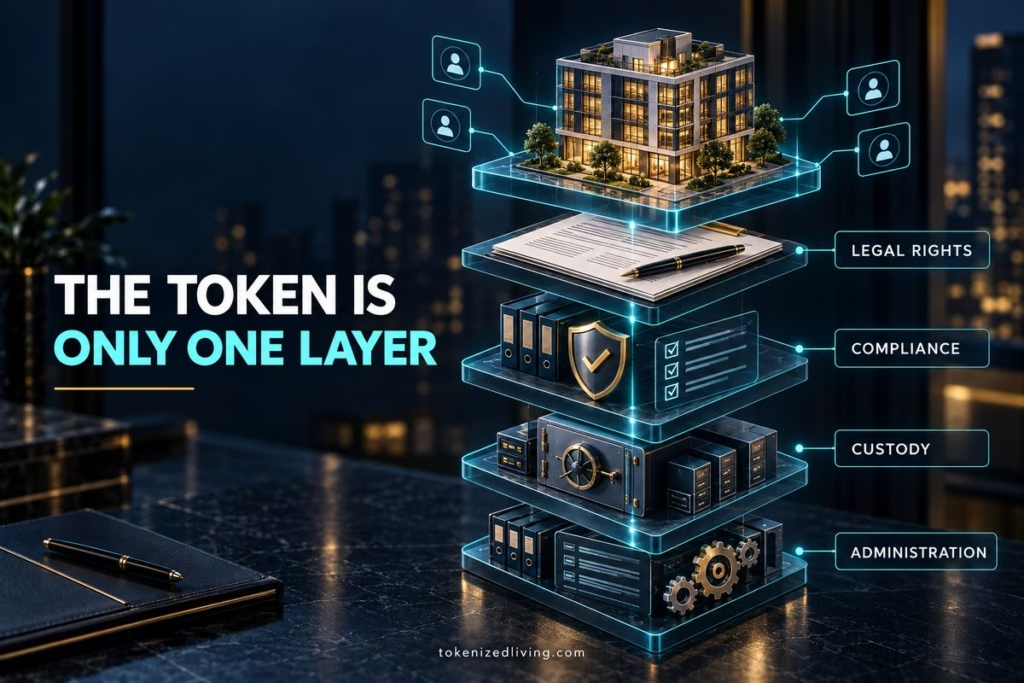
A visible token transfer does not reveal a property’s maintenance backlog or establish whether a borrower can repay. Investors still need reliable financial and operational reporting.
Specify who verifies the underlying information, how often it is updated and which investors can access it. Also explain what happens when the reported information is wrong.
The Reental review offers a practical example of examining project rights, advertised returns and exit conditions together.
How to Test a Tokenization Proposal
Start with one clearly defined offering or workflow. Record the existing cost, completion time and error rate, then set measurable targets for the proposed system.
During the pilot, test the entire investor journey. Include subscription, transfer approval, distributions, reporting and the intended exit process.
Ask the providers to demonstrate an exception as well as the normal process. A failed payment, disputed record or inaccessible wallet can reveal responsibilities that a smooth demonstration leaves unclear.
Before expanding, answer five questions:
- Demand: Which eligible investors or distribution partners have shown credible interest?
- Economics: Does the project remain viable if subscriptions are lower and operating costs are higher than forecast?
- Rights: Are ownership, income, control and exit terms clear to every participant?
- Operations: Who maintains records, approves exceptions and handles complaints?
- Continuity: Can the investment continue if a technology provider is replaced?
Agree on the success criteria before the pilot begins. Measure actual results against the conventional alternative, including the work that remains outside the blockchain.
Verdict: Give Tokenization a Specific Job
The strongest reason to tokenize an asset is a demonstrable improvement in financing, distribution or administration. Its value comes from the complete arrangement, including the investment terms and participating service providers.
For some issuers, compatible digital channels and repeated administrative tasks can support a convincing case. For others, conventional structures can meet the same goal with fewer moving parts.
Define the rights, test demand and compare full costs before selecting the technology. Proceed when the evidence supports the proposal and the responsibilities are clear.
Frequently Asked Questions
Why Tokenize Your Assets as a Business?
Potential reasons include reaching suitable investors, simplifying repeated administration and supporting compatible transfer or financing services. Each benefit should be measured against the full cost of the proposed arrangement.
Does Tokenization Increase an Asset’s Value?
There is no automatic increase. Improved access or administration may make an offering more useful, but valuation still depends on its cash flows, rights, risks and demand.
Can Tokenization Make a Property Easy to Sell?
It can support transfers of investment interests, subject to the relevant rules. Finding a willing buyer at an acceptable price remains a separate requirement.
Is Tokenization Necessary for Fractional Ownership?
No. Several investors can hold interests through conventional companies or funds. Tokenization should be assessed for the additional functions it provides.
How Much Does Asset Tokenization Cost?
Request a project-specific quote covering setup, legal work, technology, administration, distribution and closure. Compare total costs over the expected project life, including any conventional expenses that tokenization would replace.
Can a Tokenization Provider Handle Everything?
A provider may coordinate several services, but its contract should identify the responsible parties and any excluded work. Confirm responsibility for the asset, legal obligations, investor records, payments and continuity.