

Institutional interest in tokenized real estate is growing. However, it is not developing in the way many early predictions suggested.
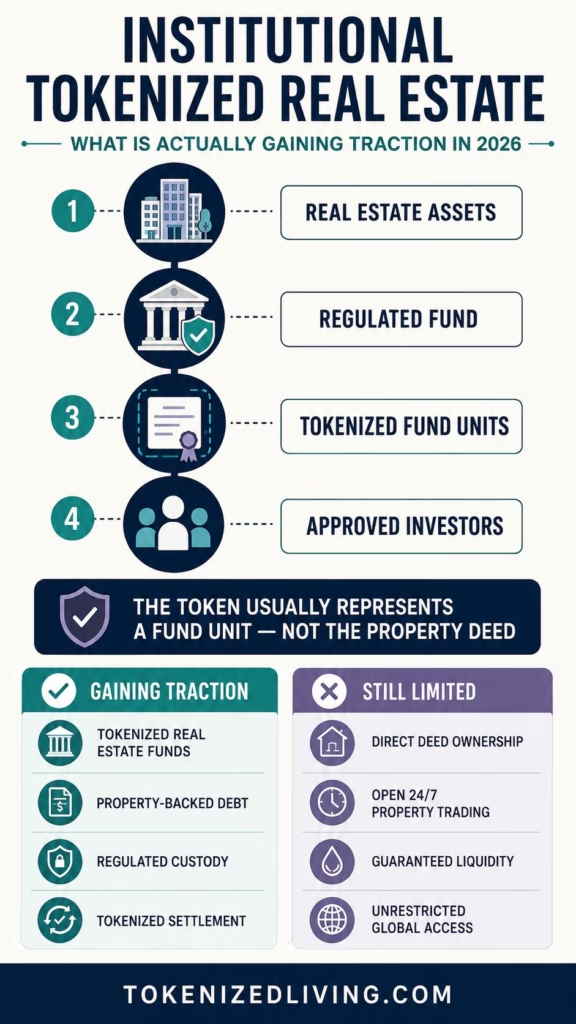
Banks and asset managers are not rushing to trade tiny pieces of individual buildings on public crypto exchanges. Instead, they are building regulated funds, digital ownership records, custody systems and settlement infrastructure.
That distinction matters.
Tokenized real estate is beginning to enter institutional finance. Yet most of the progress remains behind the scenes.
TL;DR
- Institutional adoption of tokenization is real, but direct property tokenization remains limited.
- Regulated real estate fund units are gaining more traction than tokens linked to individual buildings.
- A major June 2026 launch involved Goldman Sachs, LRC Group, Archax, Apex Group and Ownera.
- The project tokenized shares in a regulated real estate fund, not property deeds.
- Banks are focusing on custody, settlement, compliance and operational efficiency.
- Tokenization can make an asset transferable. It cannot guarantee buyers or liquidity.
- Legal ownership, investor rights and regulatory status still matter more than the blockchain used.
Institutions Are Interested—but Not in the Version Sold to Retail Investors
Tokenized real estate is often presented as a simple idea.
A building is divided into digital tokens. Investors purchase those tokens. They can then trade their property exposure as easily as buying shares.
The institutional market is taking a more cautious route.
Large financial organizations generally want regulated products that fit their existing systems. They need verified investors, professional custody, reliable valuations and clear legal rights.
They also require approved transfer processes and detailed reporting.
As a result, institutional tokenization looks less like cryptocurrency trading and more like traditional finance using new infrastructure.
A 2025 State Street survey of 324 institutional executives found strong interest in digital assets. More than half of the respondents expected between 10% and 24% of institutional investments to use tokenized instruments by 2030.
However, the respondents expected private equity and private fixed income to move first.
That is not proof that institutions are already buying large amounts of tokenized property. Instead, it shows where their priorities currently sit.
They are targeting markets where tokenization could improve slow and expensive financial processes.
What Does Institutional Real Estate Tokenization Actually Mean?
Institutional real estate tokenization can operate at several different levels.
| Tokenized element | What the token may represent | Current institutional relevance |
|---|---|---|
| Real estate fund units | Shares or interests in a regulated property fund | One of the strongest emerging uses |
| Property-owning company | Equity or membership interests in a company that owns property | Possible, but legally complex |
| Property-backed debt | Loans, notes or bonds secured against real estate | Attractive because debt terms are easier to standardize |
| Income rights | Contractual claims connected to rent or project revenue | Depends heavily on the issuer and legal agreement |
| Property title | Direct legal ownership recorded through a land registry | Still rare and usually limited to pilots |
| Settlement assets | Tokenized cash, deposits or money market funds used to complete transactions | Developing faster than direct property ownership |
These structures are not interchangeable.
A token representing a fund unit is not the same as a land title. Likewise, a token connected to rental income may not provide any ownership rights over the property.
For a broader explanation, see our complete guide to tokenized real estate.
The Strongest 2026 Example: A Blockchain-Native Real Estate Fund
The clearest sign of institutional progress arrived in June 2026.
Apex Group announced the launch of a blockchain-native real estate fund developed with:
- LRC Group
- Goldman Sachs
- Archax
- Ownera
- Apex Group
This was not a small experimental property listed on a retail platform.
LRC Group is an established European real estate investment manager. According to the announcement, the company has acquired and managed more than €10 billion in property assets since it was founded.
The structure also brought together several parts of the institutional investment system.
LRC acts as the real estate manager. Meanwhile, Archax provides custody for the digital securities and serves as the first distribution partner.
Apex Group supplies fund management, administration, depositary and banking services. Ownera connects the different participants and distribution channels.
Finally, the fund shares were issued through GS DAP, Goldman Sachs’ blockchain-based digital asset platform.
For the wider context, our review of Goldman Sachs’ tokenization projects traces GS DAP’s use across digital debt, money market fund records and real estate fund units.
The Apex Group announcement described the project as a regulated fund structure with blockchain-native units.
That makes this a genuine institutional real estate tokenization case.
However, we should not exaggerate what happened.
The physical property titles were not transferred onto a public blockchain. Instead, investors receive tokenized units in a regulated real estate fund.
Furthermore, the announcement did not disclose the fund’s size, its investors or any active secondary-market trading volume.
It referred to the potential for more seamless transferability in the future.
Potential transferability is not the same as proven liquidity.
| Our overview of tokenization in 2026 places these property developments alongside dated Treasury, stock and banking milestones. |
Why This Fund Matters
The LRC fund matters because it shows what serious institutional adoption may look like.
It combines blockchain-based issuance with familiar financial roles:
- regulated fund manager
- property investment manager
- custodian
- depositary
- administrator
- bank
- distribution platform
- investor identity checks
Tokenization has not eliminated these intermediaries.
Instead, it has created a digital system through which they can work together.
That may sound less revolutionary than putting a skyscraper on Ethereum. Nevertheless, it is far more realistic.
Institutions need systems that can survive audits, regulatory reviews, ownership disputes and operational failures. A fast token transfer means very little if the legal records do not recognize the new owner.
Therefore, institutional adoption depends on connecting the token to an enforceable financial structure.
What Is Actually Gaining Traction?
Several parts of tokenized real estate are advancing faster than others.
1. Tokenized Real Estate Funds
Funds provide a familiar structure for institutional investors.
The fund owns or controls a portfolio of property assets. Investors then purchase units in that fund.
Tokenization can potentially improve:
- investor onboarding
- ownership records
- unit transfers
- distribution
- reporting
- income payments
- reconciliation between service providers
It may also make smaller fund interests easier to issue and manage.
However, the fund still needs professional management. It also requires valuations, legal documents and regulated service providers.
The token changes how the interest is issued and recorded. It does not remove the underlying investment structure.
2. Property-Backed Debt
Real estate debt may prove easier to tokenize than direct property ownership.
A loan already has defined terms. These include its principal, interest rate, maturity date and repayment schedule.
Therefore, the financial rights can be easier to represent digitally.
Institutions could use tokenization to issue, distribute or manage:
- commercial property loans
- development finance
- mortgage-backed instruments
- private credit funds
- secured notes
This area connects property markets with the wider growth of tokenized private credit.
However, investors still carry borrower, property and default risk. Blockchain does not improve the quality of weak collateral.
3. Regulated Distribution and Custody
Institutions cannot normally send valuable securities to anonymous wallets.
They need to know who owns each asset. They must also control who can receive it.
Consequently, institutional tokenization often uses permissioned systems. Wallets may need approval before they can hold or transfer the token.
Smart contracts can help enforce these rules.
For example, they may prevent transfers to an ineligible investor. They can also record ownership changes and automate certain compliance processes.
Nevertheless, legal agreements and regulated records still determine whether that transfer is valid.

4. Tokenized Settlement
Buying an asset digitally is only one side of a transaction.
The payment must also move.
Traditional transactions can involve separate banks, custodians, brokers and settlement systems. Each participant keeps its own records.
Tokenized cash or bank deposits could allow the asset and payment to move together. This is sometimes called atomic settlement.
In theory, the asset transfers only if the payment also completes.
This could reduce failed transactions and reconciliation work. Therefore, settlement infrastructure may become one of tokenization’s most valuable institutional applications.
It is also why banks are investing heavily in tokenized deposits, money market funds and digital settlement networks.
The development is broader than real estate. Yet property funds could eventually use the same infrastructure.
5. Government-Backed Property Pilots
Some jurisdictions are testing closer connections between tokens and official property systems.
Dubai offers one example.
The Dubai Land Department launched a limited real estate tokenization pilot in March 2025. However, an official VARA warning stressed that only selected and approved participants could take part.
That restriction tells us something important.
Government involvement does not automatically create an open global property market. Early projects remain controlled because regulators must resolve ownership, investor protection and transfer rules.
Different regions are also taking different approaches. Our guide to global tokenized real estate trends in 2026 examines those differences.
What Is Not Gaining Traction Yet?
Several early promises remain largely unproven.
Direct Blockchain Property Ownership
Most property tokens do not put an investor’s name directly on a land title.
Instead, a company, fund or special-purpose vehicle owns the property. The token represents rights connected to that structure.
This is not necessarily a problem.
However, investors must understand the difference between owning property and owning an interest in a company that owns property.
The SEC’s January 2026 statement on tokenized securities reinforces this point.
It explains that tokenized products can use several structures. The rights of holders depend on the economic and legal reality, not simply the token’s name or format.
Open 24/7 Property Trading
A token can technically move at any time.
That does not mean someone will buy it.
Property values also change more slowly than publicly traded shares. Reliable valuations may only arrive monthly, quarterly or annually.
As a result, continuous trading could create an illusion of precise pricing without enough market activity to support it.
Institutions may prefer controlled trading windows or periodic liquidity events.
Instant Global Access
Cross-border access sounds attractive. Unfortunately, securities laws remain national.
An investor may face:
- eligibility restrictions
- residency limitations
- tax reporting
- withholding taxes
- currency risk
- sanctions screening
- anti-money-laundering checks
Tokenization can make distribution technically easier. It cannot erase these obligations.
Guaranteed Liquidity
Liquidity remains the most abused claim in tokenized real estate.
A secondary marketplace only provides a place to offer an asset for sale. It does not guarantee a buyer or a fair price.
Recent research provides an important warning.
A BIS working paper on U.S. tokenized property markets found that trading activity could hold up during certain periods of stress. However, this benefit depended on platform-supported buyback features.
Those buybacks also increased the platform’s solvency risk.
In other words, somebody must provide the liquidity. It does not appear simply because an asset uses blockchain technology.
Read our full guide to the benefits and risks of tokenized real estate for a deeper breakdown.
Why Real Estate Is Moving More Slowly Than Other Tokenized Assets
Real estate is one of the world’s largest asset classes. It is also one of the most difficult to standardize.
Every property is different.
Buildings have different tenants, maintenance costs, locations and legal restrictions. Their values depend on local conditions.
Furthermore, property transactions connect with planning rules, land registries, taxes, insurance and physical inspections.
A government bond is easier to standardize. So is a money market fund.
That helps explain why institutional tokenization has advanced faster in bonds, funds and cash-equivalent products.
Real estate tokenization adds another layer of complexity to an already complicated asset.
Therefore, institutions are starting with fund units and financial claims rather than attempting to replace entire land-registration systems.
Does Blockchain Make Tokenized Real Estate Safer?
Not automatically.
A blockchain can make approved transaction records difficult to change. It may also improve auditability between participants.
However, it cannot verify whether the original information was correct.
Blockchain cannot confirm that:
- the property valuation is reasonable
- the building is properly maintained
- rental income has been reported accurately
- the issuer owns the assets it claims to own
- the legal documents protect token holders
- a secondary market will remain active
Bad information can still be recorded permanently.
Smart contracts can also contain errors. Meanwhile, compromised wallets and private keys create additional risks.
Institutional systems address these weaknesses through legal contracts, professional custody, audits and regulated administration.
The blockchain forms part of the infrastructure. It is not a substitute for due diligence.
What Should Investors Check?
Institutional involvement can add credibility. Nevertheless, a famous bank or asset manager does not make every tokenized product safe.
Before investing, check:
- What does the token legally represent?
Is it a fund unit, company share, debt instrument or contractual income right? - Who owns the physical property?
Find the company, trust, fund or special-purpose vehicle named in the documents. - Which record proves ownership?
Determine whether the blockchain record, company register or administrator’s records take priority. - Who holds the assets?
Review the custodian, depositary, bank and property manager. - Who can buy or sell the token?
Check residency, accreditation and transfer restrictions. - Where does liquidity come from?
Look for real trading volume rather than the existence of a marketplace. - How is the property valued?
Independent and regular valuations matter. - What happens if the platform fails?
Token holders need enforceable rights outside the platform’s website. - How are income and expenses calculated?
Rental income can fall after management fees, vacancies, repairs and taxes. - Which regulator oversees the structure?
A blockchain address is not a regulatory licence.
Investors comparing retail options can also review our guide to tokenized real estate platforms in 2026.
The 2026 Verdict
Institutional adoption of tokenized real estate has moved beyond presentations and theoretical trials.
The launch of a blockchain-native property fund involving LRC Group, Goldman Sachs, Archax, Apex Group and Ownera provides meaningful evidence.
However, it also shows where the market is heading.
Institutions are not abandoning traditional legal and financial structures. They are placing digital issuance, ownership records and settlement tools inside those structures.
In the near term, the strongest areas are likely to be:
- tokenized real estate fund units
- property-backed private credit
- regulated digital securities
- permissioned distribution networks
- institutional custody
- tokenized cash and settlement
- government-approved property pilots
Direct ownership of buildings through freely traded public tokens remains much less developed.
Therefore, the real institutional story is not that property has suddenly become as liquid as stocks.
The real story is quieter.
Real estate funds and financial service providers are beginning to rebuild parts of their infrastructure around programmable digital assets.
That transition could eventually widen access and reduce operational friction. Still, it will happen through regulation, legal structures and controlled markets—not through blockchain technology alone.
Frequently Asked Questions
Are institutions investing in tokenized real estate?
Some institutions are participating in tokenized real estate funds, pilots and infrastructure projects. However, verified direct investment remains limited compared with institutional activity in tokenized bonds, money market funds and private credit.
Do institutional real estate tokens represent property deeds?
Usually not. Most represent interests in a fund, company, loan or other legal structure connected to real estate.
Does tokenization make real estate liquid?
Tokenization can make an investment easier to transfer. It cannot guarantee buyers, sufficient trading volume or fair pricing.
Why would institutions use blockchain for real estate?
Potential uses include digital fund issuance, automated compliance, ownership records, investor servicing, faster settlement and improved coordination between financial service providers.
Are permissioned blockchains still blockchains?
Yes. However, only approved participants can normally access or validate transactions. Institutions often prefer this model because it supports identity checks, privacy and regulatory control.
Will institutional adoption make retail tokenized property safer?
It may improve custody, administration and regulatory standards. Nevertheless, retail investors must still assess the specific legal structure, fees, property risks and liquidity of each product.