
Virtual real estate was one of the biggest stories of the NFT boom.
Buyers spent cryptocurrency on digital plots inside platforms such as Decentraland and The Sandbox. Some planned to build games, shops and event spaces. Others simply expected the land to become more valuable.
The idea was marketed as digital property ownership.
However, virtual land is not the blockchain equivalent of buying a house.
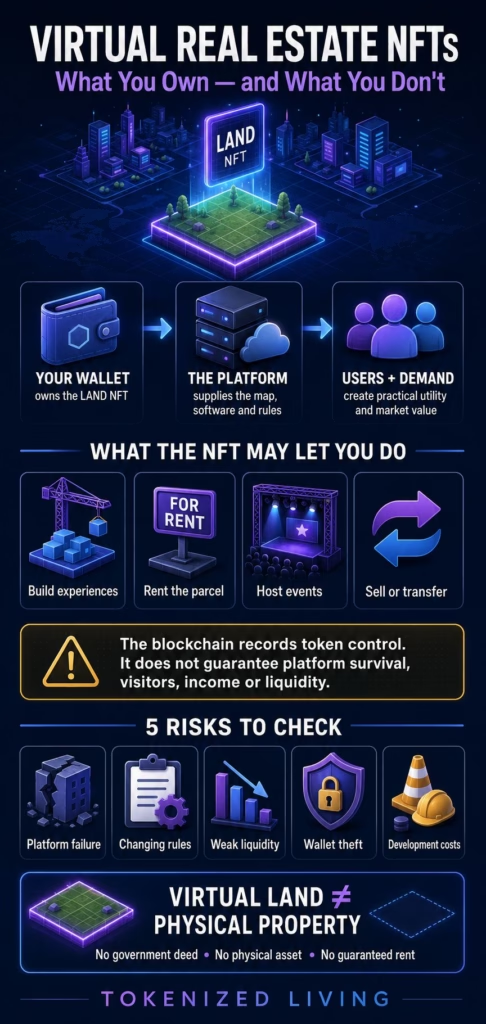
When you purchase virtual real estate, you normally receive an NFT associated with a location inside one particular online world. The blockchain can record which wallet controls that token. Meanwhile, the platform determines how the land appears, what can be built and whether anyone visits it.
That distinction changes the entire investment case.
You may own the NFT. You do not own the platform, its software, its audience or a guaranteed right to earn money.
TL;DR
- Virtual real estate is digital space inside an online platform.
- An NFT can identify a unique parcel and record which wallet controls it.
- The token does not represent physical land or a government-recognized property deed.
- Its practical value depends on the platform continuing to recognize and support it.
- Virtual land may be developed, rented or resold, but income is not guaranteed.
- Limited token supply does not create value without users and demand.
- Platform failure, weak liquidity, wallet theft and changing rules are major risks.
- Virtual land is better viewed as a platform-dependent digital asset than conventional real estate.
What Is Virtual Real Estate?
Virtual real estate refers to digital locations inside online worlds, games and social platforms.
These locations may include:
- Individual land parcels
- Groups of connected parcels
- Buildings and event venues
- Games and interactive experiences
- Virtual shops
- Advertising locations
- Social spaces
- Private community areas
Not every virtual world uses blockchain technology.
Traditional platforms can store digital land ownership in a private company database. Blockchain-based worlds instead use NFTs to identify parcels and record transfers between wallets.
An NFT is useful here because each location is different. One parcel may have unique coordinates, surrounding areas and platform-defined features.
For a broader introduction to digital tokens, read our guide explaining what tokenization means.
What Do You Actually Own?
Buying virtual land normally gives you control of an NFT and the platform-specific rights connected to it.
Those rights may allow you to:
- Transfer or sell the NFT
- Build an approved experience on the parcel
- Give another user permission to develop it
- Rent access to the land
- Host events
- Participate in platform governance
- Display content or digital items
However, the purchase does not usually give you ownership of:
- Physical land
- A government-recognized property title
- The platform’s software
- The platform’s trademarks or intellectual property
- The servers or infrastructure supporting the world
- A permanent audience
- Guaranteed income
- Guaranteed access to every platform feature
The blockchain proves which wallet controls the token according to its smart contract.
The platform gives that token its practical meaning.
If the platform stops recognizing the NFT, removes an important feature or loses most of its users, the token may remain in your wallet. Nevertheless, its usefulness and market value could collapse.
Is a Virtual LAND NFT the Same as a Property Deed?
No.
Calling a LAND NFT a digital deed creates the wrong impression.
A physical property deed exists within a legal system. Courts, government registries and property laws recognize the owner’s rights. Those rights may continue even if a particular property website or estate agent closes.
Virtual land works differently.
The token identifies a parcel inside a privately developed or community-governed digital environment. Its rights come from smart contracts, platform rules and user agreements.
A buyer therefore owns a crypto-native digital asset, not a piece of real-world property.
This also means virtual land is not normally classed as a real-world asset. Our guide to real-world assets explains why RWAs must connect to an asset, right or financial claim outside the blockchain environment.
Virtual Real Estate Versus Tokenized Physical Real Estate
Virtual real estate and tokenized physical property use some of the same technology. However, they represent completely different assets.
| Feature | Virtual real estate NFT | Tokenized physical real estate |
|---|---|---|
| Underlying asset | Digital location inside a platform | Physical land, building or property-related claim |
| Ownership record | Blockchain token and platform rules | Deed, company, contract or security plus blockchain records |
| Main source of rights | Smart contract and terms of service | Property, company and securities law |
| Main source of utility | Platform users and supported features | Housing, commercial use, rent or property value |
| Platform failure | Can destroy most of the asset’s practical utility | Property may remain even if the investment platform fails |
| Government title | None | Usually held by a person, company, trust or other legal entity |
Our rebuilt guide to NFTs in physical real estate examines how an NFT can connect to a property-holding company without replacing the legal deed.
You can also read our complete guide to tokenized real estate for a broader explanation of physical property tokens.
How Virtual LAND NFTs Work
The exact process differs between platforms. However, most virtual-land systems follow a similar structure.
1. The Platform Creates a Digital Map
The developer or community divides the virtual world into individual locations.
Each plot receives identifying data, such as coordinates, parcel size or location within a district.
2. Each Parcel Is Connected to an NFT
A smart contract creates unique tokens representing the parcels.
The NFT does not contain an entire virtual world. Instead, it usually contains or points to identifying information that the platform can read.
3. A Wallet Acquires the Token
The buyer purchases the LAND NFT through an official sale or marketplace.
Once the blockchain transaction completes, the buyer’s wallet controls the token.
4. The Platform Recognizes the Wallet
When the wallet connects to the platform, the system checks the blockchain record.
The owner can then access supported land-management and building features.
5. The NFT Can Be Transferred
A holder can list the token for sale or transfer it to another compatible wallet.
Blockchain technology handles the token transfer. The virtual world continues to supply the map, graphics, development tools and user experience.
That final point matters most.
The blockchain tracks the token. It does not create the platform’s users or make the land commercially useful.
Decentraland LAND
Decentraland divides its virtual world into individual LAND parcels and larger Estates.
The platform’s documentation explains that LAND parcels are NFTs because each location is unique. Different coordinates and proximity to roads, districts or other parcels distinguish one token from another.
According to the Decentraland terms of use, title and ownership rights over each LAND token lie with its owner. Landowners can determine what content appears on their parcels, subject to applicable policies.
However, this ownership concerns LAND inside Decentraland.
It does not give the holder a physical location or ownership of the wider Decentraland software and infrastructure.
Decentraland also supports land rentals. Its official rental documentation allows owners to offer Parcels or Estates through its marketplace.
That creates a possible use case. It does not guarantee that a renter will appear or pay enough to justify the original purchase.
The Sandbox LAND
The Sandbox also uses NFTs to represent locations in its virtual environment.
According to the platform, its LAND can be used to host games, build experiences, organize events and monetize digital creations. The platform has a fixed supply of 166,464 LAND parcels.
Scarcity within one platform can matter. However, supply alone does not create demand.
The Sandbox terms of use reveal the platform-dependence clearly. The company retains ownership of its software and platform content. It can moderate land metadata, update the software and modify or stop providing parts of the service.
A holder may therefore continue to own a LAND NFT while the experience and services connected to it change.
This is not a minor technical detail. It is one of the asset’s central risks.
Is Virtual Land Really Scarce?
A platform can place a hard limit on the number of LAND tokens in its collection.
That makes the tokens scarce within that particular system.
Nevertheless, digital space as a whole is not scarce.
New virtual worlds can launch. Existing platforms can introduce different types of spaces, experiences or discovery tools. Users can also move to games and social platforms that do not require land ownership at all.
Physical land is limited by geography.
Virtual land is limited by code and platform design.
Therefore, investors should not treat a fixed token supply as automatic proof of long-term value.
Scarcity without demand is merely a limited supply of something nobody needs.
How Can Virtual Land Make Money?
Virtual land can potentially generate value in several ways.
Reselling the NFT
An owner may sell the parcel to another buyer at a higher price.
This is the simplest strategy. It is also the most speculative because it depends on someone else paying more later.
Renting the Parcel
Some platforms allow owners to rent or delegate land to creators.
The creator gets permission to use the space for an agreed period. Meanwhile, the owner keeps the underlying NFT.
Demand can still be weak. A rental feature does not guarantee renters.
Creating an Experience
Owners may build:
- Games
- Galleries
- Social venues
- Branded experiences
- Educational spaces
- Shops
- Ticketed events
A successful experience might attract users or support sales. Yet the owner still needs development skills, content and marketing.
Buying the land is only the starting cost.
Advertising and Sponsorship
A high-traffic experience might attract advertisers or commercial partners.
However, virtual footfall is not guaranteed. A parcel described as a “prime location” may generate little attention if platform users discover content through menus, search functions or direct links instead of walking past it.
Token-Gated Access
An owner can create private experiences for NFT holders or community members.
This may be useful for an existing brand or organization. It is far weaker when the owner has no audience to bring into the space.
What Determines Virtual Land Value?
Virtual land prices do not depend on a single factor.
Possible value drivers include:
- The number of active platform users
- How much time users spend in the world
- The quality of nearby experiences
- Visibility in platform discovery tools
- Development and maintenance costs
- The platform’s creator tools
- Marketplace activity
- Demand for the ecosystem’s cryptocurrency
- Governance decisions
- Brand partnerships
- The parcel’s size and supported functions
- The number of genuine potential buyers
Listing prices are not reliable evidence of value.
A seller can list an NFT at any price. Completed transactions and sustained user activity are much more meaningful.
Even those figures require caution. Wash trading, promotional rewards and speculative buying can create activity that does not represent genuine end-user demand.
The Main Risks of Virtual Real Estate NFTs
The two original articles acknowledged risk but still treated virtual land as a developing version of physical property. That comparison was too generous.
Virtual land has several unique failure points.
Platform Failure
The online world may close, lose funding or stop attracting users.
Your NFT could remain on the blockchain. Even so, it may no longer connect to a functional or commercially relevant environment.
Changing Platform Rules
The platform can change its software, content policies, fees, development tools or discovery system.
A parcel’s usefulness can therefore change without the NFT leaving your wallet.
Weak Liquidity
Being able to list an NFT does not mean someone will buy it.
A marketplace full of unsold listings is not a liquid market. The true exit price may be far below the owner’s expected valuation.
Price Volatility
Virtual land prices can move with NFT sentiment, cryptocurrency markets and social-media attention.
The SEC’s Investor.gov website warns that crypto assets, including NFTs, are speculative and buyers can lose some or all of their investment.
Wallet Theft
Anyone who gains control of the wallet’s private key may be able to transfer the NFT.
Blockchain transactions may be difficult or impossible to reverse.
Counterfeit Collections
Scammers can create fake NFT collections resembling official virtual land.
Buyers should verify the contract address through the platform’s official website. The Sandbox even publishes guidance for identifying legitimate LAND on marketplaces.
Smart-Contract and Network Risk
Coding errors, compromised administrator keys, network problems or bridge failures could affect the NFT or its transfer process.
A public blockchain can improve record visibility. It does not make every smart contract safe.
Cryptocurrency Risk
Land may be priced in a volatile cryptocurrency.
The NFT price and payment token can both move sharply, adding another layer of uncertainty.
Intellectual Property and Moderation Risk
Land ownership does not provide unlimited rights to use platform content, logos or third-party intellectual property.
Platforms may also remove content that violates their policies.
Development Risk
Building a useful experience can require designers, developers, artists and ongoing maintenance.
An undeveloped parcel does not automatically attract visitors or produce income.
Tax Risk
NFT sales and other digital-asset transactions may create tax obligations.
For U.S. taxpayers, the IRS includes NFTs within its digital-asset guidance and states that income from digital assets is taxable.
Buyers should keep records of purchase prices, fees, sales, token swaps and income.
Virtual Land Versus Fractional Ownership
A standard LAND NFT usually represents one unique digital parcel. It is not necessarily a fractional investment.
Several people can share control through another agreement or token structure. However, the NFT itself normally sits in one blockchain address at a time.
This differs from fractional ownership, where several participants hold divided ownership or financial rights in the same asset.
Virtual-land projects may add fractional structures. That introduces further questions about control, governance, securities law and exit rights.
Questions to Ask Before Buying Virtual Land
Do not begin with the floor price.
Begin with these questions:
- What exactly does the NFT represent?
- Which smart contract created it?
- Is the contract address verified by the official platform?
- What rights do the platform’s terms provide?
- Can those terms or features change?
- How many people actively use the virtual world?
- What do users actually do there?
- Is the parcel useful without further development?
- How much would development cost?
- Are buyers completing sales or merely listing NFTs?
- Can the land be rented?
- Is there genuine rental demand?
- Which cryptocurrency and network are required?
- What fees apply when buying or selling?
- How will the NFT and wallet recovery phrase be secured?
- What happens if the platform stops operating?
- What is the realistic exit plan?
If the investment case depends mainly on “the metaverse will be huge,” there is no proper investment case.
There is only a slogan.
How to Buy Virtual Land More Safely
Anyone who still wants to buy should take a cautious approach.
Choose the Platform Before the Parcel
Research the ecosystem, governance, development activity and user community first.
A cheap parcel in a dead platform is not a bargain.
Use Official Links
Start from the platform’s website and official documentation.
Do not trust contract addresses posted in unsolicited messages, advertisements or social-media replies.
Read the Terms
Check what ownership provides and what powers the platform retains.
Pay particular attention to moderation, account restrictions, service changes, fees and dispute procedures.
Verify the NFT Contract
Confirm that the NFT belongs to the genuine LAND collection.
Similar artwork and names are not proof of authenticity.
Study Completed Sales
Look at actual transactions instead of optimistic listing prices.
Also check how frequently parcels sell and whether activity is concentrated among a small number of wallets.
Calculate the Full Cost
Include:
- Purchase price
- Marketplace fees
- Network fees
- Currency-conversion costs
- Development expenses
- Maintenance costs
- Possible taxes
Secure the Wallet
Consider using a hardware wallet for valuable NFTs.
Never share a recovery phrase, and verify every transaction before signing it.
Assume the Asset Is Illiquid
Do not use money that may be needed quickly.
A LAND NFT can be technically transferable while remaining extremely difficult to sell at a reasonable price.
Is Virtual Real Estate a Good Investment?
For most passive investors, virtual land is highly speculative.
It does not produce rent automatically. No physical property sits behind it. The NFT does not provide a claim against a building, company or government registry.
Its value depends heavily on continued demand for one digital ecosystem.
Virtual land may make more sense for:
- Game developers
- Digital creators
- Existing communities
- Event organizers
- Brands with a defined campaign
- Businesses that understand the platform’s audience
These buyers may have an immediate reason to use the parcel.
By contrast, purchasing empty virtual land and waiting for another buyer to pay more is not a business plan. It is speculation with a token ID.
Physical tokenized property has its own substantial risks, as our guide to the benefits and risks of tokenized real estate explains. At least the physical-property structure can connect to a real building, income stream or legal claim.
Virtual land does not have that same foundation.
The Future of Virtual Real Estate NFTs
NFTs can remain useful tools for assigning control over digital locations.
They allow users to hold and transfer platform assets through independent wallets. Smart contracts can also support permissions, rentals and creator access.
However, that does not mean another virtual-land investment boom is inevitable.
The stronger long-term use case may be ownership for creators who need a digital location, rather than passive investors stockpiling parcels.
Successful platforms will still need:
- Engaging experiences
- Active users
- Reliable software
- Accessible creator tools
- Sensible transaction costs
- Clear ownership rules
- Effective moderation
- Reasons for people to return
Blockchain ownership cannot compensate for an empty world.
Final Thoughts
Virtual real estate NFTs provide a genuine form of blockchain-based ownership.
The wallet can control a unique token. That token can be transferred without relying on a conventional property database.
Nevertheless, the phrase “digital property ownership” needs limits.
The NFT does not provide physical land, a government deed or control over the platform. Its usefulness comes from an ecosystem that other people must continue to operate and use.
Therefore, the most important question is not:
“How scarce is this virtual land?”
It is:
“Why will people still want to use this platform and this parcel in the future?”
If there is no convincing answer, the NFT is not digital real estate in any economically meaningful sense.
It is just a scarce token in an empty map.
Frequently Asked Questions
What is a virtual real estate NFT?
It is a unique blockchain token associated with a digital location inside an online world. The token may allow its holder to develop, transfer, rent or use that location according to the platform’s rules.
Does a LAND NFT give me legal ownership of property?
It gives you control of a digital token and the platform-specific rights attached to it. It does not give you ownership of physical land or a government-recognized property deed.
Can virtual real estate generate income?
It may generate income through rentals, events, experiences, advertising or resale. However, none of these income sources are guaranteed, and developing useful land can require substantial work.
What happens if the virtual-world platform closes?
The NFT may remain in your wallet, but its main utility and market value could disappear if the platform no longer operates or recognizes it.
Is virtual real estate an RWA?
Normally, no. Virtual land exists inside a digital platform and does not represent an asset outside the blockchain environment. Tokenized physical property can qualify as an RWA when it connects to real legal or financial rights.
Is virtual land scarce?
A particular NFT collection may have a fixed supply. However, digital space across all platforms is not scarce because existing platforms can create other types of spaces and new virtual worlds can launch.
Do I pay tax when selling virtual land?
Potentially. Tax rules vary by country. In the United States, NFTs are digital assets, and sales, exchanges or income can create reporting and tax obligations.
What is the biggest virtual real estate risk?
Platform dependence is the biggest structural risk. The NFT can remain on a blockchain while the online world, user base and features that gave it value decline or disappear.