

NFTs in real estate sound simple.
A property becomes an NFT. A buyer purchases the token. Ownership then moves across a blockchain in seconds.
That version is easy to market. However, it leaves out the part that matters most: the legal structure.
A blockchain can prove that a wallet controls a specific token. It cannot automatically prove that the token holder owns a house under local property law. The legal rights may come from a deed, an LLC operating agreement, a securities contract or another off-chain document.
There is also a second misconception to clear up.
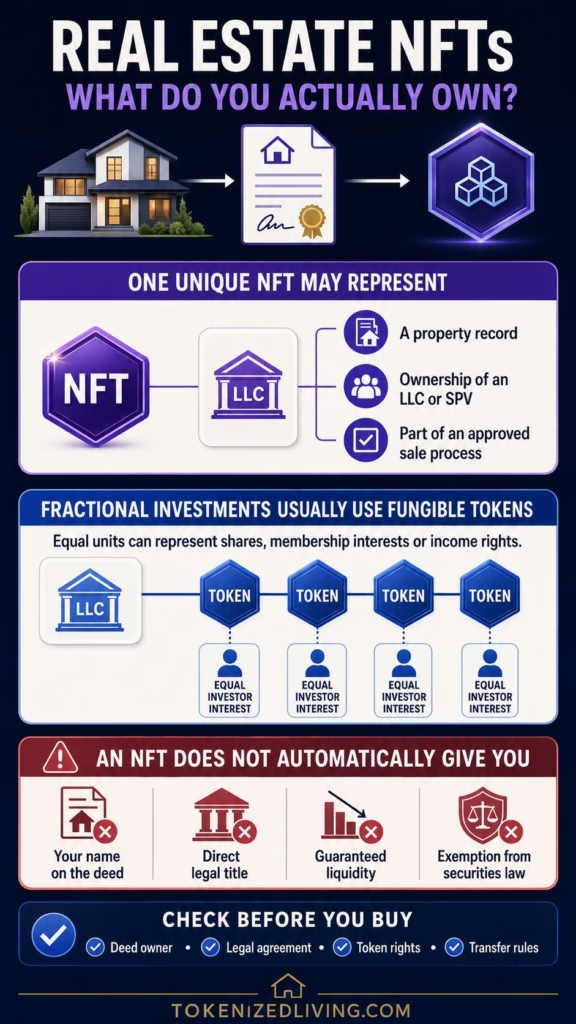
Most fractional real estate investments are not divided into hundreds of separate NFTs. Instead, platforms usually use fungible tokens to represent equal shares or economic interests. NFTs are better suited to unique assets, while investment fractions normally need to be interchangeable.
So, what can an NFT in real estate actually represent?
For a broader explanation of property tokens, legal wrappers and investor rights, read our complete guide to tokenized real estate.
TL;DR
- An NFT is a unique blockchain token.
- A property-linked NFT does not automatically equal a legal property deed.
- Some structures connect one NFT to ownership of an LLC that holds a property.
- Fractional property investments usually use fungible tokens, shares or membership interests.
- The legal documents determine the holder’s rights. The token label does not.
- Blockchain records can improve transfers and record-keeping, but they do not remove legal, property, custody or liquidity risks.
What Is an NFT in Real Estate?
An NFT, or non-fungible token, is a digital token with a unique identifier.
Unlike a fungible token, one NFT is not intended to be interchangeable with every other NFT. Each token can have different metadata, rights, history or value.
Ethereum’s explanation of NFTs describes them as individually unique tokens. That makes an NFT a logical tool for identifying one specific property, legal entity, title record or contract.
However, the NFT only proves ownership of the token itself.
The real question is what enforceable rights are attached to it.
Those rights may include:
- Ownership or control of a property-holding company
- A contractual claim linked to a property
- Access to documents or services
- A digital certificate or transaction record
- Rights recognized only by a private platform
- No legal claim to the underlying property at all
Therefore, investors should never judge a property token by its artwork, name or blockchain record alone.
NFTs Versus Fungible Real Estate Tokens
The word “non-fungible” matters.
Imagine one house held by a single company. That house is unique, and the company holding it is also a specific legal entity. One NFT could be used as the digital identifier for that structure.
Now imagine 1,000 investors buying equal interests in the same company.
If every interest carries the same income and voting rights, those interests should usually be interchangeable. Fungible tokens are better suited to that job.
RealT provides a useful example. Its published white paper describes property-owning series as being represented by ERC-20 tokens carrying equity ownership interests. ERC-20 tokens are fungible, not NFTs.
It is technically possible to issue NFTs for individual fractions. Nevertheless, uniqueness adds little value when every fraction is supposed to carry identical rights. It may also make pricing and trading more complicated.
For a broader explanation, read our guide to fractional ownership.
| Structure | Common digital format | What the holder may own | Main dependency |
|---|---|---|---|
| Property reference or certificate | NFT | A unique digital record, but not necessarily property rights | Registry recognition and legal documents |
| Whole-property entity model | NFT | Ownership or control of an LLC or SPV that holds the deed | Company agreement and valid transfer process |
| Fractional real estate investment | Fungible token | Shares, membership interests, debt or contractual economic rights | Offering documents and securities compliance |
| Virtual land | NFT | Platform-defined rights over a digital plot | The platform, its rules and continued operation |
What Can a Real Estate NFT Represent?
There is no single real estate NFT model. In practice, the token can sit at several different levels.
1. A Digital Reference to a Property
An NFT can contain or point to information about a property.
For example, its metadata might reference an address, valuation, inspection report, deed copy or transaction history.
That may help organize and verify records. However, a reference is not the same as ownership.
Propy makes this distinction in its 2025 white paper. Its basic “Address NFT” identifies a property address but, according to the document, does not give the holder legal ownership or a claim over the property. Its full real-world asset model requires an additional legal wrapper.
This is a critical distinction because anyone can create a token that points to an address. Minting the token does not prove that the creator owns the building.
2. Ownership of a Property-Holding Company
A stronger model places the property inside an LLC or special-purpose vehicle.
The legal entity remains the registered owner of the real estate. Meanwhile, an NFT becomes associated with ownership or control of that entity.
When a buyer acquires the NFT through the approved process, the connected company interest transfers as well. The buyer then controls the company that owns the property.
This is indirect ownership. The buyer is not replacing a county deed with a JPEG or blockchain entry. Instead, the buyer is acquiring the legal entity that remains named on the deed.
The operating agreement, transfer documents, identity checks and local company law make the arrangement enforceable. Without those links, the NFT is only a token.
3. A Transaction and Settlement Tool
An NFT can also act as part of a property sale process.
A smart contract may handle bidding, payment, transfer conditions and settlement. As a result, some administrative steps can happen faster.
However, the transaction may still require:
- Identity and sanctions checks
- Legal due diligence
- Proof of authority to sell
- Title searches and insurance
- Tax reporting
- Lender approval
- Updates to company records
- Compliance with local ownership rules
Tax treatment may also depend on whether the buyer acquires the property itself, an LLC interest or an investment token. Our guide to tokenized real estate taxes explains the main income, capital-gains and reporting questions.
Smart contracts can automate instructions. They cannot inspect a roof, discover an undisclosed lien or decide whether a legal document is valid.
4. A Fractional Investment Claim
An NFT could represent a unique investment position. Yet most fractional real estate structures use fungible tokens because each investor receives the same class of rights.
Those rights might include a share of rental income, part of any sale proceeds, limited voting rights or an equity interest in an LLC.
In the United States, the regulatory treatment depends on the economic reality of the arrangement. In a November 2025 speech, SEC Chairman Paul Atkins said that calling an instrument a token or NFT does not exempt it from securities law when it represents an investment claim based on the efforts of others.
Therefore, a property investment does not escape regulation because its issuer uses an NFT standard.
Watch: How NFTs Can Be Used in Real Estate
This video provides a visual introduction to property-linked NFTs and blockchain ownership.
Can an NFT Replace a Property Deed?
Usually, no.
Property ownership depends on the law and land-registration system in the relevant jurisdiction. A blockchain record does not overrule a government registry simply because it is public and difficult to alter.
An NFT could become part of an official title system if the relevant authority recognizes it. Until then, it generally works as an additional digital record or as a link to another legal structure.
This creates an important split:
- On-chain ownership shows who controls the token.
- Legal ownership shows who holds enforceable rights under property and company law.
The two can be connected. They are not automatically the same.
This point also applies to blockchain data more broadly. A blockchain can preserve a record after someone submits it. However, it cannot guarantee that the original information was accurate.
How a Whole-Property NFT Structure Can Work
A simplified transaction may follow these steps:
- The owner transfers the property into a dedicated LLC.
- The LLC becomes the name shown on the property deed.
- Legal documents connect ownership of the LLC to a specific NFT.
- A potential buyer completes identity and compliance checks.
- The buyer reviews the property, title, company and transaction documents.
- The NFT transfers through an approved smart contract.
- The connected LLC ownership or control transfers to the buyer.
- The LLC continues to hold the property.
This approach may reduce the need to record a new property deed every time the LLC changes hands. Even so, company filings, tax obligations, lender restrictions, local disclosure rules and beneficial-ownership reporting may still apply.
The structure must also prevent an accidental wallet transfer from creating a legal disaster. A serious system needs recovery procedures, transfer restrictions and clear rules for hacked or lost wallets.
Case Study: Roofstock onChain and RealT
The 2023 Roofstock onChain transaction with RealT shows how the two token models can work together.
Roofstock announced that a Georgia rental home had been sold to RealT through an NFT transaction on OpenSea. However, the NFT did not directly replace the property deed.
After buying the property-holding structure, RealT planned to fractionalize the investment for its users.
The transaction therefore had two distinct layers:
- One NFT represented the unique property-holding LLC.
- Fungible tokens could represent multiple investor interests in the fractionalized structure.
That difference is the central point.
An NFT can suit the sale of one unique entity or asset. Fungible tokens usually make more sense for equal investment fractions.
You can read more about the platform and its legal and property-management risks in our RealT review.
Potential Benefits of NFTs in Real Estate
NFTs may improve parts of the real estate process when the legal structure is sound.
Faster Transfer and Settlement
Smart contracts can coordinate payment and token transfer. Therefore, settlement may take less time than a heavily manual process.
Clearer Digital Transaction History
Blockchain records can show when a token was issued and transferred. This may improve auditability for the digital part of the transaction.
Programmable Rules
Developers can add identity checks, approved-wallet lists, transfer restrictions, payment instructions and governance rules.
Easier Integration With Digital Finance
A properly structured property token might interact with wallets, lending systems or other financial applications. However, technical compatibility does not guarantee that lenders or regulators will accept it.
Automation of Administrative Work
Smart contracts may reduce repeated paperwork and automate some distributions or approvals.
These benefits are real. Still, none of them repairs a weak legal claim.
The Risks Most NFT Marketing Leaves Out
The old NFT narrative focused too heavily on speed, transparency and access. Investors also need to examine the failure points.
Legal-Link Risk
The documents may fail to connect token ownership clearly to the property or company interest.
Title and Property Risk
Liens, unpaid taxes, structural defects, tenant problems, insurance gaps and falling property values remain off-chain risks.
Wallet and Custody Risk
A stolen private key could give an attacker control of the NFT. Recovery may be difficult unless the legal framework includes a dispute process.
Smart-Contract Risk
Coding errors, weak access controls or compromised administrators can affect transfers and ownership records.
Marketplace Risk
Listing a property NFT on a marketplace does not guarantee a buyer. Real estate remains illiquid, even when the transfer layer is digital.
Ownership structures, fees and exit options also vary sharply between providers. Our tokenized real estate platform comparison examines what investors actually receive from different platforms.
Regulatory Risk
Fractional interests may fall under securities rules. Cross-border sales can also trigger investor-eligibility, tax, sanctions and reporting requirements.
Privacy Risk
Property and ownership data can be sensitive. A permanent public record may create privacy and security concerns if a project exposes too much information.
For a wider risk assessment, see our guide to the benefits and risks of tokenized real estate.

Questions to Ask Before Buying a Property-Linked NFT
Ignore the token artwork and start with the legal documents.
Ask:
- Who is named on the property deed?
- What exactly does the NFT represent?
- Does the holder own the property directly or an entity interest?
- Which agreement connects the NFT to that legal interest?
- Is the interest a security?
- Who verifies buyer identity and eligibility?
- What happens if the wallet is hacked or access is lost?
- Can an unauthorized blockchain transfer be reversed legally?
- Are there liens, loans, taxes or transfer restrictions?
- Who manages the property and pays expenses?
- Is there title insurance?
- Where can the token be sold, and are there real buyers?
- What happens if the platform closes?
If the issuer cannot answer those questions clearly, walk away.
Physical Property NFTs Versus Virtual Real Estate NFTs
Physical and virtual real estate should not be treated as the same asset class.
A physical-property NFT must connect to laws, deeds, companies, contracts and government registries.
By contrast, a virtual-land NFT represents rights created by a digital platform. Its value and use depend on that platform’s code, rules, users and survival.
Neither model is automatically safe. However, the sources of risk are different.
We examine the digital-land model separately in our guide to virtual real estate NFTs.
The Likely Future Role of NFTs in Real Estate
NFTs are unlikely to become the standard format for every fractional property investment.
Their more credible role is narrower:
- Identifying a unique property or property-holding entity
- Connecting verified documents to a digital record
- Supporting whole-asset transactions
- Automating approved transfers
- Linking property data to digital financial systems
Meanwhile, fungible tokens are better suited to funds, debt products, fractional shares and equal investment interests.
The market does not need to force every real estate use case into an NFT. It needs to choose the token structure that matches the underlying rights.
Final Thoughts
NFTs can play a useful role in real estate. Nevertheless, the token is only one layer of the transaction.
The blockchain records who controls the NFT. The legal documents explain what that control means. Property law decides whether those rights can be enforced.
That is why the phrase “owning real estate through an NFT” can be misleading.
Sometimes, the holder controls an LLC that owns a property. In other cases, the token only points to a record or contract. Fractional investors may own fungible interests in the company rather than NFTs.
Therefore, the most important question is not, “Is this property an NFT?”
It is, “What do I legally own, and what happens if something goes wrong?”
Frequently Asked Questions
Does owning a real estate NFT mean I legally own the property?
Not automatically. The NFT proves control of a blockchain token. Legal ownership depends on the deed, company agreement, contract, and applicable property law associated with that token.
Can an NFT replace a property deed?
Usually not. An NFT can support a transaction or record, but it only replaces a deed when the relevant land registry and legal system officially recognize that structure.
Are fractional real estate tokens NFTs?
Most are not. Equal property fractions are normally represented by fungible tokens, shares or membership interests because each unit carries the same rights.
How can one NFT represent an entire property?
The property can be placed inside an LLC or SPV. One NFT may then be connected to ownership or control of that legal entity, while the entity remains named on the property deed.
What is the biggest risk with property-linked NFTs?
The biggest risk is a weak or unclear connection between the NFT and the legal interest it supposedly represents. If that connection fails, owning the token may provide little or no enforceable claim over the property.