

Updated: August 27, 2026
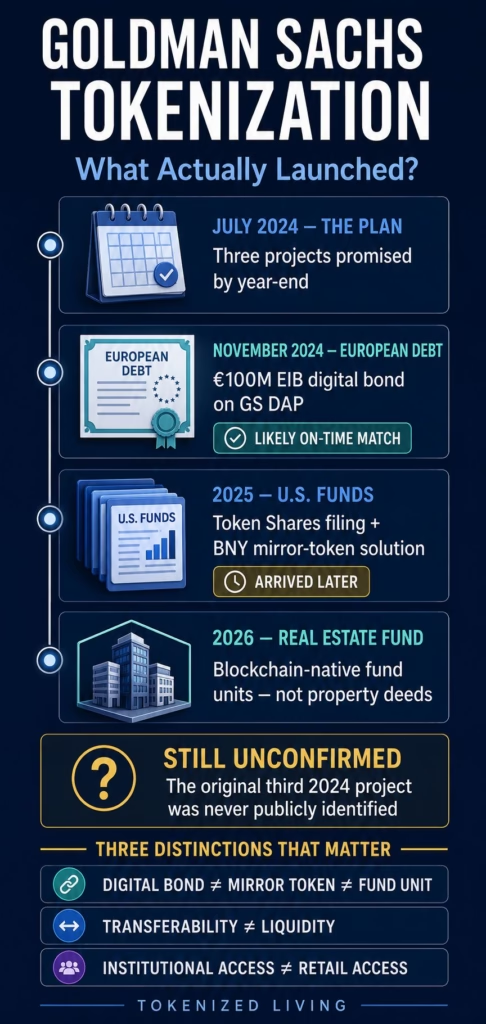
In July 2024, Goldman Sachs said it planned three tokenization projects before year-end. One would target the U.S. fund sector. Another would involve European debt. The bank did not identify the third.
That announcement deserved a follow-up. Did all three projects launch, and what did investors actually receive?
The public record gives a mixed answer. A €100 million European Investment Bank digital bond provides a strong match for the European project. U.S. fund tokenization became more concrete in 2025. However, no official source reviewed for this update identifies all three projects by name.
Goldman has still made real progress. Its GS DAP platform has supported digital bonds, token records for money market funds and blockchain-native real estate fund units. Yet those structures are not interchangeable.
A mirror token is not the same as a native digital security. A tokenized fund unit is not a property deed. In addition, technical transferability does not guarantee market liquidity.
This article separates the launches from the marketing language.
Information note: This article is educational and does not provide investment, legal or tax advice. Product access, legal rights and regulatory treatment depend on the structure and jurisdiction.
TL;DR
- Goldman Sachs said in July 2024 that it expected three tokenization projects before the end of that year.
- A November 2024 EIB digital bond on GS DAP closely matches the announced European debt project.
- The clearest U.S. fund evidence arrived in 2025, after the original deadline.
- Goldman registered a Token Shares class for a Treasury money market fund in March 2025.
- BNY and Goldman then launched a separate mirrored-token solution for selected money market funds in July 2025.
- A blockchain-native real estate fund followed in 2026, but it tokenized fund units rather than property deeds.
- Goldman never publicly identified the original third project in the sources reviewed here.
- GS DAP remains institutional infrastructure. Goldman’s current website says the platform is owned and operated by the bank.
- None of these launches proves broad retail access or deep secondary-market liquidity.
What Goldman Sachs Announced in 2024
On July 10, 2024, Fortune reported that Goldman Sachs planned three tokenization projects with major clients. The bank expected them before the end of 2024. It also expected one to become its first U.S. tokenization project.
Goldman’s global head of digital assets, Mathew McDermott, provided only two specific clues. One project concerned the U.S. fund complex. Another involved debt issuance in Europe. He declined to identify the third.
The bank’s strategy differed from many public-blockchain products. Goldman focused on institutions and permissioned networks. These networks restrict participation and can provide privacy controls for regulated firms.
That context matters. The announcement was not a plan to launch three retail crypto tokens. It described institutional capital-markets projects using distributed-ledger infrastructure.
Did the Three Tokenization Projects Launch?
The evidence supports one probable on-time delivery, one later U.S. development and one unresolved project.
| 2024 plan | Later public evidence | Assessment |
|---|---|---|
| European debt issuance | EIB issued a €100 million five-year digital bond through GS DAP in November 2024 | Strong match and likely delivered on time, although the sources do not explicitly label it as one of the three |
| U.S. fund complex | Goldman filed for a Token Shares class in March 2025; BNY and Goldman launched a broader mirrored-token solution in July 2025 | Real progress, but the clearest public evidence arrived after the 2024 deadline |
| Third undisclosed project | Goldman later announced a GS DAP spin-out plan and supported a 2026 tokenized real estate fund | No official source reviewed here identifies either development as the original third project |
Therefore, saying that Goldman completed all three projects would overstate the evidence. Saying that nothing launched would also be wrong.
The European debt project has a persuasive match. Meanwhile, U.S. fund tokenization arrived later in documented form. The third project remains unconfirmed.
What Is GS DAP?
GS DAP is Goldman Sachs’ Digital Asset Platform. It supports the issuance, recording, settlement and lifecycle management of digital assets.
The platform uses permissioning and privacy controls. Consequently, approved institutions can transact without exposing every detail to the public. Smart contracts can also automate parts of an asset’s lifecycle.
Goldman describes GS DAP as shared infrastructure for real-time transaction certification. Its current developer page also states that the platform is owned and operated by Goldman Sachs.
That last point is important. In November 2024, Goldman announced an intention to explore a spin-out of GS DAP. The bank wanted the platform to become an independent, industry-owned solution. However, the proposal remained subject to regulatory approvals.
As of this August 2026 update, Goldman’s official page still describes GS DAP as owned and operated by the bank. Therefore, the public evidence reviewed here does not show a completed spin-out.
For a plain-English explanation of the wider concept, read our guide to what tokenization means.
Project Evidence One: European Digital Debt
The strongest match to Goldman’s 2024 announcement appeared on November 22, 2024.
The European Investment Bank issued a €100 million fixed-rate digital bond due in November 2029. The five-year bond carried a 2.545% annual coupon. It was issued and recorded through GS DAP on private blockchain infrastructure.
Goldman Sachs Bank Europe, DZ Bank and LBBW acted as joint lead managers. Meanwhile, the cash side used DL3S, a permissioned blockchain platform operated by Banque de France. The transaction formed part of the Eurosystem’s exploratory work on wholesale settlement in central-bank money.
This was the EIB’s sixth digital bond overall. More importantly, it arrived during the stated 2024 window and matched the European debt description.
Goldman had already established relevant experience. In 2022, the EIB issued its €100 million Project Venus bond through GS DAP. That transaction used an experimental representation of central-bank money and achieved same-day settlement.
Therefore, the 2024 issuance was not Goldman’s first digital bond. It showed repeat use of the same institutional platform.
Still, one successful issuance does not prove an active secondary market. Issuance value measures the bond created, not the amount later traded. Our overview of the European tokenization market explains why those measures should remain separate.
Project Evidence Two: U.S. Money Market Funds
The U.S. fund project took longer to become visible.
Goldman’s Token Shares filing
On March 4, 2025, Goldman Sachs Trust filed to register Token Shares of the Goldman Sachs Financial Square Treasury Instruments Fund.
The SEC prospectus makes the structure unusually clear. The fund itself did not employ blockchain technology. Instead, participating intermediaries expected to use blockchain to maintain a record or mirror record of customer ownership.
The filing also imposed a general $10 million initial minimum on intermediaries. It did not impose that minimum separately on every underlying client. Purchases and redemptions continued through authorized intermediaries and the fund’s established transfer-agent process.
This was not a retail crypto coin. It was a regulated fund share class designed to work with blockchain-based records.
Later filings show the Token Shares class under ticker GDTXX. That provides stronger evidence than an announcement alone. Nevertheless, the first registration filing arrived in 2025, not before the original 2024 deadline.
BNY and Goldman’s mirrored-token solution
On July 23, 2025, BNY and Goldman announced a broader money market fund solution. It connected BNY’s LiquidityDirect and Digital Assets platforms with GS DAP.
BlackRock, BNY Investments Dreyfus, Federated Hermes, Fidelity Investments and Goldman Sachs Asset Management joined the initial launch.
However, the blockchain tokens were mirror records. BNY continued to maintain the official books, records and settlements for the funds. GS DAP created tokens corresponding to the value of selected fund shares.
That distinction changes the claim.
The solution provided an additional programmable ownership record. It did not replace the fund register with a freely tradable public token. Goldman described collateral utility and smoother transferability as future opportunities.
Therefore, the launch proved institutional coordination and working infrastructure. It did not prove open trading, instant collateral use everywhere or retail availability.
For more background on funds, bonds and other off-chain claims, see our beginner’s guide to RWA tokenization.

Project Evidence Three: A 2026 Tokenized Real Estate Fund
In June 2026, Apex Group announced a blockchain-native real estate fund developed with Archax, Goldman Sachs, LRC Group and Ownera.
The structure used GS DAP to issue blockchain-native fund units. LRC managed the strategy. Archax served as custodian for the regulated digital securities and as the first distribution partner. Apex supplied fund administration and regulated fund services. Ownera provided connectivity between participants and distribution channels.
This represented a meaningful expansion beyond bonds and mirror records. Even so, investors received units in a fund structure. They did not receive property deeds recorded on GS DAP.
The announcement also described transferability as a future possibility. It did not disclose the fund’s size, named investors or secondary-market trading volume.
As a result, the launch proves that regulated service providers can support blockchain-native real estate fund units. It does not prove fractional retail property ownership or reliable exit liquidity.
Our detailed review of institutional tokenized real estate adoption examines this fund and comparable projects.
Could this have evolved from the unnamed third project announced in 2024? Possibly. Yet no public source reviewed here makes that connection. A two-year-later launch should not be retroactively counted without evidence.
Mirror Tokens, Native Securities and Fund Units Are Different
Goldman’s projects illustrate why “tokenized asset” can be too broad.
| Structure | What the blockchain records | Where the decisive legal record sits |
| BNY money market fund mirror token | A digital representation corresponding to existing fund shares | BNY’s official books and records remain authoritative |
| EIB digital bond | The issued and recorded digital debt instrument | The bond’s governing law, issuance records and regulated infrastructure define the legal rights |
| Tokenized real estate fund unit | A blockchain-native unit in a regulated fund | The fund documents and regulated service-provider structure define investor rights |
None of these forms is automatically better. Each solves a different operational problem.
Mirror records can connect conventional funds with new collateral and transfer systems. Native digital securities can reduce duplicated records. Tokenized fund units can support more programmable administration and distribution.
However, investors must identify the controlling legal record. A wallet balance alone may not establish every enforceable right.
Why Goldman Uses Permissioned Infrastructure
Public blockchains allow anyone to inspect transactions and, where rules permit, connect applications. Permissioned systems restrict access to approved participants.
Institutions often need the second model. They must protect client data, enforce eligibility rules and meet financial-crime requirements. They also need clear responsibility for platform changes and operational failures.
GS DAP includes custom participant permissioning and data-privacy controls. Those features fit wholesale bond, fund and collateral workflows.
The trade-off is limited public visibility. Outside observers may struggle to measure balances, transfers and trading activity. Participation also depends on Goldman, connected intermediaries and applicable regulation.
Therefore, GS DAP should not be assessed like Ethereum or another open network. Its goal is regulated institutional coordination, not unrestricted access.
What Goldman Sachs Tokenization Proves
The evidence supports several conclusions.
First, GS DAP has moved beyond a presentation or isolated test. Major institutions have used it for completed digital bond transactions.
Second, tokenization can connect several regulated parties. The EIB transaction brought together an issuer, banks and central-bank settlement infrastructure. The money market fund solution connected fund managers, BNY and Goldman.
Third, institutions want better collateral and transfer workflows. Money market fund shares are attractive because they already serve treasury and liquidity-management needs.
Finally, the technology can support different legal structures. GS DAP has handled native bonds, mirrored fund records and native fund units.
That range matters more than a speculative market-size forecast.
What the Projects Do Not Prove
The same evidence also sets clear limits.
They do not prove retail access
Goldman designed GS DAP for institutional and professional participants. The bank’s developer page explicitly says its material is not for retail distribution.
They do not make every token the legal ownership record
BNY kept the official books for its money market fund solution. The corresponding GS DAP tokens were mirror records.
They do not turn fund units into property deeds
The 2026 real estate launch tokenized interests in a fund. The underlying buildings and legal titles remained inside the fund structure.
They do not guarantee liquidity
Fast settlement and technical transferability help only after eligible buyers and sellers meet. A token can remain illiquid even when the software can transfer it instantly.
Our guide to tokenized asset secondary markets explains the difference between transferability and real trading depth.
They do not prove lower total costs
Tokenization can automate records and settlement. However, regulated products still need asset managers, custodians, administrators, legal counsel and compliance controls. Savings depend on the complete operating model.
A Practical Checklist for Evaluating Institutional Tokenization
Before treating an institutional announcement as adoption, ask:
- Did a live asset launch? Separate a completed issuance from a pilot, filing or plan.
- What does the token represent? It could be a bond, fund unit, mirror record or contractual claim.
- Which record is legally authoritative? Check the issuer, transfer agent, custodian and governing documents.
- Who can participate? Institutional access does not imply retail availability.
- Can the token transfer today? Future transferability is not a current feature.
- Is there actual trading volume? A transferable token can still lack buyers.
- Which parties remain involved? Tokenization rarely removes every intermediary.
- What evidence is public? Look for filings, completed transactions and named regulated partners.
This checklist also protects against a common reporting error: converting a company’s intention into a finished product.
Final Verdict
Goldman Sachs made genuine progress in institutional tokenization, but the original three-project claim needs qualification.
The November 2024 EIB bond strongly fits the European debt project and met the stated timeline. The U.S. fund strategy later produced concrete filings and a live BNY collaboration, but those milestones arrived in 2025. Meanwhile, the original third project remains unidentified in public sources reviewed through August 27, 2026.
GS DAP now has credible use across bonds, money market fund records and real estate fund units. That is a stronger story than the old headline because it rests on completed transactions and formal documents.
Still, the evidence does not support claims of broad retail access, automatic liquidity or direct ownership of underlying property. Goldman is building regulated market infrastructure. It is not placing Wall Street assets into an open crypto marketplace.
That distinction is less exciting than the hype. It is also more accurate.
Frequently Asked Questions
What is Goldman Sachs tokenization?
Goldman Sachs tokenization uses distributed-ledger technology to issue, record or manage financial assets. Its GS DAP platform has supported digital bonds, money market fund records and blockchain-native fund units.
Did Goldman Sachs launch all three tokenization projects in 2024?
Public evidence does not confirm all three. A November 2024 EIB digital bond strongly matches the European debt project. The clearest U.S. fund developments appeared in 2025. The third project remains unidentified.
What is GS DAP?
GS DAP is the Goldman Sachs Digital Asset Platform. It provides permissioned infrastructure for issuing and managing digital assets across their lifecycle. Goldman’s current website says the bank owns and operates it.
Did Goldman Sachs spin out GS DAP?
Goldman announced an intention to explore a spin-out in November 2024, subject to approvals. As of August 27, 2026, its official developer page still describes GS DAP as owned and operated by Goldman Sachs.
Are BNY’s tokenized money market funds native blockchain funds?
The July 2025 solution uses mirror tokens on GS DAP. BNY continues to maintain the official books, records and settlements for the selected funds.
Does Goldman’s tokenized real estate fund give investors property deeds?
No. The 2026 project issued blockchain-native fund units. Those units represent interests in the fund structure, not direct title to individual buildings.
Can retail investors use GS DAP?
GS DAP targets institutional and professional use. Access depends on the product, intermediary, jurisdiction and investor eligibility rules.
Does tokenization guarantee liquidity?
No. Tokenization can improve transfer and settlement mechanics. Liquidity still requires eligible buyers, sellers, market infrastructure and sufficient demand.