

August 19, 2026
Europe’s tokenization market is growing, but not in the way earlier headlines suggested. The strongest progress is appearing in digital bonds, tokenized funds, regulated trading venues and settlement infrastructure. Mass-market adoption, meanwhile, remains limited.
That distinction matters. Forecasts often combine stablecoins, cryptocurrencies, tokenized securities and fractional property into one large number. They may also treat the value of assets issued as if it were active trading volume. The result can sound impressive while revealing little about real usage.
In March 2026, the European Securities and Markets Authority said that tokenization adoption remained low but had gained momentum, including through tokenized money market funds. That measured assessment offers a better starting point than another speculative market-size forecast.
Europe has also moved beyond experiments. Regulated market infrastructures now operate under the European Union’s DLT Pilot Regime. Digital bonds have settled in central bank money. Switzerland has licensed blockchain-based trading infrastructure, while the United Kingdom has opened a live regulatory sandbox for digital securities.
Still, Europe is not one legal market. The EU, the UK and Switzerland follow separate rulebooks. Even within the EU, national company, insolvency and property laws can shape what a token actually represents.
TL;DR
- Europe is building regulated infrastructure for tokenized securities, funds and money rather than one unified “token market.”
- MiCA mainly covers crypto-assets that other EU financial laws do not already regulate. It is not the primary framework for tokenized shares or bonds.
- Tokenized financial instruments generally remain subject to existing securities law, including MiFID II, MiFIR, the Prospectus Regulation and other sector-specific rules.
- The EU DLT Pilot Regime allows certain market infrastructures to test blockchain-based trading and settlement under temporary exemptions.
- ESMA’s January 2026 list contained six authorised DLT market infrastructures across the Czech Republic, Germany, Lithuania, France and Spain.
- The European Central Bank plans to introduce Pontes from September 2026, connecting eligible DLT platforms with TARGET Services for settlement in central bank money.
- Siemens, the European Investment Bank and other issuers have already completed substantial digital bond transactions.
- Switzerland and the UK are advancing under separate regimes, so “Europe” should not be used as a synonym for “the EU.”
- Adoption remains uneven. Liquidity, interoperability, custody, legal fragmentation and access still limit scale.
What Does the European Tokenization Market Include?
Tokenization converts rights or claims into digital tokens recorded on a distributed ledger. However, that broad definition covers several very different products.
Tokenized financial instruments
These include digital shares, bonds, fund units and money market instruments that qualify as financial instruments. Their legal rights resemble those of conventional securities, even when a blockchain records issuance or ownership.
For readers new to the concept, our guide to what tokenization is explains the basic process and its most common applications.
Stablecoins and tokenized money
Stablecoins aim to maintain a stable value against a currency or another reference asset. Tokenized commercial bank deposits represent a different claim: a liability of the issuing bank. Central bank money used on a DLT platform forms another distinct category.
These instruments can provide the cash side of a transaction. Without a reliable cash leg, a tokenized security may still need to settle through traditional payment rails.
Tokenized real-world assets
Real-world asset tokenization can cover property, private credit, commodities and infrastructure. In practice, the token often represents a share in a company, a debt claim or a fund interest rather than direct legal title to the physical asset.
Our beginner’s guide to RWA tokenization explores those structures in more detail.
Native digital assets
Some securities are issued directly on a distributed ledger instead of being converted from an existing off-chain asset. Digital bonds issued under Germany’s Electronic Securities Act provide a practical example.
These categories should not be combined carelessly. Each has different rights, risks, regulators and measures of adoption.
Why Market-Size Forecasts Can Mislead
There is no single, authoritative figure for the European tokenization market. Several measurement problems prevent a clean total.
First, reports use inconsistent definitions. One study may count stablecoins, while another may include only tokenized securities. A third may add cryptocurrency activity that has little connection to tokenized real-world assets.
Second, issuance value is not the same as assets under management. Neither figure equals secondary-market turnover or investor demand. A bond can be issued successfully but trade rarely afterwards.
Third, private and permissioned networks do not always publish complete activity data. Transactions may also move between pilot environments, production systems and conventional ledgers.
Finally, forecasts depend heavily on assumptions about regulation, interoperability and investor access. A high compound annual growth rate can arise from a very small base.
Therefore, infrastructure, completed transactions, regulated participants and repeat usage provide more useful evidence than a single headline number.
Europe Is Not One Regulatory Jurisdiction
Discussions of European tokenization often blur three separate markets:
- The European Union applies EU financial legislation, MiCA and the DLT Pilot Regime, alongside national laws.
- The United Kingdom operates its own Digital Securities Sandbox and financial services framework.
- Switzerland regulates DLT trading facilities and ledger-based securities under Swiss law.
That separation affects licensing, investor access, custody, settlement and asset recognition. A platform authorised in one jurisdiction does not automatically gain permission to operate across the others.
Even the EU does not remove every national difference. Property registration, corporate law, insolvency treatment and some tax rules remain country-specific. Consequently, cross-border tokenization still requires legal analysis beyond the blockchain layer.
Does MiCA Regulate Tokenized Securities?
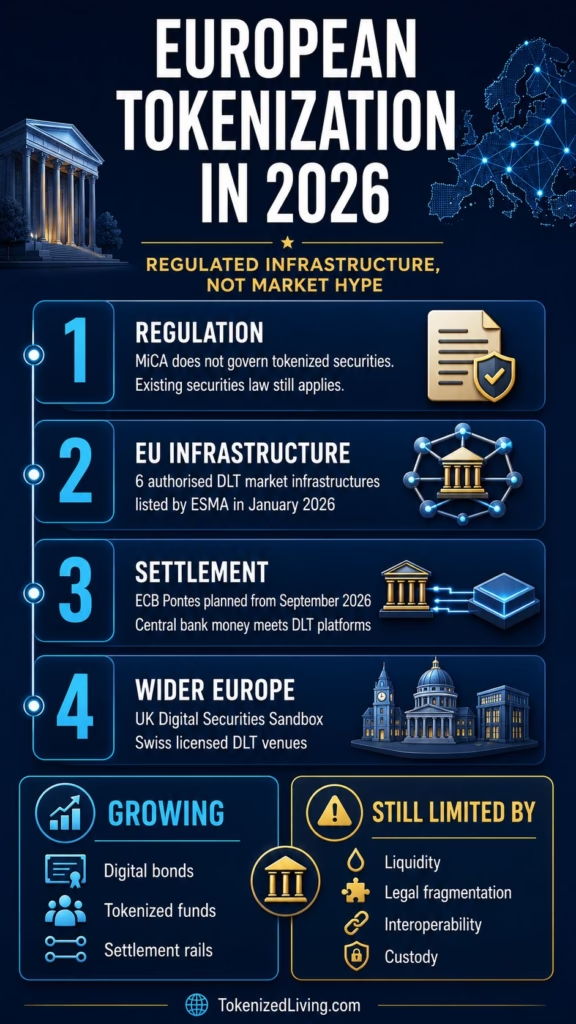
Not usually. The EU’s Markets in Crypto-Assets Regulation covers crypto-assets and related services that other EU financial legislation does not already regulate. The European Commission’s MiCA overview makes that scope clear.
If a token qualifies as a financial instrument, existing securities laws generally apply instead. The Commission’s 2026 MiCA review consultation specifically distinguishes MiCA crypto-assets from tokenized financial instruments governed by sectoral legislation.
The main EU frameworks can be summarised as follows:
| Framework | Main relevance to tokenization |
|---|---|
| MiCA | Crypto-assets and service providers not already covered by other EU financial law, including rules for asset-referenced and e-money tokens |
| MiFID II and MiFIR | Classification, trading and investment services involving tokenized financial instruments |
| Prospectus Regulation | Public offers and admission to trading where a prospectus is required |
| CSDR and settlement rules | Securities settlement and central securities depository activities |
| DLT Pilot Regime | Temporary framework for eligible DLT-based trading and settlement infrastructures |
| National company and property law | Legal ownership, issuer structures, shareholder records and real-estate interests |
| AML and operational-resilience rules | Customer checks, financial crime controls, cybersecurity and technology risk |
MiCA still matters. Stablecoins may provide a settlement asset, and crypto-asset service providers can form part of the wider ecosystem. However, describing MiCA as the main law for tokenized bonds, shares or fund units oversimplifies the legal position.
The EU DLT Pilot Regime Moves Into Production
The DLT Pilot Regime has applied since March 23, 2023. It allows authorised operators to test DLT-based market infrastructure while requesting limited exemptions from rules that were designed for conventional systems.
The regime supports three types of infrastructure:
- A DLT multilateral trading facility for trading.
- A DLT settlement system for settlement.
- A combined DLT trading and settlement system.
Eligible instruments remain subject to value thresholds. For example, shares generally need a market capitalisation below €500 million. Bonds and other securitised debt generally face an issuance-size limit of €1 billion, while eligible fund units have a €500 million assets-under-management threshold.
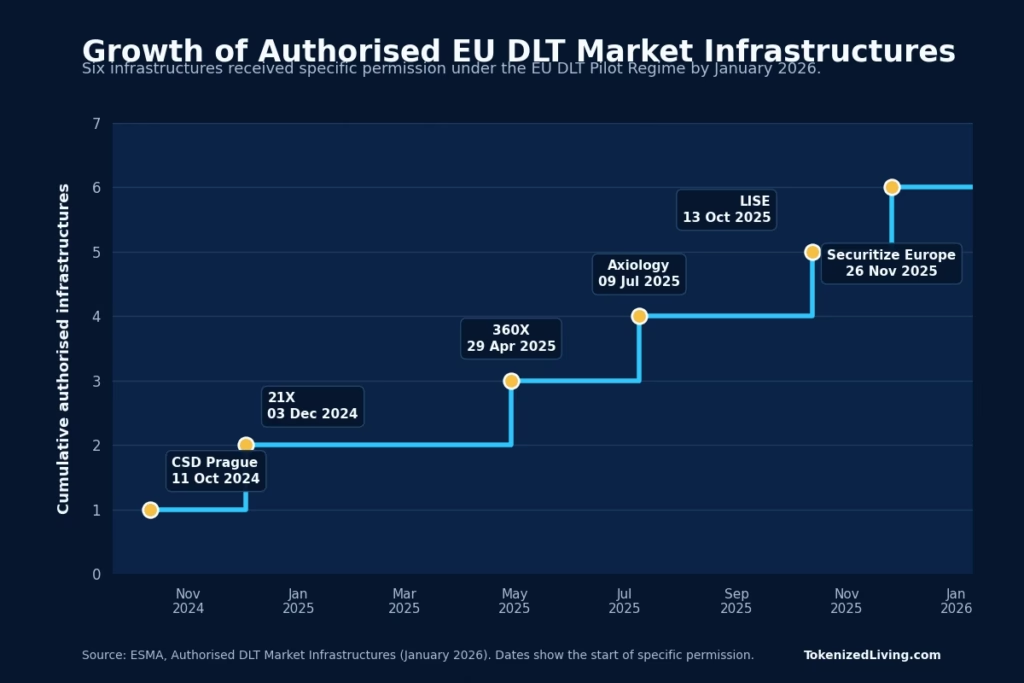
As of January 2026, ESMA’s official list contained six authorised infrastructures:
| Operator | Country | Infrastructure | Start date shown by ESMA |
| CSD Prague | Czech Republic | DLT settlement system | October 11, 2024 |
| 21X AG | Germany | DLT trading and settlement system | December 3, 2024 |
| 360X AG | Germany | DLT multilateral trading facility | April 29, 2025 |
| Axiology | Lithuania | DLT trading and settlement system | July 9, 2025 |
| LISE | France | DLT trading and settlement system | October 13, 2025 |
| Securitize Europe | Spain | DLT trading and settlement system | November 26, 2025 |
The increase from three authorised infrastructures in May 2025 to six by January 2026 shows progress. Nevertheless, authorisation alone does not prove deep liquidity or broad investor participation.
In its 2025 review of the regime, ESMA described uptake as limited. The next test is whether these venues attract repeat issuance, active trading and connected cash settlement.
Pontes Could Solve Part of the Cash-Leg Problem
Tokenized securities need a dependable settlement asset. Otherwise, participants may exchange the security on-chain while moving cash through a separate system. That division creates operational complexity and settlement risk.
The European Central Bank’s Pontes initiative aims to connect eligible market DLT platforms with TARGET Services. Under the planned model, transactions can settle in central bank money while the security remains on an external DLT platform.
Pontes uses two approaches. One uses cash tokens backed by funds held in TARGET2. The other connects directly to the T2 real-time gross settlement system. Both are designed to support delivery-versus-payment, where the cash and security legs complete together.
The ECB has said that Pontes is planned to begin from September 2026. Therefore, it was not yet a live production service at this article’s August 2026 update.
Pontes follows the Eurosystem’s 2024 exploratory work, which involved 64 market participants and more than 50 trials and experiments. The longer-term Appia project is intended to develop a more integrated European ecosystem for wholesale central bank money settlement using DLT.
If Pontes works at scale, it could remove one major barrier. It will not, however, solve legal fragmentation, secondary-market liquidity or interoperability by itself.

Real European Tokenization Projects
Europe’s progress is easiest to see through completed transactions and licensed infrastructure.
Germany: Siemens settles a €300 million digital bond
In September 2024, Siemens issued a €300 million digital bond under Germany’s Electronic Securities Act. The one-year bond used the private SWIAT blockchain and settled in central bank money through the Deutsche Bundesbank’s Trigger Solution.
According to Siemens, settlement took minutes. Its earlier €60 million digital bond had taken two days to settle. The comparison demonstrates a practical efficiency gain, although it does not establish broad market liquidity.
European Investment Bank: repeated digital issuance
The European Investment Bank has issued multiple digital bonds across different platforms. In November 2024, it completed a €100 million digital bond as part of the Eurosystem’s exploratory work.
Repeat issuance matters more than a one-off demonstration. It helps intermediaries refine custody, settlement and lifecycle processes. Yet these transactions still involve established institutions and controlled market structures rather than open retail markets.
France: regulated digital money meets market infrastructure
Societe Generale-FORGE issues EUR CoinVertible and USD CoinVertible, which it describes as MiCA-compliant e-money tokens. In November 2025, the company announced a partnership with Deutsche Börse Group to explore their use across settlement, custody and collateral services.
This development shows how regulated stable-value tokens may connect with conventional financial infrastructure. However, partnership announcements should not be confused with completed market-wide deployment.
Switzerland: SDX and BX Digital
Switzerland sits outside the EU but remains an important European centre. SIX says that more than CHF2 billion of securities have been issued through SIX Digital Exchange since the platform launched in late 2021. Some transactions also settled against Swiss National Bank wholesale central bank digital currency during Project Helvetia.
In March 2025, FINMA granted Switzerland’s first licence for a DLT trading facility to BX Digital. The platform targets supervised participants and connects to the Swiss Interbank Clearing system for delivery-versus-payment.
These examples show production infrastructure, but access remains primarily institutional.
United Kingdom: the Digital Securities Sandbox goes live
The UK’s Digital Securities Sandbox lets approved firms test issuance, trading and settlement in a regulated live environment. It can support equities, government and corporate bonds, money market instruments and fund units. Unbacked cryptocurrencies such as Bitcoin fall outside its scope.
In July 2026, the Bank of England’s sandbox dashboard showed HSBC as the first participant to pass the second gate and enter live activity. The authorities had also opened a route for firms to apply to use qualifying stablecoins for settlement.
The UK government’s proposed digital gilt, known as DIGIT, could further test institutional demand and public-sector issuance. Still, the programme’s results should be judged by live volumes, repeat transactions and market participation.
Tokenized Funds May Scale Faster Than Some Other Assets
ESMA specifically highlighted growth in tokenized money market funds when it assessed market conditions entering 2026. These products can combine familiar fund structures with faster transfers, programmable collateral and extended operating hours.
Institutional users may value tokenized fund units as collateral or as a cash-management tool. In contrast, retail demand may depend more on distribution, fees, redemption rights and regulatory access than on the underlying technology.
Global products such as BlackRock’s BUIDL fund have also raised awareness of tokenized treasuries. Our guide to BUIDL and multichain tokenized treasuries explains the broader model.
BlackRock’s European tokenized share classes provide a recent example of how existing money market funds are adding blockchain-based access and transfers.
However, a tokenized fund remains a fund. Investors still need to examine its portfolio, manager, fees, liquidity and redemption process.
What About Tokenized Real Estate?
Property tokenization attracts retail interest because it appears to offer fractional ownership and lower entry costs. European projects must nevertheless navigate securities law, fund rules, company law, property registration and taxation.
In many structures, the investor owns a token linked to an SPV, a debt instrument or a fund unit. The land registry may continue to record the property owner through conventional processes. Therefore, holding a token does not automatically mean holding direct legal title to a building.
Liquidity also requires willing buyers, a compliant trading venue and reliable price discovery. A blockchain can make transfer technically possible without creating a market.
Before investing, review the benefits and risks of tokenized real estate, including valuation, governance, legal claims and platform risk.
Where Tokenization Can Add Value
Europe’s projects suggest several credible benefits:
- Faster settlement: Atomic delivery-versus-payment can reduce the time between trade and final settlement.
- Process automation: Smart contracts can automate interest payments, redemptions, compliance checks and corporate actions.
- Collateral mobility: Tokenized assets may move more quickly between eligible participants and platforms.
- Integrated records: Issuance, ownership and lifecycle events can share one synchronised ledger.
- Smaller denominations: Fractional units may lower minimum investment sizes where regulation and distribution permit.
- Longer operating windows: Some DLT systems can process transfers outside conventional market hours.
These benefits are not automatic. Poorly designed systems may simply add a blockchain layer to existing complexity.
The Barriers Still Holding the Market Back
Limited liquidity
A token can transfer instantly and still be hard to sell. Secondary markets need buyers, market makers, transparent pricing and compatible venues.
Fragmented legal treatment
EU-level regulation does not eliminate national differences in property, insolvency, tax and company law. The UK and Switzerland add separate regimes.
Interoperability gaps
Assets, cash and identity data may sit on different public, private or permissioned networks. Bridges and integrations create their own operational risks.
Custody and key management
Institutional investors need clear controls for private keys, segregation, recovery and liability. Retail users also face phishing and irreversible transaction risks.
Legacy-system integration
Banks, registrars, custodians and central securities depositories cannot replace critical systems overnight. Parallel processes can reduce expected savings during the transition.
Regulatory access restrictions
Many European pilots target professional or supervised participants. Retail investors may not gain direct access, even when the underlying technology supports fractional units.
Unproven economics
Faster settlement can reduce some risks while increasing funding pressure elsewhere. A sound business case must account for technology, compliance, governance and migration costs.
A Due-Diligence Checklist for Investors
Before buying any tokenized asset, ask:
- Who issued the token, and which regulator oversees the issuer?
- What legal right does the token provide: equity, debt, a fund unit, a payment claim or something else?
- Who owns or holds the underlying asset?
- Can the token be redeemed, and under what conditions?
- Where can it trade, and who provides liquidity?
- Who holds the private keys or controls the custody arrangement?
- What happens if the platform, custodian or issuer fails?
- Which country’s law governs the token and the underlying claim?
- Are financial statements, valuations and smart-contract audits available?
- Do transfer restrictions or investor-eligibility rules apply?
Regulatory approval of a platform does not guarantee the value or safety of every asset listed on it.
Outlook for Europe’s Tokenization Market
The next phase will centre on market plumbing rather than headline-grabbing forecasts.
Pontes will provide an important test of central bank money settlement from September 2026. Meanwhile, the DLT Pilot infrastructures need to demonstrate repeat issuance and genuine trading activity. The UK sandbox will reveal how firms perform under live conditions, and Swiss platforms will continue testing institutional demand.
Tokenized funds and bonds appear best positioned for near-term growth because they fit established legal and investment structures. Stablecoins and tokenized deposits may also expand as settlement instruments. Real estate tokenization could develop more slowly because ownership and investor rights depend heavily on national law.
Ultimately, Europe may lead in regulated infrastructure without immediately leading in transaction volume. That is not a failure. Financial-market systems develop through legal certainty, operational resilience and repeat use—not through optimistic forecasts alone.
Final Verdict
Europe’s tokenization market has moved from concept demonstrations toward regulated production. Six EU DLT market infrastructures, repeated digital bond issuance, Switzerland’s licensed platforms and the UK’s live sandbox all support that conclusion.
However, the market is not yet unified, liquid or widely accessible. MiCA does not replace securities law, and tokenization does not remove the need for custody, disclosure, governance or investor protection.
The strongest 2026 story is therefore not that Europe’s market will “surge” to a particular value. It is that Europe is assembling the legal and settlement infrastructure needed for tokenized finance to become ordinary financial infrastructure.
Frequently Asked Questions
Is Europe’s tokenization market growing?
Yes, particularly in digital bonds, tokenized funds and regulated market infrastructure. Nevertheless, ESMA said adoption remained low entering 2026, so growth should not be confused with mass adoption.
Does MiCA regulate tokenized shares and bonds?
Usually not. If a token qualifies as a financial instrument, EU securities legislation generally applies. MiCA mainly covers crypto-assets and services not already governed by other EU financial laws.
What is the EU DLT Pilot Regime?
It is a temporary EU framework that allows authorised market infrastructures to test trading and settlement of eligible tokenized financial instruments using distributed ledger technology. Operators can request limited exemptions from certain conventional market rules.
Can retail investors use Europe’s tokenization platforms?
Access varies. Several projects and infrastructures focus on banks, institutions or professional investors. Retail access depends on the asset, platform, jurisdiction and applicable securities rules.
Does a real-estate token prove ownership of a property?
Not automatically. A token may represent shares in an SPV, a debt claim or a fund interest. Investors must check the legal documents and land-register position to understand what they actually own.
What is Pontes?
Pontes is an ECB initiative designed to connect eligible DLT platforms with TARGET Services so tokenized securities can settle in central bank money. The ECB plans to introduce it from September 2026.
Editorial note: This article replaces the previous version, which relied on broad market forecasts and overstated MiCA’s role in tokenized securities. Figures and regulatory status were checked against official sources available on August 19, 2026.
Disclaimer: This content is for educational and informational purposes only. It does not constitute financial, legal, tax or investment advice. Tokenized assets can involve loss of capital, limited liquidity, technology failures and changing regulation. Conduct independent research and consult qualified professionals before making financial decisions.