
August 19, 2026
Tether first teased a non-custodial tokenization platform in April 2024. At that point, the product did not even have a public name.
The company officially launched Hadron by Tether in November 2024. It described the platform as infrastructure for creating and managing tokenized assets, including stablecoins, bonds, funds, commodities and loyalty points.
Since then, Hadron has added compliance integrations and announced projects involving European stablecoins, tokenized investment products, an African securities exchange and real estate in Saudi Arabia.
However, the platform needs careful explanation.
Hadron is not a retail marketplace where anyone can buy fractional property or tokenized shares. Instead, it is a software service for issuers. Moreover, its non-custodial design applies to token keys. It does not remove the legal entities, custodians and contracts behind real-world assets.
This article explains how Hadron by Tether works, what it can tokenize and what its current projects actually prove.
This article provides general information and does not constitute financial, legal, investment or tax advice.
TL;DR
- Hadron by Tether is software for businesses, financial institutions and governments that want to issue and manage digital tokens.
- The platform can support tokens linked to stablecoins, bonds, funds, commodities, equities, real estate and other assets.
- Hadron is non-custodial because Tether Hadron does not hold an issuer’s private keys. The issuer must use and secure a separate blockchain wallet.
- Non-custodial technology does not remove custody of the underlying property, gold, money or securities.
- Hadron provides KYC, KYB, KYT and transaction-monitoring tools. Nevertheless, the issuer remains responsible for legal and regulatory compliance.
- Quantoz became Hadron’s first publicly identified user when it launched the EURQ and USDQ electronic-money tokens.
- Agreements involving KraneShares, the Nairobi Securities Exchange and Saudi real estate show institutional interest. However, an agreement or pilot does not prove large-scale live adoption.
- Hadron’s public website does not provide a standard fee schedule, live issuance total or complete catalog of independently verifiable assets.
- Retail investors must assess each token and issuer separately. Hadron does not issue, redeem or guarantee third-party tokens created with its software.
What Is Hadron by Tether?
Hadron by Tether is a token issuance and management platform developed by the company behind USD₮ and Tether Gold.
In simple terms, it provides the technical tools an organization may need to create a tokenized product. Those tools cover parts of the token’s life cycle, including issuance, burning, compliance checks, blockchain reporting and management.
Hadron is operated through Tether Hadron entities registered in El Salvador. However, the platform is separate from the tokens that its customers create.
This distinction matters.
Tether Hadron provides the software. Meanwhile, a customer designs the financial product, arranges the underlying asset, obtains legal advice and issues the token.
For example, a property company might use Hadron to create and manage tokens. Nevertheless, the property company would still need a legal entity that holds the building. It would also need valuation, investor agreements, regulatory approval where required and a method for distributing income.
If you are new to the subject, our guide to what tokenization means explains why a blockchain token and the asset behind it are not the same thing.
What Hadron Is—and What It Is Not
Several different organizations may participate in one tokenized investment. Hadron only fills part of that structure.
| Participant or layer | Main role |
|---|---|
| Hadron by Tether | Provides token issuance and management software |
| Token issuer | Creates the product and defines the holder’s rights |
| Blockchain | Records and processes token transactions |
| Wallet provider | Stores or controls the token’s private keys |
| Asset custodian | Holds the underlying money, securities, gold or other asset |
| Marketplace or exchange | Distributes or facilitates trading in the token |
| Investor | Purchases the token and accepts its legal, market and technical risks |
Therefore, Hadron is not a blockchain, asset custodian or guaranteed secondary market. It is also not automatically the issuer of every token created with its technology.
The platform’s end-user disclaimer makes this particularly clear. It states that Tether Hadron does not issue, redeem, manage, endorse or guarantee tokens created by third-party issuers. Any investment transaction takes place between the investor and that issuer.
How Does Hadron by Tether Work?
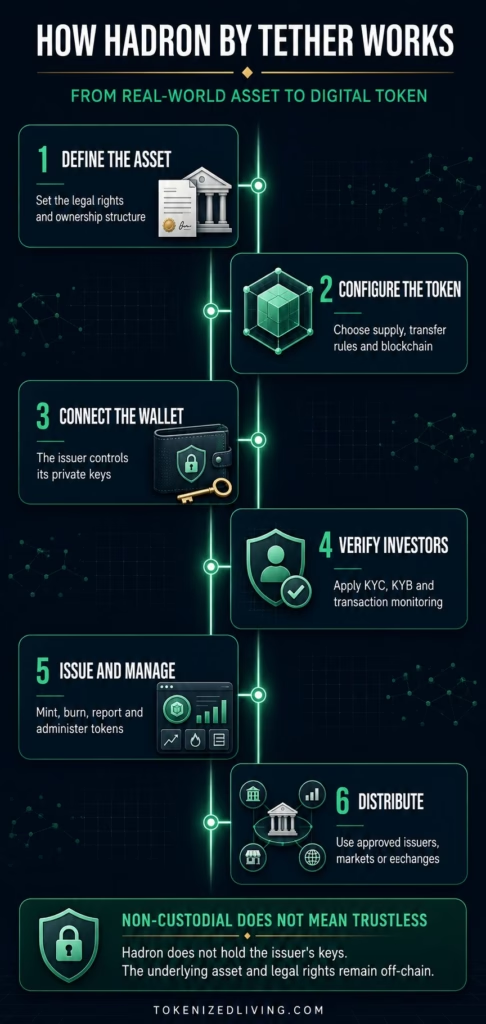
Every project will use a different legal and technical structure. Still, a typical Hadron-based issuance may involve the following stages.
1. Establish the asset and legal structure
First, the issuer must decide what the token represents.
It could represent a debt obligation, a fund interest, a redeemable stablecoin or shares in a company that owns property. The issuer must then connect those rights to enforceable contracts.
Hadron cannot turn a weak agreement into genuine ownership. Nor can a blockchain repair missing title documents, poor asset custody or an unlawful securities offering.
2. Configure the token
Next, the issuer sets the token’s economic and technical rules.
These choices may cover supply, transfer restrictions, redemption, approved investor groups and the events that allow tokens to be minted or burned.
The issuer must also choose an appropriate network. Tether says Hadron supports multiple smart-contract blockchains and Bitcoin-based infrastructure such as the Liquid Network. However, blockchain choice affects fees, security, wallet compatibility and access to investors.
Our guide to choosing a blockchain for tokenization examines those trade-offs in more detail.
3. Connect an external wallet
Hadron does not store the issuer’s private keys. Instead, the issuer connects a separate compatible wallet.
This arrangement gives the issuer direct control over actions that require its keys. It also prevents Tether Hadron from moving the issuer’s tokens independently.
However, direct control creates direct responsibility. If the issuer loses its keys or an attacker steals them, Tether Hadron says it cannot recover or control those credentials.
4. Configure investor checks
The platform provides tools for Know Your Customer, Know Your Business and Know Your Transaction processes. Issuers can use these controls to collect information and restrict token access or transfers.
Furthermore, Hadron can connect with external monitoring and compliance services. This infrastructure may help an issuer run its compliance program, but it does not replace that program.
5. Issue and manage the tokens
After completing its technical and legal preparation, the organization can issue tokens to eligible wallets.
It may later burn tokens, update permitted addresses, process redemption instructions or monitor on-chain activity. APIs can also connect Hadron with existing enterprise systems.
6. Arrange distribution and trading
Finally, the issuer needs a way to distribute the product. That may involve a regulated exchange, private placement, broker, primary market or another approved channel.
Hadron can support token management and monitoring. Nevertheless, it cannot create investor demand. A technically transferable token may still have no active secondary market.
What Does “Non-Custodial” Mean?
The original announcement placed heavy emphasis on Hadron being non-custodial. Unfortunately, that phrase can mislead readers.
According to Hadron’s platform terms, Tether Hadron acts as a technology provider. It does not provide custody for an issuer’s tokens or private keys. The issuer must control those keys through a separate wallet.
That structure can reduce one form of platform risk. Tether Hadron cannot simply access an issuer’s wallet and move its tokens.
Nevertheless, non-custodial does not mean risk-free or decentralized.
The issuer may still control minting, burning, transfer permissions and investor access. An exchange might also hold tokens for investors. In addition, a bank, trustee or specialist custodian must hold the underlying off-chain asset.
Consider tokenized real estate. Hadron might help manage the digital tokens, but it does not place a building inside a blockchain wallet. A company, trust or special-purpose vehicle still owns the property under local law.
Therefore, investors must separate three questions:
- Who controls the blockchain token?
- Who holds the underlying asset?
- What legal rights can the token holder enforce?
A non-custodial answer to the first question tells you very little about the other two.
What Assets Can Hadron Tokenize?
Tether markets Hadron as a multi-asset platform. Its public materials identify several potential asset categories.
Stablecoins and tokenized money
Hadron can support tokens linked to fiat currencies or other reserves. These products need clear reserve, redemption, custody and regulatory structures.
Bonds and sovereign debt
An issuer could use the platform for corporate bonds, government debt or other fixed-income products. Smart contracts may help automate transfers, interest processing or redemption.
However, the legal debt obligation still exists outside the blockchain.
Funds and equities
Hadron also targets fund interests, corporate equity and exchange-traded products. These tokens may face securities rules, investor eligibility limits and transfer restrictions.
Commodities
Tokens can represent rights connected to gold or other commodities. Tether already has direct experience with this model through XAU₮, although a third-party commodity token created through Hadron would remain that issuer’s responsibility.
Our tokenized gold guide explains why investors must examine reserves, custodians and redemption rights rather than trusting an on-chain token balance alone.
Real estate
Property is one of Hadron’s most important target markets. An issuer could tokenize equity, debt, income rights or interests in a property-owning company.
Still, tokenization does not guarantee fractional legal ownership, rental income or liquidity. The precise result depends on the documents behind the token.
Loyalty points and other digital rights
Not every Hadron token needs to be an investment. The platform can also support loyalty points and other programmable digital rights.
Importantly, these categories describe what the platform is designed to support. They do not prove that Hadron already operates a large live market in every category.
Hadron’s Compliance and Monitoring Tools
Institutional tokenization requires more than smart contracts. Issuers must identify customers, monitor transactions and apply restrictions across different jurisdictions.
Hadron includes tools for:
- KYC and KYB onboarding
- AML and sanctions controls
- Know Your Transaction monitoring
- Wallet screening
- Transfer restrictions
- Blockchain reporting
- Risk management
- Secondary-market monitoring
- API connections with enterprise systems
In May 2025, Tether announced a Chainalysis integration. It added transaction monitoring, risk detection and KYT support.
Later that year, Hadron entered an agreement with Crystal Intelligence. That arrangement gave customers access to additional AML screening, forensic tools and customizable risk scoring.
These integrations strengthen the platform’s monitoring options. However, software does not grant regulatory approval.
Hadron’s own terms state that each issuer remains responsible for complying with securities, AML, sanctions, privacy and tax laws. Tether Hadron also says it does not provide legal or regulatory advice and does not take responsibility for screening every end user.
Consequently, a “compliance-ready” token can still be sold unlawfully or backed by a defective legal structure.
Is Anyone Actually Using Hadron?
Hadron has moved beyond its original announcement. Even so, readers should distinguish live products from agreements, proposed deployments and exploratory projects.
Quantoz: Hadron’s first public user
In November 2024, Tether identified Quantoz as the first public user of Hadron.
Quantoz used the technology in connection with EURQ and USDQ. These euro- and dollar-referenced electronic-money tokens were designed for Europe’s Markets in Crypto-Assets framework.
This provides the clearest early proof that an external company used Hadron technology for a public product.
KraneShares and Bitfinex Securities
In November 2025, Hadron, KraneShares and Bitfinex Securities entered a strategic agreement.
The companies said they would explore tokenized exchange-traded products and wider institutional market infrastructure.
The announcement is significant because it combines asset-management expertise, tokenization software and a regulated securities venue. Nevertheless, “explore” is the key word. The agreement did not identify a completed tokenized fund with published assets and trading data.
Nairobi Securities Exchange
In July 2026, Tether signed a memorandum of understanding with the Nairobi Securities Exchange.
The parties plan to explore tokenized securities, fractional investor access and faster settlement through Hadron. They also intend to examine KYC processes suited to Kenya’s regulatory environment.
This project could become an important institutional use case. However, the agreement remains exploratory. Investors should not describe the Nairobi exchange as a live Hadron-powered token market unless the parties publish evidence of an operational launch.
Saudi Arabian real estate
The most relevant development for Tokenized Living arrived in August 2026.
Hadron announced a collaboration with First Data and BKN301 to develop institutional-grade real estate tokenization in Saudi Arabia.
Under the proposed structure, First Data will act as the commercial lead, issuer and primary market operator. Meanwhile, BKN301 will support banking connections, integration and operational infrastructure. Hadron will supply the token issuance and lifecycle-management technology.
The division of responsibilities illustrates Hadron’s real function. It provides infrastructure, while local companies handle issuance, operations and market access.
The announcement did not disclose named properties, issuance values or completed investor transactions. Therefore, it is evidence of planned adoption—not yet proof of a liquid Saudi property-token market.

Benefits of Hadron by Tether
Hadron offers several potential advantages for organizations building tokenized products.
A broader token lifecycle
The platform combines token creation, burning, compliance tools, reporting and management. Consequently, issuers may avoid assembling every component separately.
Direct key control
Issuers use external wallets and retain their private keys. This reduces their dependence on Tether Hadron for asset custody.
Multi-asset flexibility
Organizations can design different products rather than using one fixed token template. Hadron targets money, securities, commodities, real estate and non-investment assets.
Compliance integrations
Chainalysis and Crystal provide tools that institutions already recognize. Their integrations may simplify transaction monitoring and wallet screening.
Enterprise connectivity
APIs can connect blockchain functions with existing business systems. This matters because most institutions cannot abandon their banking, accounting and compliance infrastructure overnight.
Tether’s issuance experience
Tether has operated large stablecoin and tokenized-gold products. Hadron can draw on that technical experience, although customers must still evaluate the platform independently.
Limitations and Risks
Hadron’s marketing emphasizes accessibility, control and global liquidity. Those claims need context.
Legal rights remain off-chain
A token cannot independently prove ownership of a building, gold bar or bond. Investors still depend on contracts, corporate records, custodians and courts.
Compliance tools do not guarantee compliance
KYC portals and blockchain monitoring can support a compliance program. However, the issuer must determine which laws apply and obtain any necessary approvals.
Non-custodial design transfers responsibility
Issuer-controlled keys remove Tether Hadron from custody. At the same time, key loss, theft or poor wallet procedures can disrupt the entire project.
Liquidity is not automatic
Smart contracts make tokens transferable. They do not provide buyers, accurate pricing or market makers.
This problem affects the wider sector. Our guide to the benefits and risks of tokenized real estate explains why technical transferability and genuine liquidity are different.
Public adoption data remain limited
Hadron has announced credible relationships. Nevertheless, its public website does not display a real-time total value issued, a full list of live third-party products or independently verified trading volumes.
Without those figures, outsiders cannot measure adoption as easily as they can measure assets in a public fund.
Pricing lacks public transparency
Hadron does not publish a standard fee schedule on its public website. Its terms state that customers pay fees set out in individual order forms. Issuers must also cover blockchain gas charges.
Therefore, prospective customers cannot compare total costs without requesting commercial terms.
Blockchain and smart-contract risk remain
The selected network can suffer congestion, forks, outages or security failures. Smart contracts may also contain vulnerabilities.
Hadron’s terms place responsibility on users to evaluate their chosen blockchain. They also provide no general assurance about platform service levels or performance.
Platform dependency still exists
Self-custody does not eliminate reliance on Hadron’s software, APIs and support. An issuer needs a business-continuity plan for platform disruption, contract termination or integration failure.
More broadly, the Financial Stability Board has warned that tokenization projects can face legal uncertainty, interoperability problems, operational fragility and weak liquidity. Using a major technology provider does not make those market-wide risks disappear.
Who Is Hadron Designed For?
Hadron is primarily suited to organizations that already have an asset, legal structure and professional team.
Potential users include:
- Banks and payment companies
- Asset managers and fund operators
- Corporate or government bond issuers
- Commodity businesses
- Regulated real estate issuers
- Exchanges and capital-market platforms
- Governments exploring digital securities or tokenized money
It is not a simple do-it-yourself tool for someone who wants to tokenize a house over the weekend.
A credible project still needs lawyers, accountants, custodians, compliance specialists, wallet security and a distribution plan. In many jurisdictions, it will also need a license or regulated partner.
Final Verdict
Hadron by Tether has developed from a vague 2024 teaser into a serious institutional tokenization platform.
Its strongest features are broad asset support, issuer-controlled keys, compliance integrations and Tether’s experience managing blockchain-based financial products. Moreover, Quantoz provides a genuine public example of outside use.
The later agreements also show momentum. KraneShares brings asset-management credibility. The Nairobi Securities Exchange offers a possible national-market use case. Meanwhile, the Saudi initiative connects Hadron directly with institutional real estate.
However, Hadron has not proved every part of its ambitious promise.
Several headline projects remain agreements or planned deployments. Public pricing and adoption data are also limited. Most importantly, the technology cannot guarantee asset ownership, regulatory compliance or liquidity.
Hadron should therefore be viewed as infrastructure—not as the investment itself.
Its software may help credible issuers build better tokenized products. Yet investors must still examine the organization, legal rights, underlying assets, custody arrangements and exit options behind every token.
Frequently Asked Questions
What is Hadron by Tether?
Hadron by Tether is a software platform for issuing and managing tokenized assets. It provides tools for token creation, burning, compliance, reporting and lifecycle management.
Is Hadron a blockchain?
No. Hadron operates across supported blockchain networks. The blockchain processes token transactions, while Hadron supplies issuance and management tools.
Is Hadron non-custodial?
Yes, in relation to issuer token keys. Tether Hadron does not store or control the issuer’s private keys. The issuer must connect and secure a separate wallet.
Does non-custodial mean investors directly own the underlying asset?
No. Non-custodial key control does not determine legal ownership of property, securities or commodities. Investors must examine the token’s contracts and legal structure.
Can Hadron tokenize real estate?
Hadron can provide infrastructure for real estate tokens. However, the issuer must create the property-holding structure, define investor rights and comply with local laws.
Can retail investors buy assets directly from Hadron?
Hadron is not primarily a retail investment marketplace. Investors normally access tokens through the relevant issuer, exchange or distribution platform.
Does Tether guarantee tokens created through Hadron?
No. Hadron’s end-user disclaimer states that Tether Hadron does not issue, redeem, endorse or guarantee third-party tokens created with its software.
Does Hadron guarantee regulatory compliance?
No. The platform provides compliance tools and integrations, but each issuer remains responsible for meeting applicable securities, AML, sanctions, privacy and tax rules.
Is Hadron already being used?
Yes. Tether identified Quantoz as its first public user in 2024. Hadron has also announced institutional agreements involving KraneShares, Bitfinex Securities, the Nairobi Securities Exchange and a Saudi real-estate initiative. However, some of these projects remain exploratory or under development.