

Updated: August 27, 2026
Aktionariat gives Swiss companies the infrastructure to issue, manage and facilitate trading in tokenized shares.
That description requires an important qualification. Aktionariat is not a conventional stock exchange, broker or diversified investment platform. Instead, it supplies technology that individual companies can use to bring their shares on-chain.
The distinction matters because tokenizing a share does not remove the risks associated with private companies. It also does not guarantee an active secondary market.
When structured correctly, an Aktionariat token can represent a legally recognized share in a Swiss company. However, investors must still examine the issuer, shareholder rights, transfer restrictions and available liquidity.
This Aktionariat review explains how the platform works, what its share tokens represent and where its model has limitations. It also examines pricing, custody risks, regulatory status and the April 2026 Brokerbot exploit.
This is a document-based platform review. We have assessed Aktionariat’s legal disclosures, product documentation, pricing and public incident reporting. We have not completed a live token issuance or invested through every issuer using the platform.
TL;DR
- Aktionariat provides tokenization and shareholder-management infrastructure for Swiss companies.
- Properly structured tokens can represent legally recognized ledger-based securities under Swiss law.
- Each tokenized company remains responsible for its offering, disclosures and shareholder agreements.
- Investors may buy newly issued shares directly from a company or trade with other investors when secondary trading is available.
- Transferability does not guarantee liquidity, a fair price or an available buyer.
- DAKS is the ticker for Aktionariat AG’s own tokenized shares. It is not the generic name for every share issued through the platform.
- Aktionariat’s current pricing includes software, tokenization and transaction charges. Separate legal costs can also apply.
- A 2026 smart-contract exploit affected four issuers and resulted in CHF31,606 being stolen. Aktionariat reimbursed the affected issuers and reported that no shares were taken.
- The platform offers credible Swiss tokenization infrastructure. However, investors should not treat its markets like regulated public stock exchanges.
What is Aktionariat?
Aktionariat is a Swiss financial technology company that helps businesses tokenize their equity.
Its software covers several stages of the shareholder lifecycle. Companies can maintain a digital shareholder register, issue new shares, manage token holders and provide an investor-facing market.
According to the Aktionariat website, its infrastructure has supported more than 85 companies, over 35,000 registered investors and more than CHF59 million in investment volume. These are Aktionariat’s own reported figures rather than independently audited platform totals.
The company’s role has also evolved.
In a 2024 strategy update, Aktionariat emphasized that it was not an investment platform. It instead described itself as an infrastructure provider serving companies and their shareholders.
That remains the most useful way to understand the business.
Aktionariat supplies the tools. However, the individual issuer remains central to the investment. The issuer determines which shares are available, who can participate and what rights those shares provide.
Investors who are unfamiliar with the underlying concept may want to start with our explanation of what tokenization means.
Are Aktionariat tokens real company shares?
They can be, provided the issuer completes the required legal process.
Switzerland’s distributed ledger technology framework introduced a category known as ledger-based securities. These securities can represent rights through an electronic register, including a blockchain.
The Swiss Federal Council brought the DLT Act fully into force on August 1, 2021. The framework provides a clearer legal foundation for issuing and transferring certain securities through distributed ledgers.
However, deploying a token contract does not automatically create a legally enforceable share.
According to Aktionariat’s legal background documentation, a company must adapt its legal structure to recognize ledger-based securities. This generally includes amending its articles of association and completing the appropriate shareholder documentation.
The process may involve:
- Revised articles of association
- A registration agreement
- A token holder agreement
- A shareholder agreement
- An updated shareholder register
- Rules covering transfers, voting and other shareholder rights
Aktionariat works with legal service providers to help issuers establish this framework. Nevertheless, the company issuing the shares remains responsible for its corporate structure and offering.
Therefore, investors should verify the connection between the token and the legal share register. They should also read the issuer’s governing documents before investing.
What rights can tokenized shares provide?
A properly structured tokenized share can carry many of the same rights as a conventional share.
Depending on the share class and issuer documents, these may include:
- Legal ownership in the company
- Voting rights
- Dividend rights
- Rights to receive certain company information
- Rights relating to a sale or liquidation
- The ability to transfer the share under specified conditions
However, not every share class provides identical rights.
A company may tokenize only part of its equity or create a specific class for tokenized shareholders. Other shareholders may retain different voting, dividend or economic rights.
The token’s technical design cannot answer those questions by itself. Investors must examine the company’s articles, shareholder agreement and token holder agreement.
The same principle applies throughout the real-world asset tokenization market. The legal rights behind a token matter more than the appearance of the token in a wallet.
How the Aktionariat platform works
Aktionariat’s infrastructure has three main user-facing components.
| Component | Primary user | Main purpose |
|---|---|---|
| Issuer Portal | Company | Manages shareholders, tokenization, issuance settings, reserves and trading parameters |
| Investor Page | Prospective and existing shareholders | Displays company information and supports direct investment or secondary trading when enabled |
| Portfolio App | Investor | Holds and displays supported tokenized shares through a self-custody wallet |
The Issuer Portal gives companies control over their tokenized equity programme. An issuer can manage its shareholder register, monitor token activity and configure investment options.
Each company can also operate its own Investor Page. This means investors often interact with a market attached to a specific issuer rather than one central Aktionariat exchange.
The Portfolio App acts as a wallet and portfolio interface. Aktionariat describes it as non-custodial, meaning the user controls the wallet rather than depositing assets into a conventional brokerage account.
Individual issuers can configure these services differently. Therefore, one company may offer direct issuance and secondary trading, while another may provide only basic shareholder management.
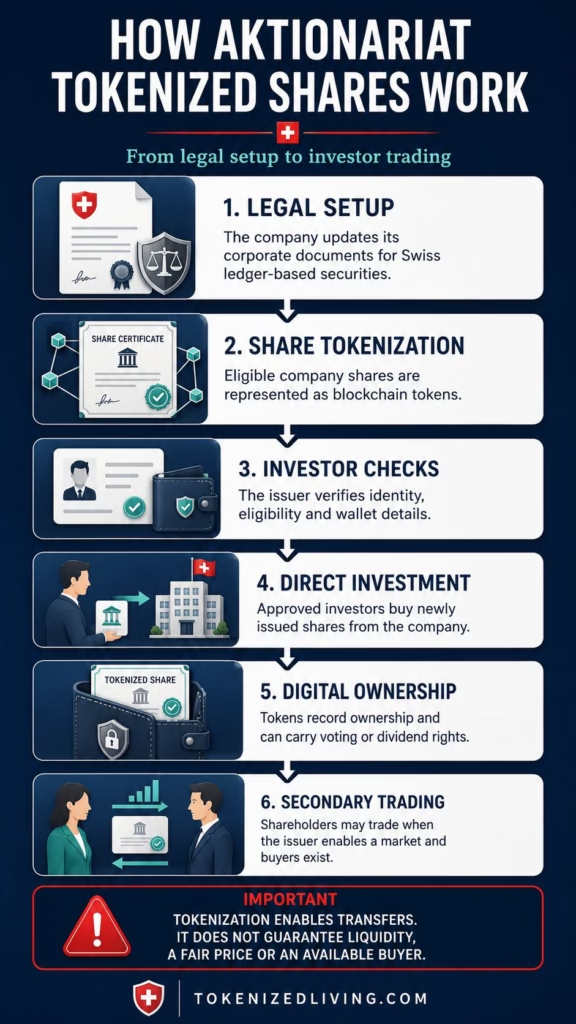
How direct investment works
Direct investment involves buying newly issued shares from the company.
The company decides how many shares it wants to offer. It can also set the price, eligibility requirements and duration of the offer.
An investor typically completes the following process:
- Opens the company’s Investor Page.
- Reviews the offering and company information.
- Connects or creates a compatible wallet.
- Completes any required identity checks.
- Accepts the legal agreements.
- Pays using one of the supported methods.
- Receives the tokenized shares after approval and settlement.
The issuer can restrict access based on residence, investor status or other eligibility criteria. It may also use an allowlist that limits which blockchain addresses can hold or receive the tokens.
Therefore, tokenized shares are not necessarily available to every internet user. Regulatory and contractual restrictions can still apply.
Aktionariat’s terms for end users also make clear that each company remains responsible for its offering. Aktionariat does not independently endorse the issuer or guarantee its information.
Anyone considering an investment should follow the same due-diligence process used for other private companies. Our guide to buying tokenized assets explains several of the checks involved.
How secondary trading works
Secondary trading allows an existing shareholder to sell shares to another investor.
Aktionariat supports mechanisms that can include an automated market maker, a bonding curve or an order-book-style market. However, each issuer chooses which functions to activate.
This creates a very different environment from a public stock exchange.
The issuer may be able to:
- Enable or disable its market
- Approve eligible participants
- Apply transfer restrictions
- Reject certain users or transactions
- Set parameters for its primary-market activity
- Decide how much capital or inventory to provide
Aktionariat’s own disclosures describe issuer-level secondary trading as operating through a non-commercial trading facility under Swiss financial-market law. The disclosure also states that users do not receive the protections that apply when trading on a prudentially supervised venue.
Consequently, investors should not assume that an Aktionariat Investor Page offers the same supervision, execution standards or market surveillance as SIX Swiss Exchange or another regulated public market.
FINMA explains that operating a DLT trading facility can require authorization, depending on the activities and structure involved. However, that does not mean every token issuer needs the same license. It also does not mean Aktionariat’s involvement constitutes FINMA approval of a company or its shares.
Does Aktionariat provide liquidity?
Aktionariat provides trading infrastructure. It does not guarantee liquidity.
This is one of the most important corrections to older descriptions of the platform.
A share may be technically transferable while remaining difficult to sell. An effective market still requires interested buyers, realistic pricing and enough trading activity.
Aktionariat acknowledges this on its tokenized companies page. It warns that issuer-reported prices and market capitalizations may not reflect executable market prices. It also notes that selling shares back to an issuer may be impossible when the issuer lacks liquidity.
Several problems can arise:
- No buyer may accept the seller’s asking price.
- The issuer may not maintain a repurchase facility.
- The market may have a wide gap between buying and selling prices.
- Trading volumes may remain extremely low.
- Transfer restrictions may reduce the pool of eligible buyers.
- A displayed valuation may come from the issuer rather than recent independent trades.
Tokenization can reduce administrative friction and make transfers easier to record. Yet it cannot manufacture market demand.
This distinction also applies to other blockchain-powered secondary markets. Better settlement infrastructure can support liquidity, but it cannot create it alone.

Is Aktionariat connected to a regulated trading venue?
Aktionariat announced a partnership with Swiss digital asset infrastructure company Taurus in September 2024.
The proposed arrangement could allow selected companies to pursue admission to the Taurus Digital Exchange, or TDX. TDX operates separately as an organized trading facility.
The partnership announcement described this as a route for qualifying companies rather than automatic access for every Aktionariat issuer.
This is an important distinction.
An issuer-specific market operated through Aktionariat is not the same as admission to TDX. Investors should verify the trading venue for the specific share they are considering.
What is DAKS?
DAKS stands for Draggable Aktionariat AG Shares.
It is the ticker used for Aktionariat AG’s own tokenized shares. It is not the generic name for shares issued through the Aktionariat platform.
Each participating company can have its own security, ticker and legal documentation.
This distinction matters because references to “DAKS tokens” can incorrectly suggest that Aktionariat wraps every company’s equity inside one common platform token. It does not.
The Aktionariat AG Investor Page provides company-specific information about DAKS, including the number of tokenized shares and shareholder disclosures.
Investors evaluating another company should use that issuer’s own Investor Page and documents.
Which blockchains does Aktionariat support?
Aktionariat currently lists support for Ethereum and several Ethereum-compatible networks, including Polygon, Optimism and Base.
These networks can provide lower-cost or faster transactions than using Ethereum’s main network for every operation. However, the available chain can depend on the issuer and its implementation.
Companies choosing an infrastructure provider should consider:
- Network security
- Transaction costs
- Wallet compatibility
- Smart-contract maturity
- Custody support
- Cross-chain risks
- Long-term maintenance
- Regulatory and data requirements
Our guide to choosing a blockchain for a tokenization project examines these trade-offs in more detail.
Aktionariat has also publicized integrations involving Chainlink’s cross-chain technology and institutional custody provider Taurus. Still, investors should confirm which integrations support the specific share they want to buy.
How much does Aktionariat cost?
Aktionariat publishes separate charges for shareholder management, tokenization and capital raising.
As of August 2026, its official pricing page lists the following headline costs:
| Service | Published price |
| Basic shareholder management | Free plan available |
| Tokenization subscription | CHF1,500 per year |
| Tokenization setup | CHF5,900 one-time fee |
| Direct investment volume up to CHF1 million | 1.5% |
| Direct investment volume from CHF1 million to CHF5 million | 1% |
| Direct investment volume above CHF5 million | 0.75% |
These prices can change. Companies should therefore request a current quotation before making a decision.
Legal work is also separate from the software price. Aktionariat’s 2026 equity tokenization guide estimates legal costs can range from approximately CHF2,000 to CHF15,000, depending on the company and complexity.
Additional costs may include corporate restructuring, identity verification, payment processing, audits, accounting and internal administration.
Aktionariat may therefore be accessible compared with a conventional public listing. Nevertheless, a legally credible tokenization project is not a no-cost software exercise.
How custody and share recovery work
The Aktionariat Portfolio App uses a self-custody model.
Self-custody gives investors direct control of their wallet. However, it also moves significant responsibility away from a conventional broker or custodian.
Users must protect their seed phrase, device and wallet credentials. A stolen seed phrase can allow an attacker to control the wallet.
Aktionariat’s current lost-share recovery procedure may help when an investor loses access to a wallet without exposing the seed phrase.
The process requires the shareholder to establish a new wallet and prove their identity to the issuer. The old wallet address must then remain inactive during a six-month waiting period before eligible shares can be reclaimed.
However, this process has limitations.
It does not recover the original seed phrase. Furthermore, it may fail when an attacker controls the wallet and can interfere with the recovery claim. Each token may also require a separate recovery process, collateral and blockchain transaction fees.
Therefore, self-custody remains a material operational risk despite the available recovery mechanism.
What happened in the 2026 Brokerbot exploit?
On April 23, 2026, an attacker exploited a vulnerability affecting certain Brokerbot smart contracts.
Brokerbot supports automated liquidity and trading functions for participating issuers. According to Aktionariat’s public incident report, the exploit worked only under a specific combination of settings.
Four issuers were affected, and the attacker removed CHF31,606 in ZCHF. Aktionariat reported that no company shares were stolen, its share registries remained intact and individual investors were not affected.
The company reimbursed the affected issuers. It also patched the relevant Brokerbot and PaymentHub contracts and disabled the vulnerable configuration.
The incident deserves a balanced assessment.
First, it demonstrates that smart-contract risk remains real, even when the underlying legal shares continue to exist. Tokenized equity can introduce technical attack surfaces that conventional shareholder registers may not have.
However, Aktionariat published a detailed explanation, reimbursed the affected issuers and described its remediation. That level of disclosure is a positive sign.
Investors and issuers should still ask whether contracts have received independent audits, how upgrades work and who carries the financial burden after a future exploit.
What Aktionariat gets right
Aktionariat addresses several genuine problems in private-company share administration.
First, it connects the blockchain record with Swiss corporate documentation. This provides a stronger foundation than issuing a token with vague or unenforceable claims.
Second, its infrastructure combines token issuance with shareholder management. The issuer can maintain a structured register rather than operating an unrelated token alongside separate company records.
Third, investors can hold shares in a self-custody wallet. This may reduce dependence on a single intermediary, although it introduces personal security responsibilities.
Fourth, the platform can support smaller direct offerings. Companies do not need to pursue a full public listing to give investors a digital onboarding and ownership process.
Finally, Aktionariat has shown a willingness to publish technical incident information. Transparent remediation does not eliminate risk, but it helps users assess how a provider responds when something fails.
Aktionariat’s main limitations and risks
| Issue | Why it matters |
| Private-company risk | Early-stage companies can fail, dilute shareholders or never provide an exit |
| Limited liquidity | A transferable token may still have few or no buyers |
| Issuer-controlled markets | Companies can restrict participants or disable trading functions |
| Valuation uncertainty | Issuer-reported prices may not reflect executable market value |
| Limited venue protections | Issuer-level trading does not provide all protections of a supervised public exchange |
| Smart-contract risk | Software vulnerabilities can affect funds or market operations |
| Self-custody risk | Users must protect wallet credentials and understand recovery limitations |
| Legal complexity | Share rights depend on corporate documents, not only the token contract |
| Concentration | Each investment depends heavily on one issuer rather than a diversified portfolio |
| Jurisdictional restrictions | Investors may face residence, suitability or offering limitations |
These risks do not make Aktionariat illegitimate. Instead, they show why tokenized private shares must be evaluated as private investments with an additional technology layer.
What investors should check before buying
Before buying shares through an Aktionariat-powered market, investors should establish:
- What legal entity issues the share?
Confirm the company’s registered name, jurisdiction and official records. - What does the token legally represent?
Read the articles of association, registration agreement and token holder agreement. - Which share class will you own?
Compare its voting, dividend and liquidation rights with other classes. - How was the valuation calculated?
Do not assume the displayed market capitalization reflects recent independent trades. - Can the company issue more shares?
Future fundraising may dilute existing shareholders. - Where can you sell?
Check whether secondary trading is active and review recent volume, spreads and market depth. - Can the issuer restrict transfers?
Determine whether allowlisting, identity checks or company approval apply. - What happens if the company fails?
A legally valid share can still become worthless. - Who controls upgrades and market contracts?
Understand whether smart contracts can change and how emergency controls work. - How will you secure the wallet?
Create a seed-phrase backup and understand the limits of share recovery.
Investors should also distinguish regulatory compliance from regulatory endorsement. A company can structure an offering under Swiss law without FINMA recommending the investment or guaranteeing its value.
Is Aktionariat suitable for companies?
Aktionariat may suit a Swiss company that wants to modernize its shareholder register, raise capital directly or create controlled transfer options for its shares.
It appears most relevant when the company:
- Has a clear reason for tokenizing its equity
- Can support the required legal restructuring
- Wants to manage investors directly
- Accepts responsibility for issuer communications
- Understands that market infrastructure will not guarantee liquidity
- Has resources for ongoing compliance and technical administration
It may be less suitable for companies seeking instant global liquidity, anonymous trading or a shortcut around securities law.
A tokenization project also needs enough investor interest to justify its operating costs. Technology cannot compensate for a weak business, unrealistic valuation or absent shareholder demand.
Aktionariat review: our verdict
Aktionariat provides credible infrastructure for issuing and managing legally structured Swiss tokenized shares.
Its strongest feature is the connection between blockchain-based ownership and Switzerland’s ledger-based securities framework. The Issuer Portal, Investor Pages and self-custody wallet create a relatively complete system for private-company equity.
However, Aktionariat does not transform private shares into liquid public stocks.
Investors may face thin trading, issuer-controlled access, uncertain valuations and limited exit opportunities. They must also accept private-company risk, smart-contract risk and the operational responsibilities of self-custody.
The 2026 Brokerbot exploit reinforces those concerns. Still, Aktionariat’s reimbursement and public incident report demonstrate a more transparent response than many infrastructure providers offer.
Overall, Aktionariat is best understood as tokenization and shareholder-management infrastructure. It is not a guarantee of investment quality, market liquidity or regulatory approval.
For suitable Swiss companies, that infrastructure can provide real administrative and capital-raising benefits. For investors, the value depends almost entirely on the issuer, the legal rights attached to the shares and the existence of genuine market demand.
Frequently asked questions
Is Aktionariat regulated by FINMA?
Aktionariat’s involvement does not mean an issuer or investment has received FINMA approval. Regulatory requirements depend on the activities, offering and trading structure involved. Investors should review the disclosures for each issuer and venue.
Are Aktionariat tokens real shares?
They can represent legally recognized shares when the issuer completes the required Swiss corporate and contractual process. Simply creating a token would not be enough.
Is DAKS the token used for every Aktionariat company?
No. DAKS means Draggable Aktionariat AG Shares and represents Aktionariat’s own tokenized shares. Other companies issue their own tokens.
Can I sell Aktionariat shares whenever I want?
Not necessarily. Selling depends on whether the issuer has enabled secondary trading and whether an eligible buyer exists. Transfer restrictions can also apply.
Does tokenization guarantee liquidity?
No. Tokenization can improve transfer and settlement infrastructure, but it cannot guarantee buyers, trading volume or fair pricing.
Can non-Swiss investors buy Aktionariat shares?
Eligibility depends on the issuer, offering structure and investor’s jurisdiction. Companies may restrict participation based on residency, identity or regulatory requirements.
Where are Aktionariat shares stored?
Supported shares can be held through a blockchain wallet, including Aktionariat’s self-custody Portfolio App. Investors remain responsible for protecting their wallet credentials.
What happens if I lose access to my wallet?
Aktionariat documents a share-recovery process for certain lost-wallet situations. It requires issuer identity verification, a new wallet and a waiting period. It may not protect users when an attacker controls the original wallet.
Was investor equity stolen in the Brokerbot exploit?
Aktionariat reported that the April 2026 incident affected CHF31,606 in ZCHF held by four issuers. It said no shares were stolen and no individual shareholders were affected. Aktionariat reimbursed the issuers and patched the affected contracts.
Is Aktionariat a stock exchange?
No. It is better described as tokenization and shareholder-management infrastructure. Issuer-level trading facilities differ from regulated public stock exchanges, while access to an external venue such as TDX requires a separate qualification process.