

Updated date: August 27, 2026
Switzerland’s tokenization regulations are among the most developed in the world. However, that does not mean every Swiss token is approved, protected or easy to trade.
The country took a targeted approach. Instead of creating one law for every blockchain business, Switzerland amended existing civil, financial-market and insolvency rules. The result is commonly called the Distributed Ledger Technology Act, or DLT Act.
The framework gives qualifying digital securities a clear legal route. It also supports regulated trading infrastructure and addresses some custody risks. Still, the blockchain does not replace the legal documents behind a token.
That distinction matters for investors, issuers and anyone trying to understand what tokenization actually means.
Important: This article provides general information. It is not legal, tax or investment advice. Swiss regulation depends on the token’s structure, the services provided and the investors being targeted.
TL;DR
- Switzerland introduced ledger-based securities on February 1, 2021.
- The full DLT Act and its accompanying ordinance took effect on August 1, 2021.
- A ledger-based security links a legal right to a qualifying electronic ledger.
- The token may represent shares, debt, income rights or another claim. It does not automatically represent direct ownership of a physical asset.
- FINMA generally classifies tokens as payment, utility or asset tokens. Hybrid forms are possible.
- Issuing a token does not automatically require FINMA approval. However, the structure may trigger securities, prospectus, banking, fund, trading or anti-money-laundering rules.
- Swiss law created a specific licence for DLT trading facilities. Nevertheless, a licence does not guarantee liquidity.
- Custodied cryptoassets may receive bankruptcy protection only when the relevant legal and operational conditions are met.
- Switzerland is not part of the European Union. Therefore, EU rules such as MiCA do not replace Swiss law.
What Is the Swiss DLT Act?
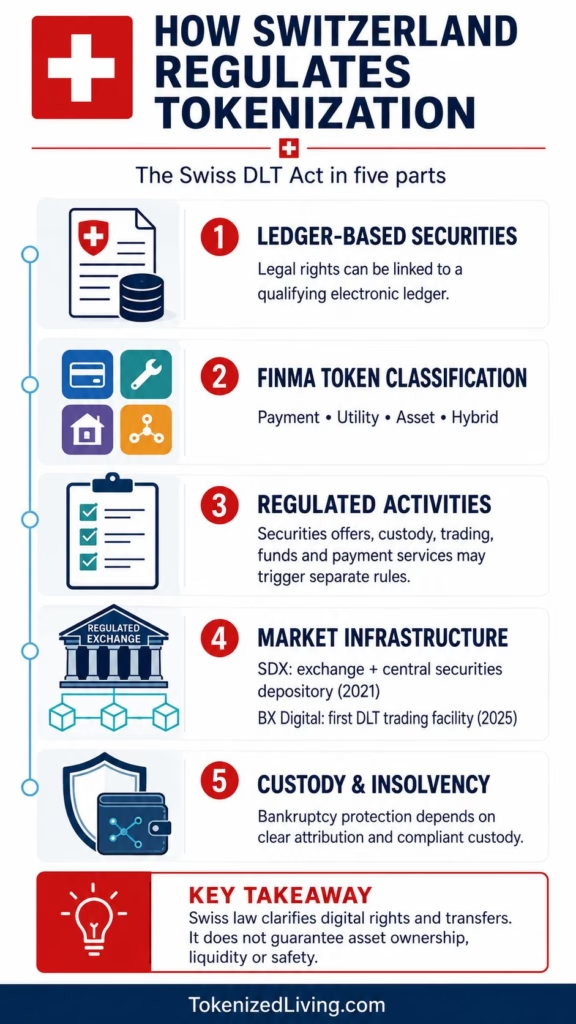
The Swiss DLT Act is not a single, self-contained “crypto law.” Instead, it is an amendment package that adapted several federal laws to distributed ledger technology.
Its main goals were to remove specific legal uncertainty while keeping Switzerland’s existing financial safeguards. The Swiss State Secretariat for International Finance identifies three particularly important results:
- A legal basis for issuing and transferring ledger-based securities
- A new licensing route for DLT trading facilities
- Greater clarity over cryptoassets and data during insolvency
The changes arrived in two stages. Provisions covering ledger-based securities entered into force on February 1, 2021. The remaining DLT Act provisions and blanket ordinance followed on August 1, 2021.
That timeline is important. Some articles describe the DLT Act as if Switzerland legalised tokenization on one date. In reality, the reform changed several connected areas of law over two stages.
Switzerland’s Tokenization Regulation Timeline
| Date | Development | Why it matters |
|---|---|---|
| December 2018 | The Federal Council published its DLT legal-framework report | It identified gaps in securities transfer, insolvency and market infrastructure |
| February 1, 2021 | Ledger-based securities provisions took effect | Qualifying rights could be issued and transferred through an electronic securities ledger |
| August 1, 2021 | The full DLT Act and ordinance took effect | New trading-facility and insolvency provisions became operational |
| September 2021 | FINMA approved SDX as a stock exchange and central securities depository | Switzerland gained regulated infrastructure for issuing, trading and settling tokenized securities |
| March 2025 | FINMA licensed BX Digital | It became the first venue licensed specifically as a DLT trading facility |
| January 2026 | FINMA issued new crypto-custody guidance | The regulator emphasized technology, outsourcing and bankruptcy risks |
Ledger-Based Securities: The Core of the Swiss Framework
Ledger-based securities sit at the centre of Switzerland’s tokenization regulations.
In simple terms, a ledger-based security is a legal right registered in a qualifying securities ledger. The parties must agree that the right can be exercised and transferred through that ledger.
The token is therefore not the underlying asset itself. Instead, it is the digital record and transfer mechanism for a defined legal right.
That right might be:
- A share in a company
- A bond or other debt claim
- A right to interest or revenue
- A structured financial product
- Another transferable contractual or membership right
However, the legal documentation must connect the right to the ledger. Simply minting an ERC-20 token and describing it as a security does not satisfy the Swiss framework.
What Must the Securities Ledger Do?
The Swiss Code of Obligations sets functional requirements for the ledger. Among other things, the system must:
- Give creditors control over their rights through technical processes
- Protect the ledger’s integrity against unauthorized changes
- Record or link to the right, the ledger’s operation and the registration agreement
- Let creditors inspect their entries and check the relevant ledger information
This approach is technology-neutral. Consequently, the law does not demand one blockchain, token standard or consensus system.
The issuer must also ensure that the ledger operates as promised. A blockchain label cannot repair a weak registration agreement or a system that fails to meet the legal requirements.
Our Aktionariat review provides a practical example of how Swiss companies connect tokenized shares with corporate documents, shareholder records and transfer rules.
Does a Swiss Token Give You Ownership of the Underlying Asset?
Not necessarily.
A digital token may represent a valid ledger-based security without giving its holder direct ownership of a building, wine collection or gold bar.
For example, a real estate token could represent:
- Shares in a property-owning company
- A loan to a development company
- Units in a collective investment structure
- A contractual claim linked to rental income
None of those structures automatically places the investor’s name on a land register.
Our Swiss real estate tokenization guide examines these property structures, the role of the land register and restrictions affecting foreign investors.
The same warning applies to other real-world asset tokens. Investors must identify the issuer, the legal right and the underlying asset separately.
Key point: Swiss law can make the transfer of a tokenized right legally clearer. It does not turn a vague token into ownership of whatever appears in the marketing image.
How FINMA Classifies Tokens
The Swiss Financial Market Supervisory Authority, FINMA, looks at a token’s economic function and transferability. The regulator does not rely only on the name selected by the issuer.
Under FINMA’s token-classification approach, three main categories apply.
| Token category | Main function | Possible regulatory consequence |
| Payment token | Used as money or a means of value transfer | Anti-money-laundering rules commonly apply |
| Utility token | Provides digital access to an application or service | It may avoid securities treatment only when it has genuine, usable utility and no investment function |
| Asset token | Represents equity, debt, earnings, dividends, interest or another investment-style claim | It is generally treated as a security |
A token can also combine several functions. FINMA calls these hybrid tokens.
Therefore, calling a product a “utility token,” “membership token” or “digital collectible” does not settle its legal status. If buyers expect profits from an issuer’s work, the economic substance may matter more than the label.
For comparison, our Qatar Digital Assets Framework guide explains how the Qatar Financial Centre distinguishes permitted asset-linked tokens from excluded cryptocurrencies and payment-style stablecoins.
Does Every Token Issuer Need FINMA Approval?
No. This is one of the most common misunderstandings about Swiss tokenization regulation.
Creating or self-issuing an asset token does not automatically mean FINMA must approve the product. However, other parts of the business may require authorization, disclosure or registration.
The answer depends on what the issuer and platform actually do.
A Prospectus May Be Required
A public offer of securities in Switzerland can trigger the Financial Services Act’s prospectus requirements unless an exemption applies. Admission to trading may also create disclosure obligations.
Therefore, investors should look for the offering memorandum, prospectus, registration agreement and issuer disclosures. “Issued under Swiss law” is not a substitute for those documents.
Banking or FinTech Rules May Apply
A company may need a banking or FinTech licence if it accepts client deposits or collectively holds certain cryptoassets. The precise requirements depend on the amounts, account structure and services involved.
FINMA’s FinTech guidance also shows why one licence cannot be treated as approval for every activity. Trading securities, managing collective investments and taking deposits sit under different regulatory rules.
Fund Rules May Apply
If a structure pools money from multiple investors and manages it collectively, the Collective Investment Schemes Act may become relevant.
This point matters for tokenized real estate, private credit and commodity products. Calling pooled exposure a token does not remove fund regulation.
AML and KYC Rules May Apply
Swiss anti-money-laundering requirements often apply when a business acts as a financial intermediary. Relevant activities can include transferring assets, operating payment services, exchanging currencies or providing certain wallet services.
As a result, compliant platforms may require identity checks, beneficial-owner information and transaction monitoring. However, completing KYC does not prove that an investment is safe.
How DLT Trading Facilities Work
The DLT Act created a licensing category for trading facilities that handle DLT securities.
Depending on its approved model, a DLT trading facility may combine multilateral trading with custody, clearing or settlement. The framework can also allow certain private clients to participate when the facility meets the additional requirements.
However, those possibilities should not be confused with the services offered by a particular venue.
In March 2025, FINMA licensed BX Digital as Switzerland’s first DLT trading facility. BX Digital uses Ethereum for settlement and connects payment processing to the Swiss Interbank Clearing system.
Still, its initial model targets supervised participants, usually banks. It does not provide custody. Therefore, the first dedicated licence did not instantly create a retail token marketplace offering every service.
More importantly, a regulated venue cannot manufacture buyer demand. It may support lawful transfers, but it cannot guarantee that investors can sell quickly or at a fair price.
Technical transferability and real liquidity remain different things. Our guide to the benefits and risks of tokenized real estate explains that problem in more detail.
SDX and BX Digital Are Not the Same Type of Approval
Swiss Digital Exchange, or SDX, is often incorrectly described as the first DLT trading facility.
That is not what FINMA approved.
In September 2021, FINMA authorized SDX Trading as a stock exchange and SIX Digital Exchange as a central securities depository. Those approvals used the traditional Financial Market Infrastructure Act route.
BX Digital later became the first platform licensed under the specific DLT trading-facility category.
Both developments matter. Nevertheless, they demonstrate two different regulatory routes.
What Switzerland’s Custody and Bankruptcy Rules Actually Protect
The DLT Act improved legal certainty when a custodian becomes insolvent. Under qualifying conditions, clients may be able to reclaim cryptoassets instead of having them absorbed into the custodian’s bankruptcy estate.
However, this is not an automatic guarantee.
Protection depends on factors such as whether the assets can be attributed to the client and whether the custodian holds them available for the client. The custody chain and contractual structure also matter.
In January 2026, FINMA warned about crypto-custody risks. It highlighted technical infrastructure, overseas sub-custodians and the legal treatment of assets during bankruptcy.
Investors should therefore ask:
- Who controls the private keys?
- Are assets held on individual or pooled addresses?
- Can the custodian identify each client’s holdings?
- Does the platform use a foreign sub-custodian?
- Which country’s insolvency law applies?
- Would the assets remain outside the custodian’s bankruptcy estate?
Even a well-designed blockchain cannot answer those legal and operational questions on its own.
Real-World Evidence That the Framework Is Being Used
Switzerland now has more than theoretical regulation. Institutions have used its infrastructure for live digital securities.
The World Bank’s CHF 200 Million Digital Bond
In 2024, the World Bank issued a seven-year CHF 200 million digital bond. It listed the bond on SDX and the traditional SIX Swiss Exchange.
The transaction used Swiss National Bank wholesale central bank digital currency for initial settlement. It also connected with conventional custodians through existing infrastructure.
The World Bank described the transaction as the first Swiss-franc digital bond by an international issuer to settle using Swiss-franc wholesale CBDC.
This example matters because it joined DLT issuance with regulated settlement and traditional market access. It was not a speculative token sold through an unregulated website.
Tokenized Wine as a Ledger-Based Security
Switzerland’s framework has also supported smaller alternative assets. In 2021, Sygnum and Fine Wine Capital issued tokens linked to investible wine collections as ledger-based securities.
The legal structure linked token holders to defined rights. It did not rely on an NFT image as proof of ownership.
Our guide to tokenized wine and spirits explains the difference between an enforceable investment right and a digital certificate.
What Swiss Regulation Does Not Guarantee
Switzerland’s framework solves real legal problems. Still, it does not remove the normal risks of investing.
It Does Not Guarantee the Asset Exists
The issuer must prove that the underlying asset or right exists. A blockchain only records the data submitted to it.
It Does Not Guarantee Accurate Valuations
Property, private-company shares, wine and other illiquid assets can be difficult to price. Tokenization does not create an independent market value.
It Does Not Guarantee Liquidity
A token can be legally and technically transferable while attracting no buyers. Investors may still face long holding periods or steep discounts.
It Does Not Guarantee FINMA Reviewed the Investment
A Swiss company registration, legal opinion or token standard does not equal FINMA approval. Investors can check FINMA’s lists of authorised institutions and products, but they must verify the exact entity and activity.
It Does Not Remove Cross-Border Rules
Switzerland is outside the European Union and applies its own framework. Meanwhile, a Swiss issuer targeting investors abroad may also face securities, marketing, tax and consumer-protection rules in those investors’ countries.
For that reason, Switzerland should not be grouped automatically with the EU’s MiCA framework or DLT Pilot Regime. Our European tokenization market guide explains the separation.
How to Check a Swiss Tokenized Investment
Before investing, work through this checklist.
1. Identify the Legal Right
Determine whether the token represents a share, bond, fund unit, revenue claim, redemption right or something else.
2. Identify the Issuer
Find the exact legal entity that owes the investor money or must honour the right.
3. Read the Registration Agreement
For a ledger-based security, the documents should explain how the right connects to the ledger and how transfers work.
4. Check the Offering Documents
Review the prospectus, offering memorandum, financial statements, risk factors and investor restrictions. Verify any claimed exemption.
5. Verify Regulatory Status
Check whether the issuer, custodian, broker, fund manager or trading venue needs authorization. Then verify the relevant entity through official registers.
6. Examine Custody
Confirm who controls the keys, where assets sit and what happens if the platform or sub-custodian fails.
7. Test the Liquidity Claim
Look for actual trading volume, buyer depth, transfer restrictions, lock-up periods and withdrawal rules. A marketplace button is not evidence of liquidity.
8. Check Your Own Jurisdiction
A product that complies with Swiss law may still be restricted where you live. Tax and reporting obligations may also follow the investor rather than the issuer.
Finally, assess the blockchain only after checking the legal structure. Technology matters, but it cannot rescue a weak investment. Our guide to choosing a blockchain for tokenization covers the technical side.
What Could Change After 2026?
Swiss digital-asset regulation continues to evolve.
In October 2025, the Federal Council opened a consultation on proposed changes to the Financial Institutions Act. The plan included possible licence categories for payment-instrument institutions and crypto-institutions.
The consultation ran until February 6, 2026. However, a consultation proposal is not the same as enacted law.
Therefore, platforms should not market the proposed categories as if they already hold those licences. Investors should check the current legislation and FINMA registers rather than relying on future-regulation claims.
Final Verdict
Switzerland’s tokenization regulations provide something valuable: a credible legal route for connecting transferable rights with electronic ledgers.
The DLT Act clarifies how qualifying securities can be issued and transferred. It also supports regulated trading infrastructure and improves insolvency treatment for certain custodied assets.
However, Switzerland has not made tokenized investments automatically safe.
The investor still needs to examine the legal right, issuer, offering documents, licence status, custody arrangements and real market liquidity. A compliant digital security can still lose value, become illiquid or depend on a failing company.
Switzerland’s achievement is legal infrastructure—not the removal of investment risk.
Frequently Asked Questions
Is asset tokenization legal in Switzerland?
Yes. Swiss law provides routes for issuing tokenized rights and ledger-based securities. However, the applicable requirements depend on the token and business model.
What is a Swiss ledger-based security?
It is a legal right registered in a qualifying securities ledger under an agreement that links exercising and transferring the right to that ledger.
Does FINMA approve every Swiss security token?
No. Issuing a token does not automatically involve FINMA product approval. Nevertheless, the issuer or service providers may face prospectus, licensing, fund, banking, trading or AML requirements.
Does a Swiss real estate token give direct property ownership?
Not automatically. It may represent shares, debt, fund units or contractual income rights. Investors must inspect the legal structure and land-ownership arrangements.
Can retail investors use Swiss DLT trading facilities?
The legal framework can allow private clients under additional conditions. However, each facility decides which participants it accepts within its approved model. BX Digital’s initial service targets supervised institutions rather than retail investors.
Are custodied cryptoassets protected if a Swiss platform fails?
They may be segregated from the bankruptcy estate when the legal and operational conditions are satisfied. Protection is not automatic, especially when pooled or foreign sub-custody arrangements are involved.
Does EU MiCA apply in Switzerland?
Not as Switzerland’s domestic framework. Switzerland is not an EU member and uses its own financial laws. However, a Swiss business targeting EU clients may still face relevant EU requirements.
Does Swiss regulation guarantee token liquidity?
No. Regulation can support lawful trading, disclosure and market infrastructure. It cannot guarantee buyers, fair prices or immediate exits.