
Updated date: September 7, 2026.
Swiss real estate tokenization sounds straightforward. A property is divided into digital tokens, investors buy a fraction, and blockchain records their ownership.
That description is convenient. It is also frequently wrong.
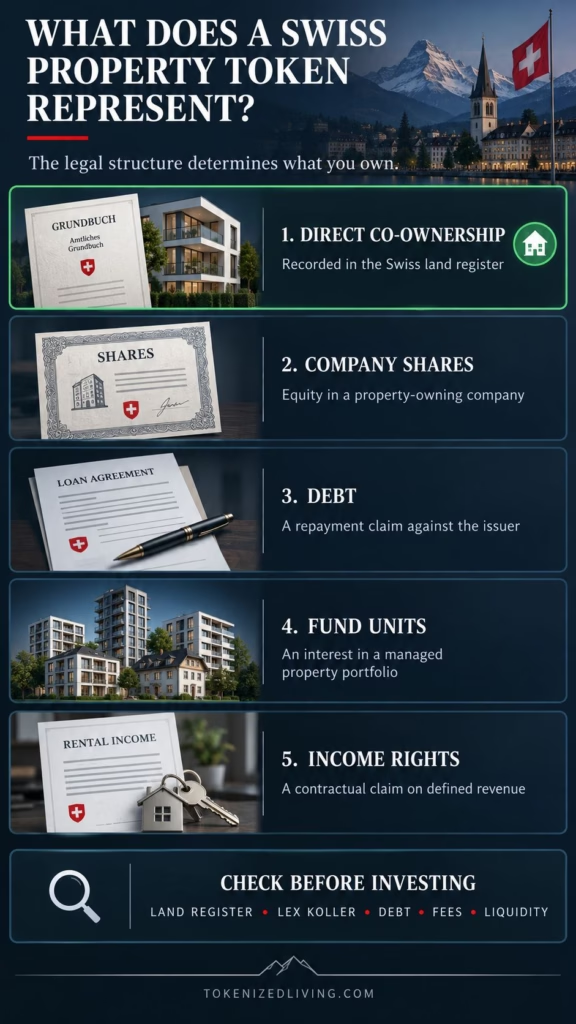
A token connected to Swiss property may represent shares in a company, a debt claim, a fund unit or a contractual right to income. It does not automatically put the investor’s name on a property deed.
Switzerland has created a strong legal framework for blockchain-based securities. However, its property laws, land registers, foreign-ownership restrictions and financial regulations still apply.
The technology can change how an investment is issued, recorded and transferred. It does not erase the legal structure underneath it.
TL;DR: Swiss law supports blockchain-based securities and regulated digital-asset infrastructure. Nevertheless, a Swiss property token does not necessarily provide direct ownership of a building. Investors must identify the issuer, legal claim, land-register owner, income rights, debt, fees, foreign-investor restrictions and exit route. Tokenization can improve administration and access, but it cannot guarantee liquidity, accurate valuations or investment returns.
Tokenized Living Insight: The blockchain may show who holds the token. The legal documents and Swiss land register determine what that token is worth and whether it represents property ownership at all.
This article provides general information and does not constitute legal, financial, investment or tax advice. Swiss property and securities rules depend on the asset, structure, canton and investor.
What Is Swiss Real Estate Tokenization?
Swiss real estate tokenization uses blockchain-based tokens to record or transfer rights connected to property.
The property remains a physical asset. It still requires maintenance, insurance, tenants, valuations and compliance with local rules. Meanwhile, the token operates as a digital layer around an investment or ownership structure.
If you are new to the subject, our guide to what tokenization means explains how off-chain assets become connected to blockchain records.
A Swiss property project might tokenize:
- Shares in a company that owns a building
- A loan made to a property company or developer
- Units in a real estate fund
- Contractual rights to specified rental or sale proceeds
- Direct co-ownership rights, where the legal and land-register requirements are satisfied
These structures are not interchangeable. Each gives the investor different rights if the property loses value, the issuer becomes insolvent or the platform closes.
Does a Swiss Property Token Give You Direct Ownership?
Usually, investors should not assume that it does.
Switzerland’s official property guidance states that the land register identifies who owns a plot and records mortgages and other rights affecting it. Direct co-ownership shares are also recorded in that register.
A blockchain entry is therefore not an automatic substitute for the land register.
When a company owns the property, the company’s name appears as the owner. Token holders may own shares or claims against that company, but they do not personally own a registered slice of the building.
The following table shows why the legal wrapper matters.
| Token structure | What the investor may hold | Who normally owns the property | Central risk |
|---|---|---|---|
| Direct co-ownership | A registered percentage of the property | The individual co-owners | Transfer, mortgage and land-register requirements can make the structure difficult to scale |
| Company or SPV equity | Shares in the property-owning company | The company or special-purpose vehicle | Shareholder rights depend on corporate documents and the company’s liabilities |
| Debt token | A repayment and interest claim | The borrower or security provider | The investor is a creditor and may have weak recovery rights if security is inadequate |
| Fund unit | An interest in a managed property portfolio | The fund or its authorised structure | Manager, valuation, redemption and portfolio risks remain |
| Revenue-sharing contract | A contractual claim on defined income | The property owner or issuer | Payment depends on contract enforceability and the payer’s solvency |
This is the same distinction that applies across fractional ownership structures. Dividing an investment into smaller units does not tell investors what those units legally represent.
How a Swiss Property Can Be Tokenized
The process begins with law and finance, not blockchain.
1. Select the property and investment model
The sponsor identifies a building, development loan or property portfolio. It then decides whether investors will receive equity, debt, fund units, co-ownership or contractual income rights.
That decision determines most of the economic and legal risk.
2. Establish the ownership vehicle
Many projects use a company or special-purpose vehicle. The vehicle may acquire the property, sign leases, borrow money and receive rental income.
Tokens can then represent shares or claims issued by that entity. Investors must examine whether other debts rank ahead of them and who controls important decisions.
3. Review property and financial regulation
The issuer must determine which rules apply. Relevant areas can include property ownership, securities, prospectuses, collective investment schemes, banking, anti-money-laundering requirements and financial-services regulation.
Switzerland follows a technology-neutral approach. FINMA generally examines a token’s economic purpose and the rights attached to it rather than accepting the issuer’s marketing label.
Our separate guide to Switzerland’s tokenization regulations examines the DLT Act, FINMA classifications and trading-venue rules in more detail.
4. Create and distribute the tokens
After the legal terms are settled, the issuer can create tokens on a selected blockchain. Transfer rules may limit which wallets can receive them.
Investors will normally complete identity and eligibility checks. The issuer may also need systems for subscriptions, distributions, voting, reporting and corporate actions.
Choosing a network involves more than comparing speed and transaction fees. Our guide to selecting a blockchain for RWA tokenization explains why custody, compliance and long-term support matter.
5. Manage the property and investor records
Tokenization does not collect rent, repair roofs or negotiate with tenants. A property manager and the issuer still perform those jobs.
Reliable systems must connect the blockchain record with bank accounts, company registers, property documents and the land register. If those records conflict, the blockchain cannot repair the underlying legal problem by itself.
How the Swiss DLT Act Helps
Switzerland’s DLT Act and associated ordinance came fully into force in 2021. The framework created legal certainty for issuing securities on distributed ledgers and introduced a licensing category for DLT trading facilities.
One important concept is the ledger-based security. This allows certain rights to be created and transferred through an electronic register when the legal and technical requirements are met.
That framework can support shares, bonds and other investment claims connected to real estate.
However, the DLT Act does not turn every property token into a deed. Nor does it approve every issuer, guarantee every smart contract or create buyers for a secondary market.
Asset tokens can fall within Swiss securities rules. Additional requirements may arise when a structure resembles a fund, accepts repayable deposits, provides financial services or involves regulated trading and custody.
Lex Koller and Foreign Investors
Claims that anyone worldwide can freely buy tokenized Swiss property are misleading.
The Federal Act on the Acquisition of Immovable Property by Persons Abroad is commonly known as Lex Koller. It can require authorisation when Swiss property is acquired by foreign nationals, foreign companies or Swiss companies under foreign control.
Whether it applies depends on several factors, including:
- The investor’s nationality and Swiss residence status
- The type and intended use of the property
- Whether the property is residential or used for qualifying commercial activity
- The legal rights represented by the investment
- Whether foreign investors gain control of a property-owning company
- The rules and decisions of the relevant canton
EU and EFTA nationals living in Switzerland generally have the same acquisition rights as Swiss citizens. Other residents and people living abroad can face authorisation requirements.
Commercial or industrial property can receive different treatment from residential investment property. Still, tokenization should never be marketed as a route around Lex Koller.
Using an SPV or dividing shares between many token holders does not make the issue disappear. The structure requires Swiss legal review before distribution begins.

Swiss Tokenization Infrastructure and Real Examples
Switzerland has credible digital-asset infrastructure. That does not mean every provider operates a retail marketplace for fractions of Swiss apartment buildings.
The distinction matters when assessing frequently cited examples.
BrickMark
BrickMark is a Zurich-based real estate tokenization company. Its website describes an end-to-end platform for structuring, issuing and managing tokenized real estate securities.
The company reports EUR 210 million in completed transactions, a USD 2.6 billion project pipeline and more than 45,000 registered investors. These are company-reported figures, not an independent assessment of active trading volume or investor returns.
BrickMark is evidence that specialist Swiss real estate tokenization infrastructure exists. Investors should still examine each issuer, property, legal wrapper and offering separately.
Mt Pelerin
Mt Pelerin provides technology and compliance services that can support real estate tokenization. Its Bridge Protocol manages the issuance, distribution, transfer restrictions and corporate actions of digital securities on compatible blockchains.
The company is affiliated with SO-FIT, a Swiss self-regulatory organisation recognised by FINMA. That status relates to its role as a financial intermediary. It does not mean FINMA has approved every property token created with its technology.
Mt Pelerin should therefore be described as infrastructure and an issuance-services provider, not automatically as a marketplace where investors can buy diversified Swiss property.
Taurus and TDX
Taurus supplies tokenization, custody and trading infrastructure to financial institutions. Its Taurus-CAPITAL platform supports several asset categories, including real estate.
In 2024, Taurus said its TDX marketplace would admit tokenized assets from issuers including Investis and Swissroc, two companies connected with real estate. This demonstrates trading infrastructure for tokenized company securities.
It does not prove that buyers receive direct title to individual Swiss buildings. They must inspect the rights attached to the particular security.
SDX
SIX Digital Exchange provides regulated infrastructure for issuing, trading, settling and holding digital securities. It strengthens Switzerland’s wider tokenization ecosystem.
Nevertheless, SDX should not be presented as a guaranteed secondary market for every real estate token. Admission, investor eligibility, custody and trading depend on the security and venue arrangements.
What Happened to the RealT Example?
Older versions of this article presented RealT as an active Swiss real estate tokenization option.
That framing is no longer suitable.
RealT focused mainly on US rental properties rather than Swiss buildings. Although it used technology supplied by Swiss-based Mt Pelerin, that did not turn its US property investments into Swiss real estate.
RealT also announced plans in July 2026 to liquidate its property portfolio. It now provides a warning about platform, property-management and liquidity risk rather than evidence that Swiss property tokenization is automatically safe.
Our tokenized real estate platform comparison explains why investors must evaluate the legal and operating model rather than the blockchain branding.
Potential Benefits of Swiss Real Estate Tokenization
Tokenization can provide meaningful improvements when the structure is sound.
Lower investment amounts
Dividing a security or economic interest into smaller units may reduce the amount needed to participate. That can broaden access to selected property investments.
It does not make the underlying property cheaper or safer.
More efficient administration
Digital registers can help issuers manage ownership records, transfer restrictions, voting and distributions. Automation may reduce some reconciliation and paperwork.
Legal, property-management, banking and compliance costs remain.
Clearer transaction records
A blockchain can provide a consistent history of token movements. Investors and administrators may gain better visibility into issuance and transfers.
The record is only as reliable as the information entered into it. A blockchain cannot verify the physical condition of a building or guarantee that a valuation is accurate.
Controlled secondary transfers
Approved investors may be able to transfer tokens through compatible venues more efficiently than conventional private securities.
This improves technical transferability. It does not guarantee liquidity, a fair price or an immediate sale.
Programmable compliance
Smart contracts can restrict transfers to eligible wallets and help automate holding periods or jurisdictional rules.
Human governance remains essential. The system also needs procedures for lost keys, court orders, inheritance, sanctions changes and erroneous transfers.
The Main Risks
The benefits and risks of tokenized real estate must always be considered together.
Legal-structure risk
An investor may believe they own property while holding only unsecured debt or a limited contractual claim. The offering documents must identify the exact right.
Property risk
Vacancies, repairs, tenant defaults, interest rates and falling valuations still affect returns. Blockchain does not change the economics of the building.
Liquidity risk
A token can be transferable without having an active market. Low trading volume may force a seller to wait or accept a substantial discount.
Platform and issuer risk
The platform may fail while the issuer survives, or the issuer may fail while the software continues running. Investors need to understand both scenarios.
Debt and priority risk
Mortgage lenders and secured creditors may rank ahead of token holders. A highly leveraged property can leave little value for equity investors after a forced sale.
Valuation risk
Private property valuations can become stale or rely on assumptions. Displaying an estimated token price does not prove that buyers will pay it.
Custody and key risk
Investors may depend on a platform wallet, qualified custodian or self-custodied address. Each model creates different risks involving access, recovery and insolvency.
Regulatory and tax risk
Eligibility, prospectus, fund, securities, AML, tax and foreign-ownership rules can all affect a project. Cross-border investors may face obligations in Switzerland and their home country.
Legal-risk box: A Swiss address, FINMA-related registration or use of a regulated service provider does not mean the investment itself has been approved. Confirm the issuer, legal claim, land-register owner, applicable licence or prospectus status, Lex Koller analysis and insolvency treatment before investing.
Due-Diligence Checklist for Investors
Before purchasing any token connected to Swiss real estate, ask:
- What precise legal right does the token represent?
- Who is named as the property owner in the Swiss land register?
- Is the token equity, debt, a fund unit, co-ownership or a contractual claim?
- Which company issued it, and where is that company incorporated?
- Does the investor have voting, information or enforcement rights?
- Has qualified Swiss counsel assessed Lex Koller?
- Is the investment open to my country and investor category?
- Which FINMA-regulated or SRO-affiliated entities are involved?
- Does the offering require a prospectus, licence or fund structure?
- How much mortgage debt or other senior debt burdens the property?
- Who manages the building, collects rent and approves expenses?
- Are valuations independent, current and explained?
- What fees apply to issuance, management, custody, trading and exit?
- Where can the token be sold, and what genuine trading volume exists?
- What happens if the platform, issuer, custodian or property manager fails?
Reviewing the relevant fractional ownership agreement clauses can help uncover transfer restrictions, voting rules, management powers and exit limitations.
Is Switzerland the Future of Tokenized Property?
Switzerland has several genuine advantages. Its DLT legislation recognises blockchain-based securities, its financial sector has developed specialist custody and trading infrastructure, and companies such as BrickMark, Mt Pelerin and Taurus provide relevant technology.
Even so, Switzerland has not placed its property market entirely on-chain.
Land registers, notaries, companies, banks, property managers and cantonal authorities remain important. Foreign-ownership rules can restrict particular structures. Meanwhile, retail secondary markets remain much thinner than public stock markets.
The strongest Swiss projects will not be those making the loudest claims about democratization or instant liquidity. They will be the ones connecting blockchain records with enforceable investor rights, accurate property information and resilient administration.
Final Verdict
Swiss real estate tokenization is credible infrastructure wrapped around a difficult asset class.
Switzerland provides one of the clearer legal environments for issuing and managing tokenized securities. It also has established providers covering issuance, custody, compliance and controlled trading.
However, none of that changes the first question an investor should ask:
What do I legally own?
If the answer is unclear, the token should be avoided.
A well-structured product can lower investment thresholds, improve records and make approved transfers more efficient. A weak product can use the same technology to package poor property, excessive debt or limited contractual rights.
The token is the digital wrapper. The property, legal documents, management and exit market determine the investment.
Frequently Asked Questions
What is Swiss real estate tokenization?
Swiss real estate tokenization uses blockchain-based tokens to represent or manage rights connected to property. Depending on the structure, a token may represent company shares, debt, a fund unit, contractual income rights or registered co-ownership.
Does a Swiss property token put my name on the deed?
Not automatically. Direct ownership and co-ownership are recorded in the Swiss land register. Many tokenized structures give investors shares or claims against a property-owning entity instead.
Can foreigners invest in tokenized Swiss real estate?
Sometimes, but access is not automatic. Lex Koller can require authorisation for acquisitions involving foreign individuals, foreign companies or Swiss companies under foreign control. The answer depends on the investor, property and legal structure.
Are Swiss real estate tokens regulated by FINMA?
There is no single classification covering every property token. Asset tokens may qualify as securities, while fund, banking, AML, financial-services or trading-venue rules can also apply. FINMA generally evaluates the economic function and rights of each structure.
Can Swiss property tokens be sold instantly?
No. Blockchain can make a token technically transferable, but resale may be restricted and there may be few buyers. Investors should verify the venue, eligibility rules, trading volume and pricing process.
Are BrickMark and Mt Pelerin property investment platforms?
BrickMark focuses on real estate tokenization infrastructure and projects. Mt Pelerin supplies issuance, compliance and blockchain tools. Neither name alone proves that a particular offering is safe, liquid or suitable for an investor.
Does the Swiss DLT Act replace property law?
No. The DLT Act supports ledger-based securities and DLT market infrastructure. Swiss property ownership, land-register, contract, tax and foreign-acquisition rules continue to apply.