
Tokenized assets can reduce investment minimums and simplify digital ownership records. However, they do not automatically make an investment safe, liquid or profitable.
The token is only the wrapper.
The underlying investment could still be a poorly managed property, an unsecured loan, an overvalued artwork or a financial product with weak legal protection.
Therefore, learning how to invest in tokenized assets does not begin with choosing a wallet or buying cryptocurrency. It begins with understanding exactly what you are buying.
This beginner’s checklist explains how to examine the asset, issuer, platform, legal rights, fees, custody arrangements and exit options before investing.
TL;DR
- Choose the asset class before choosing a platform.
- Confirm exactly what the token legally represents.
- Never assume a token provides direct ownership of the underlying asset.
- Verify the issuer, offering documents and regulatory structure.
- Check who holds the property, securities, commodities or other underlying assets.
- Understand what happens if the platform or issuer fails.
- Some platforms use normal accounts, while others require a digital wallet.
- Calculate your expected return after every fee.
- A secondary marketplace does not guarantee liquidity.
- Check investor eligibility and tax obligations before buying.
- Start with an amount you could afford to lose or leave invested for years.
- Keep independent records of every purchase, payment and distribution.
This article is for educational purposes and does not provide financial, legal or tax advice.
What Is a Tokenized Asset?
A tokenized asset is a digital token connected to an investment, financial claim or real-world asset.
The token may represent:
- a share in a property-owning company
- a unit in an investment fund
- a debt instrument
- a claim on rental or business income
- a beneficial interest in an asset
- a receipt for an asset held by a custodian
- direct ownership recorded by an issuer
- synthetic exposure created by an unrelated third party
These structures provide very different rights.
For example, a real estate token may represent shares in a company that owns a building. It does not necessarily place the investor’s name on the property title.
Similarly, a tokenized stock may provide direct ownership of a share. Alternatively, it could provide only a contractual return linked to that share.
The SEC’s January 2026 statement on tokenized securities distinguishes between securities tokenized by their issuers and tokens created by unrelated third parties. It also makes clear that the tokenization model affects the rights provided to investors.
Therefore, the first question should never be, “Which blockchain does it use?”
Ask:
What legally enforceable right do I receive in exchange for my money?
If the platform cannot answer that question clearly, do not invest.
Readers who are new to the subject should begin with our guide to what tokenization means and how it works.
Tokenized Assets Are Not One Investment Category
The phrase “tokenized assets” covers several investment markets.
Each has different risks, income sources and legal structures.
| Asset class | What the token might represent | Main risks to investigate |
|---|---|---|
| Real estate | Company shares, fund units, debt or income rights | Vacancy, repairs, valuation, legal ownership and platform failure |
| Bonds | A digital bond or interest in a debt instrument | Issuer default, interest rates, maturity and transfer restrictions |
| Private credit | A loan, note or fund interest | Borrower default, weak collateral and illiquidity |
| Public securities | Issuer-sponsored shares or third-party exposure | Counterparty risk, shareholder rights and regulatory status |
| Commodities | A claim on gold, metals or other stored assets | Custody, audits, redemption terms and storage fees |
| Art and collectibles | Shares in a company or special-purpose vehicle | Subjective valuation, storage, insurance and limited buyers |
| Investment funds | Units in a regulated or private fund | Manager performance, fees, redemption rules and asset quality |
| Carbon credits | A digital environmental credit | Verification, retirement rules, quality and regulatory changes |
Do not invest merely because an asset has been tokenized.
First decide whether you would want exposure to the underlying investment without blockchain. If the answer is no, adding a token does not improve it.
Our beginner’s guide to RWA tokenization explains the major asset categories in greater detail.
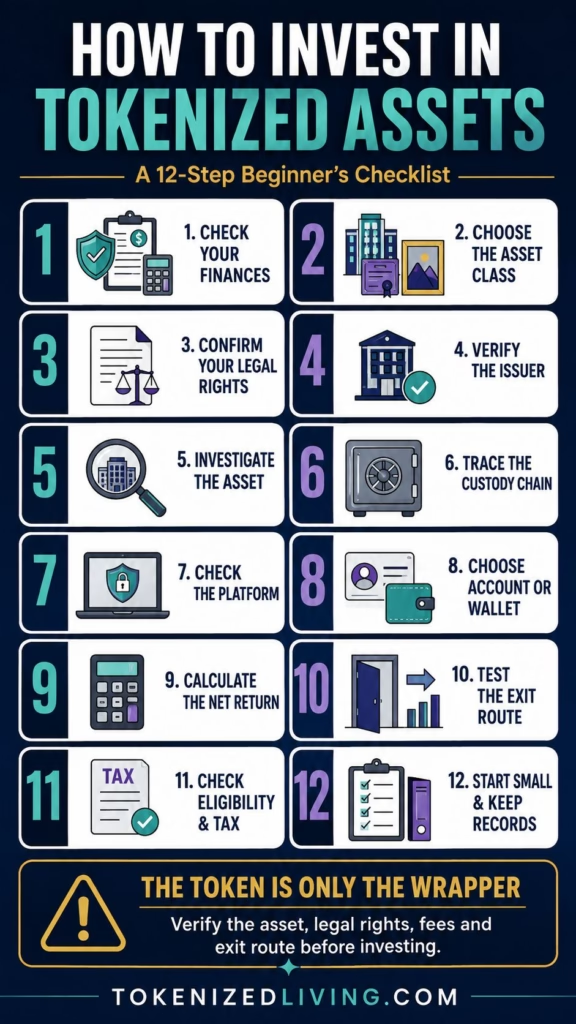
How to Invest in Tokenized Assets: A 12-Step Checklist
1. Decide Whether the Investment Fits Your Finances
Tokenized assets often come with low minimum investments. Unfortunately, a low entry price can make a risky product look harmless.
A $50 investment can still lose 100%.
Before investing, consider:
- your emergency savings
- existing high-interest debt
- investment time frame
- need for access to the money
- exposure to similar assets
- ability to withstand a complete loss
Many tokenized products are private investments with limited trading activity. You may have to hold them for several years.
Therefore, money required for rent, debt payments, emergencies or short-term goals does not belong in an illiquid tokenized investment.
Tokenization makes it easier to divide an asset. It does not make the asset suitable for everyone.
2. Choose the Asset Class Before the Platform
Beginners often start by finding an attractive platform. They then select whichever investment that platform promotes most heavily.
That reverses the correct process.
Start with the investment exposure you want.
For example:
- rental income from property
- interest from private credit
- lower-risk exposure to government securities
- long-term growth from an investment fund
- alternative exposure to art or commodities
Next, decide how much risk you can accept.
Only then should you compare platforms that provide the relevant asset class.
Otherwise, the platform’s marketing will make the investment decision for you.
If your main interest is property, read our complete guide to tokenized real estate before comparing individual offerings.
3. Confirm What the Token Legally Represents
This is the most important step.
Do not rely on the token’s name, website description or image. Read the offering documents and legal agreements.
You need to determine whether the token represents:
- direct legal ownership
- equity in a company
- a fund unit
- a debt claim
- a beneficial interest
- a right to income
- a digital receipt
- price exposure without ownership
Then identify which record proves your rights.
The authoritative ownership record might be:
- the blockchain
- a company shareholder register
- the fund administrator’s records
- the issuer’s internal ledger
- a transfer agent’s records
- a land registry
- an off-chain legal agreement
Sometimes the blockchain record forms only one part of the ownership system.
You should also check whether token holders have:
- voting rights
- rights to income
- rights to sale proceeds
- access to financial reports
- redemption rights
- protection if the issuer becomes insolvent
A blockchain transaction proves that a token moved between addresses. It does not prove that the token provides a valid claim over the underlying asset.
4. Verify the Issuer and Regulatory Structure
Find the exact legal entity issuing the investment.
A brand name is not enough.
Check:
- full company name
- registration number
- jurisdiction
- office address
- management team
- operating history
- financial statements
- regulator or licensing authority
- legal entity receiving investor funds
Next, find the offering memorandum, prospectus, subscription agreement or equivalent document.
The documents should explain:
- what is being offered
- how investor money will be used
- the major risks
- fees and conflicts of interest
- investor restrictions
- financial rights
- transfer limitations
- dispute procedures
In the United States, investors can search company filings through the SEC’s EDGAR database. They can also check financial professionals through FINRA BrokerCheck and the SEC’s Investment Adviser Public Disclosure database.
However, appearing in a filing or database does not mean that a regulator has approved the investment.
Many tokenized assets use private-placement exemptions. FINRA’s private-placement guidance explains that an offering may be registered or operate under an exemption.
An exemption is not a quality certificate.
Investors outside the United States should use their national regulator’s official register. Search the exact legal entity rather than the platform’s trading name.
If the company claims to be regulated but does not provide the regulator, licence number and licensed entity, treat that as a serious warning.
5. Investigate the Underlying Asset
The token can only be as strong as the asset and legal structure behind it.
For tokenized real estate, check:
- property address
- ownership records
- purchase price
- independent valuation
- rental history
- occupancy
- tenant concentration
- debt
- insurance
- maintenance requirements
- local property taxes
- management costs
Debt investments require an examination of:
- borrower
- interest rate
- maturity
- repayment schedule
- collateral
- seniority
- default procedure
- borrower financial condition
For art, commodities and collectibles, review:
- asset authenticity
- independent valuation
- storage
- insurance
- custodian
- inspection or audit reports
- sale procedure
Do not accept “asset-backed” as a complete explanation.
Find out which asset provides the backing, who owns it and whether token holders can enforce a claim against it.
If the platform does not disclose enough information to perform this check, walk away.
6. Examine Custody at Every Level
Tokenized investments can involve two separate custody questions.
Who holds the underlying asset?
A custodian, trustee, depositary, company or special-purpose vehicle may hold the property or financial asset.
Find out:
- the custodian’s legal name
- whether the assets remain separate from company assets
- how holdings are audited
- what happens if the custodian fails
- whether investors have redemption or enforcement rights
Who controls the token?
The token may sit:
- in a platform-controlled account
- with a regulated custodian
- in a wallet controlled by the investor
- in a smart contract
- in a wallet jointly controlled by several parties
The SEC’s retail custody bulletin explains that wallets hold the private keys used to access and transfer crypto assets. Losing a private key can permanently remove access.
However, controlling the token does not always mean controlling the underlying investment.
You need both technical control and legally enforceable rights.
7. Investigate the Platform—and Its Failure Plan
A professional website proves nothing.
Check how long the platform has operated, which legal entity runs it and whether it publishes audited or independently verified information.
Then investigate:
- regulatory permissions
- leadership history
- cybersecurity controls
- account protection
- investor complaints
- withdrawal restrictions
- smart-contract audits
- financial condition
- conflicts of interest
- dependence on affiliated companies
Most importantly, ask what happens if the platform closes.
Can investors still:
- prove ownership?
- contact the issuer?
- receive income?
- transfer their investment?
- access the underlying legal records?
- use another administrator or marketplace?
If every investor right depends on the platform’s website remaining online, the structure is weak.
An Investor.gov warning on crypto asset securities notes that investors can lose access to assets when platforms fail, suspend withdrawals or enter bankruptcy.
Blockchain does not remove platform risk.
8. Decide Between an Account and a Self-Custody Wallet
You do not always need a cryptocurrency wallet to invest in tokenized assets.
Platforms generally follow one of three models.
| Access model | How it works | Main consideration |
|---|---|---|
| Platform account | The platform holds and records the investment for you | Easier to use, but creates platform and custody dependence |
| Custodial wallet | A specialist custodian controls the keys | Professional security, but you depend on the custodian |
| Self-custody wallet | You control the private keys | Greater control, but mistakes and lost keys can be irreversible |
Account-based platforms may accept bank transfers, cards or normal currency.
Other platforms require a compatible wallet and payment in cryptocurrency or stablecoins.
Before using self-custody, confirm:
- supported blockchain
- correct wallet type
- token contract address
- network fees
- withdrawal procedure
- wallet approval requirements
- recovery and backup process
- whether transfers require platform permission
Never send money or tokens to an address copied from social media, a private message or an unofficial support account.
Start with a small test transaction when the platform permits it.
9. Calculate the Real Return After Fees
Advertised yields can be misleading.
A projected 10% return does not mean you will receive 10%.
Possible costs include:
- platform fees
- management fees
- asset administration
- property management
- custody charges
- legal fees
- insurance
- maintenance
- vacancy costs
- trading fees
- blockchain network fees
- currency conversion
- deposit and withdrawal charges
- performance fees
- taxes
Use this basic calculation:
Net return = income received + realized price change − all fees − taxes
Consider a hypothetical $1,000 investment advertising an 8% annual distribution.
That suggests $80 in income.
However, suppose you also pay:
- $10 in platform or administration fees
- $15 in currency conversion and funding costs
- $10 in withdrawal or network costs
Your first-year cash return falls to $45, or 4.5%, before tax.
The exact calculation depends on whether the advertised yield already includes certain expenses. Therefore, check whether each return figure is gross, net, historical or projected.
Never treat a projected yield as a promise.
10. Test the Liquidity and Exit Route
Tokenization can make an investment technically transferable. It cannot create buyers.
A platform may advertise a secondary marketplace even when trading volume is extremely low.
Check:
- actual completed sales
- recent trading volume
- number of active buyers
- bid and asking prices
- average time required to sell
- price discounts
- minimum holding periods
- trading windows
- redemption limits
- investor eligibility restrictions
- fees charged when exiting
Some investments can only transfer to verified investors. Others may remain locked until the issuer sells the underlying asset.
Furthermore, a platform-supported buyback is not the same as independent market liquidity. The buyback may disappear when the platform faces financial pressure.
Assume an investment is illiquid unless there is clear evidence to the contrary.
Our analysis of the benefits and risks of tokenized real estate explains why the existence of a token does not guarantee an exit.
11. Check Eligibility and Tax Obligations
Many tokenized investments are not available worldwide.
Restrictions may depend on:
- country of residence
- citizenship
- investor classification
- income or net worth
- sanctions
- local securities laws
- minimum age
- source-of-funds checks
Do not use a VPN or false address to bypass an investment restriction. Doing so could violate the platform agreement and weaken your ability to recover funds.
Tax treatment also varies by country and token structure.
Possible taxable events include:
- income distributions
- interest
- rental income
- token sales
- token swaps
- rewards
- transfers used to pay fees
- disposal of the underlying asset
- foreign currency gains
For example, the U.S. Internal Revenue Service states that digital assets are generally treated as property for federal tax purposes. Its digital asset guidance also requires taxpayers to maintain records of purchases, receipts, sales and other disposals.
That guidance applies to U.S. taxation. Investors elsewhere should check their local rules.
Do not assume the platform will provide complete tax reporting.
12. Make the First Purchase Carefully
Once the investment passes your checks, follow the platform’s official process.
A typical purchase may involve:
- Creating an account.
- Verifying your identity and address.
- Completing investor eligibility checks.
- Reading the offering documents.
- Accepting the investment agreement.
- Funding the account or wallet.
- Purchasing the tokenized asset.
- Confirming the transaction.
- Downloading the ownership and transaction records.
- Checking that the asset appears in the correct account or wallet.
Do not rush through the legal documents.
Look for restrictions, fees, risk disclosures and clauses explaining what happens after default or platform failure.
Begin with a controlled amount. Your first purchase should test the complete system, including funding, reporting, distributions and withdrawals.
A large initial investment merely increases the cost of discovering a problem.
A Quick Due-Diligence Test
Before sending money, you should be able to answer every question below.
The investment
- What is the underlying asset?
- How does it generate income or increase in value?
- Who valued it?
- What could cause it to lose money?
The token
- What does the token legally represent?
- Which record proves ownership?
- What rights do token holders receive?
- Can the issuer change those rights?
The companies
- Who issues the token?
- Who owns the underlying asset?
- Who operates the platform?
- Who holds investor money and assets?
The return
- Is the yield historical, projected or guaranteed?
- Which costs have already been deducted?
- What is the expected return after every fee?
- Could distributions stop?
The exit
- Who can buy the token?
- Is there evidence of active trading?
- Are there holding periods or redemption limits?
- What happens if the platform closes?
If you cannot answer one of these questions, delay the investment.
If the company refuses to provide the information, reject the investment.
Warning Signs of a Weak or Fraudulent Offering
Avoid platforms or issuers that use:
- guaranteed high returns
- countdown timers
- pressure to invest immediately
- vague claims of regulation
- unnamed custodians
- unverifiable partnerships
- celebrity endorsements as evidence
- referral rewards that dominate the business
- anonymous leadership
- copied or incomplete legal documents
- promises of instant liquidity
- claims that blockchain removes investment risk
- support staff who contact you through unofficial accounts
- demands for additional payments to release withdrawals
Also watch for cloned websites.
Check the domain carefully and access the platform through a saved official link. Fraudsters often create copies of investment websites with slightly altered addresses.
How Much Should a Beginner Invest?
There is no universal amount.
The correct figure depends on your finances, experience and ability to accept a loss.
Nevertheless, a beginner’s first investment should normally be small enough that:
- losing it would not affect essential expenses
- locking it up would not create financial pressure
- platform failure would not damage the wider portfolio
- it can serve as a test of the complete investment process
Low minimums allow investors to experiment cautiously. They are not an invitation to build an entire portfolio around unproven platforms.
Diversification also requires more than buying several tokens from one company. If every investment depends on the same platform, custodian, country or property market, the portfolio remains concentrated.
What Should You Do After Investing?
Due diligence does not end after purchase.
Continue monitoring:
- income payments
- financial reports
- asset valuations
- occupancy or borrower performance
- platform announcements
- custody changes
- regulatory updates
- secondary-market activity
- fees
- tax documents
Save copies of:
- offering documents
- signed agreements
- transaction confirmations
- wallet addresses
- token contract details
- payment records
- income statements
- platform correspondence
Do not rely entirely on a platform dashboard.
If the website disappears, independent records may become essential.
Should Beginners Invest Through a Tokenized Real Estate Platform?
Real estate is currently one of the most accessible tokenized asset categories for retail investors.
However, platforms use very different legal and operational structures.
Some offer shares in property-owning companies. Others provide debt, fund units or contractual income rights.
Minimum investments, eligible countries, fees and exit systems also vary.
Compare the structure rather than choosing whichever platform advertises the highest yield. Our guide to tokenized real estate platforms in 2026 provides a starting point.
Institutional involvement may improve custody and administration, but it does not remove the need for due diligence. Our analysis of institutional tokenized real estate adoption explains what is genuinely developing behind the marketing claims.
The Final Verdict
Investing in tokenized assets can provide access to markets that were once difficult or expensive to enter.
However, easier access does not equal lower risk.
Tokenization can improve ownership records, distribution and settlement. It can also reduce minimum investment sizes.
Yet it cannot fix:
- a weak asset
- an dishonest issuer
- poor management
- unreliable valuations
- missing legal rights
- insufficient buyers
- platform insolvency
- excessive fees
Therefore, beginners should focus less on the blockchain and more on the complete investment structure.
Identify the asset. Confirm your rights. Verify the companies. Trace the custody chain. Calculate the real return. Test the exit route.
Only then should you invest.
Frequently Asked Questions
Can I invest in tokenized assets without cryptocurrency?
Yes. Some platforms accept bank transfers, cards or normal currency and hold the investment in a platform account. Others require a digital wallet and cryptocurrency or stablecoins.
Do tokenized assets provide direct ownership?
Not always. The token may represent company shares, fund units, debt, income rights or synthetic exposure. Read the legal documents to determine what you own.
Are tokenized assets regulated?
The rules depend on the asset, token structure and country. Many tokenized investments qualify as securities, while others operate under different regulations or exemptions.
Are tokenized assets liquid?
Not necessarily. A token can be transferable without having enough buyers. Check actual trading activity, restrictions and exit procedures.
Is a digital wallet safer than a platform account?
Each model has different risks. Self-custody reduces dependence on a platform but makes you responsible for private-key security. A custodial account is easier to use but creates counterparty risk.
Can I lose all my money?
Yes. Losses can result from poor asset performance, issuer default, fraud, platform failure, hacking, legal disputes or an inability to sell.
What is the best tokenized asset for beginners?
There is no single best asset. Beginners should choose an understandable investment with transparent documents, credible management, clear custody and realistic fees. Avoid choosing solely by advertised yield.