
Last updated: August 10, 2026
Renewable energy tokenization sounds like a perfect match.
Solar projects need capital, while many investors want access to clean-energy infrastructure.
Blockchain can divide an investment into smaller digital units and track transfers between approved investors.
However, the token itself does not generate electricity, establish ownership, or guarantee returns.
Instead, those outcomes depend on contracts, project performance, regulation, and competent management.
The essential question is therefore simple: What does the token legally represent?
It might represent company equity, project debt, revenue rights, electricity units, or renewable energy certificates.
These structures can look similar inside a digital wallet. Economically, they are completely different.
TL;DR
- Energy tokens can represent assets, debt, revenue rights, electricity, or environmental certificates.
- A solar token rarely gives direct ownership of physical panels or land.
- Community solar usually provides electricity-bill credits. It is not automatically a tokenized investment.
- Renewable energy certificates represent environmental attributes, not project ownership.
- Blockchain may improve recordkeeping, settlement, reporting, and payment automation.
- It cannot remove project, regulatory, counterparty, technology, or liquidity risks.
What Is Renewable Energy Tokenization?
Tokenization creates digital representations of rights or assets using blockchain technology.
Renewable energy tokenization applies that process to solar farms, wind projects, batteries, or related financial contracts.
In practice, the physical asset normally remains off-chain. A company, trust, fund, or special-purpose vehicle controls it.
That link between the token and the real asset is the entire investment.
Without enforceable documents, an impressive dashboard may only display a weak contractual promise.
This is why our beginner’s guide to RWA tokenization emphasizes the off-chain legal structure.
What Can an Energy Token Represent?
| Token structure | Possible holder right | What it does not automatically provide |
|---|---|---|
| Equity token | Shares in a project company or fund | Direct title to panels, land, or equipment |
| Debt token | Interest and principal under a loan agreement | Ownership or control of the project |
| Revenue-share token | A defined portion of project revenue | Guaranteed profit or asset ownership |
| Energy token | Rights linked to electricity units or consumption | An investment return |
| REC token | Environmental attributes from renewable generation | Electricity, project equity, or carbon offsets |
| Utility token | Platform access, discounts, or services | A legal claim on project cash flow |
The “asset-backed” label proves nothing without ownership, security, redemption, and insolvency details.
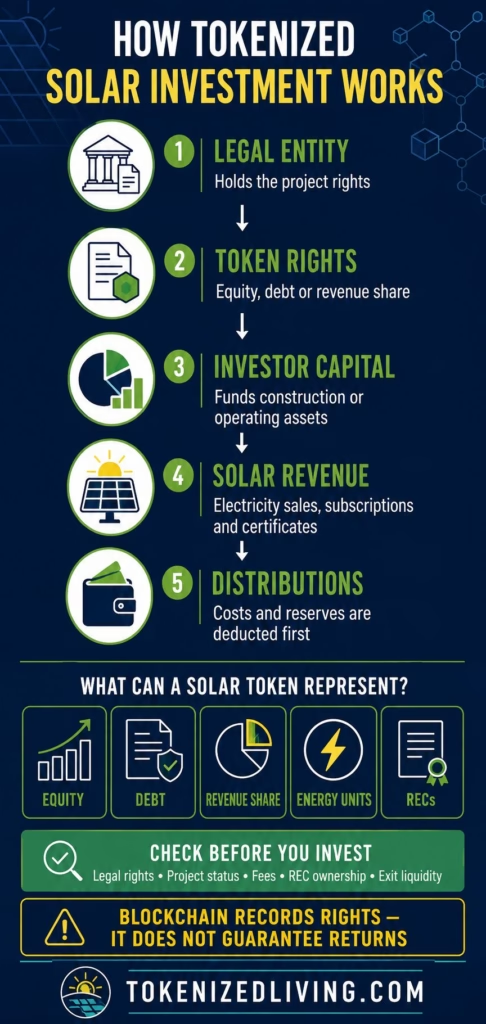
How Tokenized Solar Investment Works
A credible tokenized solar offering usually follows a recognizable structure.
1. A Legal Entity Holds the Project Rights
For example, the issuer may create a special-purpose vehicle for one project or a portfolio.
That entity might own equipment, leases, power contracts, or another operating company’s shares.
2. The Issuer Defines the Token
Offering documents should define distribution, interest, voting, redemption, information, and sale rights.
3. Investors Complete Compliance Checks
Investment tokens often require identity checks, sanctions screening, and investor-eligibility verification.
4. Capital Reaches the Project
For example, funds may finance construction, refinance existing equipment, or purchase interests in operating assets.
That distinction matters because development-stage projects carry more risk than operational projects.
5. The Project Produces Revenue
For example, projects may earn electricity revenue, subscription payments, certificates, or incentives.
6. Costs Come Out Before Distributions
However, revenue is not profit.
Operators may deduct maintenance, insurance, land leases, debt payments, taxes, administration, and reserves.
Token holders receive only the amount allowed by their contracts after those deductions.
7. Data and Payments May Move On-Chain
Oracles may transmit information to smart contracts, which can calculate payments.
Still, software cannot prove the original data’s accuracy.
Our guide to Chainlink and tokenized assets explains this data problem in more detail.
How Solar Projects Generate Investor Returns
Solar investments can produce cash flow through several channels, although electricity sales usually matter most.
A power purchase agreement may require an off-taker to buy electricity under agreed terms.
Other projects sell electricity into wholesale markets, creating greater exposure to changing prices.
Community projects may collect subscriptions, while retained renewable certificates can add revenue.
Tax benefits or public incentives may also improve project economics in certain jurisdictions.
However, token holders do not automatically receive every project benefit.
Contracts decide which cash flows reach investors and which remain elsewhere.
Weaker sunlight, equipment failures, curtailment, defaults, or rising costs can reduce projected returns.
Consequently, “backed by solar” should never be treated as another term for safe income.
Community Solar Is Not the Same as Tokenized Solar
The original article blurred these two models.
The U.S. Department of Energy defines community solar through benefits shared across multiple local customers.
Participants usually subscribe to part of an off-site solar array’s production.
They then receive credits against their electricity bills.
Some programs allow partial ownership, but many use subscriptions instead.
| Feature | Community solar subscription | Tokenized solar investment |
| Main purpose | Reduce electricity costs | Seek financial exposure or returns |
| Typical benefit | Utility-bill credit | Interest, distributions, or revenue rights |
| Geographic limits | Often tied to a utility area | Depends on securities and platform rules |
| Blockchain required | No | Usually |
| Investor status | Usually a customer or subscriber | Investor, lender, member, or token holder |
| Exit method | Cancel or transfer a subscription | Sell, redeem, or hold under offering terms |
However, a project can combine both approaches.
For example, local customers might receive bill credits while outside investors finance the project.
Nevertheless, calling something “community solar” does not explain its investment structure.
Renewable Energy Certificates Are Different Again
Renewable energy certificates, called RECs in the United States, represent environmental attributes from renewable electricity.
According to the U.S. Environmental Protection Agency, one REC corresponds to one megawatt-hour delivered to the grid.
The REC helps identify who can claim the renewable attributes connected with that generation.
It does not represent ownership of the electricity, solar farm, or operating company.
Tokenizing a REC may improve transfer records and retirement tracking.
Yet the system must prevent duplicate issuance and claims across blockchain and traditional registries.
Carbon credits are also different.
They generally represent one tonne of carbon dioxide equivalent reduced or removed.
Our tokenized carbon credits guide explains the quality and double-counting problems surrounding those markets.
Potential Benefits of Renewable Energy Tokenization
Renewable energy tokenization offers credible benefits when the underlying structure is strong.
- Smaller units may open projects to investors with less capital.
- Shared records can simplify issuance, ownership tracking, and reconciliation.
- Smart contracts may automate approved distributions and compliance rules.
- Connected dashboards can combine production, revenue, and payment data.
- Compliant markets may eventually make permitted transfers easier.
However, small minimums do not improve poor projects.
Likewise, technical transferability is not genuine liquidity.
Liquidity requires buyers, fair prices, sufficient volume, and legal permission to trade.
The Risks Investors Cannot Ignore
Renewable infrastructure still carries several serious risks.
Legal and Regulatory Risk
Tokens representing equity, debt, or profit rights may fall under securities laws.
In 2026, SEC staff explained that stocks, bonds, notes, and investment contracts can be tokenized.
Tokenization changes the format, not the underlying legal obligations.
Rules differ across countries and may restrict marketing, ownership, custody, or secondary trading.
Construction and Operating Risk
For example, projects can face delays, cost overruns, equipment failures, grid-connection problems, and maintenance disputes.
Weather variation and grid curtailment may also reduce sellable production.
Counterparty Risk
Returns may depend on developers, operators, utilities, off-takers, insurers, banks, and data providers.
Consequently, failure anywhere in that chain can reduce payments.
Liquidity Risk
A token can move between wallets within seconds.
That does not mean somebody will buy it.
Small offerings may have no active secondary market, despite claims about future liquidity.
Technology and Custody Risk
Smart-contract errors, compromised wallets, lost credentials, and platform failures can disrupt access or transfers.
Data Risk
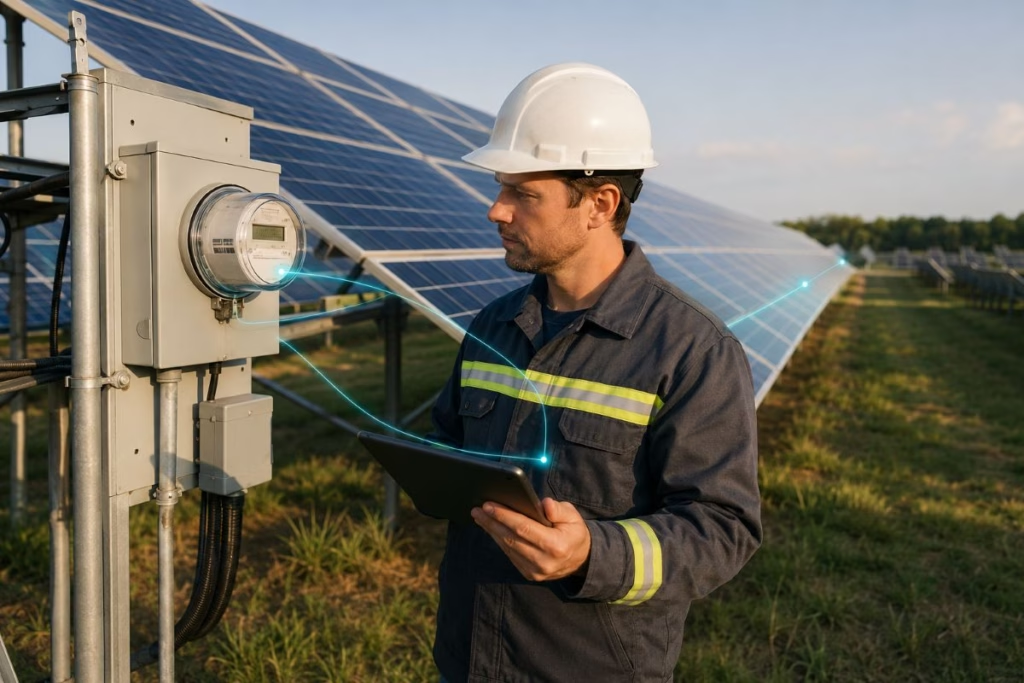
Blockchain cannot verify sunlight, meter calibration, invoices, or bank balances.
Greenwashing Risk
A green label can distract investors from weak economics or unclear environmental claims.
Projects should explain who owns the RECs and how environmental benefits are measured.
The same principle applies across other asset classes.
Our environmental-impact guide explains why digital ownership does not prove sustainability.
Real-World Examples
Plural’s Ace Solar Portfolio
Plural’s first clean-energy offering funded interests linked to operating solar projects developed by Solaris Energy.
According to Plural’s November 2024 review, Ace raised $601,000 from 50 participants.
Plural said investors could receive distributions through stablecoins or bank deposits.
The platform also connected investors with financial and production data.
This example shows how tokenization can support financing and administration for smaller infrastructure portfolios.
However, one completed raise does not prove that a deep secondary market exists.
Mundo Maipú in Argentina
Mundo Maipú operates a community solar park with 1,656 panels and 828 kilowatts-peak of capacity.
In 2025, technology provider Xcapit described a system for tokenizing the park’s generated electricity.
The project focused on traceable energy generation and exchange involving the provincial utility EPEC.
This model concerns energy units and market coordination.
It should not be mistaken for fractional equity in the solar park.
What Happened to the SunMoney–DIONE Plan?
The old article centered on a proposed partnership between SunMoney and Dione Protocol.
SunMoney marketed SDBN2 as a token backed by expanding solar-generation capacity.
Its promotional material also claimed monthly dividends and automatically growing wealth.
Those are issuer claims, not independent proof of performance.
Dione later launched the Odyssey mainnet, and its public token explorer remains online.
However, I found no reliable public confirmation that SDBN tokens deployed on Odyssey.
Dione’s published 2024 partnership review also did not mention SunMoney.
SunMoney’s SDBN2 promotional page remains accessible.
That does not verify the proposed Dione integration, asset backing, monthly distributions, or investor protections.
Therefore, readers should treat the deployment claim as unconfirmed unless the companies provide verifiable evidence.
Useful evidence would include a contract address, audited documents, asset schedules, and enforceable token-holder rights.
Renewable Energy Tokenization Due-Diligence Checklist
Before investing, demand clear answers to these questions:
- What legal right does each token represent?
- Which entity owns the project, equipment, land rights, and power contracts?
- Is the project operational, under construction, or merely planned?
- How does revenue reach the issuing entity?
- Which fees and reserves come out before investor payments?
- Who owns the RECs and other environmental attributes?
- Are financial statements and production figures independently verified?
- What happens if the developer, operator, or platform fails?
- Can investors legally resell the token, and does real trading volume exist?
- What currency, tax, and withholding rules affect net returns?
Avoid issuers hiding behind “green,” “asset-backed,” or “guaranteed by blockchain.”
The Realistic Outlook
Renewable energy tokenization has a credible use case.
Smaller solar projects often need efficient funding, reporting, and investor administration.
The strongest models will probably look less like speculative cryptocurrencies and more like digital securities infrastructure.
They will use clear entities, verified data, compliant transfers, and transparent payment rules.
Energy certificates and community markets may also use tokens without becoming investments.
Renewable energy tokenization does not need exaggerated promises to be useful.
It needs enforceable rights, functioning assets, reliable data, and honest reporting.
Frequently Asked Questions
What is renewable energy tokenization?
Renewable energy tokenization creates blockchain-based units linked to energy assets, investments, contracts, output, or environmental certificates.
Can I own part of a solar farm through tokens?
Possibly, but tokens often represent company shares, debt, or revenue rights instead.
Is community solar a tokenized investment?
Usually not. Participants generally receive utility-bill credits from subscribed production.
Are renewable energy certificates the same as carbon credits?
No. RECs concern renewable electricity attributes, while carbon credits concern greenhouse-gas reductions or removals.
Does blockchain guarantee that a token is backed by solar assets?
No. Credible backing requires legal documents, asset audits, contracts, and independent verification.
Final Thoughts
Renewable energy tokenization can widen access and improve recordkeeping, reporting, settlement, and payment administration.
However, blockchain cannot rescue a weak project or vague legal claim.
Before buying, identify the asset, issuer, rights, revenue source, costs, and exit route.
Green branding does not make a bad investment sustainable.
This article provides general education, not legal, financial, tax, or investment advice.