

Commercial real estate has traditionally required substantial capital, specialist knowledge and a long investment horizon.
Buying an office, hotel, warehouse or retail building is beyond the reach of most individual investors. Even private property funds and syndications often demand large minimum investments.
Commercial real estate tokenization aims to change how investors access these assets.
Instead of one investor purchasing an entire building, a legal interest connected to the property can be divided into smaller digital units. Investors can then buy fractional exposure through blockchain-based tokens.
However, the token is only the visible layer.
The legal structure, property economics, debt, fees and investor rights determine whether the investment works. A digital token cannot rescue a weak asset or a badly designed offering.
TL;DR
- Commercial real estate tokenization divides investment rights into digital tokens.
- Investors rarely receive their names directly on the property title.
- Tokens may represent equity, debt, fund units, trust rights or contractual claims.
- Hotels, offices, warehouses and retail properties have different income models and risks.
- Tokenization may reduce minimum investment amounts, but it does not guarantee liquidity.
- The Sapporo hotel and Tuscany resort cases show how tokenized securities can support commercial hospitality investments.
- Investors must examine the legal documents, property finances, management team, debt and exit plan.
This article is for educational purposes only. It is not financial, legal, tax or investment advice.
What Is Commercial Real Estate Tokenization?
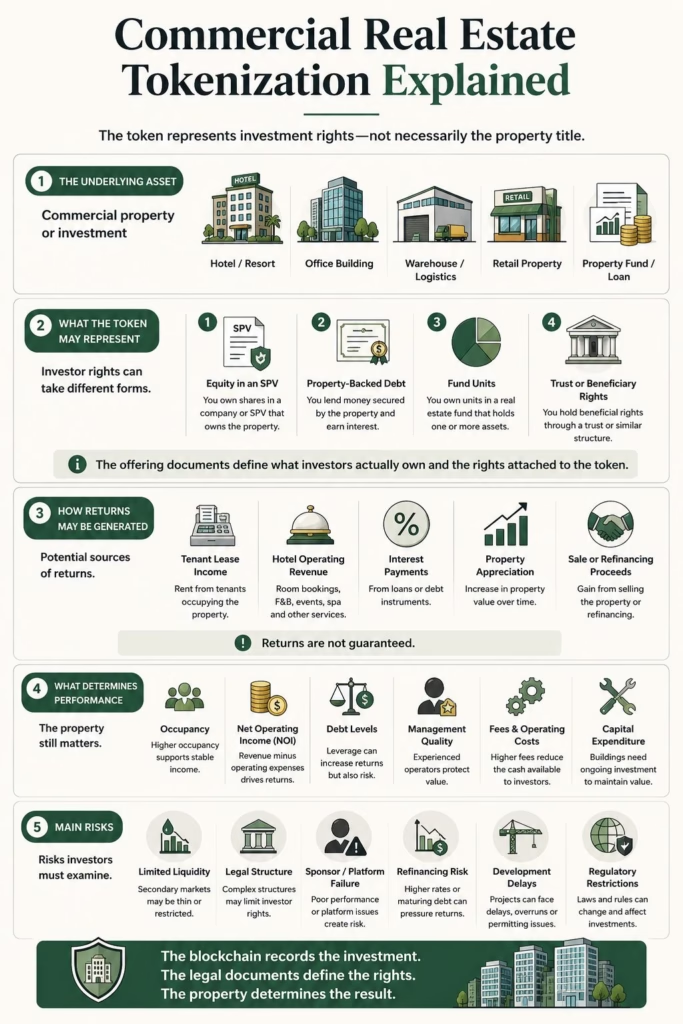
Commercial real estate tokenization uses digital tokens to represent investment rights connected to an income-producing property, property company, loan or real estate fund.
The underlying asset could include:
- An office building
- A hotel or resort
- A warehouse or logistics centre
- A shopping centre
- A mixed-use development
- A medical facility
- A student housing complex
- A multifamily apartment building
- A commercial real estate fund
- A loan secured against commercial property
Tokenization does not necessarily place the physical property title on a blockchain.
Instead, the building usually remains inside the existing legal system. A company, trust, fund or special-purpose vehicle holds the asset or controls the investment.
The digital token then represents rights defined by the offering documents.
This distinction is central to understanding how tokenized real estate works.
How Tokenized Fractional Ownership Works
A typical commercial real estate tokenization project follows several stages.
First, a sponsor identifies or acquires a commercial property.
The sponsor then places the asset inside a legal structure. Depending on the jurisdiction and offering, this could be an LLC, SPV, trust, limited partnership or regulated fund.
Next, the issuer creates investment interests connected to that structure. Blockchain-based tokens digitally represent those interests.
Investors complete identity and eligibility checks before purchasing the tokens. These checks may include know-your-customer procedures, anti-money laundering screening and securities-law restrictions.
After the investment closes, the property generates revenue. The issuer may distribute part of the available cash flow to token holders according to the offering terms.
The process can be simplified as follows:
- A sponsor selects a commercial property.
- A legal entity, trust or fund holds the asset or investment rights.
- The issuer defines the securities or contractual rights.
- Digital tokens represent those rights.
- Approved investors purchase the tokens.
- The property or investment generates revenue.
- The issuer pays distributions after expenses, debt and reserves.
- Investors may receive sale proceeds if the property eventually exits.
The blockchain can improve record-keeping, transfers and distribution processes. However, legal documents still determine ownership and investor protection.
What Do Token Holders Actually Own?
There is no universal commercial property token.
Different tokens can provide completely different rights.
Equity in a Property-Holding Company
An investor may own shares or membership interests in a company that holds the property.
In this structure, the investor owns part of the company rather than part of the title directly.
The company’s operating agreement determines voting rights, distributions, management powers and sale procedures.
Debt Secured Against Property
A token may represent a loan or note rather than equity.
The investor may receive interest payments while the borrower retains ownership of the property.
Debt investors usually sit in a different position from equity investors if the project fails. However, the precise level of protection depends on the loan documents and security arrangements.
Units in a Property Fund
Some tokens represent units in a fund that owns several commercial properties.
This model can provide greater diversification than investing in one building. However, investors have less control over individual asset selection.
Trust or Beneficiary Rights
Some jurisdictions use trusts or beneficiary certificates to connect investors with real estate assets.
Japan’s real estate security-token market has used structures in which tokenized beneficiary rights connect investors to property held through a trust.
Contractual or Synthetic Exposure
A token can also provide an economic return linked to a property without granting equity or direct ownership rights.
This creates additional counterparty risk because the investor depends on the issuer honouring the contract.
The SEC has emphasised that tokenized securities can use emphas several structures, including issuer-sponsored securities and third-party models. The technology used to record the asset does not remove existing securities-law obligations.sS
Therefore, investors should never assume that a property token automatically represents company equity.
What Usually Remains Off-Chain?
Commercial real estate tokenization often uses a hybrid structure.
Some information and transaction records may appear on-chain. However, many important parts of the investment remain off-chain, including:
- The official property title
- Lease agreements
- Planning permissions
- Property management contracts
- Bank financing
- Insurance policies
- Tax records
- Building inspections
- Legal disputes
- Independent property valuations
- Operating-company accounts
This does not make tokenization pointless.
Blockchain can still help issuers maintain investor records, automate parts of the distribution process and manage approved transfers.
However, the technology does not replace the legal and operational systems surrounding the building.
Deloitte expects asset managers to use blockchain and smart contracts increasingly across commercial real estate fund processes, including subscriptions, capital calls, distributions, reporting and redemptions. It also notes that many practical models will remain hybrid, with sensitive information and core processes staying off-arch10
Why Commercial Real Estate Tokenization Attracts Investors
The strongest argument for tokenization is access.
Commercial properties can be worth millions of dollars. Traditional private deals may also require investors to commit substantial amounts for several years.
Fractionalization can reduce the minimum investment by dividing the offering into smaller units.
As a result, an investor may gain exposure to a hotel, warehouse or commercial property fund without purchasing the entire asset.
Tokenization may also make it easier to build a property portfolio across several locations and asset types.
For example, an investor could spread capital between hospitality, logistics and office assets instead of placing everything into one property.
However, lower entry costs do not make an investment low-risk. They only make it easier to enter.
Commercial Real Estate Tokenization Case Studies
The best way to understand the model is to examine real projects.
Two hospitality cases show how tokenized securities can connect investors with commercial real estate through very different legal and regulatory structures.
Kenedix and the Tokenized Hotel in Sapporo
Kenedix issued a real estate security token linked to a hotel in Sapporo, Japan.
The approximately ¥3.4 billion issuance used the Progmat digital securities platform. MUFG acted as trustee, while Daiwa Securities served as the lead underwriter.
The structure reportedly tokenized beneficiary certificates connected to the hotel asset rather than placing the hotel title directly on-chain.
Investors also received a limited utility-token benefit that could be exchanged for souvenirs at the hotel. Although small, the perk showed how hospitality projects can combine financial rights with customer benefits
Our Kenedix, Progmat and Sapporo hotel case study explains the structure and its wider significance for Japan’s regulated security-token market.
The case also reveals an important lesson.
The tokenization infrastructure may be sophisticated, but hotel performance still depends on occupancy, room rates, tourism demand, operating costs and management quality.
Tuscany National Resort and Club
The Tuscany National Resort and Club provides a different commercial real estate example.
In 2024, Park Street Tuscany launched a $20 million Regulation D capital raise using the tZERO Securities platform.
The planned project involved a 200-acre property near Cortona, Italy. Project materials described a 47-room boutique hotel, 24 villas, a golf course, a restaurant anearch1
Our Tuscany National tokenized resort case study examines the offering and the additional risks attached to resort real estate.
Unlike a completed rental building with established tenants, a hospitality development can face acquisition, construction, completion and operational risks.
The Regulation D structure also matters. It shows that a tokenized offering can remain a private securities investment with eligibility and resale restrictions.
Tokenization may provide digital access to the investment. It does not automatically turn a private offering into an open or liquid market.
What the Two Cases Reveal
The Sapporo and Tuscany projects both involve hospitality real estate, but they are not the same investment model.
The Sapporo case used Japanese trust and security-token infrastructure connected to an operating hotel asset.
The Tuscany case used a U.S. private securities offering to raise capital for the acquisition and development of an Italian resort project.
Together, they demonstrate why investors must examine each offering separately.
The word “tokenized” tells you how the investment may be recorded or distributed. It does not tell you:
- Whether the property already operates
- Whether the token represents debt or equity
- Whether construction still needs to be completed
- Whether investors can resell their interests
- Whether income distributions have started
- Whether the investment targets retail or accredited investors
- Whether the property has substantial debt
The asset and legal documents provide those answers.
How Commercial Properties Generate Returns
Commercial real estate can produce investor returns through income, capital appreciation or both.
However, the income source depends on the asset.
Offices, Warehouses and Retail Buildings
These properties usually earn revenue through tenant leases.
The owner collects rent and pays operating expenses, management costs, maintenance, insurance and taxes.
Debt payments and capital reserves also reduce the amount available for distribution.
Hotels and Resorts
Hotels generate revenue from room bookings and other operations.
Additional income may come from restaurants, events, spas, golf courses or villas.
However, hospitality properties also carry higher operating costs. Staffing, marketing, utilities, maintenance and booking-platform fees can consume a large part of the revenue.
Development Projects
A development project may produce little or no income during construction.
Investors instead depend on successful completion, refinancing, leasing or sale.
This makes development-stage tokens fundamentally different from tokens linked to completed, income-producing buildings.
Property-Backed Debt
Debt-token investors usually receive interest rather than property income.
Their returns depend on the borrower making payments and repaying the principal.
Although collateral may provide some protection, foreclosure and recovery can still take time and cost money.
Commercial Property Metrics Investors Should Understand
A polished dashboard and a blockchain transaction record cannot replace property analysis.
Before investing, examine the commercial fundamentals.
Net Operating Income
Net operating income measures property revenue after normal operating expenses but before financing costs and taxes.
A growing NOI can support distributions and property values. A falling NOI can indicate vacancy, weak demand or rising expenses.
Occupancy
Occupancy shows how much of the property currently produces revenue.
For hotels, investors should also examine average daily rates and revenue per available room.
Lease Length
Long leases may provide more predictable income.
However, investors should check when major leases expire and whether tenants have break clauses.
Tenant Concentration
A building with one major tenant can look stable until that tenant leaves.
Investors should examine how much revenue comes from the largest occupants.
Debt and Loan-to-Value Ratio
Debt can increase returns when property values rise.
It can also magnify losses and place pressure on cash flow.
Investors should check the interest rate, repayment schedule, maturity date and refinancing plan.
Capital Expenditure
Commercial buildings require ongoing investment.
Roofs, lifts, air-conditioning systems, hotel rooms and shared areas eventually need repair or replacement.
An offering that ignores future capital expenditure may overstate the cash available for investors.
Exit Plan
Investors need to know how the sponsor expects to return their capital.
Possible exits include:
- Selling the property
- Refinancing the asset
- Selling the investment to another investor
- Redeeming the tokens
- Listing the tokens on an approved secondary market
- Holding the asset indefinitely
A vague exit plan is a warning sign.
Potential Benefits
Commercial real estate tokenization can offer genuine advantages when the legal and financial structure is sound.
Lower Investment Minimums
Fractional units may allow investors to access assets that would otherwise require substantial capital.
Greater Asset Choice
Investors may select specific properties, markets or sectors instead of relying entirely on a broad fund.
Portfolio Diversification
Smaller investment sizes can make it easier to spread capital across multiple properties.
Digital Record-Keeping
Blockchain infrastructure can help issuers maintain ownership records and process approved transfers.
Automated Processes
Smart contracts may support distributions, compliance checks and investor reporting.
Potential Secondary-Market Access
Some tokenized securities can trade through approved marketplaces.
However, this is only a potential benefit. A trading system cannot guarantee buyer demand.
For a broader assessment, see our guide to the benefits and risks of tokenized real estate.
Risks That Actually Matter
Commercial real estate tokenization combines traditional property risk with legal, platform and technology risk.
Property Performance Risk
Weak tenant demand, falling room rates or poor management can reduce income.
Vacancy Risk
Empty offices, shops or hotel rooms do not generate the expected revenue.
Development Risk
Construction delays, permit problems and cost overruns can damage development-stage projects.
Debt and Refinancing Risk
A property may struggle to refinance when interest rates rise or valuations fall.
Legal Structure Risk
Investors can lose protection if the legal wrapper, security documents or property ownership arrangements are weak.
Sponsor and Management Risk
Investors depend on the sponsor to manage the property, control expenses and communicate accurately.
Platform Risk
A platform may fail, lose funding, suffer a cyberattack or stop supporting an offering.
The property may continue to exist, but investors could still face delays and uncertainty.
Smart-Contract and Custody Risk
Code errors, wallet loss and weak custody arrangements can create additional problems.
Regulatory Risk
Tokenized securities remain subject to securities rules.
Restrictions can affect investor eligibility, marketing, custody and resale.
Currency and Cross-Border Risk
International investors may face exchange-rate movements, withholding taxes and several legal systems.
Liquidity Risk
This remains one of the most overstated benefits of tokenization.
A token can be technically transferable while remaining economically illiquid.
Investors need approved trading infrastructure, eligible buyers and sufficient market demand. Without all three, selling may prove difficult.
Traditional CRE vs Tokenized CRE vs REITs
| Feature | Direct commercial property | Tokenized commercial real estate | Public REIT |
|---|---|---|---|
| Minimum investment | Usually very high | Potentially lower | Usually low |
| Asset selection | Direct control | Often property-specific | Fund managers select assets |
| Liquidity | Low | Limited and platform-dependent | Usually high during market hours |
| Ownership | Property or controlling entity | Depends on token structure | Shares in a listed company or trust |
| Management responsibility | High | Usually handled by sponsor | Handled by REIT management |
| Diversification | Often low | Depends on portfolio | Usually broader |
| Investor control | Potentially high | Usually limited | Usually limited |
| Regulation | Property and company law | Property, securities and digital-asset rules | Public securities regulation |
| Pricing | Valuation-based | Valuation and market demand | Public market price |
Tokenized commercial real estate does not automatically beat either direct ownership or REITs.
It offers a different balance of access, asset choice, control and liquidity.
Commercial Real Estate Due-Diligence Checklist
Before investing, answer the following questions.
The Asset
- What property supports the investment?
- Is it completed, operating or still under development?
- Who valued it?
- How old is the valuation?
- What condition is the building in?
- Which expenses and repairs are expected?
The Income
- Where does the revenue come from?
- What is the current occupancy rate?
- How stable are the tenants?
- Which fees come out before investor distributions?
- How much cash will the issuer hold in reserve?
The Debt
- How much debt sits against the property?
- What interest rate applies?
- When does the loan mature?
- Could the property support higher refinancing costs?
The Token
- What legal rights does it represent?
- Is it equity, debt, a fund unit or a contractual claim?
- Which blockchain and custody system does it use?
- What happens if the platform stops operating?
Governance
- Who controls the property?
- Can the sponsor sell or refinance it without an investor vote?
- Do token holders have voting rights?
- How can investors replace a poorly performing manager?
Liquidity and Exit
- Where can the token trade?
- Who is eligible to buy it?
- Does the market have active buyers?
- Do holding periods or transfer restrictions apply?
- What is the sponsor’s intended exit timeline?
Unclear answers are not minor administrative issues. They are reasons to reject the investment.
Market Insight: The Token Is Not the Investment
Commercial real estate tokenization can improve the infrastructure surrounding property investment.
It may reduce investment minimums, digitize ownership records and automate parts of the fund-management process.
However, none of those improvements changes the fundamental economics of the asset.
A hotel still needs guests.
An office building still needs tenants.
A warehouse still needs commercial demand.
A development project still needs to finish on time and within budget.
The strongest tokenized commercial real estate projects will combine sound properties, experienced managers, clear legal rights and realistic exit plans.
What is commercial real estate tokenization?
“The token may change how investors access the deal. It does not change whether the deal is good.”
Projects that rely mainly on blockchain marketing will eventually be exposed.
Commercial real estate tokenization uses blockchain-based tokens to represent investment rights connected to offices, hotels, warehouses, retail properties, funds or property-backed loans.
Frequently Asked Questions
Do token holders own the building?
Not necessarily. They may own shares in a company, trust rights, fund units, debt instruments or contractual claims connected to the property.
Can commercial property tokens generate income?
Yes, some structures distribute cash generated by rent, hotel operations or interest payments. However, expenses, debt, fees and reserves reduce the amount available.
Can I sell a tokenized property investment whenever I want?
Not always. Resale depends on legal restrictions, platform support, investor eligibility and buyer demand.
Is tokenized commercial real estate safer than direct property?
No. Tokenization may improve access and record-keeping, but it adds platform, custody, smart-contract and regulatory risks.
Are hotels considered commercial real estate?
Yes. Hotels and resorts are commercial properties, although their performance depends heavily on business operations and tourism demand.
What happened in the Sapporo hotel case?
Kenedix issued a security token connected to a Sapporo hotel using the Progmat platform. The offering also included a small utility-token benefit for investors.
What was the Tuscany National offering?
Park Street Tuscany launched a $20 million Regulation D capital raise using the tZERO Securities platform for a resort project near Cortona, Italy.
Is fractional ownership the same as tokenization?
No. Fractional ownership divides economic or ownership rights between several investors. Tokenization digitally represents and manages those rights. Our guide to fractional ownership explains the difference in more detail.
Final Thoughts
Commercial real estate tokenization has a real purpose.
It can make large property investments easier to divide, distribute and manage. It can also give smaller investors access to assets that were previously difficult to reach.
However, access should not be confused with quality.
A tokenized hotel can fail because occupancy falls. A warehouse can lose its tenant. A development project can run out of money. A highly leveraged building can struggle to refinance.
Investors must therefore work backwards.
Start with the property.
Then examine the management, debt, income and exit plan.
After that, inspect the legal structure and investor rights.
Only then should you consider the token and blockchain infrastructure.
The token matters, but it comes last.