

Updated: September 11, 2026
Wall Street Treasury tokenization is about making familiar investments easier to hold, transfer and use within digital financial systems. Asset managers are bringing Treasury exposure onto blockchains through funds and other investment products.
The attraction is practical: earn income on cash, move eligible collateral and connect investments with digital payments.
However, a Treasury-backed token is not necessarily a Treasury bill. Its issuer, legal structure and redemption terms determine what the investor actually owns.
Understanding that difference is more useful than predicting whether tokenization will transform the entire bond market.
TL;DR
- Tokenized Treasury products can represent fund shares, secured notes or other claims linked to government debt.
- Private firms tokenizing Treasury exposure is different from the US government issuing bonds directly on a blockchain.
- Institutions are interested in cash management, collateral mobility and transaction processing.
- Transferability does not guarantee round-the-clock trading, redemption or bank withdrawals.
- Government backing of an underlying security does not guarantee the private investment product holding it.
- Fees, eligibility and legal rights matter as much as the technology.
What Does Treasury Tokenization Actually Mean?
The term covers several structures that should not be treated as interchangeable.
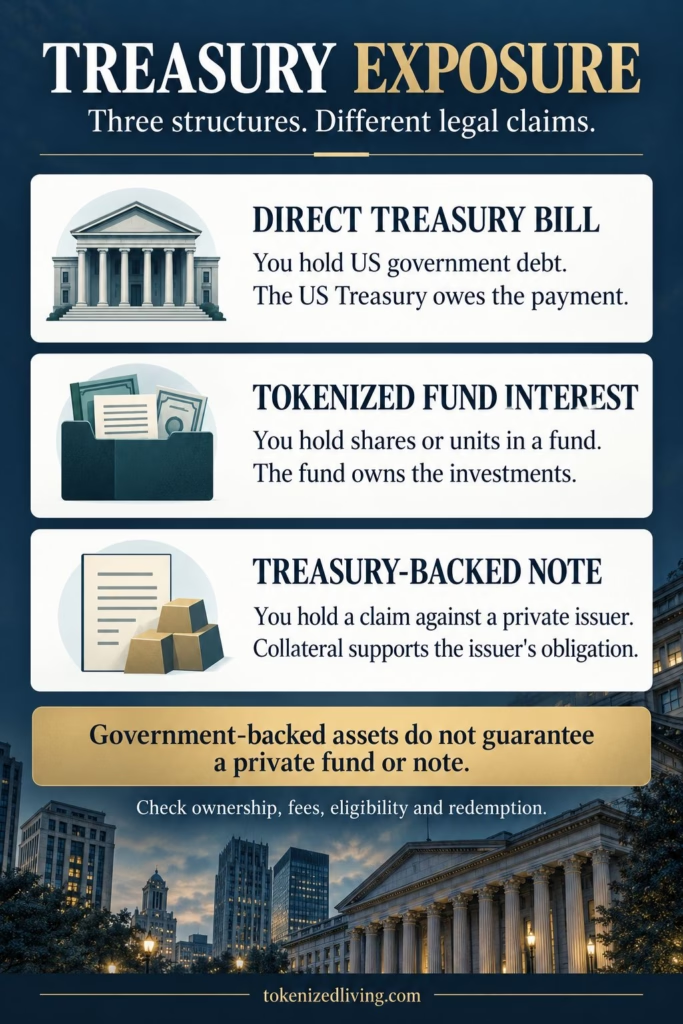
A conventional Treasury bill is a short-term debt obligation of the US government. By contrast, a tokenized fund share represents an investment in a fund. With a backed note, the investor has a claim against the note’s issuer, supported by specified collateral.
Although these products may draw income from similar assets, the investor’s legal position differs.
| Structure | What the investor holds | Main distinction |
|---|---|---|
| Direct Treasury bill | Government debt | The US Treasury owes the payment |
| Tokenized fund interest | Shares or units in a fund | The fund owns the investments |
| Treasury-backed note | A debt claim against a private issuer | Collateral supports the issuer’s obligation |
The blockchain records or transfers the relevant interest. It does not make these different claims identical.
For a practical fund example, our Superstate review explains what USTB investors own, who can participate and how its redemption conditions work.
Treasury Exposure Is Not Government Blockchain Issuance
A private manager can buy conventional bills and issue tokens representing interests in its investment vehicle.
That does not establish that the Treasury Department has moved its auction, ownership or payment systems onto the same blockchain.
Similarly, a pilot involving digital settlement is not proof that an entire national debt market has migrated.
When reading an announcement, identify what changed: the underlying security, the fund register, the trading venue or the payment process.
Why Institutions Want Tokenized Treasury Exposure
Treasury exposure can serve several purposes inside a financial institution. Tokenization’s potential value depends on which task it improves.
1. Managing Cash Between Transactions
Money waiting for its next use can still have an investment role.
An institution might hold a short-term fund while preparing for a payment or another investment. If a digital platform accepts that fund interest, it may be easier to manage alongside other digital holdings.
However, the institution must match the investment’s exit terms to its payment deadline. A yield-bearing balance is not the same as immediately spendable cash.
Consider a hypothetical $10 million balance earning 4% annually. Using a simple 365-day calculation, one day’s gross income is about $1,096.
This is an illustration, not a current product yield. It shows why even short periods can matter when an institution manages large sums.
The calculation only helps if fees and operational costs do not consume the benefit.
2. Moving Collateral
Collateral is an asset pledged to support a financial obligation. Its usefulness depends on whether the receiving institution accepts it and can enforce its rights.
The Bank for International Settlements describes how programmable systems could coordinate collateral checks, payments and securities transfers. Its research also distinguishes tokens linked to assets held in existing infrastructure from securities issued natively on a new platform. See its analysis of tokenized financial infrastructure.
For investors, the practical question is specific: which counterparty accepts this exact token, under which conditions?
A token accepted by one lending platform may be unusable elsewhere. A collateral agreement may also value it below its market price.
For example, a hypothetical 3% collateral haircut would give a $1 million holding a collateral value of $970,000. That is a risk allowance, not necessarily a trading loss.
3. Coordinating Delivery and Payment
A transaction can fail if one side delivers while the other does not pay.
Delivery-versus-payment arrangements link those actions. Programmable platforms can potentially execute both together when the required conditions are met.
However, faster processing does not remove every dependency. The payment asset must be available, both parties must qualify and the legal records must recognise the transfer.
Our assessment is that the best use cases solve a defined operational problem. Merely issuing a token does not demonstrate lower costs.
The timing distinction also matters in banking: our guide to Swift and tokenized deposits explains why customer payments and final interbank settlement can occur at different times.
What Is Already Happening?
BlackRock: Beyond the Original BUIDL Fund
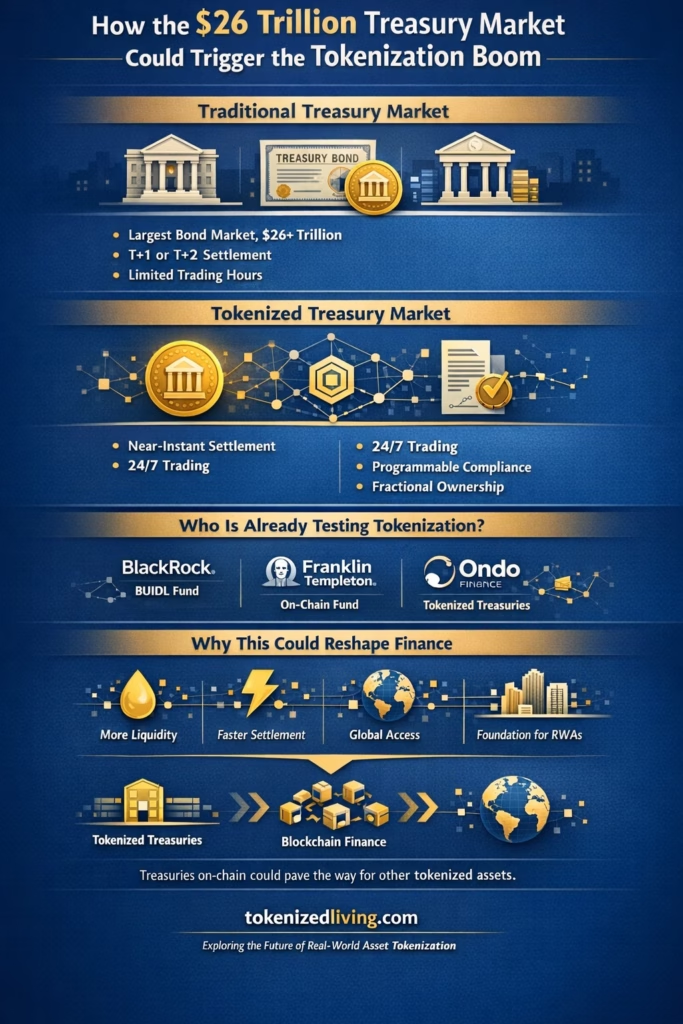
BlackRock’s BUIDL fund is an established example of tokenized fund exposure to cash, Treasury bills and repurchase agreements.
A repurchase agreement, or repo, involves a securities sale with an agreement to buy them back. It is commonly used for short-term financing.
Our BlackRock BUIDL guide explains the fund’s structure, access requirements and operational arrangements.
On August 3, 2026, BlackRock announced two further tokenized money-market products:
- BSTBL OnChain Shares: a tokenized share class of the BlackRock Select Treasury Based Liquidity Fund on Ethereum, with BNY providing transfer-agent and tokenization services.
- BRSRV: the BlackRock Daily Reinvestment Stablecoin Reserve Vehicle, designed for institutional digital-asset uses, with Securitize as transfer agent and tokenization provider.
BlackRock says both invest in cash, short-term US Treasury securities and Treasury-backed overnight repos. Its announcement describes the products and their intended uses.
These are fund developments, not evidence that the US Treasury has issued blockchain-native bills.
BlackRock’s latest tokenized fund developments covered here.
Ondo: Different Products, Different Claims
Ondo illustrates why the category needs careful labels.
OUSG provides an interest in a private fund. USDY uses a note structure backed by financial assets. Neither label should be reduced to “a Treasury bill in your wallet.”
Read our Ondo Finance review for the differences between its Treasury products, stock exposure and governance token.
Network support also deserves separate treatment. Our guide to tokenized US Treasuries on XRPL examines TBILL and OUSG in that ecosystem.
The right comparison is between specific investment structures and usable transaction routes. Token counts and blockchain lists are secondary.
Does Tokenization Make Treasuries More Accessible?
Sometimes, but broader access is not an automatic benefit.
Conventional Treasury bills already have a $100 minimum purchase through TreasuryDirect, subject to account eligibility. They are issued electronically. Those details appear in TreasuryDirect’s bill guide.
By contrast, a tokenized vehicle may restrict access by country or investor classification. A small token unit does not override those restrictions.
For someone already holding digital assets, a permitted onchain route may be convenient. Another investor may find a conventional broker or government purchasing service simpler.
Compare the route available to you rather than assuming blockchain always reduces the entry cost.
| Question | What to establish |
|---|---|
| Am I eligible? | Country, investor status and onboarding rules |
| What is the minimum? | Both purchase and redemption thresholds |
| What will I receive? | Fund interest, note or another legal claim |
| How do I exit? | Sale or redemption route and payment asset |
| What are the costs? | Fees, spreads, network charges and conversion |
Why 24/7 Transfers Do Not Mean 24/7 Cash
An investor can face several separate clocks.
The network may process transfers continuously. Meanwhile, a fund may handle requests within specified windows, and a bank may follow another schedule.
Three distinctions matter:
- Transfer: moving the investment token to another approved address.
- Sale or redemption: exchanging the investment for another asset or receiving proceeds from its issuer.
- Cash withdrawal: converting and delivering proceeds to a bank account.
Completing the first step does not guarantee immediate completion of the others.
Before relying on weekend access, ask who supplies the liquidity and whether that service has limits. Then check the payment asset you would receive.
Our secondary-market guide explains why transferability and a reliable buyer are different things.
The useful test is when you can spend the proceeds, not when a token can move.

What Investors Should Check About Yield
The blockchain does not create the underlying interest income. It changes how an investment is recorded, held or used.
Start with the portfolio. Does it hold bills directly, invest through other funds or include repo exposure?
Next, examine the yield figure. Is it before or after expenses? Does it describe recent income or a forward-looking estimate?
For illustration, assume a product earns 4% gross for a year and charges 0.25% in annual expenses. A simplified net figure would be 3.75%, before tax and other costs.
That is not a product quote. It assumes a stable investment value and excludes entry, exit and currency-conversion charges.
Also check how income reaches you. A distribution, a rising token value and automatic reinvestment create different cash-flow patterns.
If you need income for regular spending, our retirement-portfolio guide explains why projected returns and available cash need separate planning.
The Risks Tokenization Does Not Remove
Product and Custody Risk
Government backing of a Treasury security does not automatically guarantee a fund share or private note. An investor must still understand the manager, issuer and custody arrangements.
A wallet can show the token balance without showing the full legal claim. Check the governing documents and what happens if a service provider fails.
Interest-Rate and Currency Risk
Short-term investment income can decline when holdings mature and proceeds are reinvested at lower rates.
For investors spending in another currency, exchange-rate movements also affect the result. A positive dollar return can still translate into a loss in local-currency terms.
Liquidity Risk
A portfolio of liquid assets does not guarantee every investor an immediate exit.
Access rules, processing arrangements and the chosen trading venue can affect when proceeds arrive. Test the actual route before depending on it for a deadline.
Technology and Concentration Risk
Wallet security, smart contracts and network operations add responsibilities. Using bridges or lending applications can introduce further dependencies.
Holding several tokens does not necessarily spread those risks. They may rely on the same custodian, service provider or liquidity source.
Our article on tokenization and financial stability examines why these connections matter beyond individual investments.
What to Watch Next
The strongest evidence of progress will be practical results:
- More counterparties accepting the same legally defined asset.
- Clearer costs and predictable redemption procedures.
- Reliable operations during market stress and outside standard business hours.
- Better connections between investment tokens and usable payment assets.
- Reporting that separates assets under management from transaction activity.
Growth figures also need care. A tokenized fund can hold another tokenized product. Adding both values without examining the methodology can count the same underlying exposure twice.
Our view is that usable infrastructure matters more than a large headline total. Investors benefit when a service works consistently and its terms are understandable.
What Does This Mean for Tokenized Real Estate?
Treasury products can help develop tools for custody, onboarding, reporting and digital payments. Property platforms may eventually use some of that infrastructure.
However, an apartment building has its own tenants, costs and sale process. Better payment technology does not guarantee rental income or create a buyer for property shares.
Our tokenized real estate platform comparison focuses on those product-level differences.
The lesson from Wall Street Treasury tokenization is to improve the financial task first. A token is useful when its legal and operational arrangements work together.
Frequently Asked Questions
Are Tokenized Treasuries Issued by the US Government?
Many products use private funds or notes to provide exposure to conventional government debt. Identify the issuer before assuming you own a direct Treasury obligation.
Are They Guaranteed to Maintain Their Value?
No. Product structure, market conditions and operational risks still matter. Government backing of underlying securities does not guarantee every investment built around them.
Can Anyone Buy Them?
No. Eligibility depends on the product and distribution route. Fractional token units do not remove country or investor-status requirements.
Do They Always Offer Better Returns?
No. Compare net income after fees and other costs. The technology alone does not increase the return earned by the underlying assets.
Is Instant Settlement the Same as Instant Withdrawal?
No. A completed securities or token transaction may still leave conversion, redemption or banking steps before you can spend the proceeds.
Conclusion
Wall Street’s interest in Treasury tokenization has a practical foundation: managing cash, moving collateral and coordinating transactions.
Those uses deserve attention. So do the legal structure, total costs and limits on access.
Judge a product by the claim it gives you and the exit you can use. That is a stronger basis for investing than predictions about an inevitable tokenization boom.
This article provides general information, not personalised investment, legal or tax advice.