

Last updated: September 2, 2026.
Ondo Finance has become one of the largest businesses connecting traditional financial assets with public blockchains.
Its products include tokenized US Treasury exposure, yield-bearing dollar tokens and hundreds of tokenized stocks and ETFs. Furthermore, Ondo has acquired a regulated US broker-dealer, transfer agent, and trading infrastructure.
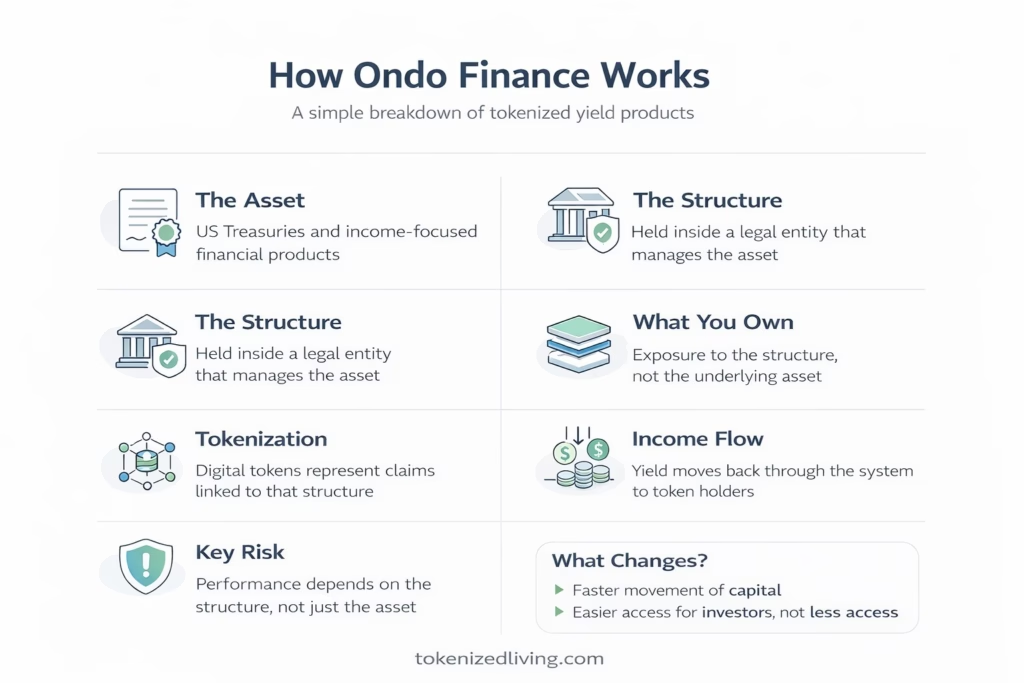
However, buying an Ondo product does not always mean owning the underlying asset directly.
OUSG represents an interest in a private fund. USDY is a tokenized note backed by financial assets. Meanwhile, most Ondo Stocks provide economic exposure without giving holders direct ownership of the referenced shares.
Ondo has also introduced a separate US custodial model with stronger shareholder rights.
Therefore, investors must identify the product, issuer, legal structure and eligibility requirements before committing money.
This Ondo Finance review examines OUSG, USDY, Ondo Stocks, fees, regulation, ownership rights and the ONDO governance token.
Ondo Finance Review: The Short Version
Ondo Finance creates tokenized products and infrastructure that connect traditional securities with blockchain networks.
Its main products include:
- OUSG for institutional Treasury exposure
- USDY for qualifying non-US investors seeking dollar-denominated yield
- Ondo Stocks for tokenized exposure to public stocks and ETFs
- Tokenization infrastructure for financial institutions
- Ondo Network for high-speed financial applications
- US securities infrastructure through Oasis Pro
- Nexus for liquidity between tokenized Treasury products and stablecoins
Ondo’s public website displayed more than 440 tokenized stocks and ETFs in September 2026. It also reported approximately $1.02 billion in Ondo Stocks TVL.
Separately, USDY had approximately $2.14 billion outstanding. Its reported underlying assets reached $2.19 billion on August 28, 2026.
OUSG held approximately $333 million on August 31, 2026.
These figures can change rapidly. They also represent different products and should not be treated as one audited company balance sheet.
| Area | Assessment |
|---|---|
| Tokenized Treasury products | Strong |
| Tokenized stock catalogue | Exceptional |
| Institutional partnerships | Strong |
| Retail accessibility | Varies by product and country |
| Ownership rights | Depend heavily on the structure |
| Fee transparency | Mixed |
| Regulatory infrastructure | Strong but entity-specific |
| Blockchain support | Extensive |
| Investor complexity | High |
| Best suited to | Institutions and experienced eligible investors |
Ondo has built serious financial infrastructure. Nevertheless, its products remain more complicated than buying ordinary shares or Treasury funds through a traditional broker.

What Is Ondo Finance?
Nathan Allman and Pinku Surana founded Ondo Finance in 2021.
The company initially concentrated on bringing institutional financial products into decentralized finance. Since then, its activities have expanded considerably.
Ondo now operates across several connected areas:
- Asset management
- Tokenized Treasury products
- Tokenized public-market exposure
- Stablecoin and token liquidity
- Blockchain settlement
- Securities infrastructure
- Regulated US trading
- Transfer-agent services
- DeFi integrations
- Financial-market execution technology
Ondo is not one legal entity providing every service.
Different companies issue, manage or administer different products. That distinction matters because registration belonging to one subsidiary does not automatically cover another.
Readers new to this area should first understand how asset tokenization works.
Ondo Finance Products Compared
Ondo’s main products do not provide identical legal rights.
| Product | What it provides | Typical eligibility | Do holders own the underlying asset? |
|---|---|---|---|
| OUSG | Interest in a private fund holding Treasury-related assets | Accredited investors and qualified purchasers | Holders own limited-partnership interests, not individual Treasury bills |
| USDY | Yield-bearing tokenized note | Qualifying non-US investors | No direct ownership of the underlying Treasuries |
| Global Ondo Stocks | Total-return exposure to stocks and ETFs | Generally eligible non-US investors | No direct title to the referenced shares |
| US custodial securities | Tokenized entitlements backed by securities held in regulated custody | Access depends on the participating regulated channel | Designed to preserve comparable shareholder rights |
| ONDO | Governance token | Depends on exchange and jurisdiction | No ownership of Ondo Finance or its financial products |
Calling all these products “tokenized assets” can hide important differences.
The blockchain token represents whatever rights its legal documents establish. Code does not create additional ownership rights by itself.
What Is OUSG?
OUSG stands for Ondo Short-Term US Government Treasuries.
The product provides exposure to short-term Treasury securities and institutional money-market funds. Its portfolio has included products managed by BlackRock, Franklin Templeton, Fidelity, WisdomTree and State Street.
OUSG does not represent individual Treasury bills held directly in an investor’s name.
Instead, OUSG tokens represent limited-partnership interests in Ondo I LP. This fund structure operates as a continuous Rule 506(c) offering under Regulation D.
The fund relies on a 3(c)(7) exemption under the Investment Company Act. Therefore, investors must generally be both accredited investors and qualified purchasers.
Ondo’s official OUSG product page lists:
- A $5,000 minimum mint
- A $5,000 minimum redemption
- Daily yield accrual
- 24/7 stablecoin minting and redemption
- A 0.15% management fee
- Management fees waived until January 1, 2027
- Fund expenses capped at 0.15% annually
- Ethereum, Polygon, Solana and XRP Ledger support
However, not every feature works identically on each network.
Ondo’s technical documentation states that instant minting and redemption are currently available only on Ethereum. Investors using other networks should confirm the latest process.
What Does OUSG Hold?
OUSG can hold interests in established Treasury and money-market products.
As of August 31, 2026, reported holdings included:
- State Street Galaxy Onchain Liquidity Sweep Fund
- BlackRock BUIDL
- Franklin OnChain US Government Money Fund
- Fidelity Treasury Digital Fund
- Other eligible short-term government products
- Cash and stablecoin liquidity
This multi-fund approach can diversify operational exposure. However, it also introduces underlying fund expenses and additional counterparties.
Our guide to BlackRock’s BUIDL fund explains one of OUSG’s important underlying holdings.
Who Can Invest in OUSG?
OUSG is not an ordinary retail Treasury product.
US investors must generally qualify as both:
- Accredited investors
- Qualified purchasers
For an individual, qualified-purchaser status usually requires at least $5 million in investments. Consequently, the $5,000 minimum does not make OUSG available to average investors.
Eligibility rules differ for companies, trusts and institutional entities.
Therefore, OUSG primarily suits institutions, funds, high-net-worth investors and blockchain businesses needing yield-bearing collateral.
What Is USDY?
USDY is the Ondo US Dollar Yield Token.
It is a tokenized note designed to provide dollar-denominated yield. Its supporting assets primarily include short-term US Treasuries, together with limited cash and bank deposits.
USDY comes in two versions:
- USDY: The token price increases as yield accrues.
- rUSDY: The price aims to remain at $1 while the wallet balance increases through rebasing.
USDY is not a conventional stablecoin. Its price can rise as income accumulates.
Moreover, USDY does not give holders ownership rights over the underlying Treasury securities. Holders instead rely on the contractual rights attached to the tokenized note.
According to Ondo’s USDY product page, the product had:
- $2.14 billion in USDY outstanding
- $2.19 billion in underlying assets
- A 105.56% reported collateralization ratio
- Approximately 97.8% of underlying assets in US Treasuries
These figures were dated August 28, 2026. Investors should check the latest attestation before making any decision.
Who Can Buy USDY?
USDY primarily targets qualifying non-US individual and institutional investors.
US persons cannot subscribe for, purchase or redeem USDY through the issuer. Other prohibited jurisdictions include Canada and several sanctioned or restricted countries.
Additional restrictions apply in some markets. Investors may need to qualify as professional, accredited or high-net-worth participants.
Ondo publishes its current USDY eligibility rules. However, these restrictions can change.
Can Anyone Receive USDY?
USDY can function as a transferable bearer-style blockchain asset. Therefore, a wallet may sometimes receive it without completing Ondo’s direct onboarding process.
However, transferability should not be confused with guaranteed redemption.
A holder may need to complete KYC and meet eligibility requirements before redeeming through the issuer. Ondo can also block restricted addresses or reject transactions that create compliance concerns.
Buying USDY through a secondary venue without confirming redemption eligibility creates an obvious risk.
USDY Versus a Stablecoin
USDY and stablecoins serve different purposes.
| Feature | USDY | Typical fiat-backed stablecoin |
|---|---|---|
| Main purpose | Yield-bearing dollar exposure | Dollar payments and settlement |
| Target price | Generally increases over time | Usually targets $1 |
| Holder yield | Reflected in token value or balance | Usually retained by the issuer |
| Underlying assets | Primarily short-term Treasuries | Cash, deposits and short-term securities |
| US availability | Not available to US persons | Often available, subject to provider rules |
| Direct redemption | Requires eligibility and onboarding | Depends on the stablecoin issuer |
| Legal form | Tokenized note | Payment or stored-value structure varies |
Their USDY may offer more yield than a standard stablecoin. Nevertheless, it introduces securities, issuer and redemption risks that ordinary users may not expect.
What Are Ondo Stocks?
Ondo Stocks brings tokenized exposure to publicly traded stocks and exchange-traded funds.
The platform’s public website displayed more than 440 assets in September 2026. These covered:
- Technology companies
- Financial companies
- Consumer brands
- Broad-market ETFs
- Sector ETFs
- Bond ETFs
- Commodity-linked ETFs
- Leveraged and inverse ETFs
- Gold and silver exposure
Ondo Stocks operates across Ethereum, BNB Chain and Solana. Tokens can also move to selected additional networks through approved bridging arrangements.
The platform permits fractional purchases. Furthermore, its direct minimum can be as low as $1.
However, investors must understand what they receive.
Do Ondo Stocks Represent Real Shares?
The global Ondo Stocks product provides economic exposure through total-return tracker tokens.
These tokens aim to follow:
- Changes in the referenced share price
- Dividends after applicable withholding tax
- Stock splits
- Mergers
- Other supported corporate actions
Ondo states that the corresponding securities are held with US-registered custodial broker-dealers. The structure also uses overcollateralization and an independent security agent.
Nevertheless, the token is not the underlying share.
Global Ondo Stocks generally do not provide holders with:
- Direct title to the referenced stock
- The right to receive the underlying shares
- Ordinary shareholder voting rights
- Statutory information rights
- A direct relationship with the public company
The issuer is Ondo Global Markets (BVI) Limited. It offers the tokens under Regulation S to eligible non-US investors.
Consequently, buying AAPLon is not legally identical to buying Apple shares through a securities broker.
The economic return may track Apple. The legal relationship does not.
Ondo’s Separate US Custodial Model
Ondo launched a different US tokenization structure in July 2026.
The first production examples involved Micron shares and BlackRock’s iShares Core S&P 500 ETF.
Under this structure:
- The underlying securities remain inside regulated US custody.
- Ondo’s registered transfer-agent subsidiary creates matching tokenized entitlements.
- Regulated custodians hold the blockchain tokens.
- Broadridge provides communications and proxy-voting infrastructure.
- Participating intermediaries apply transfer and eligibility restrictions.
Ondo says this structure gives token holders rights and protections comparable to traditional brokerage holders. These include voting, disclosures and issuer communications.
That differs significantly from the global tracker-token model.
The distinction must remain clear:
- Global Ondo Stocks generally provide economic exposure.
- US custodial entitlements connect tokens more directly with shareholder rights.
Ondo describes the arrangement in its US custodial tokenization announcement.
However, the US model does not mean every international Ondo token suddenly carries shareholder rights. Product documents still control the legal outcome.
How Do Ondo Stocks Work?
Eligible investors generally follow these stages.
1. Confirm Eligibility
Investors must first determine whether Ondo Stocks operates in their country.
The international product generally excludes US persons. Other restrictions depend on local securities laws.
2. Complete Onboarding
Direct investors complete KYC and AML checks.
Ondo may request:
- Government identification
- Address details
- Tax information
- Source-of-funds evidence
- Entity documents
- Beneficial-owner information
- Professional-investor certification
3. Fund the Purchase
Ondo Stocks uses stablecoins within its purchase and redemption process.
Investors can use USDC, while Ondo’s USDon settlement asset operates behind parts of the transaction system.
Direct bank-wire purchases of Ondo Stocks are not currently available. Large investors can acquire USDon by wire, subject to a $500,000 minimum.
4. Choose an Asset
Eligible investors select a supported stock or ETF token.
They should examine the referenced security, token structure, network and trading availability before buying.
5. Receive the Token
The investor receives a token representing the relevant contractual economic exposure.
The token can remain in an approved wallet, exchange or custody account.
6. Hold, Transfer or Redeem
Tokens can move between compatible wallets, subject to restrictions.
Ondo states that redemptions to USDon are instant. Redemptions to USDC depend on available stablecoin-swapper liquidity.
The minimum direct redemption is $1.
Our broader guide explains how to buy tokenized assets and the checks investors should complete first.
Are Ondo Stocks Available 24/7?
The tokens can move between eligible wallets at any time.
However, that does not mean the underlying stock market provides normal liquidity every hour of the week.
During standard US market hours, Ondo can use the underlying market to support pricing and arbitrage. This connection helps keep token values close to the referenced security.
When US markets close, that mechanism becomes weaker.
As a result:
- Spreads can widen
- Prices can diverge
- Quotes can become less attractive
- Certain assets may become unavailable
- Corporate events may cause trading pauses
- Prices may jump when the underlying market reopens
Ondo introduced off-hours trading for selected products. Nevertheless, its documentation warns that availability is not guaranteed.
Therefore, “24/7 tokenized stock trading” should not be interpreted as 24/7 access to ordinary stock-market liquidity.
Our analysis of blockchain-powered secondary markets explains why technical transferability does not guarantee deep liquidity.
Ondo Finance Fees
Ondo does not apply one simple fee schedule across every product.
OUSG Fees
OUSG currently lists:
- 0.15% annual management fee
- Management fee waived until January 1, 2027
- Fund expenses capped at 0.15%
- Possible expenses inside underlying funds
- Possible instant minting or redemption costs
- Blockchain network fees
Investors should confirm whether the management-fee waiver remains active.
Ondo Stocks Costs
Ondo does not advertise a universal transaction commission for every purchase.
However, the quoted buying price may sit slightly above the price Ondo pays for the underlying security. Similarly, a selling quote may sit below the underlying sale price.
Ondo can retain this difference and any associated fees.
Investors may also face:
- Blockchain gas fees
- Wallet or custody charges
- Third-party exchange fees
- Secondary-market spreads
- Bridge costs
- Stablecoin conversion costs
- Tax-reporting expenses
- Wider off-hours spreads
Therefore, “no minting fee” does not mean the transaction carries no economic cost.
Dividend Withholding
The international Ondo Stocks issuer operates from the British Virgin Islands.
Consequently, dividends from US companies generally face a 30% withholding rate before reinvestment.
For example, if a company pays a $1 dividend, approximately $0.70 may contribute to the token’s return after US withholding.
Bond and Treasury ETF distributions can receive different tax treatment. Personal tax obligations also depend on the investor’s country.
Investors should review Ondo’s current fee and tax documentation and obtain personal tax advice.
How Is Ondo Finance Regulated?
Ondo Finance operates through several legal entities.
Ondo Capital Management
The Ondo Capital Management LLC is an SEC-registered investment adviser.
It advises the OUSG fund. However, investment-adviser registration does not represent an SEC endorsement or guarantee investment performance.
Ondo I LP
Ondo I LP issues OUSG interests.
OUSG relies on Regulation D Rule 506(c) and the 3(c)(7) private-fund exemption.
Ondo Global Markets
Ondo Global Markets (BVI) Limited issues global Ondo Stocks and current USDY tokens.
The company generally offers these products outside the United States under Regulation S.
Oasis Pro Markets
Ondo completed its acquisition of Oasis Pro in October 2025.
Oasis Pro Markets operates as an SEC-registered broker-dealer and Alternative Trading System. It is also a FINRA and SIPC member.
Its registration can be checked through FINRA BrokerCheck.
In July 2026, the business received expanded FINRA authorizations covering tokenized equities, funds, primary offerings and secondary transactions.
Oasis Pro Transfer Agent
Oasis Pro TA operates as an SEC-registered transfer agent.
Its services can connect blockchain tokens with official ownership records, shareholder communications and corporate actions.
However, Ondo’s own disclosure makes an essential point:
Broker-dealer, ATS and transfer-agent registrations apply to the relevant Oasis Pro entities—not every Ondo affiliate.
Regulated subsidiaries strengthen Ondo’s infrastructure. They do not automatically make every product safe or universally available.
What Is the ONDO Token?
ONDO is the governance token for the Ondo DAO and Flux Finance.
It is entirely separate from OUSG, USDY and Ondo Stocks.
Holding ONDO does not provide:
- Ownership of Ondo Finance
- Rights to Ondo’s company revenue
- Claims on OUSG assets
- Claims on USDY collateral
- Ownership of tokenized stocks
- Guaranteed yield
- Shareholder rights in any Ondo company
ONDO holders can participate in governance over selected protocol parameters and smart-contract functions.
The token launched with an initial supply of 10 billion. Ondo Foundation states that no inflation is currently scheduled. However, governance can influence future decisions.
The Ondo Foundation’s token documentation explains its governance role.
Investors should never buy ONDO believing they are purchasing equity in Ondo Finance. They are not.
What Is the Ondo Foundation?
The Ondo Foundation is a Cayman Islands foundation company.
It supports ecosystem development, governance, education, treasury management and selected smart-contract deployments.
The Foundation is not the same organisation as Ondo Finance Inc. It also does not issue every Ondo-branded financial product.
This separation can confuse new investors because the company, Foundation, DAO and product issuers share the wider Ondo ecosystem.
Therefore, every article or investment document should identify the exact legal entity involved.
What Is the Ondo Network?
Ondo originally announced plans for Ondo Chain, an institutional blockchain for financial assets.
However, the strategy evolved.
In July 2026, Ondo introduced the Ondo Network. The company describes it as a high-speed, verifiable execution environment rather than a conventional blockchain.
The system separates:
- Private, high-speed trade execution
- Cryptographic verification
- Public-blockchain settlement
- Independent transaction attestation
Ondo Perps became its first live application.
Importantly, Ondo states that the Network is not a blockchain today. Therefore, old descriptions of Ondo Chain as a completed public blockchain are inaccurate.
The Ondo Network announcement explains the revised architecture.
The design could improve trading speed and privacy. Nevertheless, it introduces secure-enclave, attestor and operator risks that require independent evaluation.
Which Blockchains Does Ondo Support?
Ondo products operate across several networks.
Depending on the product, support includes:
- Ethereum
- BNB Chain
- Solana
- Polygon
- XRP Ledger
- Arbitrum
- Aptos
- Sui
- Stellar
- Noble
- Sei
- Mantle
- Tempo
However, not every product supports every network.
For example, OUSG exists on Ethereum, Polygon, Solana and XRP Ledger. Meanwhile, Ondo Stocks operates primarily across Ethereum, BNB Chain and Solana.
USDY has broader multi-chain distribution.
Investors should confirm:
- The correct contract address
- Whether direct minting operates on that network
- Whether redemption is available
- Which bridges are approved
- Wallet compatibility
- Gas fees
- Stablecoin support
- Transfer restrictions
- Smart-contract audit coverage
Our guide to choosing a blockchain for tokenization covers these network decisions.
Does Ondo Improve Market Efficiency?
Ondo can improve several parts of the traditional process.
Faster Settlement
Blockchain transactions can settle more quickly than conventional multi-day processes.
However, the complete transaction still depends on custodians, brokers, issuers and stablecoin liquidity.
Fractional Access
Ondo Stocks can support purchases from $1.
Nevertheless, legal restrictions still exclude investors in several countries.
Extended Availability
Tokens can move outside normal banking hours.
Still, off-hours market liquidity may weaken considerably.
Transparent Holdings
Ondo publishes product information, attestations and collateral reports.
However, an onchain token balance does not reveal every offchain legal or custody risk.
Programmability
Eligible tokens can interact with DeFi protocols, collateral systems and blockchain applications.
That utility creates new opportunities. It also creates smart-contract, liquidation and composability risks.
Cross-Border Distribution
Public blockchains can distribute assets more efficiently across supported jurisdictions.
Yet securities laws still follow the investor and issuer. Blockchain technology does not erase geographical rules.
How Secure Is Ondo Finance?
Ondo publishes smart-contract audits and operates a bug-bounty programme.
Their Stocks contracts have undergone reviews by firms including Spearbit and Cyfrin. The company also publishes information concerning collateral, custodians and third-party attestations.
Ondo Stocks uses Ankura Trust Company as an independent security agent. The agent holds a security interest in supporting collateral for token holders.
These protections are meaningful.
Nevertheless, audits do not eliminate risk. They examine specific code versions and assumptions at a particular time.
Investors should still consider:
- Upgradeable smart contracts
- Administrative keys
- Wallet compromise
- Bridge failures
- Stablecoin exposure
- Custodian insolvency
- Broker-dealer failure
- Oracle errors
- Network congestion
- Incorrect attestations
- Cyberattacks
- Regulatory intervention
Ondo’s trust and security documentation provides useful starting information.
Main Ondo Finance Risks
Underlying Asset Risk
Treasury products can lose value because of interest-rate movements, operational failures or market disruption.
Stocks and ETFs can fall sharply.
Issuer Risk
USDY and global Ondo Stocks remain obligations of their respective issuer.
Even when collateral exists, enforcement can take time and produce an incomplete recovery.
Custody Risk
Traditional securities remain with brokers, custodians or fund managers.
A blockchain token does not remove those intermediaries.
Redemption Risk
Secondary buyers may need to complete KYC before redeeming.
Ondo can reject redemptions that create legal or compliance concerns.
Stablecoin Risk
USDC and USDon support parts of the minting and redemption process.
Problems affecting those assets could interrupt settlement.
Tracking Risk
A tokenized stock may temporarily diverge from its referenced security.
This risk increases when the underlying market closes.
Smart-Contract Risk
Coding errors, upgrades or compromised administrative controls could affect tokens.
Bridge Risk
Moving tokens between blockchains adds another technical dependency.
Regulatory Risk
Tokenized securities rules continue to change.
New restrictions could affect transfers, redemptions, DeFi use or jurisdictional access.
Tax Risk
Tokenized assets can create complicated reporting obligations.
Dividend withholding may also reduce expected returns.
ONDO Token Risk
The ONDO governance token remains volatile. Its market price does not directly reflect Ondo’s product assets or business revenue.
Ondo Finance Advantages
- Large tokenized stock and ETF catalogue
- Strong tokenized Treasury products
- More than $2 billion in USDY assets
- Extensive multi-chain support
- Institutional asset-management partners
- Fractional investment capability
- Daily product information and attestations
- Regulated US subsidiaries
- Broker-dealer and ATS infrastructure
- Registered transfer-agent services
- Support for blockchain settlement
- Growing DeFi integrations
- Separate accumulating and rebasing USDY versions
- Developing US shareholder-rights model
Ondo’s Finance Disadvantages
- Product structures are difficult to understand
- Global Ondo Stocks do not provide direct share ownership
- Many products exclude US investors
- OUSG requires qualified-purchaser status
- Some jurisdictions impose additional restrictions
- Transaction costs are not always obvious
- Dividends can face 30% withholding
- Redemptions may require KYC
- Off-hours liquidity can weaken
- Blockchain bridges introduce additional risk
- Registrations apply only to specific subsidiaries
- ONDO provides no ownership of the company
- Ondo Network has a short operating history
- Product availability changes rapidly
Securitize Versus Ondo Finance
Its current focus rests more heavily on tokenized Treasuries, public-market tracker tokens and blockchain-native distribution..
Ondo currently places greater emphasis on tokenized Treasuries, public-market tracker tokens and blockchain-native distribution.
Securitize concentrates more heavily on regulated fund issuance, transfer agency, private markets and asset-manager infrastructure.
Both companies operate regulated subsidiaries. However, neither makes every product available to ordinary investors.
Our Securitize review examines its fund and investor-access model.
Who Should Consider Ondo Finance?
Ondo may suit:
- Institutional treasury managers
- Qualified purchasers
- Accredited investors
- Eligible non-US investors
- Blockchain businesses managing stablecoin reserves
- Experienced DeFi participants
- Investors seeking tokenized public-market exposure
- Financial institutions developing tokenized securities
- Users who understand self-custody
- Investors comfortable with complex legal structures
It may not suit:
- Beginners seeking a simple investment account
- US investors expecting access to the global Ondo Stocks catalogue
- Investors needing direct ownership of ordinary shares
- Anyone unwilling to complete KYC
- People expecting government deposit insurance
- Investors unable to evaluate smart-contract risks
- Users requiring guaranteed liquidity
- Anyone buying ONDO as a substitute for company equity
- Investors who may need immediate fiat withdrawals
Final Verdict: Is Ondo Finance Worth Considering?
Ondo Finance has developed into one of the strongest tokenized-asset businesses operating in 2026.
OUSG provides institutional Treasury exposure with blockchain-based settlement. USDY has become a substantial yield-bearing dollar product. Meanwhile, Ondo Stocks offers one of the largest catalogues of tokenized public-market assets.
The Oasis Pro acquisition also gives the group meaningful US regulatory infrastructure.
However, Ondo’s greatest strength creates its biggest challenge.
The ecosystem contains several issuers, token structures, investor categories and ownership models. A user cannot evaluate “Ondo Finance” as though it were one simple product.
Global tokenized stocks provide economic exposure rather than direct share ownership. USDY holders do not own the underlying Treasuries. OUSG remains restricted to wealthy eligible investors.
Ondo’s newer US custodial structure offers stronger shareholder rights, but it remains separate from the international tracker-token catalogue.
Therefore, Ondo deserves recognition for building serious financial infrastructure. It should not receive a free pass on complexity, access restrictions or legal risk.
For institutions and experienced eligible investors, Ondo offers powerful products. For ordinary users, understanding the precise legal claim matters more than the blockchain branding.
Frequently Asked Questions
Is Ondo Finance legitimate?
Ondo operates established tokenized products and works with recognised financial organisations. Certain subsidiaries hold SEC and FINRA registrations. However, investors must still investigate the specific product and issuer.
Is Ondo Finance regulated?
Some Ondo entities are regulated. Ondo Capital Management is an SEC-registered investment adviser. Oasis Pro Markets is a broker-dealer and ATS, while Oasis Pro TA is a registered transfer agent. These registrations do not apply universally across the group.
Can US investors use Ondo Finance?
Access depends on the product. OUSG accepts eligible US accredited investors who also qualify as qualified purchasers. USDY and global Ondo Stocks generally exclude US persons. Separate US tokenization structures operate through regulated channels.
What is the minimum investment?
OUSG has a $5,000 minimum. Direct Ondo Stocks purchases can start at approximately $1. Other requirements depend on the product, network and investor status.
Do Ondo Stocks provide real share ownership?
Global Ondo Stocks generally provide contractual economic exposure rather than direct title to the referenced shares. Ondo’s separate US custodial model connects tokens with stronger shareholder rights.
Does USDY always remain worth $1?
No. Standard USDY increases in price as yield accrues. Rebasing rUSDY aims to remain at $1 while the wallet balance changes.
Is USDY a stablecoin?
Ondo describes USDY as a yield-bearing tokenized note rather than a conventional stablecoin.
Are OUSGs a US Treasury?
No. OUSG represents an interest in a fund that invests in Treasury-related securities, money-market funds and liquidity assets.
Is ONDO backed by Treasuries?
No. ONDO is a governance token. It does not provide a claim on OUSG, USDY, Ondo Stocks or Ondo Finance revenue.
Does Ondo guarantee liquidity?
No. Ondo provides minting, redemption and trading infrastructure. Liquidity still depends on eligibility, stablecoin availability, market hours and underlying market conditions.
Are Ondo products insured by SIPC?
SIPC protection does not cover investment losses. Whether any protection applies also depends on the account, intermediary, asset and circumstances.
Can Ondo Finance tokenize real estate?
Ondo’s infrastructure could potentially support different securities. However, its current public products concentrate on Treasuries, stocks, ETFs and financial-market infrastructure rather than individual properties.
This article is for educational purposes only. It does not constitute investment, financial, tax or legal advice. Tokenized securities and blockchain-based products can result in the loss of some or all invested capital.