

Updated; 1st September 2026.
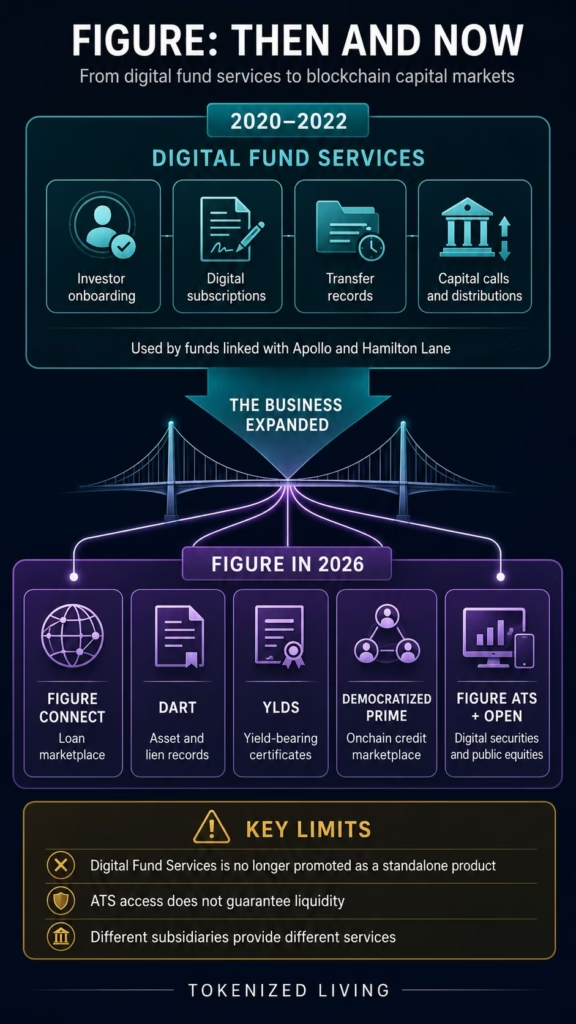
Figure launched Digital Fund Services to move fundraising, investor onboarding and fund administration onto blockchain infrastructure.
The original platform attracted major names, including Apollo and Hamilton Lane. It also promised more efficient ownership records, digital subscriptions and access to secondary trading.
However, Figure has changed considerably since that launch.
Digital Fund Services no longer appears as a prominent standalone product. Instead, Figure now focuses on blockchain-based lending, tokenized credit, digital asset markets and public equities.
Figure also became publicly traded on Nasdaq under FIGR in September 2025.
Therefore, this Figure review asks an important question: did Digital Fund Services transform fund administration, or did it become an early experiment inside a much larger blockchain capital-markets company?
Last updated: August 31, 2026.
Figure Review 2026: The Short Version
Figure Technology Solutions operates blockchain-based infrastructure for lending, credit markets, securities and digital assets.
Its current ecosystem includes:
- Figure Connect
- Blockchain-based loan origination
- DART asset and lien records
- Figure Markets
- Figure Securities
- An Alternative Trading System
- YLDS
- Democratized Prime
- The OPEN public-equity network
- Transfer-agent and investment-adviser subsidiaries
However, Figure no longer promotes Digital Fund Services as a main standalone product.
The company’s latest public filings concentrate on loan origination, Figure Connect, YLDS and Democratized Prime. They do not mention Digital Fund Services by name.
Consequently, fund managers should not assume that the original DFS package remains commercially available without first contacting Figure.
| Area | Assessment |
|---|---|
| Operating history | Strong |
| Blockchain experience | Extensive |
| Institutional credibility | Strong |
| Current fund-services transparency | Weak |
| Regulated infrastructure | Broad but divided between subsidiaries |
| Secondary-market infrastructure | Available for supported securities |
| Guaranteed liquidity | No |
| Public enterprise pricing | Unavailable |
| Best suited to | Financial institutions, lenders and sophisticated issuers |
| Retail real estate access | Not its primary purpose |
Figure remains an important tokenization business. Nevertheless, describing it simply as a digital fund-administration platform is now misleading.
What Is Figure Technology Solutions?
Mike Cagney founded Figure in 2018 after previously founding SoFi.
Figure initially concentrated on home-equity lending. It used Provenance Blockchain to record loan information and support financing, servicing and securitization.
The business later expanded into:
- Consumer credit infrastructure
- Loan marketplaces
- Digital securities
- Blockchain-based asset records
- Crypto-backed lending
- Yield-bearing digital securities
- Decentralized lending
- Public-equity infrastructure
Figure Technology Solutions and Figure Markets Holdings recombined in August 2025. Figure then completed its initial public offering the following month.
Its Class A shares began trading on Nasdaq under FIGR after Figure priced the offering at $25 per share. The official IPO announcement provides the transaction details.
Figure is not the robotics company with the same name. Figure Technology Solutions operates in financial technology and blockchain markets.
Readers comparing infrastructure providers can also review our wider guide to the leading tokenization platforms.
What Was Figure Digital Fund Services?
Figure launched Digital Fund Services in September 2020.
The original goal was to replace several manual fund-management processes with a connected blockchain system.
Its announced services included:
- Digital fundraising
- Investor onboarding
- KYC and AML checks
- Fund subscriptions
- Capital calls
- Investor communications
- Ownership records
- Transfer-agent functions
- Distributions
- Fund-interest transfers
- Primary fundraising marketplaces
- Potential secondary trading
Friends & Family Capital II became the first fund to use the system.
According to the original Digital Fund Services announcement, the fund used DFS for fundraising, onboarding, subscriptions, capital calls and transfer-agent services.
That represented a meaningful use of blockchain.
However, the announcement also described secondary trading as a future objective. It did not prove that a liquid market already existed.
How Did Figure Digital Fund Services Work?
The exact process depended on the fund. Nevertheless, the infrastructure aimed to support several connected stages.
1. Establish the Fund Structure
The fund manager created the legal fund, investment strategy and offering terms.
Blockchain software could support administration. However, it could not replace legal formation, securities advice, auditing or custody requirements.
2. Onboard Investors
Investors provided identity and eligibility information.
Figure’s Passport system could record an anonymized confirmation of verified KYC credentials. Investors could then reuse those credentials across supported opportunities.
This approach aimed to reduce repeated onboarding work.
Still, reusable credentials did not make every investor eligible for every fund. Accreditation, jurisdiction and product rules continued to apply.
3. Complete the Subscription
Approved investors reviewed the offering documents and subscribed digitally.
The blockchain recorded relevant transaction and ownership information. However, the legal documents continued to define the investor’s rights.
A blockchain entry cannot repair a defective offering agreement.
4. Manage Capital Calls and Distributions
Private funds frequently request committed capital over time.
DFS allowed managers to coordinate capital calls and distributions through its digital infrastructure. This reduced some manual communication and reconciliation.
5. Maintain Ownership Records
Transfer-agent functionality helped maintain the official investor register.
This role matters because a token alone does not automatically establish legally recognised ownership. The token must remain connected with the issuer’s official records.
6. Support Permitted Transfers
Figure’s Alternative Trading System could provide a regulated venue for supported fund interests.
However, eligible buyers still needed to exist. Transfer restrictions could also limit participation.
Therefore, access to an ATS never guaranteed liquidity.
Our guide to blockchain-powered secondary markets explains this distinction.
Apollo and Hamilton Lane Used Figure’s Platform
Figure announced an important expansion in November 2022.
Apollo and Hamilton Lane launched digitally native investment vehicles using Digital Fund Services. Figure stated that the expansion added 14 funds and special-purpose vehicles to the platform.
DFS supported:
- Onchain fund subscriptions
- Investor onboarding
- KYC credential reuse
- Capital calls
- Distributions
- Fund administration
- Potential secondary transactions
These details appear in Figure’s 2022 Digital Fund Services announcement.
Hamilton Lane also prepared blockchain-native share classes for its Private Assets Fund.
The structure used Provenance Blockchain for subscriptions, transfer records and investor servicing. Moreover, the fund operated under the Investment Company Act of 1940.
That gave Figure genuine institutional credibility.
However, Hamilton Lane’s own announcement contained an important warning.
The fund was not liquid. Its shares did not trade on a securities exchange, no secondary market existed and one might never develop.
Those warnings appeared alongside the details of the Hamilton Lane and Figure partnership.
Therefore, the old claim that Figure automatically provided continuous liquidity was wrong.
Is Figure Digital Fund Services Still Available?
The honest answer is unclear.
As of August 2026, Figure does not prominently advertise Digital Fund Services on its main website.
Furthermore, the name does not appear in Figure’s latest quarterly filing. Current investor materials instead emphasize:
- Figure Connect
- Consumer loan origination
- Digital asset marketplaces
- YLDS
- Democratized Prime
- DART
- OPEN
Figure has not publicly announced that it closed Digital Fund Services. Therefore, calling the platform discontinued would go beyond the available evidence.
However, the lack of a current product page, pricing information or updated client list matters.
The safest conclusion is:
Digital Fund Services is now a legacy Figure product name whose capabilities may have been absorbed into the company’s wider capital-markets infrastructure.
Fund managers should request written confirmation before assuming the original service remains available.
Questions should include:
- Does Figure still accept new digital fund clients?
- Which Figure entity signs the agreement?
- Which fund structures does it currently support?
- Does Figure provide complete fund administration?
- Who performs transfer-agent functions?
- Which assets can trade through the ATS?
- Which investor categories can participate?
- Which custody arrangements are available?
- What does the service cost?
- Which original DFS funds remain active?
Without clear answers, Figure should not be compared directly with a current end-to-end fund platform.
What Does Figure Offer in 2026?
Figure’s current business extends well beyond tokenized funds.
Figure Connect
Figure Connect is an electronic marketplace connecting loan originators with capital providers.
Banks, credit unions and other lenders can originate or sell loans through Figure’s infrastructure. Investors can then purchase supported loans.
Figure launched the marketplace in 2024.
Blockchain records support data integrity and transaction tracking. However, traditional documentation still establishes and transfers the underlying legal rights.
Figure Connect now represents one of the company’s most important growth areas.
DART
DART stands for Digital Asset Registry Technology.
It acts as an electronic registry for loans and liens. The system aims to help lenders and investors verify asset information, ownership changes and lien status.
Figure presents DART as an alternative to older registry processes.
Nevertheless, DART does not turn a mortgage or property into a freely tradable token. It records relevant asset and lien information within a controlled financial workflow.
Legal enforceability also depends on applicable laws, documentation and jurisdiction.
Figure Markets
Figure Markets provides access to digital asset trading, crypto-backed loans and blockchain-based financial products.
However, customers must identify the legal entity behind each service.
Figure Payments Corporation provides certain cryptocurrency services under the Figure Markets brand. Its disclosures state that it is not registered with the SEC or CFTC and is not an NFA member.
That status differs from Figure Securities, which operates regulated securities infrastructure.
The shared branding can easily confuse inexperienced users.
Figure Securities and the ATS
Figure Securities is a registered broker-dealer and a FINRA and SIPC member.
It also operates Figure’s Alternative Trading System.
Its status can be checked through FINRA BrokerCheck.
The ATS can support trading in approved digital securities. However, regulatory registration does not mean the SEC or FINRA endorses the investments.
Likewise, SIPC membership does not protect investors against ordinary market losses.
Figure Equity Solutions
Figure Equity Solutions is registered with the SEC as a transfer agent.
It can maintain official ownership records for supported blockchain-based securities.
The company also acts as transfer agent for Figure’s blockchain-native public stock and Figure Certificate Company products.
This entity most closely reflects the transfer-agent functions promoted through the original DFS platform.
YLDS
YLDS is a blockchain-based representation of interest-bearing securities issued by Figure Certificate Company.
Figure often describes YLDS as a yield-bearing stablecoin. Its investor materials also compare the product with tokenized money-market infrastructure.
However, the legal structure requires more precise language.
YLDS represents unsecured face-amount certificates. It is not a bank deposit and does not receive FDIC insurance. Furthermore, Figure’s disclosures state that it is not a conventional money-market mutual fund.
Figure Certificate Company maintains qualified assets supporting its certificate obligations. These assets can include Treasury securities, money-market instruments and repurchase agreements.
Nevertheless, investors still face issuer, credit, interest-rate and operational risks.
The Figure Certificate Company SEC filing provides detailed information about its assets, liabilities and related-party arrangements.
Therefore, investors should examine YLDS as a registered security—not assume it operates like insured cash.
Democratized Prime
Democratized Prime is an onchain lending marketplace.
It connects capital providers with borrowers seeking financing against assets. Available pools can involve:
- Home-equity loans
- Auto loans
- Small-business loans
- Crypto-backed loans
- Other cash-flowing credit assets
Rates change according to borrower demand and lender supply.
The product can create new access to real-world credit. However, it also introduces borrower, collateral, smart-contract and liquidation risks.
Figure’s own Democratized Prime disclosures warn that repayment, liquidity and asset values are not guaranteed.
Democratized Prime resembles an onchain credit marketplace more closely than a traditional investment fund.
For another approach to blockchain-based credit, compare it with our Centrifuge review.
OPEN
Figure launched the On-Chain Public Equity Network, or OPEN, in 2026.
OPEN allows companies to issue blockchain-native shares. These securities connect with the issuer’s official shareholder records instead of merely tracking a public stock’s price.
Supported shares can trade through Figure’s ATS. In addition, shareholders may gain access to lending and borrowing functions through Democratized Prime.
Figure plans to use its own blockchain stock as an early OPEN security.
However, OPEN remains a developing network. It has not yet replaced traditional public-equity infrastructure.
Figure’s OPEN announcement explains the intended model.
How Is Figure Regulated?
Figure operates through several separate companies.
Each entity performs a different function.
| Entity | Main role |
|---|---|
| Figure Technology Solutions | Public parent and technology company |
| Figure Securities | Broker-dealer, FINRA member and ATS operator |
| Figure Equity Solutions | SEC-registered transfer agent |
| Figure Investment Advisors | SEC-registered investment adviser |
| Figure Certificate Company | Registered investment company and certificate issuer |
| Figure Payments Corporation | Cryptocurrency services under the Figure Markets brand |
| Figure Lending | Consumer and crypto-backed lending activities |
This structure matters.
A licence held by one subsidiary does not automatically cover every Figure product. Customers should confirm which entity provides each service.
Figure’s SEC filings explain that Figure Securities operates the ATS, while Figure Equity Solutions performs transfer-agent functions.
Figure Investment Advisors manages Figure Certificate Company. Meanwhile, Figure Payments handles certain cryptocurrency activities without SEC or CFTC registration.
Therefore, broad claims such as “Figure is SEC regulated” lack sufficient precision.
What Role Does Provenance Blockchain Play?
Figure builds much of its blockchain infrastructure on Provenance Blockchain.
Provenance is a public blockchain designed for financial assets. It uses HASH as its native network token.
Figure has used the network for:
- Recording loan information
- Tracking ownership changes
- Supporting securities
- Processing digital transactions
- Maintaining asset histories
- Operating smart-contract systems
- Managing blockchain-based certificates
However, Figure and Provenance Blockchain are not the same entity.
Figure’s SEC disclosures also reveal an important limitation. The company continues to maintain traditional documentation for asset originations and ownership transfers.
Blockchain records provide an additional verification layer. They do not always replace the legal records.
That distinction is crucial.
If the onchain and legal records conflict, contracts, transfer-agent records and applicable law may determine ownership.
Figure also acknowledges risks connected with HASH, network availability, regulation and Provenance’s reputation in its public registration filing.
Businesses evaluating a network should also read our guide to choosing a blockchain for tokenization.

Does Figure Guarantee Regulatory Compliance?
No.
Figure provides regulated entities, identity checks, ownership records and transfer controls. These components can support a compliant offering.
However, Figure cannot guarantee compliance with every law.
Fund managers and issuers remain responsible for:
- Selecting the correct legal exemption
- Preparing offering documents
- Determining investor eligibility
- Following marketing restrictions
- Managing tax obligations
- Meeting reporting requirements
- Protecting investor information
- Complying across different jurisdictions
Smart contracts can enforce programmed restrictions. Nevertheless, they cannot determine whether the underlying legal interpretation is correct.
Consequently, issuers still need qualified legal, tax and regulatory advisers.
Our guide explaining how to tokenize an asset covers several of these legal and operational stages.
Does Figure Guarantee Secondary-Market Liquidity?
No.
Figure operates an ATS for supported securities. That creates infrastructure for regulated secondary transactions.
However, a trading venue cannot create demand by itself.
Liquidity depends on:
- The number of eligible buyers
- Investor interest
- Transfer restrictions
- Available market makers
- Pricing transparency
- Asset quality
- Fund redemption terms
- Jurisdictional limitations
- Trading volume
Hamilton Lane explicitly warned that its blockchain-native fund remained illiquid. It also stated that a secondary market might never develop.
Figure now gives a similar warning for its blockchain stock. Its SEC disclosure states that ATS eligibility does not guarantee a market, sufficient depth or easy sales.
Therefore, the correct distinction is simple:
Blockchain can improve transferability and settlement. It cannot guarantee liquidity.
Who Can Use Figure?
Eligibility depends on the product.
Figure serves several different audiences:
- Banks
- Credit unions
- Loan originators
- Institutional investors
- Asset managers
- Public and private companies
- Accredited investors
- Qualified purchasers
- Retail users of selected Figure Markets products
The original Digital Fund Services platform concentrated primarily on fund managers and eligible private-market investors.
Meanwhile, products such as YLDS and Democratized Prime use different eligibility, account and jurisdictional rules.
A Figure Markets account does not automatically provide access to every Figure security.
Investors should confirm:
- Product availability in their country
- Accreditation requirements
- Minimum investment
- Wallet requirements
- Custody arrangements
- Transfer restrictions
- Redemption conditions
- Tax treatment
Readers new to these products should first review our guide explaining how to buy tokenized assets.
Figure Pricing and Fees
Figure does not publish a standard enterprise price for Digital Fund Services.
Fund managers would need to request a tailored quotation—assuming Figure still accepts new DFS clients.
Potential issuer costs could include:
- Platform implementation
- Legal structuring
- Investor verification
- Fund administration
- Transfer-agent services
- Blockchain deployment
- Wallet integration
- Subscription processing
- Capital-call administration
- Distributions
- Secondary-trading services
- Custom development
- Ongoing technical support
Investors may also encounter:
- Fund management fees
- Administration expenses
- Trading charges
- Blockchain transaction fees
- Stablecoin conversion costs
- Withdrawal or redemption charges
- Interest spreads
- Custody costs
No universal fee applies across every Figure product.
Therefore, users must examine the relevant agreement, prospectus or offering memorandum.
The absence of transparent DFS pricing remains a weakness.
How Secure Is Figure?
Figure states that it holds ISO 27001 certification and maintains SOC 2 compliance.
It also reports using third-party audits, penetration testing, cloud-security controls and web-application protection. These claims appear in Figure’s technology documentation.
That provides more public security information than many smaller tokenization platforms offer.
However, certifications do not eliminate risk.
Figure’s own filings discuss:
- Cyberattacks
- Smart-contract vulnerabilities
- Administrative-key risks
- Network failures
- Data breaches
- Third-party provider failures
- Wallet loss
- Blockchain congestion
- Irreversible transactions
Fund managers should still request current audit reports and security documentation.
Important questions include:
- Which smart contracts have received independent audits?
- Who controls administrative keys?
- How does Figure protect KYC information?
- Which data remains offchain?
- Who can reverse or correct ownership records?
- How does the company respond to a network outage?
- What happens after a wallet compromise?
- Which insurance policies apply?
- How often does Figure conduct penetration testing?
- Which entity handles incident response?
Security depends on the complete legal and technical system—not merely the blockchain.
Figure’s Current Scale and Financial Position
Figure’s public listing provides significantly more financial information than the original article contained.
For the second quarter of 2026, Figure reported:
| Metric | Q2 2026 |
|---|---|
| Ecosystem volume | $4.95 billion |
| Figure Connect volume | $2.77 billion |
| Digital asset marketplace volume | $691.5 million |
| Net revenue | $225.6 million |
| Net income | $87.4 million |
| YLDS in circulation at quarter-end | $556.0 million |
| Democratized Prime matched offers | $391.8 million |
These figures appear in Figure’s second-quarter 2026 SEC filing.
By July 2026, Figure reported more than 380 partners and approximately $29 billion in home-equity originations across Figure and its partners.
These numbers demonstrate genuine scale.
However, they do not measure Digital Fund Services. Most of Figure’s current activity comes from lending, credit and newer digital-asset products.
Readers should not mistake total ecosystem volume for tokenized fund assets.
Figure Advantages
- Operating history dating from 2018
- Genuine blockchain activity
- Public-company financial reporting
- Experience with regulated securities
- Registered broker-dealer subsidiary
- Alternative Trading System
- Registered transfer-agent subsidiary
- Investment-adviser infrastructure
- Apollo and Hamilton Lane history
- Large loan-origination ecosystem
- Figure Connect marketplace
- DART asset records
- YLDS and Democratized Prime growth
- Onchain public-equity development
- ISO 27001 and SOC 2 claims
- Stronger financial performance in 2026
Figure Disadvantages
- Digital Fund Services’ current status remains unclear
- No active DFS product page
- No updated fund-client catalogue
- Enterprise pricing lacks transparency
- Current business focuses more heavily on credit
- Corporate structure can confuse customers
- An ATS does not guarantee liquidity
- Blockchain records do not always replace legal records
- Provenance creates network dependency
- Some products introduce DeFi and smart-contract risks
- Investor access varies between products
- Several services remain US-focused
- Figure Markets branding covers differently regulated entities
- Historical marketing can overstate accessibility
What Are the Main Risks?
Product-Status Risk
Fund managers cannot easily verify whether the original DFS package remains available.
The absence of current information creates commercial uncertainty.
Underlying Investment Risk
A tokenized fund can lose money because of poor investments, defaults or falling asset values.
Blockchain does not improve the underlying portfolio.
Credit Risk
Figure’s current products rely heavily on loans and credit assets.
Borrowers may default. Collateral may also recover less value than expected.
Liquidity Risk
Investors may struggle to sell fund interests, loans or blockchain securities.
ATS access does not guarantee buyers.
Smart-Contract Risk
Programming errors could disrupt trading, collateral management, distributions or redemptions.
Administrative privileges also create points of control.
Provenance Blockchain Risk
Network problems, governance disputes or regulatory changes involving HASH could affect Figure’s blockchain operations.
Figure maintains traditional records partly because blockchain infrastructure can fail or face legal uncertainty.
Regulatory Risk
Rules governing digital securities, stablecoins, DeFi, custody and blockchain records continue to evolve.
New interpretations could restrict existing products.
Cybersecurity Risk
Attackers may target investor accounts, wallets, personal information or administrative systems.
Third-party providers can create additional vulnerabilities.
Custody and Wallet Risk
Users may lose access to self-custodied assets if they lose their private keys.
Custodians introduce separate counterparty and operational risks.
Legal-Record Risk
The blockchain may not represent the sole official record.
Investors must understand which documents and records establish legal ownership.
Company Risk
Figure reported strong results in 2026. Nevertheless, no technology provider is risk-free.
Issuers should prepare contingency plans for service interruptions, contract termination or provider changes.
Figure Compared With Other Tokenization Platforms
Figure no longer fits neatly into one platform category.
Its current strengths lie in:
- Loan origination
- Credit marketplaces
- Blockchain asset records
- Digital securities
- Yield-bearing certificates
- Onchain lending
- Public-equity infrastructure
By comparison, Securitize currently presents a clearer end-to-end tokenized fund offering.
Centrifuge focuses more heavily on connecting real-world credit with DeFi markets.
Meanwhile, Tokensoft concentrates on compliant token events, investor onboarding and distributions.
Figure remains broader than these businesses in some areas. Yet its current fund-administration proposition is less transparent.
Therefore, fund managers should choose according to the required service—not the company’s overall size.
Who Should Consider Figure?
Figure may suit:
- Banks and credit unions
- Loan originators
- Institutional loan investors
- Companies exploring blockchain-native securities
- Issuers needing transfer-agent infrastructure
- Asset managers seeking customised blockchain systems
- Investors who understand tokenized credit
- Companies evaluating onchain public equities
- Institutions comfortable with Provenance Blockchain
It may not suit:
- Small fund managers wanting transparent fixed pricing
- Retail investors seeking tokenized property
- Investors needing guaranteed liquidity
- Users expecting permissionless securities trading
- Businesses seeking a clearly advertised turnkey fund platform
- Investors unwilling to complete KYC checks
- Anyone who does not understand credit or smart-contract risks
- Non-US issuers requiring extensive global distribution
Final Verdict: Is Figure Still a Digital Fund Platform?
Figure remains one of the most substantial blockchain financial businesses operating in 2026.
Its early Digital Fund Services platform introduced credible ideas. These included reusable investor verification, digital subscriptions, transfer records, capital calls and blockchain-based fund servicing.
Apollo and Hamilton Lane provided valuable institutional validation.
However, Digital Fund Services no longer defines Figure.
Current public materials concentrate on lending, Figure Connect, DART, YLDS, Democratized Prime and onchain equities. Meanwhile, the DFS name has largely disappeared.
That does not mean the original technology failed. Figure may have integrated parts of it into its wider infrastructure.
Nevertheless, fund managers should not assume that the 2020 service remains available in its original form.
Figure also deserves credit for developing regulated infrastructure and achieving meaningful operating scale. Its public listing gives customers more financial transparency than most private tokenization providers offer.
Still, the platform’s complexity creates risks.
Different subsidiaries provide different services. An ATS does not guarantee liquidity. Blockchain records may coexist with traditional legal documentation. Furthermore, current credit products carry genuine borrower and collateral risks.
The final conclusion is straightforward:
Figure is now a blockchain-native capital-markets and credit company with a legitimate digital fund-services history—not a clearly marketed standalone fund-administration platform.
That distinction must guide any honest Figure review.
Frequently Asked Questions
Is Figure a legitimate company?
Figure Technology Solutions is a publicly traded financial-technology company listed on Nasdaq under FIGR. Its group includes several regulated financial entities. However, legitimacy does not guarantee investment performance.
What happened to Figure Digital Fund Services?
Figure has not announced its formal closure. Nevertheless, it no longer promotes DFS as a major standalone product. Its capabilities may have been absorbed into Figure’s broader infrastructure.
Does Figure still provide fund administration?
Figure historically provided fund operations and administration through DFS. Prospective clients should ask Figure which services remain available and which entity provides them.
Is Figure SEC regulated?
Certain Figure subsidiaries hold SEC registrations. Figure Securities is a broker-dealer, while Figure Equity Solutions is a transfer agent. Figure Investment Advisors is an investment adviser. These registrations do not cover every Figure service.
Does Figure guarantee regulatory compliance?
No. Figure can support identity checks, records and transfer restrictions. Issuers remain responsible for legal structuring and regulatory compliance.
Does Figure guarantee secondary-market liquidity?
No. Figure operates an ATS, but trading infrastructure cannot guarantee buyers, market depth or successful sales.
What blockchain does Figure use?
Figure primarily uses Provenance Blockchain. However, it also maintains traditional documentation for many asset and ownership records.
What is YLDS?
YLDS represents interest-bearing face-amount certificates issued by Figure Certificate Company. It is a registered security represented on blockchain infrastructure.
Is YLDS FDIC insured?
No. YLDS is not a bank deposit and does not receive FDIC insurance. Investors can lose money.
Is Figure publicly traded?
Yes. Figure Technology Solutions trades on Nasdaq under FIGR.
Can retail investors use Figure?
Retail access depends on the product and jurisdiction. Some Figure Markets services accept eligible retail users, while private funds and securities may impose stricter requirements.
Does Figure tokenize real estate?
Figure’s infrastructure can record and finance loans connected with property, particularly home-equity loans. However, it does not operate as a retail marketplace selling fractional ownership in individual properties.
This article is for educational purposes only. It does not constitute investment, financial, tax or legal advice. Blockchain securities, private funds and credit products can result in partial or complete loss of capital.