

Updated 31st August 2026.
StegX is building a digital marketplace for institutional real estate and other private-market investments.
The Frankfurt-based company connects asset managers and property owners with professional investors. Furthermore, its platform supports deal structuring, primary distribution, token issuance, investor onboarding and ongoing reporting.
StegX attracted wider attention in 2025 when it began working with Zoniqx and Hedera on more than $100 million of institutional real estate assets.
However, several important restrictions remain.
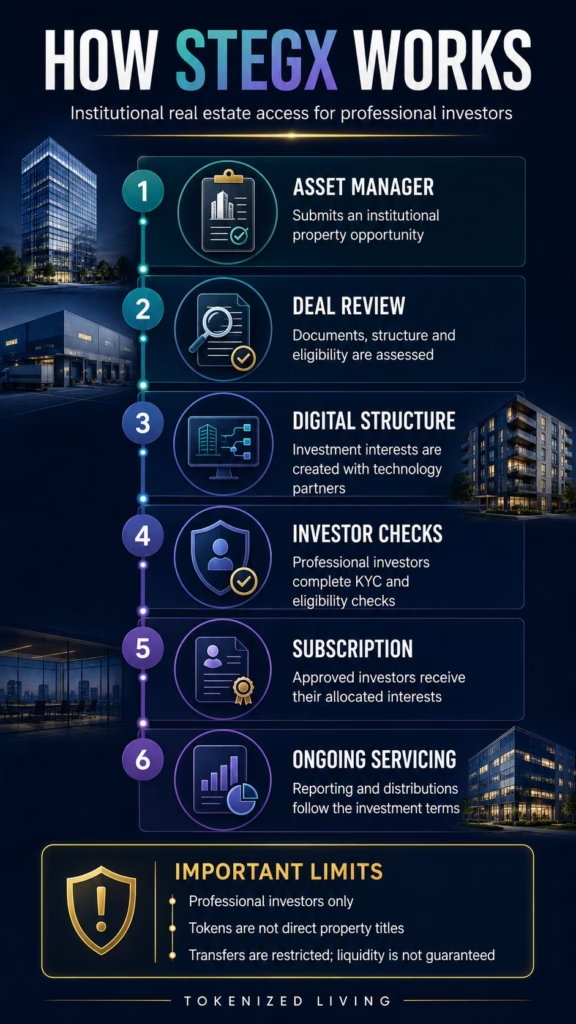
StegX does not serve ordinary retail investors. Its tokens do not provide direct legal title to properties. Moreover, investors cannot currently trade or transfer them freely.
Therefore, StegX should not be presented as a liquid global property exchange. It is better understood as a professional-investor distribution and servicing platform with developing tokenization and secondary-market capabilities.
This StegX review examines how the marketplace works, what investors own, who can participate and which risks deserve attention.
Last updated: August 31, 2026.
StegX Review: The Short Version
StegX provides digital infrastructure for raising capital and investing in real estate-related securities.
Its platform supports both traditional and tokenized investment structures. However, access is restricted to verified professional investors.
StegX also operates as a tied agent of the licensed German investment firm BMCP GmbH. It does not hold its own separate BaFin investment-firm licence.
| Area | Assessment |
|---|---|
| Primary focus | Institutional real estate and private-market deals |
| Investor access | Professional investors only |
| Regulatory structure | Tied agent of BMCP GmbH |
| Direct property ownership | No |
| Token rights | Deal-specific economic or security interest |
| Primary investments | Supported |
| Free token transfers | Not currently supported |
| Active secondary liquidity | Limited or unavailable |
| Main blockchain integration | Hedera through Zoniqx |
| Payment methods | Bank transfer and USDC where supported |
| Public pricing | Limited |
| Best suited to | Professional investors, family offices and asset managers |
StegX has developed a credible investment workflow. Nevertheless, its website overstates the ability to trade and rebalance tokenized investments.
What Is StegX?
StegX GmbH is a financial-technology company based in Frankfurt, Germany.
The company originally concentrated almost entirely on institutional real estate. Its current website uses the broader term “real asset deals” and also refers to private credit.
StegX serves two main groups.
Asset Managers and Issuers
Property owners, developers, fund managers and other issuers can use the platform to structure and distribute investment opportunities.
StegX can support:
- Issuer onboarding
- Know-Your-Business checks
- Legal and investment-product structuring
- Token creation
- Offering-document management
- Primary distribution
- Investor subscriptions
- Fiat and stablecoin payments
- Investment reporting
- Asset servicing
- Income distributions
- Lifecycle administration
Professional Investors
Verified investors can use the marketplace to discover and subscribe to eligible opportunities.
Deals may include:
- Individual properties
- Real estate portfolios
- Property funds
- Development projects
- Private credit
- Co-investment structures
- Club deals
- Tokenized securities
- Traditional investment products
Not every opportunity is visible publicly. Issuers can restrict listings to invited investors or selected groups.
Consequently, StegX’s public website does not reveal the marketplace’s complete deal inventory.
Is StegX Regulated?
StegX operates within a regulated German investment-services structure. However, precise wording matters.
StegX GmbH acts as a tied agent of BMCP GmbH, the Munich-based investment firm operated by Black Manta Capital Partners.
Under this arrangement, StegX performs investment-brokerage activities exclusively for BMCP. BMCP remains the licensed principal and accepts regulatory responsibility for those tied-agent activities.
StegX explains this arrangement in its guide covering the legal framework behind its marketplace.
Therefore, saying “StegX has a BaFin licence” would be misleading.
A more accurate description is:
StegX conducts investment brokerage as a tied agent of the BaFin-regulated investment firm BMCP GmbH.
StegX does not act as an asset custodian. It primarily connects investors with issuers, asset managers and service providers.
In addition, every offering must follow its own legal and regulatory requirements. The tied-agent arrangement does not give every issuer automatic permission to distribute investments worldwide.
Readers can check licensed firms and tied agents through BaFin’s official company databases.
Who Can Invest Through StegX?
StegX only accepts professional investors.
Both individuals and legal entities can apply. However, applicants must meet the platform’s classification requirements.
A professional individual must satisfy at least two of three qualifying criteria presented during onboarding. Legal entities follow a separate classification process.
StegX does not publish every threshold openly in text because the platform presents several criteria inside its onboarding interface. Therefore, applicants should not assume they qualify without completing the assessment.
The platform’s professional-investor onboarding guide confirms that ordinary retail investors cannot participate.
Applicants must provide:
- Personal or company information
- An address
- Tax and contact details
- A connected digital wallet
- Identity documents
- Professional-investor declarations
- Ultimate beneficial owner information where applicable
- Politically exposed person declarations
- Corporate registration documents for legal entities
Natural persons complete video identification. Companies also undergo Know-Your-Business checks.
After submitting the information, the applicant must wait for approval. Creating an account does not provide immediate investment access.
How Does StegX Work for Investors?
The exact investment process varies between deals. Nevertheless, most investors follow the same broad stages.
1. Create an Account
The applicant registers with an email address or supported social sign-in method.
Employees registering for a company should use their business email addresses.
2. Add Personal or Company Information
The investor provides the required contact, address and classification details.
A legal entity must also identify its authorised representative, directors and beneficial owners.
3. Connect or Create a Wallet
StegX requires a compatible digital wallet for tokenized investments.
The wallet can support identity authentication, document signing and token receipt. Depending on the structure, investors may also use an integrated custodial wallet rather than managing private keys themselves.
4. Complete Investor Classification
The applicant requests classification as a professional investor.
StegX then reviews whether the individual or company meets the relevant requirements.
5. Complete KYC or KYB Verification
Individuals complete identity verification and screening.
Company applicants provide additional corporate documents. These can include registry extracts, shareholder lists, organisational charts and powers of attorney.
6. Browse Eligible Deals
Approved investors can view opportunities available to their account.
Some listings may be publicly visible. Others can be private or accessible by invitation only.
7. Review the Offering Documents
Each product page can display:
- Asset information
- Financial projections
- Investment terms
- Offering documents
- Risk disclosures
- Token price
- Minimum subscription
- Property reports
- Issuer information
- Distribution arrangements
Investors should investigate these documents independently.
StegX provides the marketplace infrastructure. It does not make every listed property a strong investment.
8. Select the Investment
The investor chooses the required number of tokens or investment units.
Minimum subscriptions vary between offerings. StegX does not have one universal minimum investment.
9. Sign the Documents
The investor reviews and signs the relevant subscription and issuance documents.
Tokenized transactions can use the investor’s digital wallet for electronic signatures.
10. Make Payment
Supported offerings may accept:
- Standard bank transfers
- USDC stablecoin payments
StegX’s investment walkthrough explains both payment routes.
Stablecoin payments require additional wallet approvals. Bank transfers require the investor to submit the transaction reference and supporting payment information.
11. Receive and Monitor the Investment
After settlement, the investor receives the relevant tokens or securities.
The StegX portfolio dashboard can display:
- Token holdings
- Initial investment value
- Transaction status
- Deal information
- Portfolio allocation
- Investment updates
- Reports and distributions
However, dashboard availability does not mean the position can be sold immediately.
Our guide to buying tokenized assets explains several additional due-diligence steps.
What Do Investors Actually Own?
StegX tokens do not provide direct ownership of the underlying land or building.
According to StegX’s token-ownership explanation, investors receive a security representing a fractional economic interest connected with the property.
Potential economic rights can include:
- A share of rental income
- Distributions from the investment entity
- Participation in property appreciation
- Repayment of principal
- Interest payments
- Proceeds after the asset is sold
However, these rights depend entirely on the offering documents.
The property’s legal title normally remains with the existing owner or a special-purpose entity. Token holders do not automatically receive management rights or direct control over the building.
In practice, the token could represent:
- Shares in a special-purpose company
- A fund interest
- A tokenized bond
- A profit-participation right
- A debt security
- Another contractual investment claim
Therefore, phrases such as “own part of a building” can be misleading.
Investors generally own a security tied economically to the property—not a fraction recorded on the land register.
How Does StegX Work for Asset Managers?
StegX helps asset managers convert a property or investment strategy into a distributable product.
A typical issuer follows several stages.
1. Initial Assessment
The asset manager contacts StegX and provides basic information about the proposed deal.
This information may include:
- Property type
- Location
- Valuation
- Existing debt
- Capital requirement
- Target investors
- Investment period
- Expected income
- Exit strategy
2. Issuer Verification
StegX conducts KYB checks on the company and its controlling individuals.
The review can include company registration, ownership, management and sanctions screening.
3. Legal Structuring
The issuer selects an appropriate investment structure.
Potential structures include:
- Property-holding companies
- Securitization vehicles
- Investment funds
- Bonds
- Private placements
- Co-investment arrangements
StegX works with external legal, financial and administrative partners. Therefore, the exact structure may involve entities in Germany, Luxembourg or another jurisdiction.
4. Due Diligence
The project must provide the documents required for investor and regulatory review.
These can include:
- Valuation reports
- Financial statements
- Ownership records
- Lease information
- Debt agreements
- Development plans
- Environmental assessments
- Corporate documents
- Risk disclosures
StegX’s involvement does not replace independent property due diligence.
5. Tokenization
Where the issuer chooses a tokenized structure, the investment rights become digital securities.
Smart contracts can apply:
- Investor eligibility
- Transfer restrictions
- Wallet whitelisting
- Distribution rules
- Holding limits
- Jurisdictional controls
- Token recovery
- Lifecycle events
However, the legal agreement still defines the investment. The blockchain record does not replace the underlying contract.
Readers planning an issuance should first examine our guide explaining how to tokenize an asset.
6. Listing and Distribution
StegX creates the deal page and makes it available to the selected investor group.
Issuers can choose different visibility levels, ranging from wider marketplace exposure to invitation-only access.
The company says a standard listing may take around five weeks. An “Express Interest” listing may appear earlier.
These remain target timelines rather than guarantees.
7. Post-Investment Servicing
After closing, the platform can distribute reports and manage investor communications.
It may also help record:
- Distributions
- Valuation updates
- Corporate actions
- Ownership changes
- Redemptions
- Investment exits

The $100 Million Hedera Tokenization Programme
StegX’s most important development occurred in 2025.
The company partnered with Zoniqx to use its tokenization and lifecycle-management infrastructure on Hedera.
The programme involved more than $100 million of institutional real estate connected with three European family offices.
Zoniqx announced that the assets were onboarding through its ERC-7518 compliance framework. It also stated that the properties would receive tokenized investment structures on Hedera.
The original Zoniqx announcement used inconsistent language.
At one point, it described the assets as already tokenized. Elsewhere, it said StegX would “soon issue” the property-backed tokens.
Consequently, the safest conclusion is:
StegX began onboarding and tokenizing more than $100 million of institutional real estate during 2025.
That does not prove the entire amount was sold, distributed or actively trading.
Hedera’s 2025 ecosystem review later said StegX had begun tokenizing more than $100 million in institutional real estate. This wording supports the more cautious interpretation.
What Is ERC-7518?
ERC-7518 is a compliance-focused security-token framework developed by Zoniqx.
The company also refers to the standard as the Dynamic Compliant Interoperable Security Token protocol.
Its intended functions include:
- Embedding jurisdictional rules
- Applying KYC and AML restrictions
- Controlling token transfers
- Managing investor eligibility
- Supporting asset servicing
- Automating compliance changes
- Connecting ownership with lifecycle records
StegX uses Zoniqx’s infrastructure rather than building every tokenization component itself.
This distinction matters. StegX concentrates on marketplace access, real estate workflows and investment distribution. Zoniqx provides much of the underlying tokenization technology.
Our detailed Zoniqx review examines that infrastructure separately.
Why Did StegX Choose Hedera?
StegX and Zoniqx selected Hedera as the main network for the $100 million programme.
Their stated reasons include:
- Predictable transaction fees
- Fast settlement
- High throughput
- Network governance
- Low energy consumption
- Enterprise-focused infrastructure
However, the blockchain does not determine whether the property performs well.
Investors should prioritise:
- Asset quality
- Legal rights
- Income
- Debt
- Valuation
- Fees
- Management
- Liquidity
- Exit terms
A weak real estate investment remains weak when recorded on Hedera.
Likewise, Hedera’s involvement does not approve the issuer or guarantee the token.
Our guide to choosing a blockchain for tokenization explains the wider infrastructure decision.
StegX and Bolder Group
StegX also works with Bolder Group on legal and operational structures.
In April 2025, the companies announced their first joint tokenization projects. The initial programme involved three family offices and Luxembourg-based securitization structures.
Bolder Group supplied services such as:
- Company and fund structuring
- Corporate administration
- Directorship
- Governance
- Ongoing operational support
The Bolder Group announcement said the projects would go live in the following weeks.
This partnership adds institutional substance. Nevertheless, the announcement did not publish the properties, investment terms or completed transaction values.
Does StegX Provide Secondary-Market Liquidity?
Not currently in the form suggested by its marketing.
StegX repeatedly refers to trading, portfolio rebalancing and secondary-market access.
However, its own token-transfer documentation says:
- Investors cannot freely trade their tokens
- Tokens must remain within the StegX ecosystem
- Users cannot send tokens to outside parties
- StegX can initiate a forced transfer when necessary
- Connections with licensed secondary markets remain under development
Therefore, the existing article’s claim that StegX provides continuous trading is false.
A token can exist on a public distributed ledger while remaining tightly restricted.
Even after a secondary venue becomes available, liquidity will depend on:
- The number of eligible investors
- Buyer and seller demand
- Property performance
- Current valuation
- Minimum trade sizes
- Transfer restrictions
- Regulatory eligibility
- Available market makers
- Investment lock-ups
- Issuer approval requirements
A secondary marketplace creates a possible route to sell. It does not guarantee a buyer.
Our article about blockchain-powered secondary markets explains this distinction.
StegX Fees and Investment Minimums
StegX does not publish a universal fee schedule.
Minimum investments also vary between deals. Investors can only see the applicable minimum on the individual product page.
Potential costs may include:
- Fund or asset-management fees
- Property-management expenses
- Legal-structuring fees
- Token-issuance costs
- Brokerage or placement fees
- Platform charges
- Administration expenses
- Custody or wallet fees
- Stablecoin transaction costs
- Blockchain fees
- Foreign-exchange costs
- Performance fees
- Redemption charges
- Property sale expenses
Asset managers must contact StegX for commercial terms.
The company promotes reduced administration and lower upfront costs. However, it does not provide enough public pricing information to verify the total savings.
Investors should request a complete fee breakdown before subscribing.
Where Are Investor Funds and Tokens Held?
StegX says it does not act as a custodian.
For bank-transfer investments, the investor keeps funds in their bank account until payment. The money then moves to the account specified for that particular transaction.
Investors should confirm whether that account belongs to:
- The issuer
- A subscription vehicle
- An escrow provider
- A regulated payment partner
- Another intermediary
The correct arrangement may vary between offerings.
StegX has also announced a partnership with Palisade for institutional custodial wallet infrastructure. Palisade can provide wallet governance, key management and custody-related technology for tokenized securities.
The Palisade partnership announcement says its wallet infrastructure supports Hedera and the XRP Ledger.
However, partnership announcements do not guarantee that every StegX product uses the same custody structure.
Investors must examine the custody disclosures for the specific deal.
How Secure Is StegX?
StegX combines several security and compliance components.
These include:
- Professional-investor verification
- KYC and KYB screening
- Wallet-based signatures
- Transfer restrictions
- Whitelisted investors
- Regulated investment brokerage through BMCP
- Third-party tokenization infrastructure
- Institutional wallet options
- Blockchain transaction records
However, the public website does not prominently provide:
- A current platform penetration-test report
- Independent smart-contract audits for every token
- A comprehensive audit library
- Detailed cybersecurity certifications
- A public incident history
- Custodian insurance limits
- Platform uptime data
The old article claimed that StegX conducted regular security audits. No evidence supported that statement.
Serious investors and issuers should request security documentation directly.
What Are the Main Investment Risks?
Property Risk
Vacancy, falling rents, maintenance problems or weak local demand can reduce returns.
Development Risk
Construction delays, cost overruns and planning disputes can damage development projects.
Debt Risk
Mortgage lenders and other secured creditors may rank ahead of token holders.
Issuer Risk
The company issuing the security could fail or misuse investor funds.
Structural Risk
Investor rights depend on the special-purpose company, fund or security documentation.
Liquidity Risk
Investors cannot currently trade StegX tokens freely. They may need to hold the investment until redemption or asset disposal.
Valuation Risk
Private real estate does not receive continuous market pricing. Valuations may depend on periodic appraisals.
Technology Risk
Smart-contract errors, wallet failures or platform outages could interrupt transactions and distributions.
Custody Risk
A wallet provider or custodian could experience an operational failure, cyberattack or insolvency.
Stablecoin Risk
Investors using USDC face conversion, issuer, banking and blockchain risks.
Currency Risk
An investor may fund the transaction in one currency while the property generates income in another.
Regulatory Risk
Different countries may classify and restrict the same tokenized security differently.
Partner Risk
StegX depends on outside firms for brokerage, tokenization, structuring, custody and other services.
StegX Advantages
- Clear institutional real estate focus
- Marketplace restricted to professional investors
- Regulated brokerage structure through BMCP
- Traditional and tokenized investment options
- KYC and KYB onboarding
- Support for fiat and stablecoin payments
- Wallet-based document signing
- Private and invitation-only listings
- Issuer reporting and asset servicing
- Zoniqx tokenization integration
- Hedera-based institutional programme
- Partnerships with legal and administrative providers
- Potential access to cross-border deal flow
- More than $100 million of announced tokenization activity
StegX Disadvantages
- No retail-investor access
- Investors do not directly own properties
- Tokens cannot currently trade freely
- External token transfers are prohibited
- Secondary-market liquidity remains undeveloped
- Public fee transparency is weak
- Minimum investments vary by deal
- Complete deal inventory requires onboarding
- Limited independently verifiable transaction data
- No public platform-volume figures
- No public assets-under-management total
- Security-audit information remains limited
- Each offering introduces separate issuer and legal risks
- Global marketing can overstate cross-border availability
- The $100 million programme should not be confused with completed sales
Who Should Consider StegX?
StegX may suit:
- Professional real estate investors
- Family offices
- Institutional investors
- Wealth-management businesses
- Property funds
- Real estate asset managers
- Developers seeking professional capital
- Issuers exploring tokenized securities
- Companies requiring private deal distribution
- Investors comfortable with long holding periods
- Investors who understand structured securities
It may not suit:
- Ordinary retail investors
- Beginners seeking simple property fractions
- Investors requiring daily liquidity
- People expecting direct property ownership
- Users seeking permissionless cryptocurrency trading
- Investors unwilling to complete extensive KYC
- Anyone unable to review complex offering documents
- Investors who may need to sell quickly
- Buyers expecting transparent fixed fees
- People who assume blockchain removes property risk
Final Verdict: Is StegX Worth Considering?
StegX has evolved into a credible professional-investor platform.
Its tied-agent relationship with BMCP gives its brokerage activity a legitimate regulatory framework. In addition, partnerships with Zoniqx, Hedera, Bolder Group and Palisade address important technology and operational requirements.
The $100 million real estate programme represents meaningful progress. However, public announcements do not prove that every asset was issued, sold or actively traded.
The largest weakness concerns liquidity.
StegX promotes trading and portfolio rebalancing. Yet its documentation confirms that investors cannot freely transfer tokens. A functioning global secondary market remains a future objective.
Furthermore, StegX is not democratizing property ownership for ordinary investors. Access is limited to professionals, while tokens usually represent securities or economic rights rather than legal title.
Therefore, StegX should be praised for building professional real estate infrastructure—not marketed as a liquid property exchange.
For eligible investors who can tolerate long holding periods, the platform may provide access to deals outside their existing networks. Asset managers may also value its connected structuring, distribution and reporting services.
However, every investment still requires separate examination.
The property, issuer, legal wrapper, debt, fees and exit terms matter more than the blockchain.
Frequently Asked Questions
Is StegX legitimate?
StegX is an active German company operating as a tied agent of BMCP GmbH. Its investment-brokerage activities are conducted under BMCP’s regulatory responsibility. Nevertheless, investors must investigate each offering.
Is StegX regulated by BaFin?
StegX does not hold its own independent BaFin investment-firm licence. It acts as a tied agent of the BaFin-regulated investment firm BMCP GmbH.
Can anyone invest through StegX?
No. StegX only accepts verified professional investors. Both individuals and companies must satisfy the applicable classification requirements.
What is the minimum investment?
There is no universal minimum. Each issuer determines its token price and minimum subscription.
Do StegX tokens provide property ownership?
Not directly. Tokens normally represent securities or economic interests connected with a property. The investor’s precise rights appear in the offering documents.
Can I trade StegX tokens?
Not freely. StegX says individual investors cannot currently transfer tokens at will or send them outside its ecosystem.
Does StegX guarantee liquidity?
No. The company is developing connections with licensed secondary markets, but neither tokenization nor a future trading venue guarantees buyers.
Did StegX tokenize $100 million of real estate?
StegX began onboarding and tokenizing more than $100 million of real estate connected with three family offices during 2025. Public evidence does not confirm that the full amount was sold or actively traded.
Which blockchain does StegX use?
Its most important current tokenization programme uses Hedera through Zoniqx’s infrastructure. Other technology and custody partnerships may support additional networks.
Can investors pay with cryptocurrency?
Supported deals may accept USDC. Investors can also pay through standard bank transfers.
Does StegX hold investor funds?
StegX says it does not act as a custodian. Payment and custody arrangements depend on the individual offering and its service providers.
Is StegX suitable for retail property investors?
No. Retail investors who want lower minimums and simpler onboarding need a different platform.
This article is for educational purposes only. It does not constitute investment, financial, tax or legal advice. Institutional, private-market and tokenized real estate investments can result in the loss of some or all invested capital.