

Last updated: September 2, 2026.
Tokenized US Treasuries have become one of the XRP Ledger’s most credible real-world asset use cases.
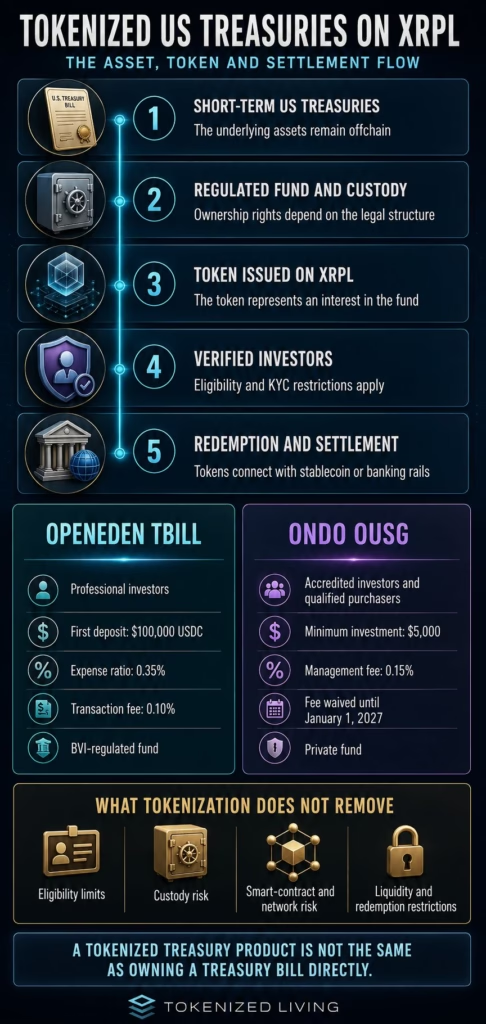
OpenEden brought its TBILL product to XRPL in 2024. Ripple supported the launch with a planned $10 million allocation.
Since then, Ondo Finance has deployed OUSG on the network. Ripple, Mastercard, Kinexys by J.P. Morgan and Ondo also completed a cross-border Treasury redemption in May 2026.
These developments provide stronger evidence than another speculative XRP price forecast.
However, tokenized Treasuries on XRPL remain regulated financial products. Investors must satisfy eligibility requirements, while traditional institutions continue to manage and custody the underlying assets.
This article examines OpenEden TBILL, Ondo OUSG, RLUSD settlement and the risks behind the “institutional DeFi” narrative.
Tokenized Treasuries on XRPL: The Short Version
XRPL now supports at least two important tokenized US Treasury products:
- OpenEden TBILL
- Ondo Finance OUSG
Both products connect short-term government securities with blockchain-based ownership and settlement records.
Nevertheless, neither works like buying a Treasury bill directly from the US government.
| Area | OpenEden TBILL | Ondo OUSG |
|---|---|---|
| Main exposure | Short-dated Treasuries and Treasury-backed repurchase agreements | Treasury securities and institutional money-market funds |
| Legal structure | BVI-regulated professional fund | US private fund |
| Typical eligibility | Professional investors | Accredited investors and qualified purchasers |
| Initial minimum | 100,000 USDC | $5,000 |
| XRPL support | Yes | Yes |
| Other networks | Ethereum, Arbitrum, Solana and BNB Chain | Ethereum, Polygon and Solana |
| Asset manager or adviser | BNY provides investment management | Ondo Capital Management |
| Primary custodian | BNY | Depends on the underlying portfolio |
| Credit ratings | Moody’s A; S&P AA+f | No equivalent fund rating highlighted |
| Direct government ownership | No | No |
Tokenization can accelerate transfers and improve collateral mobility. Yet legal rights, KYC, custody and redemption still depend on regulated organisations.
Most importantly, growing XRPL Treasury activity does not provide a credible basis for predicting XRP’s future price.
What Are Tokenized US Treasury Bills?
A conventional Treasury bill is short-term debt issued by the US government.
Investors purchase bills below or near their face value. At maturity, the government pays the specified amount.
Tokenized Treasury products work differently.
An investment vehicle purchases Treasury bills or related instruments. The platform then issues blockchain tokens connected with interests in that vehicle.
Depending on the structure, a token may represent:
- Shares in a fund
- Limited-partnership interests
- A secured note
- A contractual claim against an issuer
- Economic exposure to a Treasury portfolio
Therefore, “backed by US Treasuries” does not necessarily mean the US government owes money directly to the token holder.
The issuer, fund manager, custodian and legal documents sit between the investor and the Treasury assets.
Our guide explaining how asset tokenization works covers this relationship in more detail.
Why Put Treasury Products on XRPL?
XRPL is a public blockchain designed for payments, token issuance and financial settlement.
Transactions usually settle within several seconds. Network costs also remain low compared with many general-purpose blockchains.
Relevant features include:
- Native token issuance
- Issuer-controlled authorization
- Account freezing
- Token clawback functions
- Multi-signature accounts
- A built-in decentralized exchange
- Automated Market Maker functionality
- Escrow
- Multi-Purpose Tokens
- Stablecoin settlement
- An XRPL-native lending protocol
These tools can help issuers control who receives a regulated token.
For example, a fund can restrict transfers to authorized wallets. The issuer may also freeze assets after a legal order, compromised account or compliance breach.
Such controls make XRPL more practical for regulated securities. However, they also mean the tokens are not entirely permissionless.
Ripple Does Not Own XRPL
Ripple contributes technology and commercial partnerships to the XRP Ledger ecosystem.
However, XRPL operates as a public blockchain maintained by a wider validator community. Ripple does not possess unilateral authority to change its consensus rules.
This distinction matters because Ripple, XRPL and XRP are not interchangeable terms.
A financial institution can use XRPL without making a speculative investment in XRP beyond the small amount needed for network activity.
What Is OpenEden TBILL?
OpenEden launched its TBILL Vault in 2023.
The product gives eligible investors exposure to a professionally managed portfolio of:
- Short-dated US Treasury bills
- Overnight reverse-repurchase agreements
- Treasury money-market instruments
- Limited cash and liquidity positions
Treasury Bills Institutional Liquidity Limited issues the TBILL tokens.
The entity operates as a professional fund regulated by the British Virgin Islands Financial Services Commission. Therefore, TBILL is not an unrestricted retail crypto token.
OpenEden permits approved investors to deposit stablecoins and mint tokens representing their fund exposure.
As interest accumulates inside the portfolio, TBILL’s net asset value can increase. Investors do not receive individual Treasury bills into their wallets.
What Does a TBILL Token Represent?
A TBILL token represents an interest in OpenEden’s professional Treasury fund.
It does not represent:
- A TreasuryDirect account
- An individual Treasury bill
- A bank deposit
- A government-insured savings product
- An obligation guaranteed directly to the wallet by the US government
- An investment in Ripple or XRP
The fund owns and manages the financial assets. Meanwhile, the blockchain token records the investor’s connected interest.
That structure introduces several additional parties between the investor and the government securities.
These parties include:
- The fund issuer
- Investment manager
- Custodian
- Tokenization platform
- Blockchain network
- Stablecoin provider
- Administrators and auditors
- Banking partners
Each component can strengthen the product. Every additional dependency also creates another potential failure point.
BNY’s Role in OpenEden TBILL
OpenEden appointed BNY as investment manager and primary custodian for TBILL’s underlying assets in August 2025.
The arrangement was significant because BNY is one of the world’s largest custody and asset-servicing institutions.
Its responsibilities include managing the underlying Treasury portfolio and safeguarding the traditional assets.
According to BNY’s announcement, TBILL provides exposure to short-dated Treasury bills and overnight reverse-repurchase agreements.
BNY’s involvement gives OpenEden stronger institutional infrastructure. Nevertheless, the relationship does not eliminate token, issuer or redemption risk.
OpenEden TBILL Ratings
Moody’s originally gave the TBILL fund an investment-grade A rating.
In 2025, S&P Global assigned:
- AA+f fund credit-quality rating
- S1+ fund volatility rating
The AA+f assessment reflects the portfolio’s high credit quality. Meanwhile, S1+ indicates extremely low sensitivity to market conditions under S&P’s fund-volatility methodology.
These are strong ratings.
Still, they do not guarantee:
- Smart-contract security
- Stablecoin stability
- Instant redemption
- Correct wallet management
- Continuous secondary-market liquidity
- Regulatory approval in every country
- Protection from operational failures
- Positive investment returns
S&P evaluates the fund under a specific ratings framework. It does not guarantee the blockchain token or endorse XRP.
The current assessment is available through S&P Global Ratings.
Who Can Invest in OpenEden TBILL?
TBILL is only available to eligible professional investors.
OpenEden’s documentation lists a first-deposit minimum of 100,000 USDC. After completing the initial investment, subsequent deposits can start from 1 USDC.
Applicants must complete KYC and AML checks.
The onboarding process may request:
- Company registration records
- Personal identification
- Beneficial-owner details
- Address verification
- Source-of-funds evidence
- Tax information
- Professional-investor certification
- Wallet ownership verification
Availability also depends on the investor’s jurisdiction.
Consequently, TBILL does not democratize Treasury access for ordinary small investors. The product primarily serves institutions, professional investors, corporate treasuries and eligible blockchain organisations.
KYC confirms identity and eligibility. It does not guarantee that the product is technically secure or financially suitable.
OpenEden TBILL Fees
OpenEden’s displayed fee information can change.
Its product page currently shows:
- A 0.35% total expense ratio
- A 0.10% transaction fee
Additional costs may include:
- Stablecoin conversion spreads
- Blockchain network fees
- Custody charges
- Third-party platform fees
- Redemption costs
- Foreign-exchange expenses
- Tax-reporting costs
Investors should check the live fee schedule before subscribing or redeeming.
Comparing TBILL with a conventional Treasury ETF also requires examining both products’ complete costs. Blockchain fees represent only one part of the calculation.
Can TBILL Be Redeemed Instantly?
OpenEden advertises continuous blockchain-based access and 24/7 liquidity.
However, instant redemption remains conditional.
The platform must hold enough available stablecoin or cash liquidity to satisfy the request. Otherwise, traditional assets may need to settle or be sold first.
Large redemptions can therefore take longer than an ordinary token transfer.
Other factors can also delay repayment:
- KYC reviews
- Compliance investigations
- Stablecoin shortages
- Banking interruptions
- Market closures
- Custodian problems
- Blockchain congestion
- Smart-contract restrictions
- Legal orders
A transferable token is not the same as guaranteed cash liquidity.
Our examination of blockchain secondary markets explains this difference.
OpenEden TBILL Arrives on XRPL
OpenEden announced its XRPL integration in August 2024.
Ripple also stated that it would allocate $10 million to TBILL as part of a wider tokenized-Treasury initiative.
The original arrangement planned to support subscriptions with stablecoins, including RLUSD after its launch.
At the time, OpenEden reported more than $90 million in TBILL value across Ethereum, Arbitrum and XRPL. That figure did not represent assets held solely on the XRP Ledger.
This distinction matters.
By September 2026, DeFiLlama displayed approximately $247 million in total TBILL value across five networks. BNB Chain held the largest share.
Therefore, aggregate TBILL growth should not be presented as proof that XRPL attracted the entire amount.
Ripple’s original OpenEden announcement confirms the $10 million allocation and initial integration.
What Is RLUSD’s Role?
RLUSD is Ripple’s US-dollar stablecoin.
Within tokenized Treasury infrastructure, it can provide a settlement asset for subscriptions and redemptions.
A simplified transaction could work as follows:
- An approved investor holds RLUSD.
- The investor submits a Treasury-token purchase.
- Compliance systems verify eligibility.
- RLUSD settles the cash side.
- The issuer delivers TBILL or OUSG.
- A later redemption reverses the process.
Keeping the security token and settlement asset on the same network can reduce unnecessary bridging.
However, RLUSD does not remove the underlying fund’s legal or operational requirements. Investors still depend on issuers, custodians and banking partners.
OpenEden, Doppler and Institutional DeFi
OpenEden and Doppler Finance announced an XRPL partnership in February 2026.
The project aims to connect TBILL and OpenEden’s USDO yield-bearing stablecoin with XRPL-native liquidity.
Potential uses include:
- Treasury-backed yield for eligible participants
- RLUSD liquidity management
- Tokenized assets as collateral
- Institutional borrowing
- Onchain cash management
- Cross-border settlement
The announcement represents continued XRPL development.
Nevertheless, partnerships and planned integrations do not prove deep liquidity or sustained user activity. Investors should separate announced intentions from measurable deposits, loans and redemptions.
OpenEden describes the proposed integration in its Doppler partnership announcement.
What Is Ondo OUSG?
Ondo Short-Term US Government Treasuries provides another Treasury product on XRPL.
OUSG invests primarily in institutional Treasury and money-market products. Its portfolio has included funds managed by BlackRock, Franklin Templeton, Fidelity, WisdomTree and State Street.
Unlike TBILL, OUSG operates through a US private-fund structure.
Tokens represent limited-partnership interests in Ondo I LP. The offering relies on Rule 506(c) of Regulation D and a 3(c)(7) private-fund exemption.
Eligible investors must generally be both:
- Accredited investors
- Qualified purchasers
Qualified-purchaser status creates a much higher barrier than ordinary accreditation. For individuals, it usually requires at least $5 million in investments.
Ondo currently lists a $5,000 minimum subscription and redemption amount.
The management fee is 0.15%, although Ondo has waived it until January 1, 2027. Fund expenses are capped at 0.15% annually.
Our complete Ondo Finance review examines OUSG’s legal structure, portfolio and wider risks.
How OUSG Uses XRPL
Ondo deployed OUSG to XRPL in 2025.
The integration supports blockchain-based ownership records and settlement using RLUSD. It also gives institutions another network for moving yield-bearing collateral.
OUSG is available on:
- Ethereum
- Polygon
- Solana
- XRP Ledger
However, features can differ between blockchains. Ondo’s documentation states that instant minting and redemption are currently available only through Ethereum.
Therefore, investors should confirm exactly which XRPL functions operate before transferring capital.
The Five-Second Cross-Border Treasury Redemption
A more meaningful XRPL test occurred in May 2026.

Ripple redeemed part of its OUSG holdings on the XRP Ledger. The asset leg completed in under five seconds.
However, the transaction did not end with an XRPL transfer.
Mastercard’s Multi-Token Network routed the payment instruction to Kinexys by J.P. Morgan. Kinexys then moved dollar proceeds through banking infrastructure to Ripple’s account in Singapore.
The complete process connected:
- Ondo’s tokenized Treasury fund
- XRP Ledger
- Ripple
- Mastercard’s Multi-Token Network
- Kinexys by J.P. Morgan
- Correspondent banking infrastructure
This pilot matters because tokenized assets often settle quickly while fiat payments remain trapped inside banking hours.
In this case, the blockchain redemption initiated a connected cross-border bank settlement outside traditional cut-off windows.
Still, one successful institutional pilot does not prove unlimited scale. Wider adoption requires repeated transactions, standardised legal agreements and dependable liquidity.
Ondo’s official transaction report explains how the redemption worked.
Does This Qualify as Institutional DeFi?
The answer depends on how DeFi is defined.
TBILL and OUSG operate on public blockchains. They can also connect with wallets, collateral systems and blockchain settlement tools.
Yet major parts of the process remain permissioned.
Investors need approval. Regulated entities manage the funds, while licensed custodians hold the underlying assets.
Issuers can also restrict, freeze or redeem tokens under specific circumstances.
A more accurate description would be:
Tokenized Treasuries combine regulated financial products with selected elements of decentralized blockchain infrastructure.
This model is not fully permissionless DeFi. Instead, it creates a hybrid system connecting public networks with controlled financial assets.
Does XRPL Improve Treasury Settlement?
XRPL can improve specific operational stages.
Faster Token Transfers
The blockchain can settle its side of a transaction within seconds.
Nevertheless, asset liquidation and fiat delivery may still take longer.
Lower Network Costs
XRPL transactions usually cost a fraction of a cent.
Traditional management, custody and compliance expenses remain separate.
Extended Operating Hours
Blockchain records operate continuously.
Fund administrators, banks and underlying Treasury markets still follow their own schedules.
Transparent Balances
Investors can verify token issuance and wallet transfers onchain.
However, third-party reports remain necessary for confirming the offchain assets.
Programmable Compliance
Issuer authorization, freezing and clawback functions can support regulated products.
Those controls protect the structure but reduce permissionless transferability.
Collateral Mobility
Eligible institutions can potentially use Treasury tokens as collateral without first selling their exposure.
This may improve capital efficiency, although lending introduces liquidation and counterparty risks.
XRPL Tokenization Beyond Treasuries
Treasuries represent only one XRPL asset category.
The network also supports stablecoins, credit products, investment funds and tokenized property projects.
Dubai provides its strongest real-estate example. That model links blockchain tokens with government land records and controlled secondary trading.
Our analysis of XRPL real estate tokenization explains what Ripple and its partners have actually delivered.
The same principle applies across both sectors.
XRPL can record and transfer tokens. Legal documents, regulated issuers and government records still determine what those tokens represent.
Do Tokenized Treasuries Increase XRP’s Price?
Nobody can reliably calculate how Treasury tokenization will affect XRP’s market price.
XRPL transactions consume small amounts of XRP. Accounts also require XRP reserves.
However, these requirements remain tiny compared with XRP’s circulating supply and speculative trading volume.
Institutional use of XRPL does not necessarily require institutions to hold large XRP positions. They may transact primarily through RLUSD, TBILL, OUSG or other issued assets.
Consequently, the following argument does not hold:
Large Treasury market × small XRPL market share = predictable XRP price.
That calculation ignores:
- XRP supply
- Velocity
- Transaction-fee requirements
- Competing networks
- Stablecoin settlement
- Investor speculation
- Regulatory changes
- Actual institutional XRP holdings
- Token demand unrelated to XRP
The old article predicted a $104.70 XRP price and a 186-fold increase.
No credible evidence supported that claim. It has been removed because serious infrastructure analysis should not manufacture cryptocurrency price targets.
Main OpenEden TBILL and OUSG Risks
Underlying Asset Risk
Short-term Treasuries carry relatively low credit and interest-rate risk.
Nevertheless, their market value and yield can change.
Fund-Issuer Risk
Investors rely on the legal entity issuing the tokens.
A Treasury portfolio does not remove corporate, administrative or insolvency risk.
Custody Risk
Traditional institutions hold the underlying financial assets.
Operational failures, fraud or legal disputes could interrupt access.
Stablecoin Risk
Subscriptions and redemptions can involve RLUSD, USDC or other stablecoins.
A depeg, freeze or issuer problem could delay settlement.
Smart-Contract Risk
A coding flaw might affect minting, transfers or redemptions.
Audits reduce risk but cannot eliminate it.
Redemption Risk
Instant redemption depends on available liquidity and functioning counterparties.
Large withdrawals may require additional time.
Regulatory Risk
Securities and investment-fund regulations differ between countries.
A token available today may become restricted tomorrow.
Wallet Risk
A compromised wallet can expose an investor to theft or unauthorized transactions.
Recovery also depends on the issuer’s policies and administrative controls.
Liquidity Risk
Technical transferability does not guarantee active buyers.
Professional-investor restrictions further reduce the potential market.
Interest-Rate Risk
Falling Treasury rates reduce future yields.
Existing positions can also experience small value changes when rates move.
Governance Risk
Fund managers, issuers and administrators control important decisions.
Token holders do not necessarily receive direct management rights.
Advantages of Tokenized Treasuries on XRPL
- Settlement within seconds
- Low blockchain transaction costs
- Continuous token-transfer capability
- Stablecoin settlement through RLUSD
- Transparent token balances
- Built-in compliance controls
- Potential use as collateral
- Connections with institutional infrastructure
- Reduced manual reconciliation
- Multi-chain availability
- BNY management and custody for TBILL
- Cross-border settlement potential
Disadvantages and Limitations
- Access remains restricted
- TBILL requires a $100,000 initial deposit
- OUSG requires qualified-purchaser status
- Investors do not own individual Treasury bills
- Traditional custodians remain necessary
- Stablecoins introduce another dependency
- Redemptions may not always be instant
- Secondary-market liquidity remains uncertain
- Fund and transaction fees reduce returns
- Smart-contract and wallet risks remain
- Regulatory treatment varies by country
- XRPL adoption does not guarantee XRP appreciation
Who Should Consider These Products?
Tokenized Treasury products may suit:
- Institutional investors
- Professional investors
- Qualified purchasers
- Corporate treasuries
- Blockchain businesses
- Funds managing stablecoin reserves
- Eligible DeFi protocols
- Investors needing onchain collateral
- Organisations operating outside banking hours
They may not suit:
- Small retail investors
- People seeking direct Treasury ownership
- Investors unable to complete extensive KYC
- Anyone requiring deposit insurance
- Users expecting guaranteed redemptions
- Investors unfamiliar with stablecoin risks
- People buying solely because they expect XRP to rise
Final Verdict: Do Tokenized Treasuries Strengthen XRPL?
Yes. OpenEden TBILL and Ondo OUSG give XRPL credible connections with regulated financial assets.
The 2026 cross-border OUSG redemption also demonstrated something practical. A tokenized Treasury position moved through XRPL and triggered a linked international bank settlement.
That represents genuine infrastructure progress.
However, the phrase “institutional DeFi” can create the wrong impression.
TBILL and OUSG remain permissioned investment products. Professional managers control the portfolios, while traditional custodians safeguard the underlying assets.
Tokenization improves the settlement layer. It does not remove regulation, counterparty risk or investor restrictions.
XRPL has established a legitimate role in the tokenized-Treasury market. Nevertheless, its success should be measured through assets, transactions, redemptions and integrations—not speculative XRP price predictions.
Frequently Asked Questions
What is OpenEden TBILL?
TBILL is a blockchain token connected with a BVI-regulated professional fund holding short-term Treasury-related assets. BNY manages and safeguards the underlying portfolio.
Is TBILL a US Treasury bill?
No. It represents an interest in a fund that owns Treasury bills and related financial assets.
Can retail investors buy TBILL?
Generally, no. OpenEden restricts the product to eligible professional investors and requires a 100,000 USDC initial deposit.
What is Ondo OUSG?
OUSG represents limited-partnership interests in a US private fund holding Treasury and institutional money-market products.
Can ordinary investors buy OUSG?
Most cannot. Investors must generally be both accredited investors and qualified purchasers.
Is TBILL available on XRPL?
Yes. TBILL supports XRPL alongside Ethereum, Arbitrum, Solana and BNB Chain.
Does OUSG operate on XRPL?
Yes. Ondo deployed OUSG to XRPL with support for RLUSD-based settlement.
What was Ripple’s $10 million investment?
Ripple announced plans to allocate $10 million to OpenEden TBILL in 2024. The allocation supported tokenized-Treasury development on XRPL but did not guarantee investor returns.
Does a fund rating guarantee TBILL’s safety?
No. Credit and volatility ratings assess specific fund characteristics. They do not guarantee smart-contract security, liquidity, custody or investment performance.
Are tokenized Treasuries risk-free?
No. The underlying Treasuries carry relatively low credit risk, but the tokenized structure introduces issuer, custody, stablecoin, smart-contract and redemption risks.
Will Treasury tokenization increase XRP’s price?
It may increase XRPL usage. However, no dependable formula connects tokenized Treasury value with XRP’s market price.
Is Ripple the owner of XRPL?
No. XRPL is a public blockchain maintained by an independent validator community. Ripple contributes to its development and ecosystem.
This article is for educational purposes only. It does not constitute investment, financial, tax or legal advice. Tokenized securities and blockchain-based products can result in the loss of some or all invested capital.