

Updated: September 29, 2026
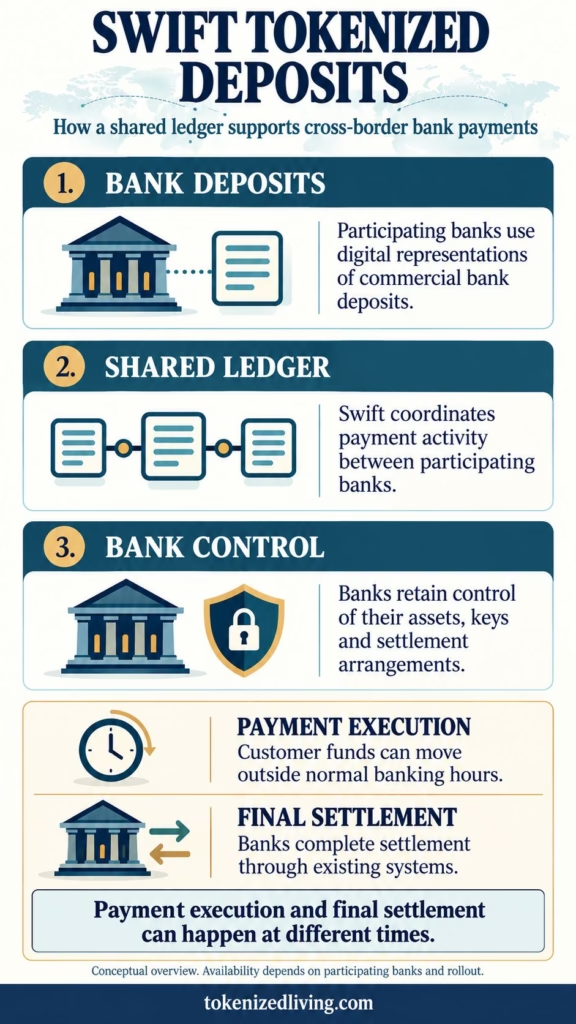
Swift tokenized deposits are part of an effort to make cross-border bank payments available around the clock. The central question is how banks coordinate those payments while retaining their existing settlement arrangements.
On July 9, 2026, Swift announced that its blockchain ledger was ready for initial use. Seventeen banks across six continents were preparing to pilot live transactions.
However, that announcement did not establish unrestricted access for every bank or customer. It described a controlled first phase, with availability and functionality set to expand.
TL;DR
- The initial focus is cross-border payments using tokenized commercial bank deposits.
- Swift provides shared coordination; participating banks retain control over their funds and settlement.
- Customer payments and final settlement between banks can happen at different times.
- The published rollout supports an initial-use milestone, rather than universal availability.
What Has Swift Actually Announced?
Swift’s July announcement named banks including HSBC, Citi, BNP Paribas, DBS and Wells Fargo among the initial participants. Its language matters: those institutions were preparing to pilot live transactions.
The announcement also explains the intended benefit. Participating banks could move customer funds overnight or at weekends, then complete final settlement through existing systems.
Market insight: A bank joining a pilot tells readers who is involved. Evidence of regular use requires completed transactions, operating coverage and repeat customer activity.
What Is a Tokenized Deposit?
A tokenized deposit represents money held at a commercial bank in a form that can operate on a digital ledger. The bank remains central to the financial claim.
Swift’s explanation of tokenized-deposit interoperability describes this as adding programmable capabilities to commercial bank money. That can support automation while preserving familiar banking relationships.
The difficulty comes when different banks use separate systems. A deposit that works within one institution’s network may have limited usefulness when a customer needs to pay another bank’s client.
This is the problem Swift is trying to address: helping institutions coordinate across those separate environments. For the underlying concept, see our guide to tokenization.
How Does It Differ From Other Digital Money?
| Form of money | Who issues it? | What matters to the holder? |
|---|---|---|
| Tokenized deposit | A commercial bank | The deposit claim and the bank’s terms. |
| Stablecoin | A private issuer | Reserve backing, redemption rights and issuer arrangements. |
| Central bank digital currency | A central bank | The central bank’s issuance framework and access rules. |
The Bank of England’s explanation distinguishes privately issued stablecoins from central bank digital currency. A shared use of digital technology does not make these products interchangeable.
How Does the Swift Ledger Work?
Swift’s March implementation update describes a shared system for recording and checking payment commitments between banks. Swift operates that coordination layer, while banks run their own environments.
Banks retain authority over their keys, assets, funding and settlement. The design accommodates settlement through real-time gross settlement systems, correspondent banking relationships or other agreed arrangements.
The announced architecture uses Hyperledger Besu and is compatible with the Ethereum Virtual Machine. That technical compatibility does not establish that customer deposits move on Ethereum’s public mainnet.
In practical terms, the ledger helps participants agree on the progress of a payment. It connects digital records with the institutions responsible for completing the transaction.
Does 24/7 Payment Mean Instant Final Settlement?
The distinction is crucial. Swift’s design explanation separates payment execution from settlement through existing banking systems.
Consider an illustrative weekend payment between two businesses in different countries. Their banks might coordinate the customer payment through the ledger while settling their own obligations later under agreed terms.
That is an explanation of the design principle, not a report of a particular completed Swift transaction. The funding, timing and credit arrangements would depend on the participating banks.
For customers, earlier access to funds could be useful. For banks, obligations still need funding, reconciliation and final settlement.
A payment can reach its customer before the banks finish settling with each other.
What Risks and Limits Remain?
Technology introduces operational questions alongside familiar banking responsibilities. Institutions still need to manage cyber threats, service failures and their dependence on outside providers.
Canada’s banking regulator, OSFI, reinforced this point in its September 10 statement. Under the Canadian framework it supervises, tokenized deposits remain deposits, and existing legal and risk-management obligations continue.
That statement concerns Canada. It does not establish identical treatment or protection for every product in every country.
Before relying on a service, ask: Which bank owes the money? Which customers and currencies qualify? When can funds be used, and what happens if the service is unavailable?
These questions make a more useful assessment than the word “blockchain” alone. They also prevent a technical demonstration from being mistaken for a complete customer service.

Why Does This Matter for Tokenized Assets?
We assess that more dependable payment coordination could help institutions handle the cash side of tokenized transactions. An asset transfer still needs a compatible way to pay for it.
However, this does not mean a property platform can immediately connect to Swift’s ledger. Nor would improved payment infrastructure create buyers for an illiquid investment.
Our Wall Street Treasury tokenization guide explores related questions around cash management, collateral and settlement. For property investors, legal ownership and exit terms remain separate checks.
What Should Readers Watch Next?
The useful evidence will be specific: completed live payments, supported currencies, participating customer groups and published operating conditions. Transaction volumes and repeat use would make the progress easier to judge.
Swift’s ledger overview identifies banks and financial institutions as its intended users. Readers should therefore look for bank-level service announcements before assuming access through their own account.
Frequently Asked Questions
Is Swift launching a cryptocurrency?
The described initiative uses bank-issued tokenized deposits. It is infrastructure for financial institutions, rather than an announcement of a retail investment coin.
Is the ledger already available everywhere?
The July announcement established readiness for initial use and preparation for live pilots. It did not establish availability across every market served by Swift.
Will this make every international payment cheaper?
That has not been demonstrated by the sources reviewed here. Customer charges would need to be assessed using actual bank pricing and service terms.
Does tokenization remove bank risk?
No. A different recordkeeping system does not remove the institution behind the deposit or the risks of operating the service.