

Updated: 3 September 2026.
Superstate has moved far beyond the industry council covered in the original version of this article. It now operates infrastructure for tokenized funds and public-company shares, while its platform displays more than $1 billion across three private funds.
This Superstate review examines what the company actually offers in 2026, who can use it, what investors own and where the legal, liquidity and technology risks remain. The short answer is that Superstate has built credible institutional infrastructure, but access is restricted and an onchain token does not remove the risks of the underlying investment.
Important: This article is for general information and education only. It is not investment, legal or tax advice. Product figures and availability can change. Review the latest offering documents and obtain professional advice before investing.
Superstate Review: The Short Version
| Question | Answer |
|---|---|
| What is Superstate? | A tokenization platform whose affiliated entities provide investment-advisory and transfer-agent services. |
| What is live? | FundOS, three tokenized private funds and Opening Bell tokenized equities. |
| Which funds are shown? | USTB, USCC and CUSHY. |
| Are the products open to everyone? | No. The private funds have investor-qualification and jurisdiction limits. Tokenized equities have broader access in supported countries, subject to each offering and compliance checks. |
| Do the tokens create guaranteed liquidity? | No. Redemption terms, transfer restrictions, market depth, counterparties and operating hours still matter. |
| Main strength | Superstate connects regulated ownership records, allowlisted wallets, fund operations and supported blockchains. |
| Main concern | The products are complex, and some public disclosures are not perfectly consistent. Current offering documents must take priority. |
Our verdict: Superstate is more compelling as institutional market infrastructure than as a beginner investment platform. Its model shows how funds and genuine company shares can use blockchain-based records without pretending that securities law, administrators, custodians or transfer agents have disappeared.
What Is Superstate?
Superstate provides infrastructure for issuing, recording and managing securities across conventional book-entry systems and supported blockchains. Its two main issuer products are FundOS, for tokenized investment funds, and Opening Bell, for public-company shares.
That distinction matters. Superstate is not simply creating freely transferable crypto tokens that track asset prices. The system combines identity checks, investor eligibility, wallet allowlisting, transfer restrictions and regulated record-keeping.
If you are new to the subject, our guide to what tokenization means explains why a blockchain token is only one layer of the investment structure.
Superstate’s website identifies two regulated affiliates, and both statuses can be checked in public regulatory records:
- Superstate Advisers LLC appears in the SEC’s Investment Adviser Public Disclosure database.
- Superstate Services LLC filed Form TA-1 to register as a transfer agent.
Registration does not mean that the SEC has approved Superstate or endorsed any investment. It describes a firm’s regulatory status, not the quality, safety or suitability of a product.
The asset managers also vary by fund. Invesco Advisers manages USTB, Bitwise Investment Manager manages USCC, and Coinbase Asset Management manages CUSHY. Superstate supplies important infrastructure and services, but it is not the sole organization behind every product.
How Does Superstate Work?
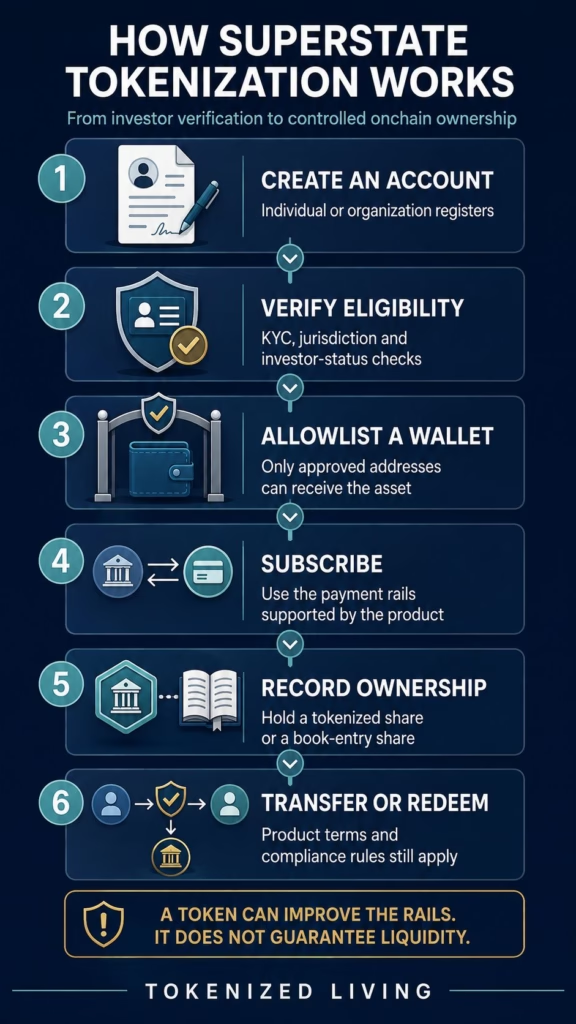
The process depends on the asset, but the broad workflow looks like this:
- An individual or organization creates an account.
- Superstate or the relevant provider completes identity, jurisdiction and eligibility checks.
- An approved blockchain wallet is added to an allowlist.
- The investor subscribes using the payment rails supported by the product, such as USD or USDC.
- Ownership is recorded either as a tokenized share in the approved wallet or as a conventional book-entry share.
- Transfers, redemptions and DeFi use remain subject to the product documents, compliance rules and supported integrations.
The allowlist is central to the design. A token may sit in a self-controlled wallet, but it cannot necessarily move to any address or interact with any protocol. Legal and technical controls restrict who can receive it and where it can be used.
This setup is closer to programmable securities administration than permissionless crypto trading.
FundOS: Infrastructure for Tokenized Funds
FundOS is Superstate’s operating layer for private funds, mutual funds and ETFs. It is designed to connect with existing custodians, administrators and service providers rather than replace every part of the traditional fund stack.
The platform combines:
- shareholder records across book-entry and supported blockchain systems;
- subscription, redemption and transfer workflows;
- USD and USDC payment rails;
- investor and wallet allowlisting; and
- selected DeFi integrations.
That architecture is practical because regulated assets still depend on offchain organizations. Custodians hold assets, administrators calculate values, investment managers make portfolio decisions and transfer agents maintain ownership records.
FundOS can make those processes more programmable. It does not eliminate them.
Our State Street digital asset platform analysis examines how an established custodian connects tokenization with fund administration, digital wallets and investment products.
Superstate Funds Compared
The figures below were displayed on Superstate’s website on 3 September 2026. They are company-reported, dynamic and not a recommendation.
| Fund | Underlying strategy | Displayed AUM | Displayed yield | Main management fee | Stated liquidity | Networks |
|---|---|---|---|---|---|---|
| USTB | Short-duration US government securities | $849.72 million | 3.54% 30-day yield | 0.15% or less | Same-day under stated conditions | Ethereum, Solana, Plume |
| USCC | Crypto basis trades, staking and government securities | $140.08 million | 6.97% 30-day yield | 0.75% | Public page gives conflicting information; verify before investing | Ethereum, Solana, Plume |
| CUSHY | Stablecoin private credit, direct lending and tokenized credit | $25.25 million | No meaningful current yield displayed | 0.75% for tokenized Class T, plus a 10% performance fee and operating costs | Monthly subscriptions; quarterly redemptions | Solana, Base |
Together, the three displayed AUM figures total about $1.015 billion. Most of that amount sits in USTB, so the headline total should not be interpreted as evenly distributed demand across the product range.
USTB: Tokenized Short-Term Government Securities
USTB is the largest Superstate-supported fund by a wide margin. The product page calls it the Invesco Short Duration US Government Securities Fund and describes it as a tokenized private fund focused on short-duration Treasury bills.
Ownership can be represented by an USTB token or a book-entry record. The fund is a series of a Delaware statutory trust, while BNY Mellon is named as custodian, PwC as auditor, NAV Fund Services as NAV calculation agent, Invesco Advisers as investment manager and Superstate Services as transfer agent.
Superstate displayed a 3.54% 30-day yield and a management fee of 0.15% on the date checked. Investors maintaining an average holding above $25 million may receive a rebate on the portion above that threshold. Returns remain variable, and the fund can lose value.
USTB liquidity needs careful wording
The USTB product page states that subscriptions and redemptions can use USD or USDC, with same-day timing under specified cut-offs. However, that is not an unconditional promise of instant, around-the-clock cash access.
Its detailed risk disclosure says protocol redemption is limited, available only when enabled, subject to dynamic daily limits and currently restricted to Ethereum. Blockchain congestion, cybersecurity events, operational failures or an unavailable liquidity facility can delay or suspend processing.
Continuous NAV also requires context. Superstate says the value is based on a linear extrapolation from the prior market-day valuation, including estimated income and expenses. It is not a live market price for every security in the portfolio.
Finally, tokenized USTB shares are not listed on an exchange. Restricted peer-to-peer transfers may be possible, but the buyer pool can be narrow and a negotiated price may differ from NAV. Tokenization changes the rails; it does not manufacture buyers.
Our BlackRock BUIDL fund explainer provides another example of how tokenized Treasury products combine blockchain records with conventional financial entities.
USCC: Crypto Carry With More Moving Parts
USCC is now presented as the Bitwise Crypto Carry Fund. Its strategy seeks returns from differences between crypto spot and futures prices, alongside staking and US government securities.
A cash-and-carry trade may try to reduce direct market direction exposure by holding an asset and offsetting it with a futures position. That does not make the fund risk-free or reliably uncorrelated.
The portfolio displayed on 2 September 2026 included cash collateral, USTB, Bitcoin, Ether, Solana, staked assets, wrapped tokens, XRP and offsetting futures positions. This creates exposure to exchanges, derivatives, collateral management, custody, staking, basis changes and digital-asset operations.
Superstate listed a $100,000 minimum investment, a 0.75% management fee and eligibility limited to qualified purchasers in supported jurisdictions. Anchorage Digital was named as custodian, EY as auditor, Bitwise Investment Manager as manager and Superstate Advisers as sub-adviser.
A material redemption disclosure conflict
The USCC page says in its product details that subscriptions and redemptions are available daily with a 5 p.m. ET cut-off. Yet the disclaimer on the same page states: “The Fund does not currently operate a redemption program.”
Those statements cannot both describe the same current arrangement without more explanation. Prospective investors should obtain written clarification and rely on the latest definitive offering documents before subscribing. Until then, it would be misleading to present USCC as having dependable daily liquidity.
The page also states that the shares are offered through private-placement exemptions and are not registered under the Securities Act or the Investment Company Act. Investors therefore should not assume they receive the protections associated with a registered mutual fund or ETF.
CUSHY: Tokenized Private Credit
CUSHY is the Coinbase USD Stablecoin Yield Fund. Despite the name, it is not a savings account or a simple stablecoin balance.
The fund seeks yield from stablecoin-related private credit, senior secured direct lending, asset-backed finance and tokenized credit opportunities. Credit quality, borrower defaults, collateral values, manager decisions and redemption limits all matter.
According to the CUSHY product page, the Cayman-domiciled fund uses a 506(c) open-ended structure. Monthly subscriptions and quarterly redemptions make it materially less liquid than USTB’s stated timetable.
The tokenized Class T carries a 0.75% management fee. Superstate’s disclosure also says net returns account for a 10% performance fee and operating costs, so investors should not compare its headline target with a Treasury yield on a like-for-like basis.
CUSHY targets a spread over the Secured Overnight Financing Rate, but the page repeatedly describes those targets as hypothetical and says they may not be achieved. On the date checked, Superstate’s main asset table did not show a current yield for CUSHY.
Opening Bell: Tokenized Public-Company Shares
Opening Bell is Superstate’s public-equity infrastructure. Companies can work with Superstate to represent shares on supported blockchains, migrate existing holdings from traditional brokerage rails and administer corporate actions such as dividends and stock splits.
Superstate says these tokenized shares are not derivatives, wrappers or new share classes. That is a meaningful difference from third-party products that merely track a stock’s price.
SEC staff described the broader distinction in its January 2026 Statement on Tokenized Securities. In an issuer-sponsored model, the issuer or its agent integrates blockchain records with the master securityholder file. Third-party custodial or synthetic models may instead give the token holder an indirect interest, a separate claim or price exposure.
Superstate’s assets page listed five live equities when checked:
- Galaxy Digital (GLXY)
- SharpLink Gaming (SBET)
- Forward Industries (FWDI)
- Exodus Movement (EXOD)
- Solana Company (HSDT)
The list being “live” does not prove an active two-sided market. Displayed onchain values varied sharply, and two entries showed no current price or value on the page. Investors still need to examine where trading occurs, the spread, order-book depth, settlement rules and whether their wallet and jurisdiction are supported.
Opening Bell also offers a Direct Issuance Program through which a public company can sell newly issued tokenized shares to eligible investors using stablecoin settlement and an eligible SEC prospectus. Terms are issuer-specific; this is not a universal route to buy every US stock onchain.
Another proposed route appears in our guide to NYSE and Blockchain.com’s tokenized-stock plans, which separates the partnership announcement from confirmed customer access.
What Does an Investor Actually Own?
The answer depends on the product.
With USTB, USCC or CUSHY, the investor owns a share of a private investment fund. The token records that fund interest; it does not give direct ownership of individual Treasury bills, futures contracts, loans or stablecoins in the portfolio.
Opening Bell takes a different approach. Superstate says its tokenized equities represent the company’s shares within the transfer-agent record, rather than a derivative that only follows the market price.
In either case, the legal documents and official ownership records control the rights. A wallet balance is important, but it must connect correctly to the issuer, fund, transfer agent and applicable law.
Who Can Invest Through Superstate?
Access is more limited than the phrase “assets onchain” may suggest.
Superstate’s registration page says tokenized equities are available to investors in supported countries. Tokenized funds are generally restricted to qualified purchasers, defined there as individuals with at least $5 million in investable assets or institutions with at least $25 million.
Product-level wording varies. USTB’s page refers to accredited investors and qualified purchasers, while USCC specifies qualified purchasers and CUSHY applies its own US and non-US qualification rules. These differences reinforce the need to check the current documents for the exact product, investor type and jurisdiction.
Anyone considering an eligible product should expect identity checks, beneficial-owner information, wallet verification and transfer restrictions. Our guide to buying tokenized assets explains those steps in more detail.
Custody and Wallet Risk
Tokenized ownership does not place every asset in the investor’s wallet.
The investor may control a tokenized fund share or equity token, while a fund custodian holds the portfolio assets. The transfer agent maintains the official holder record, and other firms handle administration, valuation, auditing or investment management.
Self-custody adds responsibility. Losing keys, signing a malicious transaction or using an unsupported address can cause serious problems, even when transfer controls offer some recovery or intervention options. Smart-contract bugs, blockchain outages and high network fees add another layer of operational risk.
USDC subscriptions and redemptions introduce stablecoin and third-party dependencies too. A dollar-denominated token is not the same as a bank deposit, and transaction timing depends on the stablecoin issuer, blockchain and fund procedures.
Does Superstate Create Liquidity?
No platform can create reliable liquidity merely by issuing a token.
Superstate may improve transfer availability, automate compliance and connect assets with supported applications. Those capabilities can reduce operational friction. Actual liquidity still depends on willing buyers, redemption rights, market makers, trading venues, eligible counterparties and the underlying portfolio.
This distinction is especially important for private funds. A token can move quickly at the technical level while the investment remains legally restricted or economically hard to sell.
Our guide to tokenized-asset secondary markets explains why 24/7 transferability and 24/7 liquidity are not interchangeable.
What Happened to the Superstate Industry Council?
The Superstate Industry Council still exists, but it is no longer the strongest reason to evaluate the company.
Its current council page describes a network spanning DeFi protocols, infrastructure providers, asset managers, market makers and trading firms. Activities include monthly market calls, quarterly social events, policy briefs and conference dinners, alongside feedback on Superstate’s product roadmap.
That may help Superstate gather market input and develop commercial relationships. Public information does not establish that the council itself created USTB, USCC or the wider tokenization market, however. The original article overstated that connection.
The measurable part of Superstate’s story is now its live infrastructure, fund assets, integrations and tokenized-equity programs—not the prestige of a member list.
Superstate’s Main Strengths
1. It connects onchain records with real financial operations
Fund managers, custodians, auditors and transfer agents remain visible in the structure. That makes the offering easier to analyse than a token whose legal and operational backing is vague.
2. Investors can choose tokenized or book-entry holdings
Supporting both formats may help institutions adopt blockchain rails without forcing every position and process onchain at once.
3. The product range covers funds and genuine company shares
FundOS and Opening Bell address different issuer needs. The equity model is particularly notable because it focuses on issuer-supported shares rather than anonymous synthetic exposure.
4. Compliance is built into transfers
Allowlisted wallets and programmed restrictions can help issuers control who holds and uses a security. They also reduce permissionless portability, which investors should recognise as a trade-off rather than a hidden limitation.
Risks and Weaknesses
Restricted access
Most readers will not qualify for the private funds. Supported-country lists and product rules can narrow access further.
Liquidity limits
Private fund interests may have restricted transfers or scheduled redemptions. Even tokenized public equities need sufficient market depth and supported venues.
Disclosure inconsistency
The conflicting USCC redemption statements are material. USTB eligibility language also differs from Superstate’s general registration page. Definitive documents and written confirmation should override summaries on a marketing page.
Underlying investment risk
USTB has interest-rate, counterparty and operational exposure. USCC adds derivatives, digital assets, staking and basis risk. CUSHY introduces private-credit, borrower and quarterly-liquidity risk.
Technology and wallet risk
Smart-contract faults, network disruption, unsupported integrations, key loss and malicious transactions can affect access or execution.
Regulatory and legal change
Tokenized securities remain securities. Their digital format does not remove registration, transfer, offering or investor-protection rules, and legal treatment can evolve across jurisdictions.
Multiple service-provider dependencies
Each product relies on a chain of organizations. A failure at the manager, custodian, administrator, transfer agent, stablecoin provider or blockchain layer may interrupt normal operations.
How Superstate Compares With Other Tokenization Platforms
Superstate’s clearest differentiator is its combination of transfer-agent infrastructure, tokenized private funds and issuer-supported public equities.
Other platforms emphasise different parts of the market. Securitize has become closely associated with tokenized fund issuance and distribution, while Ondo offers a broader mix of tokenized financial products and infrastructure. Our separate Securitize review and Ondo Finance review examine those models.
For a Swiss equity-focused model, our review of Aktionariat’s tokenized shares examines company-level issuance, shareholder management and the limits of secondary trading.
No single platform comparison should stop at asset count or blockchain support. The stronger questions are who issues the security, what the token represents, which entity keeps the authoritative record, where the assets are held and how an investor exits.
Who Might Superstate Suit?
Superstate may suit:
- qualified or accredited investors who understand private funds;
- institutions seeking tokenized Treasury, carry or credit exposure;
- asset managers that want blockchain-based fund administration;
- public companies exploring issuer-supported tokenized shares; and
- investors comfortable with wallet controls, compliance checks and several service providers.
It may not suit:
- beginners seeking a simple savings product;
- retail investors who do not meet fund eligibility requirements;
- anyone who needs guaranteed or immediate liquidity;
- investors who cannot tolerate principal loss; or
- users expecting unrestricted, permissionless transfers.
Final Verdict: Is Superstate Worth Watching?
Yes—as infrastructure. Superstate has developed beyond a council-led awareness story into an operating platform with more than $1 billion in displayed fund assets, multiple asset managers, several supported blockchains and live tokenized equities.
Its strongest contribution is the connection between blockchain-based ownership and regulated record-keeping. FundOS keeps existing financial service providers in the loop, while Opening Bell offers an issuer-supported alternative to tokenized stock wrappers.
The investor proposition needs more caution. USTB is comparatively straightforward but still carries fund, rate, liquidity and technology risk. USCC and CUSHY use more complex strategies, charge higher fees and introduce additional counterparties or redemption constraints.
Most importantly, tokenization does not improve the underlying asset by itself. A token can make ownership records and transfers more programmable, but it cannot guarantee returns, market depth, redemption capacity or legal protection.
Superstate is therefore a credible company to watch in tokenized capital markets. It is not a shortcut around due diligence.
Frequently Asked Questions
Is Superstate legitimate?
Public SEC records identify Superstate Advisers as a registered investment adviser and show Superstate Services’ transfer-agent registration filing. Superstate also names established managers, custodians, administrators and auditors for its funds. Those facts support operational credibility, but they do not amount to government approval or make an investment safe.
Is Superstate available to retail investors?
Tokenized equities are described as available to investors in supported countries, subject to onboarding and product rules. Private funds are restricted by wealth, status and jurisdiction requirements, so most retail investors will not qualify.
What is the Superstate USTB token?
USTB represents a share in the Invesco Short Duration US Government Securities Fund. It gives fund exposure rather than direct ownership of individual Treasury bills.
Can USTB lose money?
Yes. Short-duration government securities are generally lower risk than many crypto assets, but the fund still faces interest-rate, market, counterparty, stablecoin, liquidity, operational and technology risks. It is not a bank deposit and is not FDIC-insured.
What is the difference between USTB and USCC?
USTB focuses on short-duration US government securities. USCC uses crypto basis trades, staking and government securities, giving it more moving parts and a higher risk profile.
Are Superstate’s tokenized stocks real shares?
Superstate says Opening Bell tokens represent issuer-supported shares within the transfer-agent system, not derivatives or wrappers. Investors should still confirm the rights, offering documents and authoritative ownership record for each company.
Can Superstate assets trade 24/7?
The technology can support continuous transfers and settlement in approved applications. That does not guarantee a buyer, a fair price or unrestricted trading at every hour. Compliance rules, venue availability, market depth and issuer terms still apply.
What does the Superstate Industry Council do?
The council brings together firms from traditional finance and digital assets for market calls, policy material, events and feedback on Superstate’s roadmap. Public evidence does not justify treating it as the main driver of Superstate’s funds or of tokenization across financial markets.